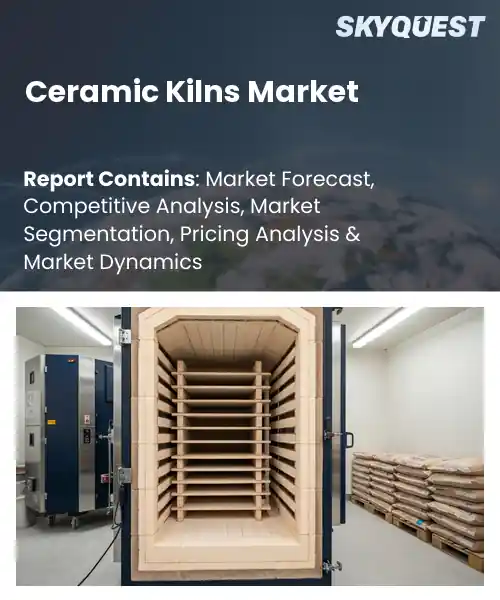
Ceramic Kilns Market
Report ID: SQMIG20I2753
Report ID: SQMIG20I2753
[email protected]
USA +1 351-333-4748
Report ID:
SQMIG20I2753 |
Region:
Global |
Published Date: March, 2026
Pages:
157
|Tables:
122
|Figures:
77


Global Ceramic Kilns Market size was valued at USD 275.3 Billion in 2024 and is poised to grow from USD 285.76 Billion in 2025 to USD 385.11 Billion by 2033, growing at a CAGR of 3.8% during the forecast period (2026-2033).
The global ceramic kilns market share is growing because of artisanal studios, tile and sanitaryware factories, and advanced ceramics producers, and its trajectory matters because kiln technology determines product quality, operating cost and environmental footprint. The main catalyst has been strong construction and manufacturing demand resulting in tile and sanitaryware production growth in developing countries and forcing manufacturers to update their heat treatment processes. Over the course of many years, to gas- and electric-fired kilns, to continuous tunnel kilns to produce ceramics as demonstrated by the rapid growth of tile plants in China and the adoption of extremely precise furnaces for the production of ceramic parts by electronics manufacturers.
Rising regulatory pressure on emissions and fuel prices have incentivized firms to invest in energy efficient digitally controlled kilns, which lowers operating expenses and shortens lead times while enabling tighter process control. Because manufacturers reduce costs and improve yields, they can offer customized ceramic products and enter higher margin segments such as technical ceramics for medical implants and automotive sensors. For example a tile producer who installs heat recovery and predictive maintenance can cut energy bills and unplanned downtime, creating cash flow to expand capacity. Consequently, suppliers providing retrofit solutions and IoT enabled furnaces face growing market opportunities in Asia.
How is IoT Improving Energy Efficiency in the Ceramic Kilns Market?
The ceramic kiln sector has seen a rise in energy efficiency due to the utilisation of the IoT. This is due to the interconnectivity between sensors, controls, and analytics to provide smarter, more accurate firing processes. One of the most notable features of this advancement, is the ability for continuous temperature measurement, automated burner control, and predictive maintenance through equipment signal monitoring. Current evidence indicates an increased level of adoption in both large tile manufacturing facilities and smaller studios; as both types of facilities implement retrofits to seamlessly connect their kiln controllers to the Internet and also load cloud-based platforms to enhance the use of fuel and reclaim waste heat.
In March 2025, RAK Ceramics introduced a new high efficiency kiln and reported the rollout of smart manufacturing upgrades that link kiln controls to energy management systems. IoT enables continuous monitoring and adaptive control which supports lower fuel use and stronger market growth through more efficient, scalable production.
Market snapshot - (2026-2033)
Global Market Size
USD 275.3 Billion
Largest Segment
Tunnel Kilns
Fastest Growth
Roller Hearth Kilns
Growth Rate
3.8% CAGR
To get more insights on this market click here to Request a Free Sample Report
Global ceramic kilns market is segmented by kiln type, operational temperature, capacity, fuel type and region. Based on kiln type, the market is segmented into top loading kilns, front loading kilns, shuttle kilns, tunnel kilns, roller hearth kilns, and bell kilns. Based on operational temperature, the market is segmented into low temperature (<1000°C), medium temperature (1000-1200°C) and high temperature (>1200°C). Based on capacity, the market is segmented into small (<1 cubic foot), medium (1-5 cubic feet) and large (>5 cubic feet). Based on fuel type, the market is segmented into electric, gas, propane, wood and microwave. Based on region, the market is segmented into North America, Europe, Asia Pacific, Latin America and Middle East & Africa.
Based on the global ceramic kilns market growth, top loading kilns segment dominates because their straightforward loading orientation and compact footprints align with the needs of ceramic studios, educational institutions, and hobbyists. The less complicated the construction and the more affordable the purchase cost, as well as the less complicated the ongoing maintenance, the more likely institutions or small businesses will be able to use them. The easy access to these products reduces the amount of time it takes to train users and supports the need for quick, small batches to be fired frequently; therefore establishing an ongoing demand for the product along with having product availability, aftermarket support, and supplier focus.
However, front loading kilns are witnessing strong growth momentum as manufacturers and mid sized studios seek higher throughput and ergonomic loading for larger ware sizes. Advances in door design, automation compatibility, and improved thermal uniformity make these kilns attractive for semi industrial production, expanding application range and prompting investment that accelerates market opportunity.
High temperature (>1200°C) segment dominates because only these furnaces can achieve the thermal profiles required for sintering advanced technical ceramics and specialty refractories, enabling superior densification and critical microstructure development. Product manufacturers now utilize these kilns in critical production environments due to their consistent high capacity and durable insulation designs that meet stringent industry performance standards. The demand for suppliers specializing in kilns, engineered controls, and maintenance ecosystems for their end-users has led many producers to implement formalized processes to help establish themselves as market leaders.
Meanwhile, medium temperature (1000-1200°C) is emerging as the most rapidly expanding area because it balances energy efficiency and material versatility for emerging composite ceramics and advanced glazes. The application possibilities for research laboratories and high-value artisanal production have been broadened by advancements in control systems as well as hybrid firing protocols; therefore, driving more widespread use of these technologies while also providing opportunities to innovate new products.
To get detailed segments analysis, Request a Free Sample Report
As per the global ceramic kilns market share, Asia Pacific dominance reflects an interplay of concentrated manufacturing capability, deep artisanal traditions, and strategic specialization across the value chain. Big industrial hubs create, while being cost competitive, allows for wide distribution of product to market. The solid domestic demand within the construction, consumer goods and industrial ceramics industries, has allowed manufacturers to maintain a large variety of kilns; from small studios to commercial sized models. Healthy export orientation along with established service centres and maintenance organizations create market leadership through innovation and customized products that attract global buyers for both quality and quantity products.
Ceramic kilns market in Japan is characterized by high precision engineering, advanced materials focus, and a strong connection between manufacturers and research institutions. The demand for high-performing industrial kilns is strong and positive; however, artisans also prefer small kilns that have an established environmental management system. The trend toward energy-efficient manufacturing processes and strict quality assurance has resulted in companies developing products that are user-friendly and have good technical support. Companies that are oriented toward exporting also have incremental levels of technology improvements, which provide Japanese companies with a unique position to produce kiln equipment specifically for niche markets.
Ceramic kilns market in South Korea reflects rapid technological adoption, strong industrial integration, and a focus on compact and high performance kiln designs. Collaboration among technology companies and producers is enhancing the sophistication of control systems and optimizing energy usage in both the home and in the marketplace. In addition, the growth of domestic demand for electronics, advanced ceramics and designer-oriented consumer goods is driving the development of customized solutions for the industrial (or production) segment and the studio segment. By focusing on fast manufacturing, strong supplier networks and targeted innovation, South Korea has positioned itself to compete on the basis of technical differentiation and timely service with both regional and export markets.
Based on global ceramic kilns regional forecast, rapid expansion in Europe is being influenced by a combination of regulatory emphasis on sustainability, a thriving creative and artisanal ecosystem, and strong industrial demand for high quality, specialty ceramics. Energy efficient regulations and incentives are encouraging equipment modernization/replace with greater efficiency as new kiln technologies evolve. Design & Luxury segments create the demand for precision small-scale kilns, while Industrial Applications emphasize advanced control systems & reproducibility of process results. Cross-border collaborations between manufacturers, research institutes & designers accelerate product innovation & aftermarket services. Established engineering expertise in core markets provides the capacity to deliver tailored high-performance kiln solutions that meet diverse European customer requirements for environmental sustainability and quality.
Ceramic kilns market trends in Germany is dominated by strong industrial engineering capabilities, a focus on robust automation and integration, and high expectations for energy efficiency. The demand for kiln systems has increased due to the growth of heavy industrial ceramic products as well as additional technical ceramic precision processes where reliable, repeatable processes are needed. The research organizations have developed relationships with manufacturers to develop advanced kiln control systems and customized solutions that target specific industrial customers.
Ceramic kilns market in United Kingdom is characterized by vibrant growth driven by a strong creative sector, educational institutions and a burgeoning community of small-scale studios. Easily operated kilns that can be controlled by advanced methods for both experimentation and custom design projects. Designing creativity and entrepreneurship has facilitated the adoption of modern kiln technologies; ongoing support for the use of these kiln technologies comes through training and service. Artisans, designers, and small manufacturers want to develop products quickly so that they can take advantage of flexibility.
Ceramic kilns market in France is emerging through the influence of design led luxury goods, artisanal ateliers and regional craft traditions that value aesthetic quality and technical refinement. Collaboration between designers and producers enables custom kilns built to satisfy the specific production needs of boutique production techniques. The pursuit of environmentally friendly manufacturing approaches, along with the increasing desire to purchase products made nearby, has led to the modernization of kiln machinery along with the use of some efficient small machinery to produce high value ceramics and decorative items.
As per global ceramic kilns regional outlook, North America is strengthening its position through a focus on modernization, technological integration and diversification of end use applications. Investing innovative control systems, automated production methods, and enabling technologies will be critical to helping kilns meet the requirements of smart manufacturing by improving consistency throughout the production process. Educational institutions, along with supporting an extensive number of independent artist studios, provide a foundation for inspiration, innovation and developing the craft or industrial segments of the market. A coherent service & rental ecosystem, inclusive of a network of aftermarket providers, will also make it easier for all users to access these new types of high-quality offerings to overcome any barriers related to adoption of the product or service.
Ceramic kilns market in United States exhibits a diverse landscape spanning education, artisanal studios and industrial users, with strong demand for adaptable, high-performance kilns. Through innovation centers and service networks, advanced controls and connectivity features are integrated and provided for current day manufacturers. The support of customization, aftermarket support, and training helps meet the needs of both small, creative enterprises and technical ceramics manufacturers. Rapid adoption of energy efficient, digitally enabled kiln solutions are already happening because of a large supplier of ecosystem and market sophistication.
Ceramic kilns market in Canada is characterized by a focus on niche and regional strengths, including craft communities, academic research and specialized industrial applications. Demand for energy-efficient, well-performing products across a range of environments and supported by quality aftersales service and distributed locally. The development of collaborative relationships between producers, users of products, and those that make products will ultimately lead to the development of new control systems and kiln designs. Focus on sustainability, locally produced, and customized solutions provides the opportunity for Canada to further strengthen its position in the larger North American market as a responsive, high-quality market.
To know more about the market opportunities by region and country, click here to
Buy The Complete Report
Rising Demand from Construction Industry
Technological Advancements in Kilns
High Energy Consumption Costs
Stringent Environmental Regulations Globally
Request Free Customization of this report to help us to meet your business objectives.
Competitive intensity in the global ceramic kilns market outlook is being driven by decarbonization mandates and automation demand, which are forcing firms into targeted M&A, strategic partnerships, and product innovation to secure retrofit and turnkey electric firing contracts; examples include Roca Group’s majority stake and collaboration with Keramischer OFENBAU to deploy an electric tunnel kiln and Italcer Group’s collaboration with Systemfoc and Equipe Cerámicas to commercialize fully electric kilns, moves that reconfigure supplier relationships and technology footprints.
SkyQuest’s ABIRAW (Advanced Business Intelligence, Research & Analysis Wing) is our Business Information Services team that Collects, Collates, Correlates, and Analyses the Data collected by means of Primary Exploratory Research backed by robust Secondary Desk research.
As per SkyQuest analysis, the global ceramic kilns industry is driven primarily by rising construction and manufacturing demand, which is expanding tile and sanitaryware production, and additionally by technological advancements including digital controls and IoT-enabled energy optimization. A notable restraint remains at high energy consumption costs that pressure operating margins and slow fleet modernization. Asia Pacific continues to dominate the market due to concentrated manufacturing clusters, cost competitiveness, and strong domestic demand. Top loading kilns remain the leading segment serving studios, educational institutions and small-batch producers because of their simplicity and low ownership costs. Suppliers offering retrofits, smart control systems and energy recovery stand to benefit from these trends.
| Report Metric | Details |
|---|---|
| Market size value in 2024 | USD 275.3 Billion |
| Market size value in 2033 | USD 385.11 Billion |
| Growth Rate | 3.8% |
| Base year | 2024 |
| Forecast period | (2026-2033) |
| Forecast Unit (Value) | USD Billion |
| Segments covered |
|
| Regions covered | North America (US, Canada), Europe (Germany, France, United Kingdom, Italy, Spain, Rest of Europe), Asia Pacific (China, India, Japan, Rest of Asia-Pacific), Latin America (Brazil, Rest of Latin America), Middle East & Africa (South Africa, GCC Countries, Rest of MEA) |
| Companies covered |
|
| Customization scope | Free report customization with purchase. Customization includes:-
|
To get a free trial access to our platform which is a one stop solution for all your data requirements for quicker decision making. This platform allows you to compare markets, competitors who are prominent in the market, and mega trends that are influencing the dynamics in the market. Also, get access to detailed SkyQuest exclusive matrix.
Table Of Content
Executive Summary
Market overview
Parent Market Analysis
Market overview
Market size
KEY MARKET INSIGHTS
COVID IMPACT
MARKET DYNAMICS & OUTLOOK
Market Size by Region
KEY COMPANY PROFILES
Methodology
For the Ceramic Kilns Market, our research methodology involved a mixture of primary and secondary data sources. Key steps involved in the research process are listed below:
1. Information Procurement: This stage involved the procurement of Market data or related information via primary and secondary sources. The various secondary sources used included various company websites, annual reports, trade databases, and paid databases such as Hoover's, Bloomberg Business, Factiva, and Avention. Our team did 45 primary interactions Globally which included several stakeholders such as manufacturers, customers, key opinion leaders, etc. Overall, information procurement was one of the most extensive stages in our research process.
2. Information Analysis: This step involved triangulation of data through bottom-up and top-down approaches to estimate and validate the total size and future estimate of the Ceramic Kilns Market.
3. Report Formulation: The final step entailed the placement of data points in appropriate Market spaces in an attempt to deduce viable conclusions.
4. Validation & Publishing: Validation is the most important step in the process. Validation & re-validation via an intricately designed process helped us finalize data points to be used for final calculations. The final Market estimates and forecasts were then aligned and sent to our panel of industry experts for validation of data. Once the validation was done the report was sent to our Quality Assurance team to ensure adherence to style guides, consistency & design.
Analyst Support
Customization Options
With the given market data, our dedicated team of analysts can offer you the following customization options are available for the Ceramic Kilns Market:
Product Analysis: Product matrix, which offers a detailed comparison of the product portfolio of companies.
Regional Analysis: Further analysis of the Ceramic Kilns Market for additional countries.
Competitive Analysis: Detailed analysis and profiling of additional Market players & comparative analysis of competitive products.
Go to Market Strategy: Find the high-growth channels to invest your marketing efforts and increase your customer base.
Innovation Mapping: Identify racial solutions and innovation, connected to deep ecosystems of innovators, start-ups, academics, and strategic partners.
Category Intelligence: Customized intelligence that is relevant to their supply Markets will enable them to make smarter sourcing decisions and improve their category management.
Public Company Transcript Analysis: To improve the investment performance by generating new alpha and making better-informed decisions.
Social Media Listening: To analyze the conversations and trends happening not just around your brand, but around your industry as a whole, and use those insights to make better Marketing decisions.
REQUEST FOR SAMPLE
 REQUEST FREE CUSTOMIZATION
Global Ceramic Kilns Market size was valued at USD 275.3 Billion in 2024 and is poised to grow from USD 285.76 Billion in 2025 to USD 385.11 Billion by 2033, growing at a CAGR of 3.8% during the forecast period (2026-2033).
Competitive intensity in the global ceramic kilns market is being driven by decarbonization mandates and automation demand, which are forcing firms into targeted M&A, strategic partnerships, and product innovation to secure retrofit and turnkey electric firing contracts; examples include Roca Group’s majority stake and collaboration with Keramischer OFENBAU to deploy an electric tunnel kiln and Italcer Group’s collaboration with Systemfoc and Equipe Cerámicas to commercialize fully electric kilns, moves that reconfigure supplier relationships and technology footprints. 'Häfner', 'L&L Kiln Manufacturing', 'Cress Mfg. Co.', 'Paragon Industries, L.P.', 'Skutt Ceramic Products', 'Ceramic Products, Inc.', 'Nabertherm GmbH', 'Sierra Instruments', 'Olympic Kilns', 'Jen-Ken Kilns', 'A.M.A. Heller GmbH', 'Potterycrafts', 'KILNSPOT', 'Sanwa Seika Co., Ltd.', 'EDCO', 'LHT Enterprises', 'up! ceramics', 'Clayscapes Pottery', 'Axner Pottery Supply', 'Myartisticpottery.com'
Expanding construction activities increase demand for ceramic building materials and architectural components, prompting manufacturers to scale production and seek reliable kiln technologies that ensure consistent firing quality and throughput. As builders and designers favor durable and aesthetic ceramic products, producers prioritize investments in efficient kilns to meet evolving specifications and finish requirements. This focus on capacity and product quality strengthens supplier confidence and stimulates procurement of advanced kiln systems, thereby contributing to market growth through sustained industry-driven requirements and long-term equipment modernization initiatives.
Digitalization And Remote Monitoring: Manufacturers are adopting digital control systems and remote monitoring to improve process consistency and enable predictive maintenance. Integrated sensor networks and cloud analytics allow operators to visualize kiln performance, detect anomalies early, and coordinate maintenance across distributed facilities. Remote access supports expert troubleshooting and continuous parameter optimization, increasing equipment availability and material yield. Software driven recipes and data feedback loops facilitate rapid adoption of new ceramic formulations while reducing reliance on local specialist presence and enabling scalable operations across locations.
Why does Asia Pacific Dominate the Global Ceramic Kilns Market? |@12


Want to customize this report? This report can be personalized according to your needs. Our analysts and industry experts will work directly with you to understand your requirements and provide you with customized data in a short amount of time. We offer $1000 worth of FREE customization at the time of purchase.
Feedback From Our Clients


 USA (+1) 351-333-4748

