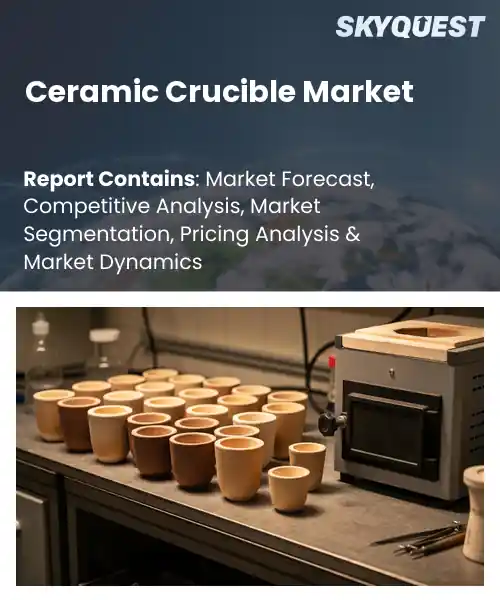
Ceramic Crucible Market
Report ID: SQMIG15J2172
Report ID: SQMIG15J2172
[email protected]
USA +1 351-333-4748
Report ID:
SQMIG15J2172 |
Region:
Global |
Published Date: March, 2026
Pages:
157
|Tables:
120
|Figures:
77


Global Ceramic Crucible Market size was valued at USD 2.00 Billion in 2024 and is poised to grow from USD 2.04 Billion in 2025 to USD 2.39 Billion by 2033, growing at a CAGR of 2.0% during the forecast period (2026-2033).
The primary driver of the ceramic crucible market is escalating demand for high-purity, high-temperature containment in advanced manufacturing and materials processing, which has reshaped supply chains and specifications over recent decades. Ceramic crucibles have become a critical component of metallurgical processes because they can help to prevent contamination while also offering thermal shock resistance and precise material properties of materials. Historically, the market moved from clay and graphite vessels to engineered alumina, zirconia and silicon carbide as sectors such as semiconductors, specialty alloys and battery recycling raised purity and durability expectations. For instance, wafer fabrication and specialty alloy casting increasingly depend on engineered ceramics.
A key trend driving the global ceramic crucible sector expansion is technological specialization by crucible manufacturers, because as industrial processes demand greater purity and thermal endurance, suppliers innovate materials, geometries and coatings that unlock new applications. For example, semiconductor firms using the Czochralski silicon growth technique require alumina crucibles with controlled porosity, so producers develop sintering regimes and treatments that reduce contamination and downtime. Similarly, growth in electric vehicle batteries raises metal recovery needs, which increases demand for crucibles that tolerate corrosive slags and repeated thermal cycling and therefore creates opportunities for silicon carbide and zirconia composite products and additive manufacturing to supply longer-life crucibles.
How is AI Enhancing Quality Control in the Ceramic Crucible Market?
The ceramic crucible industry is seeing an improvement in quality control because of an increase in the use of advanced imaging, sensor fusion, and process analytics due to the implementation of AI technology. Some of the elements that are being used in this process include automated visual inspection, spectral surface analysis of the ceramics, and detection of changes in firing and kiln conditions through real-time monitoring. Manufacturers need to meet higher purity and consistency requirements or face removing their customers' products entirely or having a significant longer lead time due to quality assurance issues. AI can create models that identify small defects and impurities on the surface that are typically undetected through human inspection.
In April 2025, PVA TePla acquisition of DIVE imaging systems brought hyperspectral AI vision into its metrology portfolio. This advancement enables nondestructive surface and layer inspection specifically suited to crucible production. The result is faster defect detection, reduced scrap and smoother scale up for higher quality crucible output.
Market snapshot - (2026-2033)
Global Market Size
USD 2.0 Billion
Largest Segment
Alumina (High Purity)
Fastest Growth
Silicon Carbide (SiC)
Growth Rate
2.0% CAGR
To get more insights on this market click here to Request a Free Sample Report
Global ceramic crucible market is segmented by material type, manufacturing process, application vertical, temperature resistance range and region. Based on material type, the market is segmented into alumina (high purity), zirconia, silicon carbide (SiC), quartz/fused silica, and graphite-ceramic composites. Based on manufacturing process, the market is segmented into isostatic pressing, slip casting and injection molding. Based on vertical application, the market is segmented into metal casting & metallurgy, chemical & laboratory analysis, glass manufacturing, and semiconductor processing. Based on temperature resistance range, the market is segmented into mid-range, high-range and ultra-high range. Based on region, the market is segmented into North America, Europe, Asia Pacific, Latin America, and Middle East & Africa.
Based on the global ceramic crucible market growth, silicon carbide (SiC) segment dominates because SiC crucibles deliver exceptional thermal shock resistance, high thermal conductivity and mechanical robustness that suit prolonged exposure to aggressive melting cycles. Due to its chemically inert nature at very high temperatures, contamination is minimized, therefore extending the lifetime of the product while decreasing downtime for processing operations. As a result of these same characteristics, there is strong demand from end-users when producing industrial metals and high temperature semiconductor devices.
However, alumina (high purity) is witnessing the strongest growth momentum as its low impurity profile and compatibility with sensitive chemical and semiconductor processes drive adoption. Refined and sintered at high purity, thinner-walled designs and lower levels of contamination are now available to developers of laboratory and analytical applications. Quality specialists are experiencing a growth in demand for products with higher quality, which is attributed to these innovations.
Injection molding segment leads because it enables high volume production of intricate crucible geometries with consistent dimensional accuracy and minimal secondary machining. The process shortens lead times and reduces unit labor intensity, allowing manufacturers to meet tight tolerances demanded by semiconductors and glass manufacturers. Its reproducibility and compatibility with composite feedstocks support supply chain scaling and cost efficiencies, making injection molding the preferred manufacturing route for mainstream crucible output.
On the other hand, isostatic pressing is emerging as the fastest growing manufacturing approach owing to its ability to produce highly uniform density and structurally sound crucibles suitable for ultra-high temperature applications. Specialty crucibles for demanding metallurgical and semiconductor research are unlocked by advances in cold and hot isostatic techniques, creating niche higher margin opportunities and different suppliers.
To get detailed segments analysis, Request a Free Sample Report
As per the global ceramic crucible market share, Asia Pacific dominates the global ceramic crucible market due to a powerful combination of concentrated industrial demand, mature materials research, and an extensive manufacturing supply chain. Across major economies in the region, key end-use sectors (e.g., semiconductor fabrication, specialty metallurgy, and advanced ceramics production) are well established, driving the demand for high-performance crucibles. The close cooperation between universities, research institutions, and manufacturers promotes the rapid development of new materials and high-quality products. Suppliers have the advantage of being located close to large customer groups that allow for rapid customization and logistical efficiency. A good balance between smaller, experienced medium-ranged manufacturers and specialist high-precision manufacturers provides ample opportunity for competitive product offerings that meet the criteria of purity, thermal stability, and contamination control required by sophisticated industrial customers globally.
Ceramic crucible market trends in Japan are characterized by advanced materials research, close integration with semiconductor and metal processing industries, and a strong focus on high purity and precision manufacturing. To meet today's stringent industrial requirements, there is a strong focus on research-based material innovation and quality control among local producers. Working together, researchers and manufacturers are developing incremental improvements in thermal stability and contamination resistance that will enhance the reliability of our supply chain as well as develop specialized products for high performance in niche markets.
Ceramic crucible market in South Korea is driven by a technologically advanced manufacturing base and downstream demand from electronics and metal sectors. Partnerships between suppliers and users of product allow for new customized products with improved thermal and chemical durability. The successful participation of suppliers with manufacturers enhances the relationship between them and the ability to work as reliable partners to provide specialized products for manufacturing networks in the region.
Based on the global ceramic crucible market forecast, rapid expansion in North America is driven by a convergence of reindustrialization trends, investment in advanced materials research, and intensified demand from capital intensive industries that require high quality ceramic components. Increased focus on domestic supply chain stability, as well as greater collaboration between research labs and manufacturers, promotes the use of specialized crucibles designed to withstand harsh operating conditions. A strong engineering services foundation and easily accessible technical expertise make customizing crucibles for specific thermal and chemical properties possible. The close geographic relationship between industrial users of crucibles in urgent sectors, such as electronics, aerospace and R&D, creates predictable demand streams, which will support suppliers scaling up their capabilities and developing value added services for discerning customers. The automotive industry's focus on achieving high standards of reliability and being part of an established quality system has also attracted specialized producers.
Ceramic crucible market in United States is characterized by strong demand from semiconductor fabs, research laboratories, and specialty foundries that require high precision and purity. U.S.-based manufacturers utilize thorough quality control processes, supply chain traceability, and intensive technical support to fulfill the toughness of worldwide demands for their respective industries. Additionally, partnerships among industrial corporations and educational institutions create new avenues for new innovation in both refractory science/ceramics and coatings technology.
Ceramic crucible market in Canada focuses on supplying research institutions, niche metallurgy operations, and precision manufacturers with reliable solutions. Canadian industries support their producers through adaptable manufacturing processes, technical assistance, and access to regional logistics to support multiple types of industrial markets. Working collaboratively with research institutions and cross-border partners allows Canadian firms entry to an advanced level of material design and testing capabilities. The focus on quality control and the ability to perform flexible manufacturing provides Canadian producers with the ability to create customized products and maintain local relationships with their customers.
As per global ceramic crucible regional outlook, Europe is strengthening its position in the ceramic crucible market through a focus on advanced materials innovation, stringent quality and environmental standards, and close ties between industrial clusters and research institutions. Resilient supply chains and high-quality product features that provide suitable end use applications in metallurgy, research and high-end manufacturing are components of national industrial strategies. Investment in process optimization, recycling and coating technologies improve cost effectiveness and performance of material, as well as reduce material lifecycle impacts. Collaborative networks between other countries are a resource for sharing knowledge, as well as allowing producers to provide differentiated products, therefore increasing the appeal of certified products to potential customers. Engineering hubs located in Germany, and both research centers in the United Kingdom and France provide manufacturers with high temperature material and coating engineering expertise. This collective approach supports a competitive European supply base able to address complex thermal and contamination control challenges for industrial customers.
Ceramic crucible market in Germany is anchored by a strong engineering tradition, precision manufacturing capabilities, and expertise in high temperature materials. The supplier is committed to providing a certified quality management system, state-of-the-art sintering and coating technology, and integration with industrial automation for metallurgical applications which require rigorous testing. Firms have developed collaboration networks between universities, research institutions, and OEMs to continuously improve products.
Ceramic crucible market in United Kingdom benefits from strong academic research, advanced materials science capabilities, and vibrant precision manufacturers serving research and high technology sectors. Companies focus on creating products through prototyping, custom-designed products, and coating technologies that enhance their thermal properties and keep them clean from contamination. Close collaboration with laboratory networks helps speed up the process of verifying products. The focus on engineering know-how and quick to respond to customer needs helps UK manufacturers support specialized applications for both domestic and international customers.
Ceramic crucible market in France is shaped by strong materials research, metallurgy expertise, and network of precision ceramics producers serving laboratory and industrial customers. Firms concentrate on refined material formulations, surface treatments, and thermal management solutions tailored to demanding processes. Collaboration between manufacturers and research institutions helps validate products and integrate them into processes. Commercial and industrial manufacturers in France put greater emphasis on developing technically certified products for both domestic and export markets.
To know more about the market opportunities by region and country, click here to
Buy The Complete Report
Advances In High Performance Ceramics
Rising Demand From Electronics Industry
High Manufacturing Costs
Limited Raw Material Availability
Request Free Customization of this report to help us to meet your business objectives.
Competitive landscape in the global ceramic crucible market outlook is shaped by supply consolidation and premium quality demands from semiconductor and battery customers, driving concrete M&A and capacity plays rather than vague growth statements. Key strategic developments include the acquisition of CoorsTek's crucible business by Momentive in 2022 and the burgeoning popularity of corporate additive manufacturing strategies, including Bosch Advanced Ceramics' development of additive manufacturing systems for ceramics to speed up the pace of product development and increase production capacity.
SkyQuest’s ABIRAW (Advanced Business Intelligence, Research & Analysis Wing) is our Business Information Services team that Collects, Collates, Correlates, and Analyses the Data collected by means of Primary Exploratory Research backed by robust Secondary Desk research.
As per SkyQuest analysis, the key driver behind the global ceramic crucible industry is escalating demand for high purity, high temperature containment in advanced manufacturing and materials processing, while a second driver is technological specialization by crucible manufacturers that improves materials, geometries and coatings for demanding applications. The biggest country for semiconductor and metals is the Asia-Pacific region where semiconductor and metals clusters drive growth in the adoption of both products; silicon carbide crucibles are also the largest market segment because of their superior thermal shock resistance and durability. A significant limitation for the growth of this market is the high cost of manufacturing, which restricts the number of users who can afford to buy these products and the ability to scale up production. Suppliers who focus on innovation, lifecycle management, and AI-powered quality control will have the greatest opportunity for successful growth in the semiconductor and metals markets through 2033.
| Report Metric | Details |
|---|---|
| Market size value in 2024 | USD 2.0 Billion |
| Market size value in 2033 | USD 2.39 Billion |
| Growth Rate | 2.0% |
| Base year | 2024 |
| Forecast period | (2026-2033) |
| Forecast Unit (Value) | USD Billion |
| Segments covered |
|
| Regions covered | North America (US, Canada), Europe (Germany, France, United Kingdom, Italy, Spain, Rest of Europe), Asia Pacific (China, India, Japan, Rest of Asia-Pacific), Latin America (Brazil, Rest of Latin America), Middle East & Africa (South Africa, GCC Countries, Rest of MEA) |
| Companies covered |
|
| Customization scope | Free report customization with purchase. Customization includes:-
|
To get a free trial access to our platform which is a one stop solution for all your data requirements for quicker decision making. This platform allows you to compare markets, competitors who are prominent in the market, and mega trends that are influencing the dynamics in the market. Also, get access to detailed SkyQuest exclusive matrix.
Table Of Content
Executive Summary
Market overview
Parent Market Analysis
Market overview
Market size
KEY MARKET INSIGHTS
COVID IMPACT
MARKET DYNAMICS & OUTLOOK
Market Size by Region
KEY COMPANY PROFILES
Methodology
For the Ceramic Crucible Market, our research methodology involved a mixture of primary and secondary data sources. Key steps involved in the research process are listed below:
1. Information Procurement: This stage involved the procurement of Market data or related information via primary and secondary sources. The various secondary sources used included various company websites, annual reports, trade databases, and paid databases such as Hoover's, Bloomberg Business, Factiva, and Avention. Our team did 45 primary interactions Globally which included several stakeholders such as manufacturers, customers, key opinion leaders, etc. Overall, information procurement was one of the most extensive stages in our research process.
2. Information Analysis: This step involved triangulation of data through bottom-up and top-down approaches to estimate and validate the total size and future estimate of the Ceramic Crucible Market.
3. Report Formulation: The final step entailed the placement of data points in appropriate Market spaces in an attempt to deduce viable conclusions.
4. Validation & Publishing: Validation is the most important step in the process. Validation & re-validation via an intricately designed process helped us finalize data points to be used for final calculations. The final Market estimates and forecasts were then aligned and sent to our panel of industry experts for validation of data. Once the validation was done the report was sent to our Quality Assurance team to ensure adherence to style guides, consistency & design.
Analyst Support
Customization Options
With the given market data, our dedicated team of analysts can offer you the following customization options are available for the Ceramic Crucible Market:
Product Analysis: Product matrix, which offers a detailed comparison of the product portfolio of companies.
Regional Analysis: Further analysis of the Ceramic Crucible Market for additional countries.
Competitive Analysis: Detailed analysis and profiling of additional Market players & comparative analysis of competitive products.
Go to Market Strategy: Find the high-growth channels to invest your marketing efforts and increase your customer base.
Innovation Mapping: Identify racial solutions and innovation, connected to deep ecosystems of innovators, start-ups, academics, and strategic partners.
Category Intelligence: Customized intelligence that is relevant to their supply Markets will enable them to make smarter sourcing decisions and improve their category management.
Public Company Transcript Analysis: To improve the investment performance by generating new alpha and making better-informed decisions.
Social Media Listening: To analyze the conversations and trends happening not just around your brand, but around your industry as a whole, and use those insights to make better Marketing decisions.
REQUEST FOR SAMPLE
 REQUEST FREE CUSTOMIZATION
Global Ceramic Crucible Market size was valued at USD 2.0 Billion in 2024 and is poised to grow from USD 2.04 Billion in 2025 to USD 2.39 Billion by 2033, growing at a CAGR of 2.0% during the forecast period (2026-2033).
Competitive landscape is shaped by supply consolidation and premium quality demands from semiconductor and battery customers, driving concrete M&A and capacity plays rather than vague growth statements. Notable strategic moves include Momentive’s 2022 acquisition of CoorsTek’s crucibles business and the rise of corporate additive manufacturing initiatives such as Bosch Advanced Ceramics working with ceramic AM platforms to accelerate product innovation and capacity expansion. Search summary and insufficiency note: Publicly verifiable evidence of independent startups founded in or after 2019 that focus exclusively on manufacturing ceramic crucibles was not located; recent market activity is dominated by incumbent acquisitions, corporate AM spinups and specialty coating or parts suppliers, which explains the absence of suitable startup candidates for the precise criteria requested. 'Morgan Advanced Materials', 'Saint-Gobain Performance Ceramics', 'Vesuvius PLC', 'RHI Magnesita', 'Imerys', 'Zircar Ceramics', 'McDanel Advanced Ceramic', 'CoorsTek', 'BCE (Canada)', 'SCJ Ceramic', 'LECO Corporation', 'Kashimira Ceramics', 'Shandong Guojing', 'MTS (Mizumoto)', 'Anderman Ceramics', 'Almatis', 'Calderys', 'LafargeHolcim', 'Washington Mills', 'Resco Products'
Continuous advances in material composition and processing technologies have enhanced the thermal stability, chemical resistance, and mechanical strength of ceramic crucibles, making them more suitable for demanding metallurgical and laboratory applications. Improved purity and consistency reduce contamination risk and increase component longevity, which encourages end users to adopt ceramic crucibles over alternative materials. These developments enable manufacturers to meet stricter performance requirements and broaden application scope, thereby supporting expanded procurement by industries that prioritize reliability, reproducibility, and long service life in high temperature environments.
Advanced Ceramic Engineering: Demand from high performance metallurgy, semiconductor fabrication and research institutions is driving development of ceramics with engineered microstructures and composite reinforcements that deliver superior thermal shock resistance and dimensional stability. Manufacturers are prioritizing tailored crucible geometries and surface treatments to improve process integration and reduce contamination risk. This trend fosters closer collaboration between material scientists and end users, accelerating adoption of proprietary formulations and product tiers that emphasize reliability, extended service intervals across established and emerging high temperature processing applications
Why does Asia Pacific Dominate the Global Ceramic Crucible Market? |@12


Want to customize this report? This report can be personalized according to your needs. Our analysts and industry experts will work directly with you to understand your requirements and provide you with customized data in a short amount of time. We offer $1000 worth of FREE customization at the time of purchase.
Feedback From Our Clients


 USA (+1) 351-333-4748

