Ceramic Backplane Market
Report ID: SQMIG45I2362
Report ID: SQMIG45I2362
[email protected]
USA +1 351-333-4748
Report ID:
SQMIG45I2362 |
Region:
Global |
Published Date: March, 2026
Pages:
157
|Tables:
116
|Figures:
77


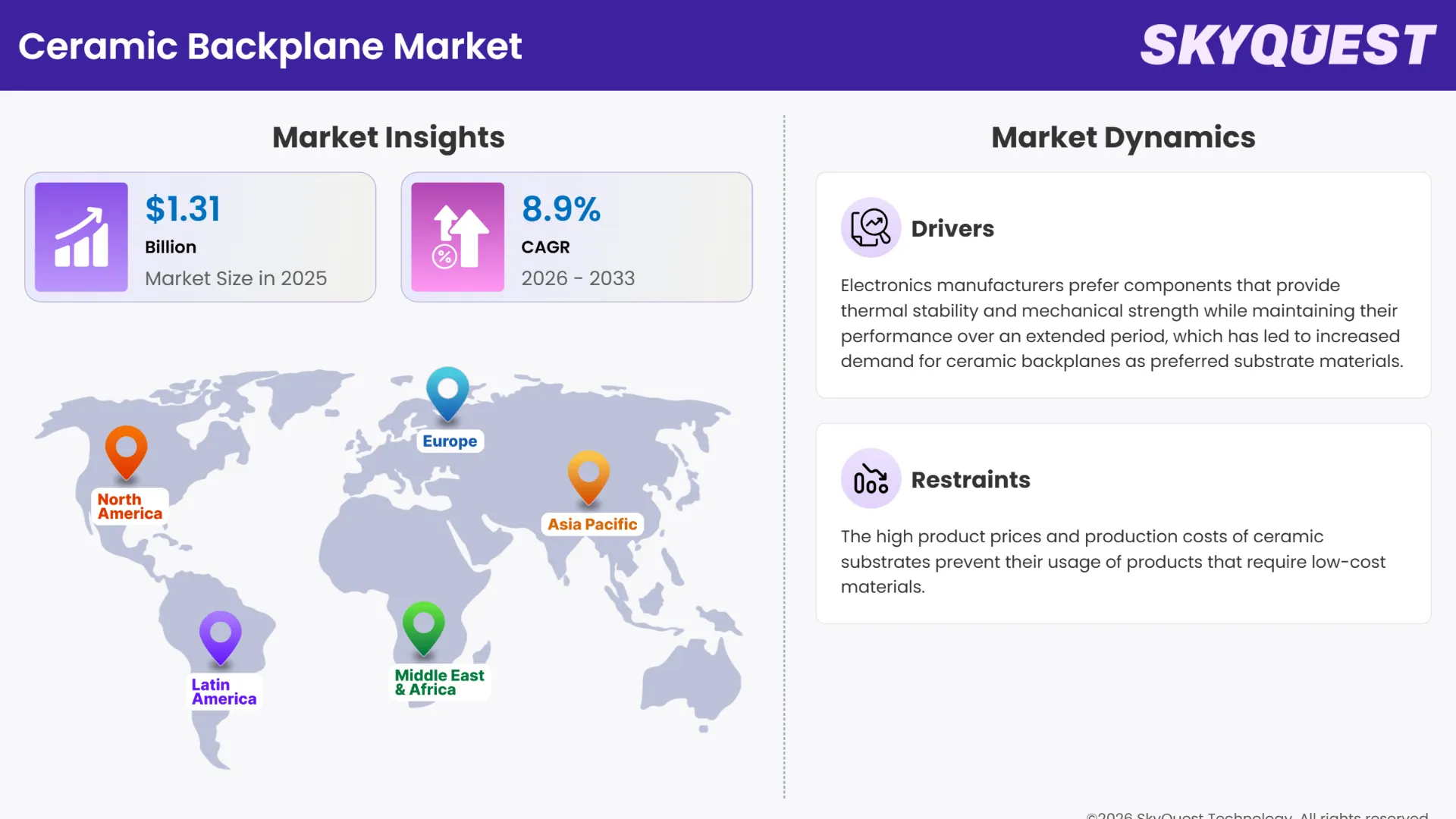
Global Ceramic Backplane Market size was valued at USD 1.20 Billion in 2024 and is poised to grow from USD 1.31 Billion in 2025 to USD 2.58 Billion by 2033, growing at a CAGR of 8.9% during the forecast period (2026-2033).
The ceramic substrates of ceramic backplanes function as support structures for modules while they handle power and signal transmission in high-power electronics and communication systems. The main reason for the increase originates from the need for better thermal management solutions which electric vehicles and utility-scale renewable systems require to achieve efficient compact and dependable heat dissipation.
The technology originated as an aerospace and defense solution but modern advancements in low-temperature co-fired ceramics and enhanced metallization capabilities now enable industrial applications of this technology which was formerly restricted to defense purposes. Automotive manufacturers that use silicon carbide inverters depend on ceramic backplanes to preserve the quality of their signals while preventing thermal runaway, but solar inverter suppliers select durable substrates that enable their systems to operate continuously in challenging environments.
The global ceramic backplane market outlook experiences a significant transition towards wide-bandgap semiconductors based on silicon carbide technology since these advanced devices can generate high thermal density levels which regular FR-4 substrates do not possess the capacity to control. The rising demand for ceramic backplanes occurs because aluminum nitride and LTCC materials deliver better thermal performance combined with multilayer electrical pathways that prevent overheating while providing crucial reliability for EV inverters and telecom base stations and industrial drives. Manufacturers build capacity through their investments in scalable LTCC processes together with high-thermal materials, whereas design-for-manufacture support enables providers to create joint ventures and component integration and localized production, which will meet automotive and grid certification needs.
How is AI Adoption Impacting Demand And Pricing in the Ceramic Backplane Market?
The adoption of AI technology creates operational changes that drive the global ceramic backplane market growth, which results in price increases because thermal management standards and operational reliability and high-speed signal integrity requirements have grown more stringent. AI accelerator systems and dense server interconnects both require stable dielectric properties and thermal conduction performance that ceramic backplanes provide. The architectural changes caused by AI workloads lead customers to choose ceramic solutions because they minimize risks of failure while extending operational life for the modules. The value of specialized materials and advanced processing has increased because of supply chain pressures. The design wins in hyperscale and telecom markets create a demand increase which will continue to grow.
Kyocera, in March 2026, announced new high speed ceramic packages and substrates aimed at optical and server markets, which improve thermal performance and signal integrity and help justify higher backplane pricing while accelerating adoption in AI infrastructure.
To get more insights on this market click here to Request a Free Sample Report
The global ceramic backplane market is segmented by material grade, circuitry density, application vertical, board size or form factor, and region. Based on material grade, the market is categorized into alumina-based, aluminum nitride, and low-temperature co-fired ceramic. In terms of circuitry density, it is divided into high-density interconnect (HDI) and multi-layer backplanes. By application vertical, the market includes aerospace and defense, high-performance computing (HPC), telecom and 5G infrastructure, and automotive electronic control units (ECUs). Based on board size or form factor, the segmentation comprises standard and large-format custom backplanes. Regionally, the market is analyzed across North America, Europe, Asia Pacific, Latin America, and the Middle East & Africa.
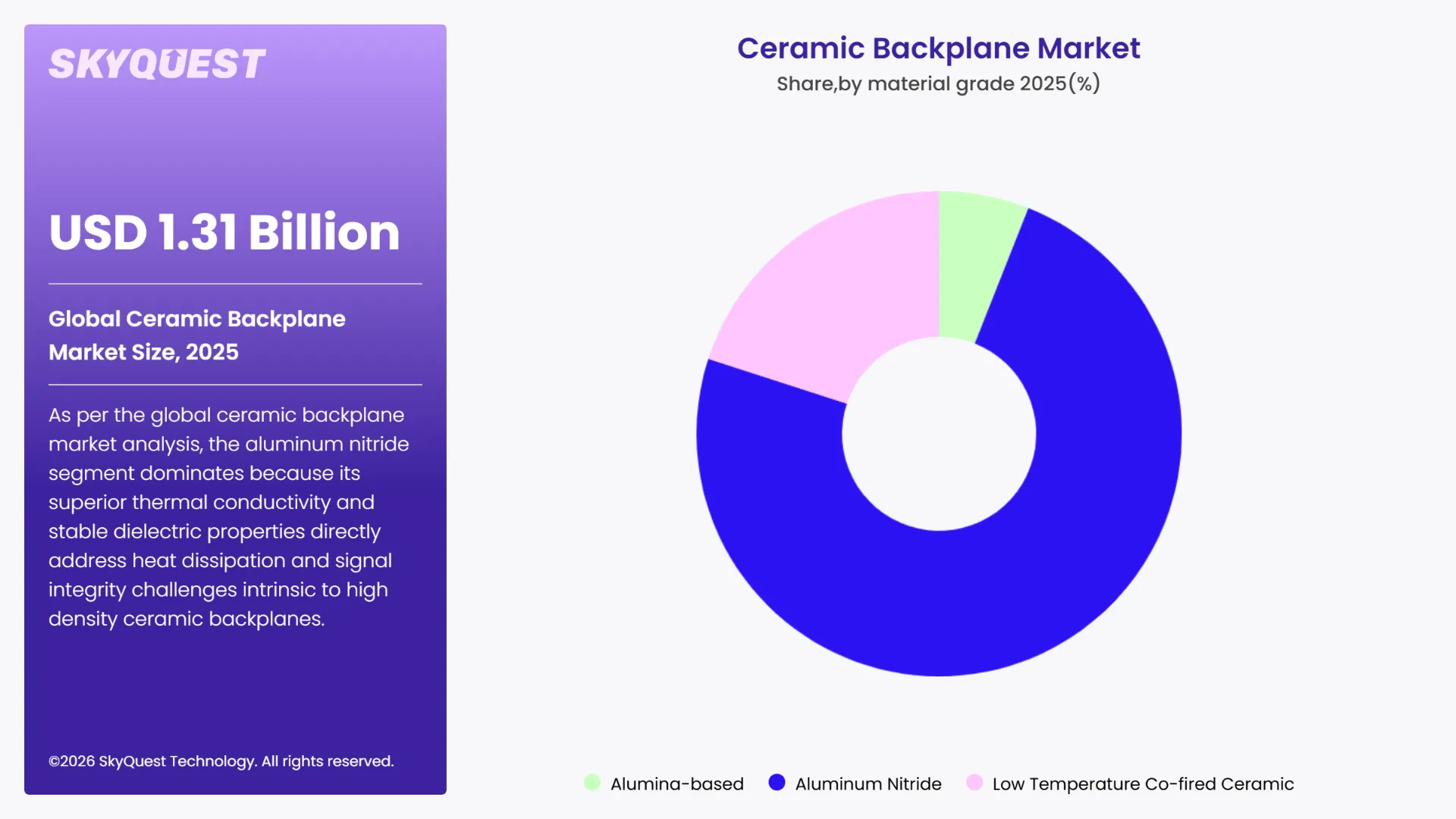
As per the global ceramic backplane market analysis, the aluminum nitride segment dominates because its superior thermal conductivity and stable dielectric properties directly address heat dissipation and signal integrity challenges intrinsic to high density ceramic backplanes. The manufacturing sector depends on this material because it maintains operational efficiency during thermal and electrical load testing and provides stable multilayer routing functions with secure connections across all components. The combination of advanced metallurgy technology implementation and supply chain development will enable manufacturers to protect aluminum nitride market share by decreasing product risks and extending product life.
However, the development of low temperature cofired ceramic technology has become the leading growth sector because it enables passive component and fine pitch interconnect integration into substrate designs, which produces more efficient and cost-effective backplane assemblies. The implementation of better cofiring methods together with the increasing need for miniaturized systems creates fresh market prospects for modular and large-scale production processes dedicated to upcoming electronic platforms.
According to the global ceramic backplane market forecast, the multilayer architecture of multi-layer backplanes allows for detailed routing while it maintains impedance control and power distribution which complex systems require that use ceramic substrate technology. The stacking techniques decrease the need for additional wiring, while the system maintains signal quality and power shielding through embedded power planes. Ceramic multilayer systems benefit from established manufacturing processes which reduce integration risks and provide design flexibility for applications that require high performance with stable thermal characteristics.
Whereas the high-density interconnect technology field has grown most rapidly because narrower line widths with microvia methods allow users to create high routing capacity in ceramic backplanes, which fulfills requirements for small high-speed systems. The adoption of HDI technology grows because laser drilling and metallization improvements enable designers to create compact integrated systems, which provide new opportunities for performance-limited applications.
To get detailed segments analysis, Request a Free Sample Report
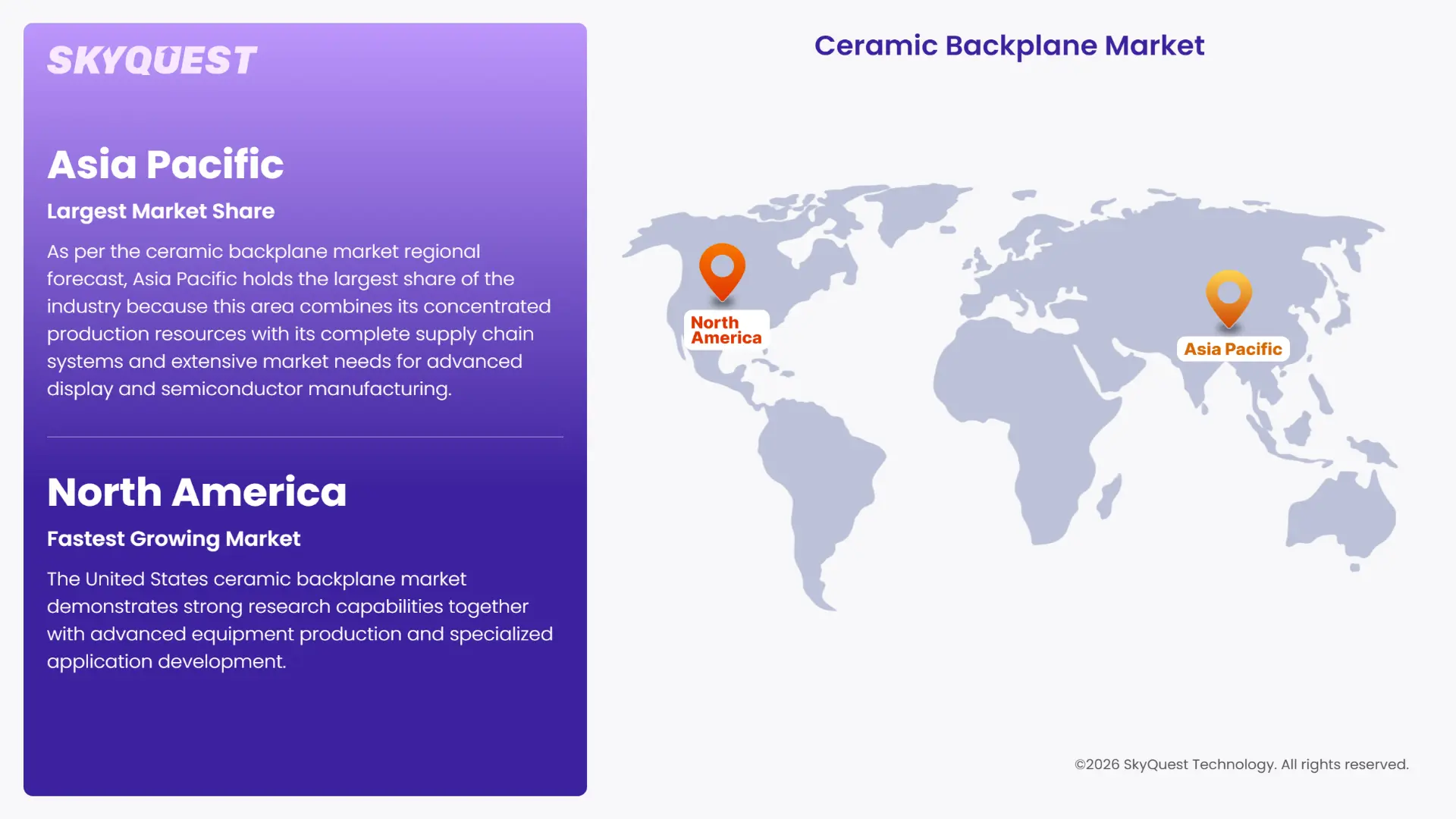
As per the ceramic backplane market regional forecast, Asia Pacific holds the largest share of the industry because this area combines its concentrated production resources with its complete supply chain systems and extensive market needs for advanced display and semiconductor manufacturing. Local producers can utilize their existing knowledge of ceramics processing together with their access to essential component manufacturers who are located nearby to achieve successful product development and manufacturing ramp up.
Industrial ecosystems create strong partnerships between material scientists and display developers and equipment manufacturers which leads to faster technology development and personalized solutions. High precision manufacturing results from specific policy frameworks together with investment systems which enable capital funding for special production operations. The combination of research facilities and production sites enables quicker knowledge exchange while cutting product development time which helps regions maintain their cost and time advantages to lead in backplane technology and performance critical application innovation.
The Japanese ceramic backplane industry draws its advantages from well-developed materials science capabilities and operational precision ceramics supply networks and direct connection to advanced display production systems. The ecosystem emphasizes quality and reliability, which enables the creation of high-performance backplanes designed for specialized display and sensor applications. The manufacturing sector, research institutes, and equipment suppliers work together to transform laboratory breakthroughs into market-ready products through their strict process management and focus on step-by-step improvement initiatives.
The South Korean ceramic backplane market growth depends on its close relationship with advanced display manufacturers and semiconductor production facilities. Companies dedicate their resources to developing fast track prototyping processes which create custom backplane solutions for displaying products that need high resolution and flexible design capabilities. Partnerships across different sectors enable materials developers and equipment vendors and system integrators to work together on refining products at a faster rate.
The North American ceramic backplane sector experiences rapid growth because advanced electronics manufacturing requires excessive product demand while domestic supply chain investments increase and technology resilience becomes more critical. Industry players use their research relationships with universities and national laboratories together with their collaboration with private manufacturers to speed up materials research and new process development.
The market momentum builds through activities which establish local production of essential components which help companies develop multiple sourcing options and increase their capacity to produce goods. North America establishes itself as a rapidly growing market for ceramic backplane technologies through its dedication to maintaining high standards and creating tailored solutions for specialized uses which join with its regional system manufacturers. The commercialization of specialized manufacturing clusters receives support from regulations which match industry standards and from specific partnerships between public and private sectors that assist firms in scaling their operations.
The United States ceramic backplane market demonstrates strong research capabilities together with advanced equipment production and specialized application development. Companies in the industrial sector work with academic institutions to speed up their development of prototypes into finished products. The supply chain system drives investment toward domestic production of high precision ceramics because companies need to establish multiple contact points. The market favors customization for aerospace, medical, and high-end display systems, where stringent reliability requirements and integration support premium backplane solutions.
The ceramic backplane market in Canada operates through multiple channels which include specialized materials research and niche manufacturing capabilities and established connections to North American assembly networks. Companies provide precise expertise in ceramics and coating processes which enable the creation of unique backplane products for industrial instrumentation and ruggedized systems. Companies establish partnerships with universities and regional businesses to promote the development and transfer of skills to the workforce. The market benefits from an emphasis on quality, environmental compliance, and adaptability to customer requirements across applications.
The ceramic backplane market of Europe expands its market presence through industrial research activities and manufacturing excellence and advanced material research that directly benefits their market development. The combination of cross-border research partnerships and public-private research initiatives enables laboratories to develop operations while the regulatory environment promotes sustainable manufacturing methods. European firms concentrate their efforts on creating customized products which meet quality certification standards while they establish connections with system suppliers who bring their products to the market.
The ceramic backplane market in Germany requires three main elements which include precise engineering work, advanced production machinery and strict quality control methods. Industrial clusters with strong capabilities connect materials experts and tool manufacturers and system integrators to create advanced backplane systems which serve industrial automation and high-end display markets. The optimization process together with certification methods establishes a route for companies to move their operations from pilot testing to complete production.
The ceramic backplane market in the United Kingdom exists through three main resources which include established research centers together with specialized materials knowledge and manufacturing services that focus on custom backplane production. The design process for telecommunications and professional display applications uses manufacturing and testing methods which create unique solutions. Materials chemists work together with system engineers to create assembly systems which integrate into complex product designs. The government promotes innovation together with export-oriented manufacturing, which creates opportunities for businesses to develop international supply partnerships.
The French ceramic backplane market operates through three main resources which include advanced materials research together with high-precision manufacturing and direct industry ties with aerospace and industrial equipment markets. Surface engineering and thermal management techniques enable the creation of backplane components which perform reliably in environments that experience high operational demands. The cooperative programs developed by public research organizations and private manufacturers enable both validation testing and product development at full scale.
To know more about the market opportunities by region and country, click here to
Buy The Complete Report
Increasing Demand For High Reliability
Electronics manufacturers prefer components that provide thermal stability and mechanical strength while maintaining their performance over an extended period, which has led to increased demand for ceramic backplanes as preferred substrate materials. The inherent material properties enable the production of compact assemblies which maintain their quality through thermal cycling while creating power density designs. The aerospace defense telecommunications and industrial sectors have increased their market demand for ceramic backplanes because they meet high reliability standards which original equipment manufacturers now consider essential for product lifespan.
Advances In Fabrication Techniques
The manufacturing process of ceramic backplanes has improved through recent advances in precision ceramic processing and new sintering techniques and additive deposition technology. The new fabrication techniques enable the creation of more precise product features which deliver better material consistency and fewer defects while opening new possibilities for designers to select ceramics instead of organic substrates. The production process has improved consistency which enables companies to build scalable supply chains and suppliers to trust ceramic backplanes, resulting in more product developers using the technology across multiple markets that require compact and high-performing interconnect solutions.
High Material And Processing Costs
The high product prices and production costs of ceramic substrates prevent their usage of products that require low-cost materials. The advanced ceramic materials require special manufacturing environments which lead to higher unit production costs and create difficulties for designers who need to balance material costs with desired product performance. The procurement teams and contract manufacturers of companies prefer to use cheaper materials for their large-scale production, which decreases the potential market size for ceramic backplanes. The technical capabilities of ceramics in thermal management and reliability are not attracting customers because budget limitations and cost-driven design decisions are preventing wider adoption.
Limited Standardization And Ecosystem
The current adoption of ceramic backplanes is facing challenges due to two major issues which include divided industry standards together with limited access to essential supporting infrastructure. The product development process gets delayed because developers face difficulties obtaining established supplier networks and compatible connectors and validated design libraries. The absence of standardized guidelines together with proven integration methods prevents businesses from adopting new substrate materials. The potential advantages of ceramic backplane technology are being delayed because of uncertainty about investment and product development processes which require time for testing.
Request Free Customization of this report to help us to meet your business objectives.
The global ceramic backplane market faces fierce competition because existing companies use different materials and processes while hyperscaler companies and microLED experts use their mergers with partners to control their supply chain operations. Google has acquired Raxium which specializes in microLED technology as part of their strategy to obtain active backplane technology through partnerships and foundry collaborations between Compound Photonics and GLOBALFOUNDRIES to develop industrial manufacturing processes for backplane ASICs and associated production operations.
SkyQuest’s ABIRAW (Advanced Business Intelligence, Research & Analysis Wing) is our Business Information Services team that Collects, Collates, Correlates, and Analyses the Data collected by means of Primary Exploratory Research backed by robust Secondary Desk research.
As per SkyQuest analysis, the growth of electric vehicles and high-power electronics is driving demand for advanced thermal management solutions, positioning ceramic backplanes as critical components in power modules and electronic systems. However, high material and processing costs remain a barrier to broader market entry, particularly in price-sensitive applications. Aluminum nitride dominates the material segment due to its superior thermal conductivity and dielectric strength, making it ideal for high-performance ceramic backplanes. Asia Pacific leads the market, supported by integrated supply chains, strong electronics manufacturing capabilities, and rising regional demand. Advancements in fabrication technologies such as direct bonded copper (DBC) and active metal brazing (AMB) are enabling scalable production and improved reliability. Additionally, stringent automotive and telecom standards are encouraging manufacturers to pursue strategic partnerships, localized production, and design-for-manufacturing approaches to enhance competitiveness despite ongoing cost and standardization challenges.
| Report Metric | Details |
|---|---|
| Market size value in 2024 | USD 1.20 Billion |
| Market size value in 2033 | USD 2.58 Billion |
| Growth Rate | 8.9% |
| Base year | 2024 |
| Forecast period | 2026-2033 |
| Forecast Unit (Value) | USD Billion |
| Segments covered |
|
| Regions covered | North America (US, Canada), Europe (Germany, France, United Kingdom, Italy, Spain, Rest of Europe), Asia Pacific (China, India, Japan, Rest of Asia-Pacific), Latin America (Brazil, Rest of Latin America), Middle East & Africa (South Africa, GCC Countries, Rest of MEA) |
| Companies covered |
|
| Customization scope | Free report customization with purchase. Customization includes:-
|
To get a free trial access to our platform which is a one stop solution for all your data requirements for quicker decision making. This platform allows you to compare markets, competitors who are prominent in the market, and mega trends that are influencing the dynamics in the market. Also, get access to detailed SkyQuest exclusive matrix.
Table Of Content
Executive Summary
Market overview
Parent Market Analysis
Market overview
Market size
KEY MARKET INSIGHTS
COVID IMPACT
MARKET DYNAMICS & OUTLOOK
Market Size by Region
KEY COMPANY PROFILES
Methodology
For the Ceramic Backplane Market, our research methodology involved a mixture of primary and secondary data sources. Key steps involved in the research process are listed below:
1. Information Procurement: This stage involved the procurement of Market data or related information via primary and secondary sources. The various secondary sources used included various company websites, annual reports, trade databases, and paid databases such as Hoover's, Bloomberg Business, Factiva, and Avention. Our team did 45 primary interactions Globally which included several stakeholders such as manufacturers, customers, key opinion leaders, etc. Overall, information procurement was one of the most extensive stages in our research process.
2. Information Analysis: This step involved triangulation of data through bottom-up and top-down approaches to estimate and validate the total size and future estimate of the Ceramic Backplane Market.
3. Report Formulation: The final step entailed the placement of data points in appropriate Market spaces in an attempt to deduce viable conclusions.
4. Validation & Publishing: Validation is the most important step in the process. Validation & re-validation via an intricately designed process helped us finalize data points to be used for final calculations. The final Market estimates and forecasts were then aligned and sent to our panel of industry experts for validation of data. Once the validation was done the report was sent to our Quality Assurance team to ensure adherence to style guides, consistency & design.
Analyst Support
Customization Options
With the given market data, our dedicated team of analysts can offer you the following customization options are available for the Ceramic Backplane Market:
Product Analysis: Product matrix, which offers a detailed comparison of the product portfolio of companies.
Regional Analysis: Further analysis of the Ceramic Backplane Market for additional countries.
Competitive Analysis: Detailed analysis and profiling of additional Market players & comparative analysis of competitive products.
Go to Market Strategy: Find the high-growth channels to invest your marketing efforts and increase your customer base.
Innovation Mapping: Identify racial solutions and innovation, connected to deep ecosystems of innovators, start-ups, academics, and strategic partners.
Category Intelligence: Customized intelligence that is relevant to their supply Markets will enable them to make smarter sourcing decisions and improve their category management.
Public Company Transcript Analysis: To improve the investment performance by generating new alpha and making better-informed decisions.
Social Media Listening: To analyze the conversations and trends happening not just around your brand, but around your industry as a whole, and use those insights to make better Marketing decisions.
REQUEST FOR SAMPLE
 REQUEST FREE CUSTOMIZATION
Global Ceramic Backplane Market size was valued at USD 188.0 Billion in 2024 and is poised to grow from USD 203.04 Billion in 2025 to USD 375.81 Billion by 2033, growing at a CAGR of 8.0% during the forecast period (2026-2033).
Competition in the global ceramic backplane market has intensified as incumbents pursue material and process differentiation while hyperscalers and microLED specialists use M&A and partnerships to secure supply chains. Notable strategies include Google’s acquisition of microLED specialist Raxium, partnerships to co-develop active backplanes such as Micledi’s collaboration with Kopin, and foundry alliances like Compound Photonics with GLOBALFOUNDRIES to industrialize backplane ASIC and manufacturing flows. 'Kyocera Corporation', 'Murata Manufacturing', 'TDK Corporation', 'CeramTec', 'NGK Spark Plug', 'CoorsTek', 'Maruwa Co., Ltd.', 'Schott AG', 'Rogers Corporation', 'Morgan Advanced Materials', 'Saint-Gobain Performance Ceramics', 'Taiyo Yuden', 'Samsung Electro-Mechanics', 'Yageo Corporation', 'Vishay Intertechnology', 'KEMET Electronics', 'Walsin Technology', 'Adamant Namiki', 'Nippon Carbide Industries', 'EnvisionTEC'
The growing preference among electronics manufacturers for components that deliver exceptional thermal stability, mechanical strength, and long term performance has elevated ceramic backplanes as a favored substrate choice. Their inherent resistance to thermal cycling and superior dimensional stability support smaller, more integrated assemblies and enable higher power density designs. As original equipment manufacturers prioritize product longevity and reduced field failures, procurement decisions increasingly favor ceramic backplanes to meet stringent reliability specifications, fostering adoption across aerospace, defense, telecommunications, and industrial segments and thereby propelling market expansion.
Advanced Packaging Integration: Advanced ceramic backplanes are central to evolving packaging approaches that integrate multiple dies and heterogeneous components, enabling higher interconnect density while improving thermal management and radio frequency behavior. Suppliers highlight alignment with chiplet ecosystems, high frequency modules, and precise substrate placement to support next generation communication and computing platforms. Ceramic dimensional stability and material robustness make backplanes well suited for hybrid assemblies where long term reliability and signal integrity are essential, prompting closer collaboration among substrate makers, assemblers and OEMs.
Asia Pacific Dominate the Global Ceramic Backplane Market?


Want to customize this report? This report can be personalized according to your needs. Our analysts and industry experts will work directly with you to understand your requirements and provide you with customized data in a short amount of time. We offer $1000 worth of FREE customization at the time of purchase.
Feedback From Our Clients


 USA (+1) 351-333-4748

