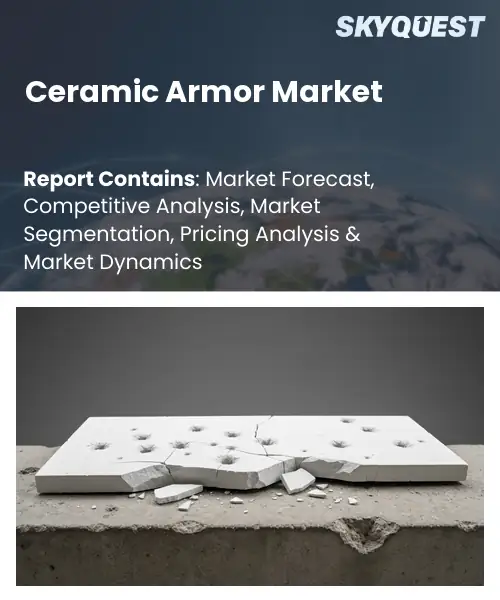
Ceramic Armor Market
Report ID: SQMIG20A2678
Report ID: SQMIG20A2678
[email protected]
USA +1 351-333-4748
Report ID:
SQMIG20A2678 |
Region:
Global |
Published Date: June, 2026
Pages:
157
|Tables:
94
|Figures:
76


Global Ceramic Armor Market size was valued at USD 3.1 Billion in 2024 and is poised to grow from USD 3.29 Billion in 2025 to USD 5.28 Billion by 2033, growing at a CAGR of 6.1% during the forecast period (2026-2033).
The market growth is attributed to the increasing demand for lightweight yet high performance ballistic protection in defense and law enforcement sector as the procurement is shifting towards advanced materials and modular systems. Ceramic armour is used for plates and applique for vehicles, made up of alumina, silicon carbide and boron carbide tiles to stop projectiles while keeping the load on the soldier and the weight of the vehicle down. NATO procurements and U.S. fielding of silicon carbide plates highlight the strategic value and growth path of the market. Together they illustrate the use of ceramic inserts driven by decades of materials science progress and asymmetric threats. The manufacturers are still focused on processing and cost reduction.
The global ceramic armor market is driven by improved manufacturing techniques and economies of scale which result in reduced unit costs, making the advanced plates affordable for more military and law enforcement fleets. And with falling production costs, procurement programs are shifting to higher-volume, lower-priced areas like applique for vehicles, helicopter panels and civilian tactical markets. This lowers the barrier for suppliers to invest in SiC and B4C R&D, leading to lighter, multi hit solutions that can increase survivability in urban combat, SWAT raids and armored transport missions, and avail export opportunities and private sector adoption in emerging markets.
How is AI improving ballistic performance prediction in the ceramic armor market?
The ceramic armour market is enhancing its ballistic performance prediction through the integration of data driven machine learning with physics based simulation and test data. Key aspects include models that learn links between ceramic composition, microstructure and failure modes, coupling with finite element impact simulations, and development of digital twin workflows that explore trade offs without costly live fire. The state of the art consists of academic and industrial studies using machine learning for impact resistance prediction and the reduction of the experimental loop. This work is helping producers to design lighter, reliable plates faster and reducing time to certification, making ceramic solutions more competitive and practical in the market context.
Safe Pro Group January 2026, unveiled new high performance armor, demonstrating AI enabled design and testing capabilities that accelerate validation and material optimization. This real world step supports market growth by reducing development time and increasing predictive confidence which increases manufacturing efficiency and adoption.
Market snapshot - (2026-2033)
Global Market Size
USD 3.1 Billion
Largest Segment
Silicon Carbide
Fastest Growth
Ceramic Matrix Composite
Growth Rate
6.1% CAGR
To get more insights on this market click here to Request a Free Sample Report
Global ceramic armor market is segmented by material type, application, end-user and region. Based on material type, the market is segmented into Alumina, Boron Carbide, Silicon Carbide, Ceramic Matrix Composite and Others. Based on application, the market is segmented into Body Armor, Aircraft Armor, Marine Armor, Vehicle Armor and Others. Based on end-user, the market is segmented into Homeland Security, Defense and Others. Based on region, the market is segmented into North America, Europe, Asia Pacific, Latin America and Middle East & Africa.
Boron Carbide segment dominates the market owing to its better hardness to weight ratio and established ballistic resistance. It is the preferred material for high velocity and armor piercing threats in ceramic armor systems. This is the driver for this performance advantage and for defense and security procurement priorities. Manufacturers are focusing on processing optimization, scaling production and integration of boron carbide into hybrid composites, strengthening supplier focus and sustained market preference.
However, the Silicon Carbide segment is witnessing the fastest growth momentum, as manufacturers are adopting better processing and coating techniques, which reduce the production costs, while still providing good ballistic protection. These technical improvements expand their applicability to weight sensitive platforms and gain broader defense and law enforcement procurement translating into new application pathways and commercial opportunities that accelerate ceramic armor market expansion.
Armored platforms need scalable ceramic solutions to optimize protection, weight and integration with composite backings, which creates consistent demand, making the Vehicle Armor segment dominant. The evolving threat profiles are compelling buyers to focus on ceramics that can preserve mobility without sacrificing survivability while aligning R&D, manufacturing investment and procurement cycles to vehicle applications and underpinning market structure and supplier roadmaps.
The Body Armor segment is becoming a major growth area due to thinner, multi-hit ceramic plates that are more wearable and concealable. Growing focus on individual survivability by security forces and private organizations along with innovations in materials and scalable production is expanding procurement and after-market services creating new commercial opportunities in ceramic armor.
To get detailed segments analysis, Request a Free Sample Report
The Asia Pacific region is the largest region in the global ceramic armor market, owing to strategic defense modernization efforts, strong manufacturing capabilities and concentrated technological expertise in key markets. Procurement is still guided by regional defense priorities, which favor local production ecosystems that shorten supply chains and improve responsiveness. Fast-paced innovation in ceramic composites and scalable manufacturing is being driven by robust research institutions and material science clusters. Close cooperation between government agencies, domestic OEMs and system integrators and regional suppliers with close access to raw material sources and competitive production capacity provide tailor made solutions for a variety of platforms. The export orientation and regional security dynamics continue to drive the deployment of ceramic armor in military and law enforcement applications, fostering a self-reinforcing environment for sustained market leadership and industrial depth.
Japan’s Ceramic Armor Market is driven by advanced material research, precision manufacturing, and strong ties between defense agencies and private industry. We design and build lightweight, high-performance ceramic solutions for naval and ground platforms. We back our solutions with high quality control standards and a skilled engineering workforce. Academic institutions offer an iterative process of material improvement but it is the suppliers who concentrate on the system electronics integration and modular designs necessary to meet demanding operational and export requirements.
South Korea has a strong defense industrial base and the collaboration between the system integrators and the material suppliers is pushing the Ceramic Armor market in the country. The emphasis on vehicle survivability and personnel protection leads to a modular ceramic solution approach that is intended to be mobile and cater to multiple threat profiles. Iterative testing and prototyping requires close coordination with procurement agencies. Export-oriented programs and international partnerships enable technology diffusion and scaling of production for regional platform needs.
North America is experiencing a rapid growth of its ceramic armor market due to targeted defense procurement goals, active private sector investment and a well developed supply chain that supports advanced materials commercialization. A robust network of research laboratories, specialty manufacturers, and capable testing facilities helps to accelerate the transition of ceramic composite research into fieldable armor. Industry focus on weight reduction and better multi threat protection is leading to modular, system level integration using composite and metallic components. Scalable production and iterative refinement of products result from strong collaboration between prime contractors, innovative startups and procurement agencies. The increased demand from the law enforcement and security sectors further expands the application scope to ground and vehicle platforms. Strong aftermarket services and specialized training ecosystems improve field performance and long term sustainment Increasing market momentum and supplier confidence.
The U.S. ceramic armor market benefits from a robust ecosystem of prime contractors, material manufacturers and research institutions that drives innovation and scalability. Lightweight system-level integration for defense and homeland security protection of vehicles and personnel. Robust testing and certification infrastructure for rigorous qualification Industry and start-up partnerships to speed up uptake of ceramic composites and advanced manufacturing for domestic and export applications.
Canada Ceramic Armor Market Manufacturers Specialized and Universities Collaborate to Develop Protection Solutions for Speeding up Collaborative Networks The choice of material and design is dictated by the need to be adaptable to harsh environments and interoperable with allied systems. Domestic suppliers are focusing on niche innovation, certification and aftermarket support, while international partnerships are helping to provide channels for technology transfer and production scale-up. It enables land and maritime platform deployment and a procurement emphasis on sustainment and field readiness.
Through joint industrial and research efforts, Europe is strengthening its position in the ceramic armor market with a focus on interoperability, standardization and the development of advanced materials. National champions and pan European consortia work with defence agencies to develop operational requirements and to speed up the qualification pathways; Meanwhile, specialist manufacturers are investing in scalable manufacturing methods and the precision processing of ceramics. The dual use applications focus promotes technology transfer between military and civilian markets and improves commercial viability. Cross border partnerships and supplier diversification strategies are reinforcing supply chain resilience, while targeted collaboration between Germany, United Kingdom and France is enhancing platform integration, testing capabilities and export competitiveness across allied markets. We invest in our workforce skills and modern manufacturing lines to support quality and throughput. Our regional testing centers put multi threat performance through the ringer. Harmonised procurement approaches across allied customers lead to larger production runs and cross border sourcing, helping European suppliers to grab more market share and accelerate product maturity.
The German Ceramic Armor Market benefits from advanced material know-how, precision manufacturing and close cooperation between industrial OEMs and research institutes. The emphasis is on the system integration of armoured vehicles and protective equipment, which is driving the development of high performance ceramic components and composite hybrids. Requiring qualification and quality assurance based on sound engineering skills and extensive test infrastructure. Export strategies and partnerships with European primes further broaden application in a variety of operational environments worldwide.
Ceramic Armor Market in United Kingdom benefits from the defense technology ecosystem combining specialized SMEs, system integrators and research centers. Lightweight ballistic protection and multi threat resistance focus development of ceramic modules and modular kits. Strong testing capabilities and certification routes allow for quick validation, and cooperation projects with global partners and export programs help increase production and expand use in defense and security applications and civil protection programs.
The French Ceramic Armor Market is supported by strong relationships between national defense agencies, major primes and advanced materials laboratories focused on high performance ceramic solutions. The aim is to improve the survivability of the vehicles, and protect the troops. The development of integrated armor modules and modular kits is thus achieved. We are very focused on industrial partnerships and export programs to facilitate the transfer of technology and to ramp up production. Strong testing capabilities, cross border collaboration enhance competitiveness in global defence markets.
To know more about the market opportunities by region and country, click here to
Buy The Complete Report
Rising Defense and Security Demand
Advances In Material Science
High Production and Material Costs
Supply Chain and Material Availability
Request Free Customization of this report to help us to meet your business objectives.
The competitive landscape of the global ceramic armor market is shaped by competition for materials and supply security that incentivizes targeted M&A, production partnerships, and product-level technology races for lighter, multiimpact ceramics. Examples are Avon Rubber’s acquisition of 3M’s ballistic protection business and SINTX’s acquisition of B4C assets and partnership with Precision Ceramics to commercialize boron carbide and composite plates.
SkyQuest’s ABIRAW (Advanced Business Intelligence, Research & Analysis Wing) is our Business Information Services team that Collects, Collates, Correlates and Analyses the Data gathered through Primary Exploratory Research supported by robust Secondary Desk research.
According to SkyQuest analysis the global ceramic armor market is expanding because of the growing demand for lightweight high performance ballistic protection. The key driver is shifting procurement towards advanced ceramic plates and vehicle applique. One constraint that limits civilian adoption and slows broader market expansion is high production and material costs. Buoyed by defense modernization, manufacturing scale and local research clusters, the Asia Pacific is the dominant region. Vehicle armor is the largest segment, requiring scalable ceramic solutions with a balance of protection and weight. A second driver is falling unit costs as manufacturing improves, allowing for broader procurement, R&D investment and faster commercialization favoring continued innovation and supplier consolidation.
| Report Metric | Details |
|---|---|
| Market size value in 2024 | USD 3.1 Billion |
| Market size value in 2033 | USD 5.28 Billion |
| Growth Rate | 6.1% |
| Base year | 2024 |
| Forecast period | (2026-2033) |
| Forecast Unit (Value) | USD Billion |
| Segments covered |
|
| Regions covered | North America (US, Canada), Europe (Germany, France, United Kingdom, Italy, Spain, Rest of Europe), Asia Pacific (China, India, Japan, Rest of Asia-Pacific), Latin America (Brazil, Rest of Latin America), Middle East & Africa (South Africa, GCC Countries, Rest of MEA) |
| Companies covered |
|
| Customization scope | Free report customization with purchase. Customization includes:-
|
To get a free trial access to our platform which is a one stop solution for all your data requirements for quicker decision making. This platform allows you to compare markets, competitors who are prominent in the market, and mega trends that are influencing the dynamics in the market. Also, get access to detailed SkyQuest exclusive matrix.
Table Of Content
Executive Summary
Market overview
Parent Market Analysis
Market overview
Market size
KEY MARKET INSIGHTS
COVID IMPACT
MARKET DYNAMICS & OUTLOOK
Market Size by Region
KEY COMPANY PROFILES
Methodology
For the Ceramic Armor Market, our research methodology involved a mixture of primary and secondary data sources. Key steps involved in the research process are listed below:
1. Information Procurement: This stage involved the procurement of Market data or related information via primary and secondary sources. The various secondary sources used included various company websites, annual reports, trade databases, and paid databases such as Hoover's, Bloomberg Business, Factiva, and Avention. Our team did 45 primary interactions Globally which included several stakeholders such as manufacturers, customers, key opinion leaders, etc. Overall, information procurement was one of the most extensive stages in our research process.
2. Information Analysis: This step involved triangulation of data through bottom-up and top-down approaches to estimate and validate the total size and future estimate of the Ceramic Armor Market.
3. Report Formulation: The final step entailed the placement of data points in appropriate Market spaces in an attempt to deduce viable conclusions.
4. Validation & Publishing: Validation is the most important step in the process. Validation & re-validation via an intricately designed process helped us finalize data points to be used for final calculations. The final Market estimates and forecasts were then aligned and sent to our panel of industry experts for validation of data. Once the validation was done the report was sent to our Quality Assurance team to ensure adherence to style guides, consistency & design.
Analyst Support
Customization Options
With the given market data, our dedicated team of analysts can offer you the following customization options are available for the Ceramic Armor Market:
Product Analysis: Product matrix, which offers a detailed comparison of the product portfolio of companies.
Regional Analysis: Further analysis of the Ceramic Armor Market for additional countries.
Competitive Analysis: Detailed analysis and profiling of additional Market players & comparative analysis of competitive products.
Go to Market Strategy: Find the high-growth channels to invest your marketing efforts and increase your customer base.
Innovation Mapping: Identify racial solutions and innovation, connected to deep ecosystems of innovators, start-ups, academics, and strategic partners.
Category Intelligence: Customized intelligence that is relevant to their supply Markets will enable them to make smarter sourcing decisions and improve their category management.
Public Company Transcript Analysis: To improve the investment performance by generating new alpha and making better-informed decisions.
Social Media Listening: To analyze the conversations and trends happening not just around your brand, but around your industry as a whole, and use those insights to make better Marketing decisions.
REQUEST FOR SAMPLE
 REQUEST FREE CUSTOMIZATION
Global Ceramic Armor Market size was valued at USD 3.1 Billion in 2024 and is poised to grow from USD 3.29 Billion in 2025 to USD 5.28 Billion by 2033, growing at a CAGR of 6.1% during the forecast period (2026-2033).
Competitive landscape in the global ceramic armor market centers on materials and supply security competition that drives targeted M&A, production partnerships, and product-level technology races for lighter, multiimpact ceramics; examples include Avon Rubber acquiring 3M’s ballistic protection business and SINTX acquiring B4C assets and partnering with Precision Ceramics to commercialize boron carbide and composite plates. 'BAE Systems', '3M Company', 'Saint-Gobain', 'Honeywell', 'DuPont', 'Ceradyne', 'CoorsTek', 'Morgan Advanced Materials', 'Rheinmetall', 'Plasan Sasa', 'Safariland', 'Point Blank Enterprises', 'Armor Express', 'MKU Limited', 'TenCate Advanced Armor', 'CeramTec', 'Schott', 'Saab', 'Elbit Systems', 'Survitec Group'
Ceramic armor's adoption by military and security agencies is driven by its ability to provide effective ballistic protection while reducing system weight, which enhances soldier mobility and platform performance. Procurement priorities favor solutions that combine survivability with ergonomic benefits, encouraging investment in advanced ceramic composites and integration into personal protective equipment and vehicle armoring. The perceived operational advantages stimulate supplier development and procurement cycles, creating sustained demand for specialty ceramics and promoting collaboration between defense organizations and material manufacturers to refine performance and manufacturability.
Defense Modernization Driving Demand: Governments and armed forces are prioritizing next generation protection systems, accelerating procurement of ceramic armor that balances survivability and mobility. Strategic programs emphasize modular upgradeable solutions compatible with diverse platforms, creating sustained procurement pipelines and encouraging long term supplier partnerships. This focus elevates requirements for quality standards and lifecycle support, prompting manufacturers to invest in specialized engineering, certification and collaborative research and development with defense integrators to meet evolving operational doctrines and theater specific protection needs.
Why does Asia Pacific Dominate the Global Ceramic Armor Market? |@12


Want to customize this report? This report can be personalized according to your needs. Our analysts and industry experts will work directly with you to understand your requirements and provide you with customized data in a short amount of time. We offer $1000 worth of FREE customization at the time of purchase.
Feedback From Our Clients


 USA (+1) 351-333-4748

