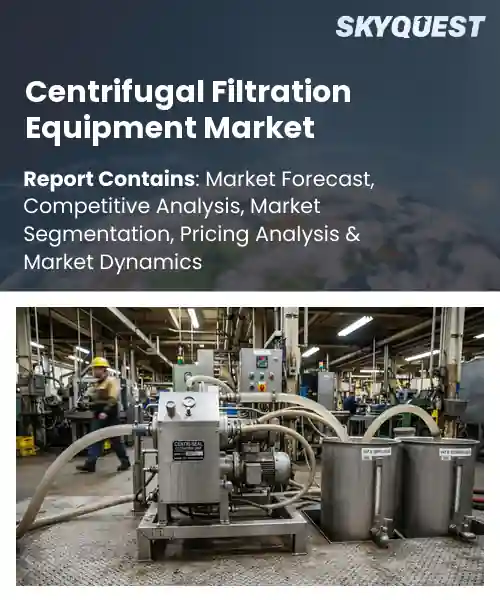
Centrifugal Filtration Equipment Market
Report ID: SQMIG20I3978
Report ID: SQMIG20I3978
[email protected]
USA +1 351-333-4748
Report ID:
SQMIG20I3978 |
Region:
Global |
Published Date: August, 2026
Pages:
157
|Tables:
118
|Figures:
77


Global Centrifugal Filtration Equipment Market size was valued at USD 1.73 Billion in 2024 and is poised to grow from USD 1.85 Billion in 2025 to USD 3.24 Billion by 2033, growing at a CAGR of 7.2% during the forecast period (2026-2033).
The centrifugal filtration equipment market has emerged as a pivotal segment within the broader liquid separation industry, driven primarily by the need for high‑efficiency particulate removal in pharmaceutical and food processing. Historically, early centrifuges in the 1950s were limited to batch operations, but advancements in rotor design and automation have transformed them into continuous, low‑footprint systems. This evolution matters because manufacturers can now meet stringent regulatory standards while reducing energy consumption and waste. For example, a biotech firm using multi‑speed disc‑stack centrifuges reported a 30 % increase in product yield, illustrating how the technology translates operational improvement into tangible profit overall.
Beyond the primary driver, the market’s expansion hinges on the convergence of sustainability mandates and digital integration, which together create a compelling growth engine. Companies adopting smart sensors can monitor flow rates, shear forces, and filter integrity in real time, allowing immediate adjustments that lower downtime and extend equipment life. This cause‑and‑effect relationship is evident in a dairy processor that integrated IoT‑enabled centrifuges, cutting cleaning cycles by 25 % and achieving a 15 % reduction in water use, thereby meeting both cost and environmental targets. Such opportunities attract investment in modular designs and service‑based models, promising further market acceleration for future growth.
How is AI-driven automation influencing the centrifugal filtration equipment market?
AI driven automation is reshaping the centrifugal filtration equipment market by making machines smarter, more efficient, and less dependent on manual supervision. Modern centrifuges now integrate sensors and machine learning algorithms that monitor vibration, temperature, torque, and separation performance in real time. This allows operators to adjust speed, feed rate, and cycle duration automatically, which improves throughput and product quality while reducing energy consumption. Predictive maintenance is another major benefit, as AI models can detect early signs of bearing wear or imbalance and schedule repairs before costly breakdowns occur.
This cuts downtime and extends equipment life, which is especially valuable in pharmaceuticals, food processing, chemicals, and wastewater treatment. Manufacturers are also embedding digital twins and cloud connectivity into their offerings, enabling remote monitoring and performance optimization across multiple plants. As a result, buyers increasingly prefer connected systems over conventional units, pushing suppliers to invest in software capabilities and data analytics partnerships. Although higher upfront costs and cybersecurity concerns remain barriers for smaller operators, the long term savings and compliance advantages are driving steady adoption. Overall, AI is turning centrifugal filtration from a purely mechanical process into a data driven, self optimizing operation, and it is expected to remain a key growth driver for the market in the coming years.
Market snapshot - (2026-2033)
Global Market Size
USD 1.73 Billion
Largest Segment
Centrifugal Filter Units
Fastest Growth
Centrifugal Microfiltration Devices
Growth Rate
7.2% CAGR
To get more insights on this market click here to Request a Free Sample Report
Global centrifugal filtration equipment market is segmented by product type, membrane type, application, end user and region. Based on product type, the market is segmented into Centrifugal Filter Units, Centrifugal Ultrafiltration Devices and Centrifugal Microfiltration Devices. Based on membrane type, the market is segmented into Regenerated Cellulose, Polyethersulfone and Other Membrane Materials. Based on application, the market is segmented into Sample Preparation, Protein Concentration, DNA/RNA Purification and Pharmaceutical Processing. Based on end user, the market is segmented into Pharmaceutical & Biotechnology Companies, Academic & Research Institutes and Clinical Laboratories. Based on region, the market is segmented into North America, Europe, Asia Pacific, Latin America and Middle East & Africa.
Centrifugal Ultrafiltration Devices segment leads because they combine high separation precision with scalable throughput, meeting the stringent purity demands of biopharma workflows. Their ability to retain macromolecules while allowing solvents to pass reduces downstream processing steps, which shortens development cycles. Moreover, the integration of robust rotor designs and automated control systems enhances reliability, making them the preferred choice for large‑scale protein and antibody purification in regulated environments throughout the industry.
Meanwhile, Centrifugal Microfiltration Devices segment emerges as the most rapidly expanding area because its compact footprint and lower operational pressures suit high‑throughput screening and cell‑culture clarification. The surge in disposable bioprocessing and the need for quick sample cleanup accelerate adoption, creating fresh avenues for equipment innovation and market penetration.
Polyethersulfone membrane type stands out because its superior chemical resistance and thermal stability enable consistent performance under harsh cleaning regimes typical in biopharmaceutical production. The material’s fine pore uniformity delivers reliable selective separation, which is critical for maintaining product integrity. Consequently, manufacturers favor this membrane for high‑value protein and monoclonal antibody processes, reinforcing its central role in driving market confidence and equipment adoption across diverse pipelines throughout development stages.
Conversely, Regenerated Cellulose membrane type is witnessing the strongest growth momentum as its low protein binding characteristics attract increasing use in delicate nucleic acid purification workflows. Emerging demand for gentle processing of fragile biomolecules and expanding research applications propel its adoption, opening new opportunities for specialized centrifugal filtration solutions.
To get detailed segments analysis, Request a Free Sample Report
Asia Pacific’s dominance stems from a confluence of advanced manufacturing capabilities, deep R&D investment, and a broad base of end‑use industries that demand high‑precision filtration. The region hosts world‑class chemical, pharmaceutical, food and beverage, and electronics sectors, each requiring reliable and efficient centrifugal solutions. Strong governmental support for industrial modernization and export‑oriented policies further accelerate adoption. A skilled engineering workforce and close collaboration between equipment makers and academic institutions foster continuous innovation, while strategic location facilitates supply‑chain integration across global markets. These combined strengths create a resilient ecosystem that consistently drives market leadership for the region.
Centrifugal Filtration Equipment Market in Japan benefits from a mature industrial ecosystem that emphasizes precision engineering and stringent quality standards. The country’s strong focus on high‑value sectors such as pharmaceuticals, electronics, and advanced materials drives continuous demand for reliable filtration solutions. Collaborative networks between equipment manufacturers and research institutions foster innovation, while long‑standing relationships with global suppliers support technology transfer and market resilience in both domestic and export markets today.
Centrifugal Filtration Equipment Market in South Korea is propelled by a dynamic manufacturing sector that prioritizes rapid technology adoption and cost efficiency. The nation’s emphasis on petrochemical processing, biotechnology, and food safety creates a steady need for high‑performance filtration systems. Strong government incentives for industrial modernization encourage local firms to invest in advanced designs, while close ties with multinational corporations enhance access to cutting‑edge components and global distribution channels worldwide.
North America’s rapid expansion is propelled by heightened demand for high‑purity processes across pharmaceuticals, biotechnology, and food production, coupled with stringent regulatory frameworks that emphasize product safety. The region’s robust investment climate supports the development of next‑generation filtration technologies, while a mature supply chain ensures timely availability of components and services. Growing emphasis on sustainability drives adoption of energy‑efficient equipment, and digital integration enables real‑time monitoring and predictive maintenance. Collaborative ecosystems linking research universities, equipment manufacturers, and end‑users accelerate innovation, positioning North America as a dynamic hub for advanced centrifugal filtration solutions.
Centrifugal Filtration Equipment Market in the United States is shaped by a vast network of research institutions and a diversified industrial base that spans pharmaceuticals, aerospace, and food processing. The emphasis on regulatory compliance and product purity drives adoption of sophisticated filtration technologies. Strong venture capital support fuels startups developing next‑generation solutions, while established manufacturers leverage extensive distribution channels to meet both domestic and international demand across global markets today.
Centrifugal Filtration Equipment Market in Canada benefits from a strong emphasis on environmental stewardship and a growing biotech sector that requires high‑quality filtration solutions. Government programs encouraging clean technology adoption provide incentives for manufacturers to upgrade equipment. Proximity to major US markets enables seamless cross‑border supply chains, while domestic food and beverage industries maintain steady demand for reliable filtration systems that meet rigorous safety standards throughout the nation today as.
Europe strengthens its position through a blend of engineering excellence, rigorous environmental standards, and a collaborative research landscape that fuels continuous product improvement. The region’s mature chemical, pharmaceutical, and food sectors demand sophisticated filtration solutions, encouraging manufacturers to invest in high‑efficiency and low‑waste technologies. Strong policy incentives for green manufacturing and circular economy initiatives drive the adoption of recyclable and energy‑saving equipment. Cross‑border cooperation among EU members facilitates harmonized standards and shared best practices, while deep expertise in digitalization integrates smart monitoring into filtration systems, reinforcing Europe’s role as a leader in sustainable and innovative centrifugal filtration.
Centrifugal Filtration Equipment Market in Germany is anchored by a robust engineering tradition and a high concentration of chemical and pharmaceutical manufacturers that demand precision filtration. The nation’s commitment to digital manufacturing drives integration of digital monitoring and predictive maintenance into filtration systems. Collaborative research initiatives between universities and equipment suppliers accelerate innovation, while stringent environmental regulations push firms toward low‑waste solutions for sustainable industrial growth worldwide in future.
Centrifugal Filtration Equipment Market in the United Kingdom is driven by a strong life‑science sector and a focus on regulatory compliance that elevates the need for high‑performance filtration. The country’s emphasis on research collaboration between academic institutions and industrial partners fosters development of advanced membrane technologies. Growing awareness of environmental impact encourages adoption of energy‑saving designs, while a service network ensures timely maintenance and support for end‑users across diverse industries.
Centrifugal Filtration Equipment Market in France benefits from a strong tradition of chemical processing and a vibrant pharmaceutical industry that prioritize precision and reliability. National initiatives promoting circular economy encourage manufacturers to develop recyclable and low‑energy filtration solutions. Close collaboration between research labs and equipment firms accelerates the introduction of novel filter media, while a comprehensive regulatory framework ensures consistent product quality across domestic and export markets for global competitiveness.
To know more about the market opportunities by region and country, click here to
Buy The Complete Report
Increasing Demand For Clean Water
Advancements In Filtration Technology
High Capital Investment Requirements
Stringent Environmental Regulatory Standards
Request Free Customization of this report to help us to meet your business objectives.
The market is shaped by established players such as Thomas Scientific, Sterlitech, Argos Technologies and Mann + Hummel, each pursuing distinct tactics: Thomas Scientific completed an acquisition of a niche centrifuge manufacturer to broaden its product line; Sterlitech formed a partnership with leading biotech firms to integrate single‑use centrifugal filtration modules; Argos Technologies rolled out a next‑generation high‑speed centrifugal system, while Mann + Hummel invested in advanced rotor‑design technology to improve separation efficiency.
Top Player’s Company Profile
SkyQuest’s ABIRAW (Advanced Business Intelligence, Research & Analysis Wing) is our Business Information Services team that Collects, Collates, Correlates, and Analyses the Data collected by means of Primary Exploratory Research backed by robust Secondary Desk research.
As per SkyQuest analysis, the global centrifugal filtration equipment market is being propelled primarily by rapid advancements in filtration technology that deliver higher efficiency, lower energy use and seamless digital integration, while a second strong driver is the growing demand for clean water across pharmaceutical, food and industrial processes. The market’s leading segment is centrifugal ultrafiltration devices, which combine precise separation with scalable throughput, making them the preferred choice for biopharma and high‑purity applications. Asia Pacific dominates the landscape due to its robust manufacturing base, intensive R&D investment and supportive policies. However, high capital investment requirements remain a significant restraint, tempering adoption among smaller players.
| Report Metric | Details |
|---|---|
| Market size value in 2024 | USD 1.73 Billion |
| Market size value in 2033 | USD 3.24 Billion |
| Growth Rate | 7.2% |
| Base year | 2024 |
| Forecast period | (2026-2033) |
| Forecast Unit (Value) | USD Billion |
| Segments covered |
|
| Regions covered | North America (US, Canada), Europe (Germany, France, United Kingdom, Italy, Spain, Rest of Europe), Asia Pacific (China, India, Japan, Rest of Asia-Pacific), Latin America (Brazil, Rest of Latin America), Middle East & Africa (South Africa, GCC Countries, Rest of MEA) |
| Companies covered |
|
| Customization scope | Free report customization with purchase. Customization includes:-
|
To get a free trial access to our platform which is a one stop solution for all your data requirements for quicker decision making. This platform allows you to compare markets, competitors who are prominent in the market, and mega trends that are influencing the dynamics in the market. Also, get access to detailed SkyQuest exclusive matrix.
Table Of Content
Executive Summary
Market overview
Parent Market Analysis
Market overview
Market size
KEY MARKET INSIGHTS
COVID IMPACT
MARKET DYNAMICS & OUTLOOK
Market Size by Region
KEY COMPANY PROFILES
Methodology
For the Centrifugal Filtration Equipment Market, our research methodology involved a mixture of primary and secondary data sources. Key steps involved in the research process are listed below:
1. Information Procurement: This stage involved the procurement of Market data or related information via primary and secondary sources. The various secondary sources used included various company websites, annual reports, trade databases, and paid databases such as Hoover's, Bloomberg Business, Factiva, and Avention. Our team did 45 primary interactions Globally which included several stakeholders such as manufacturers, customers, key opinion leaders, etc. Overall, information procurement was one of the most extensive stages in our research process.
2. Information Analysis: This step involved triangulation of data through bottom-up and top-down approaches to estimate and validate the total size and future estimate of the Centrifugal Filtration Equipment Market.
3. Report Formulation: The final step entailed the placement of data points in appropriate Market spaces in an attempt to deduce viable conclusions.
4. Validation & Publishing: Validation is the most important step in the process. Validation & re-validation via an intricately designed process helped us finalize data points to be used for final calculations. The final Market estimates and forecasts were then aligned and sent to our panel of industry experts for validation of data. Once the validation was done the report was sent to our Quality Assurance team to ensure adherence to style guides, consistency & design.
Analyst Support
Customization Options
With the given market data, our dedicated team of analysts can offer you the following customization options are available for the Centrifugal Filtration Equipment Market:
Product Analysis: Product matrix, which offers a detailed comparison of the product portfolio of companies.
Regional Analysis: Further analysis of the Centrifugal Filtration Equipment Market for additional countries.
Competitive Analysis: Detailed analysis and profiling of additional Market players & comparative analysis of competitive products.
Go to Market Strategy: Find the high-growth channels to invest your marketing efforts and increase your customer base.
Innovation Mapping: Identify racial solutions and innovation, connected to deep ecosystems of innovators, start-ups, academics, and strategic partners.
Category Intelligence: Customized intelligence that is relevant to their supply Markets will enable them to make smarter sourcing decisions and improve their category management.
Public Company Transcript Analysis: To improve the investment performance by generating new alpha and making better-informed decisions.
Social Media Listening: To analyze the conversations and trends happening not just around your brand, but around your industry as a whole, and use those insights to make better Marketing decisions.
REQUEST FOR SAMPLE
 REQUEST FREE CUSTOMIZATION
Global Centrifugal Filtration Equipment Market size was valued at USD 1.73 Billion in 2024 and is poised to grow from USD 1.85 Billion in 2025 to USD 3.24 Billion by 2033, growing at a CAGR of 7.2% during the forecast period (2026-2033).
The market is shaped by established players such as Thomas Scientific, Sterlitech, Argos Technologies and Mann + Hummel, each pursuing distinct tactics: Thomas Scientific completed an acquisition of a niche centrifuge manufacturer to broaden its product line; Sterlitech formed a partnership with leading biotech firms to integrate single‑use centrifugal filtration modules; Argos Technologies rolled out a next‑generation high‑speed centrifugal system, while Mann + Hummel invested in advanced rotor‑design technology to improve separation efficiency. 'Merck KGaA', 'Sartorius AG', 'Danaher Corporation', 'Thermo Fisher Scientific Inc.', 'Repligen Corporation', 'GE HealthCare Technologies Inc.', 'Pall Corporation', 'Eppendorf SE', 'Andritz AG', 'Alfa Laval AB', 'GEA Group Aktiengesellschaft', 'SPX FLOW, Inc.', 'Koch Separation Solutions, Inc.', 'Veolia Water Technologies', 'Evoqua Water Technologies LLC', 'Pentair plc', 'Bucher Industries AG', 'Flottweg SE', 'Hettich Holding GmbH', 'Kubota Corporation'
The growing need for safe drinking water and industrial process fluids drives adoption of centrifugal filtration equipment, as it offers efficient separation of contaminants while maintaining high throughput. Industries such as food and beverage, pharmaceuticals, and municipal water treatment rely on this technology to meet quality standards, reducing reliance on chemical additives. Consequently, the equipment’s ability to enhance product purity and operational reliability fuels market expansion, encouraging manufacturers to develop tailored solutions for diverse applications across global markets and customer satisfaction.
Advanced Process Automation Adoption: Manufacturers are integrating control algorithms and monitoring systems into centrifugal filtration lines, allowing adjustment of speed, pressure, and feed composition. This automation reduces manual intervention, improves product consistency, and shortens change‑over periods. As digital twins and predictive maintenance become commonplace, operators gain deeper insight into equipment health, leading to fewer downtimes and lower operating expenses. The shift toward fully automated plants is reshaping supplier expectations and driving demand for smarter, interoperable filtration solutions across pharmaceuticals, food processing, and specialty chemicals.
Why does Asia Pacific Dominate the Global Centrifugal Filtration Equipment Market? |@12


Want to customize this report? This report can be personalized according to your needs. Our analysts and industry experts will work directly with you to understand your requirements and provide you with customized data in a short amount of time. We offer $1000 worth of FREE customization at the time of purchase.
Feedback From Our Clients


 USA (+1) 351-333-4748

