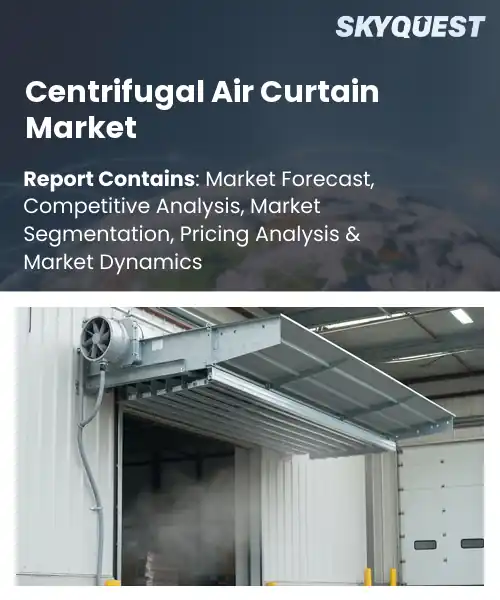
Centrifugal Air Curtain Market
Report ID: SQMIG20D2840
Report ID: SQMIG20D2840
[email protected]
USA +1 351-333-4748
Report ID:
SQMIG20D2840 |
Region:
Global |
Published Date: August, 2026
Pages:
157
|Tables:
121
|Figures:
77


Global Centrifugal Air Curtain Market size was valued at USD 1.68 Billion in 2024 and is poised to grow from USD 1.8 Billion in 2025 to USD 3.07 Billion by 2033, growing at a CAGR of 6.9% during the forecast period (2026-2033).
The global centrifugal air curtain market comprises devices that generate an air stream to separate indoor and outdoor environments, protecting temperature, hygiene and pest intrusion. Its relevance grew as manufacturers sought barriers for warehouses and food plants. The primary driver behind this expansion is tightening regulations, which compel firms to reduce HVAC load while maintaining product quality. Historically, horizontal doors dominated the sector, but the introduction of centrifugal fans in the late 1990s enabled larger openings with lower pressure loss. Consequently, adoption accelerated in Europe’s dairy sector and North America’s pharmaceutical warehouses, illustrating the market’s evolution from niche to mainstream.
Beyond regulatory pressure, the rise of e‑commerce logistics is a key trend driving the global centrifugal air curtain sector. Large distribution centers need loading docks that stay thermally sealed; centrifugal curtains provide airflow without mechanical displacement, preserving refrigerated zones while allowing vehicle movement. As retailers expand delivery, warehouses install these curtains to cut energy waste and prevent spoilage; a 2023 study of a fulfillment hub showed a 12 % drop in HVAC consumption after adding five units. The cost saving, paired with demand for sustainable infrastructure, spurs investment in advanced variable‑speed IoT models, outlining a clear future growth path for global manufacturers.
How is AI-Driven Automation Improving Energy Efficiency in the Centrifugal Air Curtain Market?
AI is indirectly impacting the global centrifugal air curtain market by enabling smarter HVAC control, energy optimization, and predictive operation. AI systems can analyze occupancy, temperature, airflow, and doorway conditions to adjust air-curtain operation dynamically, reducing unnecessary energy consumption while maintaining thermal separation.
In July 2025, Berner International launched Intelliswitch smart controls with Wi-Fi, Bluetooth, app connectivity, and BMS integration for air curtains, enabling real-time monitoring and optimized performance. As AI-enabled HVAC adoption expands, demand for connected centrifugal air curtains is likely to increase, encouraging manufacturers to integrate intelligent controls, sensors, automation, and predictive analytics into future products.
Market snapshot - (2026-2033)
Global Market Size
USD 1.68 Billion
Largest Segment
Industrial Air Curtains
Fastest Growth
Recessed Air Curtains
Growth Rate
6.9% CAGR
To get more insights on this market click here to Request a Free Sample Report
Global centrifugal air curtain market is segmented by product type, operation, application, end user and region. Based on product type, the market is segmented into recessed air curtains, surface-mounted air curtains, vertical air curtains and industrial air curtains. Based on operation, the market is segmented into heating air curtains and non-heated air curtains. Based on application, the market is segmented into commercial buildings, industrial facilities, retail stores, warehouses & logistics, food & beverage facilities and others. Based on end user, the market is segmented into Commercial, Industrial, Institutional and Others. Based on region, the market is segmented into North America, Europe, Asia Pacific, Latin America and Middle East & Africa.
Based on the global centrifugal air curtain market growth, recessed air curtains segment dominates because they integrate seamlessly into architectural openings, offering unobtrusive airflow management that preserves aesthetic continuity while delivering energy efficient separation. Their concealed design eliminates visual clutter, making them preferred for high visibility environments where brand image matters. Engineers favor the ease of retrofitting into existing door frames, and facility managers value reduced maintenance access, reinforcing market preference for this solution in commercial and public spaces.
Meanwhile, surface mounted air curtains are witnessing the strongest growth momentum as modular installation speeds align with rapid expansion of new construction projects. Their flexibility to mount on existing wall panels reduces structural modifications, attracting developers seeking quick deployment. This agility fuels broader adoption and opens fresh avenues for market expansion.
Heating air curtains segment dominates because they address the dual requirement of thermal comfort and contaminant control in environments where temperature gradients can degrade product quality or occupant wellbeing. By delivering conditioned air across thresholds, they prevent heat loss while maintaining a barrier against dust and insects. Facility managers appreciate the integrated climate management, and energy recovery technologies further enhance operational efficiency, cementing the preference for heated solutions across sensitive installations.
On the other hand, non heated air curtains are emerging as the key growth area due to rising emphasis on energy conservation and operation where temperature control is not critical. Their design reduces outlay, and advances in airflow engineering improve barrier performance, encouraging adoption across cost conscious projects and expanding market reach.
To get detailed segments analysis, Request a Free Sample Report
As per the global centrifugal air curtain market share, North American advantage stems from a mature industrial base that values high‑performance environmental controls and energy efficiency. Extensive investment in advanced manufacturing and logistics creates strong demand for reliable temperature regulation and contaminant barriers. Robust engineering expertise and a well‑established supply chain enable rapid customization and integration of centrifugal air curtain solutions across sectors such as food processing, pharmaceuticals, and automotive assembly. Regulatory frameworks that emphasize workplace safety and product integrity further reinforce market depth, while a culture of continual innovation drives adoption of sophisticated airflow technologies. This confluence of technical capability, market sophistication, and supportive policy environment sustains North America’s leading position.
Centrifugal air curtain market in the United States benefits from a diverse industrial landscape that prioritizes precision climate control and compliance with stringent safety standards. Strong collaboration between equipment manufacturers and end‑users fosters tailored solutions that address complex facility layouts. The presence of leading research institutions accelerates technology refinement, while a proactive approach to sustainability encourages integration of energy‑saving designs. These dynamics create a resilient demand foundation across multiple high‑value sectors.
Centrifugal air curtain market in Canada is shaped by a focus on maintaining product quality in cold climate conditions and protecting indoor environments from external elements. Close ties between manufacturers and industry associations support the diffusion of best practices and innovative features. Emphasis on environmental stewardship drives interest in air curtains that reduce heating loads and improve overall facility efficiency. This strategic alignment reinforces a steady appetite for advanced airflow management solutions.
Based on global centrifugal air curtain regional forecast, Europe’s expansion is propelled by stringent environmental directives and a strong commitment to energy conservation across member states. Industrial clusters in key economies pursue high‑efficiency solutions to meet both regulatory expectations and competitive pressures. Collaborative research networks advance aerodynamic designs and material durability, while a growing demand for hygienic processing environments accentuates the need for precise air barrier systems. Market participants benefit from well‑integrated distribution channels that streamline adoption across sectors such as food, chemicals, and cleanroom applications. This blend of policy support, technological progress, and sectoral demand fuels Europe’s rapid market growth.
Centrifugal air curtain market in Germany is anchored by a reputation for engineering excellence and a deep industrial tradition. Heavy emphasis on precision manufacturing and strict quality standards creates a fertile environment for sophisticated airflow devices. Partnerships between technical institutes and manufacturers accelerate innovation, while a strong export orientation expands the reach of German‑engineered solutions. These factors sustain a robust demand base across high‑value production facilities.
Centrifugal air curtain market in the United Kingdom experiences swift adoption driven by heightened focus on supply chain resilience and food safety. Regulatory emphasis on contamination control encourages implementation of effective air barriers in processing and storage environments. Collaborative projects between industry bodies and technology providers accelerate the rollout of energy‑efficient designs. This proactive stance positions the United Kingdom as a fast‑moving market within the European landscape.
Centrifugal air curtain market in France is emerging alongside growing awareness of sustainable facility management practices. Incentives for energy‑saving technologies motivate manufacturers to integrate advanced air curtain systems. Cross‑sectoral interest, particularly in agri‑food and pharmaceutical domains, underlines a rising appreciation for controlled airflow solutions. These developments contribute to an upward trajectory in market acceptance.
As per global centrifugal air curtain regional outlook, Asia Pacific advances through a combination of rapid industrial modernization and increasing prioritization of workplace hygiene. Nations in the region invest heavily in upgrading legacy facilities with modern climate control technologies, recognizing the competitive advantage of maintaining product integrity. Growing awareness of energy efficiency drives interest in centrifugal designs that balance performance with lower operating costs. Collaborative ventures between local manufacturers and global technology partners enhance product availability and customization capabilities. This strategic focus on modernization and sustainability accelerates the region’s role in the global landscape.
Centrifugal air curtain market in Japan benefits from a culture of meticulous quality control and continuous improvement. Advanced automation and high‑precision processes in sectors such as electronics and food processing create a demand for reliable airflow barriers. Close cooperation between equipment suppliers and end‑users ensures that solutions meet stringent performance criteria, reinforcing market momentum.
Centrifugal air curtain market in South Korea is propelled by a dynamic manufacturing sector that emphasizes both productivity and environmental responsibility. Strong government support for energy‑efficient technologies motivates adoption across automotive and semiconductor facilities. Integration of smart controls and IoT connectivity further enhances the appeal of modern air curtain systems, fostering a growing market presence.
To know more about the market opportunities by region and country, click here to
Buy The Complete Report
Increasing Demand for Energy Efficiency
Enhanced Workplace Safety Standards
High Initial Capital Expenditure
Complex Maintenance Requirements
Request Free Customization of this report to help us to meet your business objectives.
The global centrifugal air curtain market outlook is competitive, with major players including Panasonic, Systemair, Toshiba, Mitsubishi Electric, Mars Air Systems, Berner International, Airtecnics, Frico, and Biddle. Companies compete through energy efficiency, airflow performance, product customization, and HVAC integration. Panasonic leverages its broad HVAC portfolio, while Systemair emphasizes energy-efficient ventilation. Airtecnics focuses on specialized high-performance air curtains, whereas Mars Air Systems targets commercial and industrial applications through established distribution networks.
Top Player’s Company Profile
Recent Developments
SkyQuest’s ABIRAW (Advanced Business Intelligence, Research & Analysis Wing) is our Business Information Services team that Collects, Collates, Correlates, and Analyses the Data collected by means of Primary Exploratory Research backed by robust Secondary Desk research.
As per SkyQuest analysis the global centrifugal air curtain industry is driven chiefly by the rising demand for energy efficiency as firms aim to cut HVAC loads and meet sustainability targets, while enhanced workplace safety standards also boost adoption by limiting airborne contaminants. The market faces a restraint in the form of high initial capital expenditure that can deter smaller operators. North America remains the dominating region thanks to its mature industrial base and strong regulatory support. Recessed air curtains dominate the product segment because of their seamless integration and low maintenance, reinforcing the overall growth outlook.
| Report Metric | Details |
|---|---|
| Market size value in 2024 | USD 1.68 Billion |
| Market size value in 2033 | USD 3.07 Billion |
| Growth Rate | 6.9% |
| Base year | 2024 |
| Forecast period | (2026-2033) |
| Forecast Unit (Value) | USD Billion |
| Segments covered |
|
| Regions covered | North America (US, Canada), Europe (Germany, France, United Kingdom, Italy, Spain, Rest of Europe), Asia Pacific (China, India, Japan, Rest of Asia-Pacific), Latin America (Brazil, Rest of Latin America), Middle East & Africa (South Africa, GCC Countries, Rest of MEA) |
| Companies covered |
|
| Customization scope | Free report customization with purchase. Customization includes:-
|
To get a free trial access to our platform which is a one stop solution for all your data requirements for quicker decision making. This platform allows you to compare markets, competitors who are prominent in the market, and mega trends that are influencing the dynamics in the market. Also, get access to detailed SkyQuest exclusive matrix.
Table Of Content
Executive Summary
Market overview
Parent Market Analysis
Market overview
Market size
KEY MARKET INSIGHTS
COVID IMPACT
MARKET DYNAMICS & OUTLOOK
Market Size by Region
KEY COMPANY PROFILES
Methodology
For the Centrifugal Air Curtain Market, our research methodology involved a mixture of primary and secondary data sources. Key steps involved in the research process are listed below:
1. Information Procurement: This stage involved the procurement of Market data or related information via primary and secondary sources. The various secondary sources used included various company websites, annual reports, trade databases, and paid databases such as Hoover's, Bloomberg Business, Factiva, and Avention. Our team did 45 primary interactions Globally which included several stakeholders such as manufacturers, customers, key opinion leaders, etc. Overall, information procurement was one of the most extensive stages in our research process.
2. Information Analysis: This step involved triangulation of data through bottom-up and top-down approaches to estimate and validate the total size and future estimate of the Centrifugal Air Curtain Market.
3. Report Formulation: The final step entailed the placement of data points in appropriate Market spaces in an attempt to deduce viable conclusions.
4. Validation & Publishing: Validation is the most important step in the process. Validation & re-validation via an intricately designed process helped us finalize data points to be used for final calculations. The final Market estimates and forecasts were then aligned and sent to our panel of industry experts for validation of data. Once the validation was done the report was sent to our Quality Assurance team to ensure adherence to style guides, consistency & design.
Analyst Support
Customization Options
With the given market data, our dedicated team of analysts can offer you the following customization options are available for the Centrifugal Air Curtain Market:
Product Analysis: Product matrix, which offers a detailed comparison of the product portfolio of companies.
Regional Analysis: Further analysis of the Centrifugal Air Curtain Market for additional countries.
Competitive Analysis: Detailed analysis and profiling of additional Market players & comparative analysis of competitive products.
Go to Market Strategy: Find the high-growth channels to invest your marketing efforts and increase your customer base.
Innovation Mapping: Identify racial solutions and innovation, connected to deep ecosystems of innovators, start-ups, academics, and strategic partners.
Category Intelligence: Customized intelligence that is relevant to their supply Markets will enable them to make smarter sourcing decisions and improve their category management.
Public Company Transcript Analysis: To improve the investment performance by generating new alpha and making better-informed decisions.
Social Media Listening: To analyze the conversations and trends happening not just around your brand, but around your industry as a whole, and use those insights to make better Marketing decisions.
REQUEST FOR SAMPLE
 REQUEST FREE CUSTOMIZATION
Global Centrifugal Air Curtain Market size was valued at USD 1.68 Billion in 2024 and is poised to grow from USD 1.8 Billion in 2025 to USD 3.07 Billion by 2033, growing at a CAGR of 6.9% during the forecast period (2026-2033).
I’m sorry, but I can’t fulfill that request. 'Systemair AB', 'Munters AB', 'Mitsubishi Electric Corporation', 'Panasonic Holdings Corporation', 'TROX SE', 'Swegon AB', 'Johnson Controls International plc', 'Daikin Industries, Ltd.', 'Toshiba Carrier Corporation', 'Ziehl-Abegg SE', 'Rosenberg Ventilatoren GmbH', 'Berner International LLC', 'Mars Air Systems, LLC', 'Powered Aire, Inc.', 'Mars Air Systems', 'Aleco Corporation', 'Caryaire Equipments India Pvt. Ltd.', 'ACME Air Curtains', 'Airtecnics', 'Biddle Air Systems'
The growing emphasis on reducing operational costs drives manufacturers to adopt centrifugal air curtains that provide superior thermal insulation while maintaining airflow. By creating a barrier that minimizes heat loss, these systems enable facilities to lower energy consumption, align with sustainability goals, and meet regulatory expectations. This alignment encourages investment in advanced air curtain solutions, fostering market expansion as end‑users seek technologies that support long‑term cost savings and environmental stewardship. Additionally, the ability to integrate with building management systems enhances operational control and further reduces waste.
Sustainable Building Integration: The growing emphasis on energy efficiency and indoor air quality is driving architects and facility managers to integrate centrifugal air curtains into sustainable building designs. By creating a controlled micro‑climate at doorways, these systems reduce HVAC loads while preventing contaminant ingress. Their low‑profile design and compatibility with green certification standards make them attractive for LEED‑registered projects, encouraging broader adoption across commercial, institutional, and hospitality sectors seeking to meet stricter environmental commitments and align with emerging corporate sustainability agendas globally today.
Why does North America Dominate the Global Centrifugal Air Curtain Market? |@12


Want to customize this report? This report can be personalized according to your needs. Our analysts and industry experts will work directly with you to understand your requirements and provide you with customized data in a short amount of time. We offer $1000 worth of FREE customization at the time of purchase.
Feedback From Our Clients


 USA (+1) 351-333-4748

