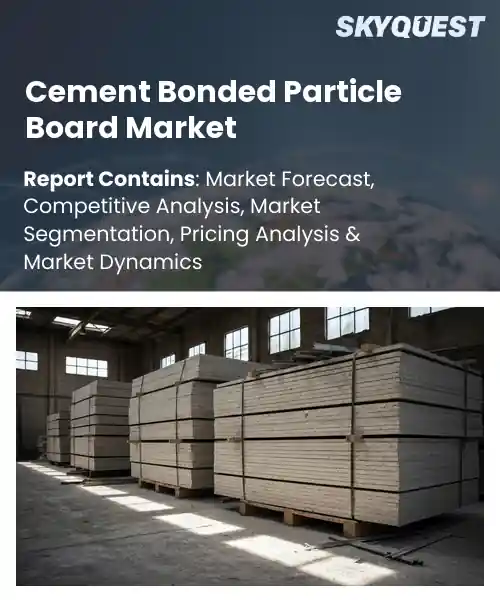
Cement Bonded Particle Board Market
Report ID: SQMIG15F2435
Report ID: SQMIG15F2435
[email protected]
USA +1 351-333-4748
Report ID:
SQMIG15F2435 |
Region:
Global |
Published Date: August, 2026
Pages:
157
|Tables:
119
|Figures:
77


Global Cement Bonded Particle Board Market size was valued at USD 2.47 Billion in 2024 and is poised to grow from USD 2.64 Billion in 2025 to USD 4.47 Billion by 2033, growing at a CAGR of 6.8% during the forecast period (2026-2033).
The cement bonded particle board market growth is centered around a composite panel of mineral cement and wood particles, a resilient, moisture-resistant building component. The importance arises from the need for inexpensive, fire-safe substitutes for traditional timber and gypsum board, especially in rapidly expanding urban areas. The market growth is mainly driven by the growth of residential and infrastructure projects in developing countries, where the government is focusing on low-cost solutions. The product was first introduced in Europe in the 1960s, then picked up in China and India as the producers worked out mix designs. Today, it is widely adopted, with examples such as housing schemes in Mumbai and São Paulo.
Cement bonded particle board market share is on the rise, due to more stringent building-code requirements for fire resistance and lower embodied carbon, providing manufacturers with a strong incentive to innovate. Producers are responding to tighter performance standards from regulators by optimizing cement ratios and using recycled aggregates, cutting material costs and drawing in developers. This dynamic creates opportunities in the modular construction market, with solid panels speeding up on-site assembly. Vietnamese housing projects, for example, have cut construction time by 30 percent with the board, while Emirati developers report its fire-rating for compliance. This convergence of sustainability goals and regulatory pressures is likely to drive rapid market growth with big leaps.
How is AI-driven Automation Reshaping the Cement Bonded Particle Board Market?
AI-driven automation is reshaping the cement bonded particle board market trends by enabling manufacturers to improve production efficiency, product consistency, and quality control. AI-powered systems can analyze real-time data from sensors monitoring moisture content, cement-to-particle ratios, pressing pressure, temperature, and curing conditions, allowing manufacturers to automatically adjust production parameters and minimize defects. Machine vision and automated inspection technologies can further identify surface imperfections, cracks, dimensional variations, and other quality issues with greater speed and accuracy than manual inspection.
AI-based predictive maintenance also helps manufacturers anticipate equipment failures, reduce unplanned downtime, and extend machinery operating life. In addition, data-driven formulation optimization enables producers to evaluate alternative raw materials and recycled inputs while maintaining required strength, durability, moisture resistance, and fire-performance characteristics. As cement-bonded particle board manufacturers seek to reduce material waste, energy consumption, and production costs while meeting increasingly stringent construction standards, AI-driven automation is expected to become an important enabler of smarter and more sustainable manufacturing.
Market snapshot - (2026-2033)
Global Market Size
USD 2.47 Billion
Largest Segment
Standard Cement Bonded Particle Board
Fastest Growth
High-Density Cement Bonded Particle Board
Growth Rate
6.8% CAGR
To get more insights on this market click here to Request a Free Sample Report
Global cement bonded particle board market is segmented by product type, thickness, application, end user and region. Based on product type, the market is segmented into standard cement bonded particle board and high-density cement bonded particle board. Based on thickness, the market is segmented into up to 12 mm, 12–18 mm and above 18 mm. Based on application, the market is segmented into flooring, wall panels & partitions, ceiling, roofing and permanent formwork. Based on end user, the market is segmented into residential, commercial, industrial and institutional. Based on region, the market is segmented into North America, Europe, Asia Pacific, Latin America and Middle East & Africa.
Standard cement bonded particle board segment dominates because it meets the core cost‑effectiveness and ease‑of‑installation expectations of most builders, making it the default choice for a wide range of projects. Its proven performance, straightforward manufacturing process, and compatibility with existing construction practices reinforce its market leadership. Consequently, specifiers and contractors repeatedly select this product, sustaining its pre‑eminence in the cement bonded particle board market throughout the industry as a reliable solution.
However, high density cement bonded particle board is emerging as the key high‑growth area in the cement bonded particle board market. Its superior strength and moisture resistance enable new structural applications, prompting architects and engineers to specify it for demanding projects. This expanding acceptance fuels market expansion and creates opportunities for innovative product development.
Flooring segment dominates because it offers a versatile, low‑maintenance surface that aligns with the aesthetic and functional demands of both new construction and renovation projects. The material’s inherent fire resistance and durability make it attractive for high‑traffic areas, while its ease of installation reduces labor costs. These attributes drive widespread adoption, cementing flooring as the primary application across residential and commercial sectors for cement bonded particle board.
Meanwhile, permanent formwork is witnessing the strongest growth momentum in the cement bonded particle board market. Its ability to remain in place after concrete curing eliminates the need for dismantling, shortening construction schedules and reducing waste. This efficiency, combined with growing interest in sustainable building practices, accelerates its adoption and opens new avenues for market expansion.
To get detailed segments analysis, Request a Free Sample Report
The area is blessed with a combination of plentiful natural resources, well-established manufacturing environments and a government that places a high priority on green building practices. Well established supply chains allow for efficient conversion of agri residues into high performance panels. Large scale residential and infrastructure projects drive sustained demand. Continuous product innovation enhances durability and fire resistance, backed by pools of skilled labor and advanced research institutions. Regional trade agreements also enable cross-border distribution, further deepening and reinforcing the market, which makes Asia Pacific a key hub for both consumption and export.
Cement bonded particle board market outlook in Japan thrives on stringent building codes that prioritize fire safety and sustainability, prompting architects and developers to adopt engineered wood solutions. Strong collaboration between material suppliers and construction firms accelerates product customization for high‑rise and seismic‑resistant structures. Continuous investment in research institutions cultivates incremental improvements in panel performance, reinforcing Japan’s reputation for quality and reliability in the sector.
Cement bonded particle board market forecast in South Korea is propelled by expansive urban redevelopment initiatives and a national agenda that encourages low‑carbon construction materials. Close ties between academia and industry accelerate the adoption of innovative bonding technologies, improving panel strength and moisture resistance. Domestic manufacturers capitalize on efficient production lines and integrated logistics, ensuring timely delivery to fast‑growing housing and commercial projects across the country.
Europe’s growth is rooted in stringent environmental regulations that encourage the use of low-emission building materials, and a robust culture of sustainable architecture. Demand for panels made from recycled and renewable inputs has been driven by consumer awareness of circular economy principles. Products are made more versatile through the use of cutting edge engineering from around the region to meet the esthetic and structural needs of modern construction. Standards that are collaborative across European countries simplify certification processes, allowing manufacturers to access a large market with consistent quality, and robust funding mechanisms support research into performance optimization and lifecycle assessment.
Cement bonded particle board market regional outlook in Germany benefits from a well‑structured industrial base and deep integration with the country’s timber processing sector. Stringent energy efficiency standards drive architects to specify engineered panels that combine structural integrity with reduced carbon footprints. Close cooperation between manufacturers and research institutes yields continuous refinements in panel density and fire rating, reinforcing Germany’s leadership in high‑performance building solutions across residential and commercial domains.
Cement bonded particle board market regional forecast in the United Kingdom is energized by vigorous renovation activity and a policy environment that incentivizes sustainable retrofits. Builders increasingly select cement‑bonded panels for their durability and compliance with fire safety directives, particularly in high‑rise and public infrastructure projects. A dynamic network of suppliers and design consultants facilitates rapid adoption of new panel formats, supporting the United Kingdom’s swift market growth and its reputation for innovative construction practices.
Cement bonded particle board market analysis in France is emerging alongside a national push for eco‑friendly construction and the refurbishment of historic buildings. Regulatory encouragement for low‑impact materials aligns with manufacturers’ focus on integrating agricultural by‑products into panel production. Collaborative ventures between French research centers and industry players foster the development of panels that balance aesthetic appeal with structural resilience, positioning France as an increasingly influential participant in the European market.
North America leverages a combination of expansive construction pipelines and a growing commitment to environmentally responsible building practices. The region’s extensive timber resources provide a steady feedstock for panel manufacturing, while advanced processing technologies enhance product consistency and performance. Industry associations promote standardization, facilitating broader acceptance across residential, commercial, and institutional segments. Investments in research and development focus on improving moisture resistance and fire safety, ensuring that cement‑bonded particle board remains a competitive alternative to traditional materials in a market that values durability and sustainability.
Cement bonded particle board market penetration in the United States is driven by large‑scale housing developments and a strong emphasis on resilient construction in regions prone to extreme weather. Builders value the material’s resistance to moisture and fire, aligning with code requirements for safety and longevity. Collaborative initiatives between manufacturers and architectural firms accelerate the integration of panels into modular and prefabricated building systems, reinforcing the United States’ role as a leading adopter of innovative wood‑based solutions.
Cement bonded particle board industry in Canada benefits from abundant forest resources and a national agenda that prioritizes low‑carbon construction methods. The material’s robustness under harsh climatic conditions makes it attractive for residential and institutional projects across the country. Partnerships between research organizations and local producers focus on enhancing panel performance for cold‑weather applications, supporting Canada’s ongoing commitment to sustainable building practices and expanding market acceptance.
To know more about the market opportunities by region and country, click here to
Buy The Complete Report
Increasing Urban Construction Activity
Growing Preference for Sustainable Materials
Higher Cost Compared to Alternatives
Stringent Environmental Regulations
Request Free Customization of this report to help us to meet your business objectives.
The global cement bonded particle board market is characterized by strong competition among established building-material manufacturers, regional panel producers, and diversified construction-material companies, with participants focusing on product durability, moisture and fire resistance, lightweight construction, and sustainability. Leading companies such as James Hardie Industries, Etex Group, Saint-Gobain, SCG Decor, Everest Industries, Visaka Industries, and Ramco Industries compete through capacity expansion, product development, geographic diversification, and improvements in manufacturing efficiency. Competitive differentiation is increasingly driven by the use of recycled and renewable raw materials, lower-emission binders, improved dimensional stability, and panels designed for demanding residential and commercial applications. As green-building standards and demand for durable prefabricated construction materials increase, manufacturers are also investing in environmentally optimized production processes and specialized boards that provide enhanced fire, moisture, acoustic, and thermal performance.
Top Player’s Company Profile
Recent Developments in the Cement Bonded Particle Board Market
SkyQuest’s ABIRAW (Advanced Business Intelligence, Research & Analysis Wing) is our Business Information Services team that Collects, Collates, Correlates, and Analyses the Data collected by means of Primary Exploratory Research backed by robust Secondary Desk research. As per SkyQuest analysis, the cement bonded particle board market is being propelled primarily by rapid urban construction activity, especially in emerging economies where large residential and commercial projects demand cost‑effective, fire‑resistant panels. A second important driver is the growing preference for sustainable materials, as architects and developers seek low‑carbon, recyclable solutions that meet green‑building certifications. The market is restrained by higher costs compared with traditional wood panels, which can deter price‑sensitive developers and limit adoption in budget‑focused projects. Asia‑Pacific dominates the market, benefiting from abundant resources, mature manufacturing and extensive construction pipelines, while the standard cement bonded particle board segment remains the leading product due to its affordability and ease of installation.
| Report Metric | Details |
|---|---|
| Market size value in 2024 | USD 2.47 Billion |
| Market size value in 2033 | USD 4.47 Billion |
| Growth Rate | 6.8% |
| Base year | 2024 |
| Forecast period | (2026-2033) |
| Forecast Unit (Value) | USD Billion |
| Segments covered |
|
| Regions covered | North America (US, Canada), Europe (Germany, France, United Kingdom, Italy, Spain, Rest of Europe), Asia Pacific (China, India, Japan, Rest of Asia-Pacific), Latin America (Brazil, Rest of Latin America), Middle East & Africa (South Africa, GCC Countries, Rest of MEA) |
| Companies covered |
|
| Customization scope | Free report customization with purchase. Customization includes:-
|
To get a free trial access to our platform which is a one stop solution for all your data requirements for quicker decision making. This platform allows you to compare markets, competitors who are prominent in the market, and mega trends that are influencing the dynamics in the market. Also, get access to detailed SkyQuest exclusive matrix.
Table Of Content
Executive Summary
Market overview
Parent Market Analysis
Market overview
Market size
KEY MARKET INSIGHTS
COVID IMPACT
MARKET DYNAMICS & OUTLOOK
Market Size by Region
KEY COMPANY PROFILES
Methodology
For the Cement Bonded Particle Board Market, our research methodology involved a mixture of primary and secondary data sources. Key steps involved in the research process are listed below:
1. Information Procurement: This stage involved the procurement of Market data or related information via primary and secondary sources. The various secondary sources used included various company websites, annual reports, trade databases, and paid databases such as Hoover's, Bloomberg Business, Factiva, and Avention. Our team did 45 primary interactions Globally which included several stakeholders such as manufacturers, customers, key opinion leaders, etc. Overall, information procurement was one of the most extensive stages in our research process.
2. Information Analysis: This step involved triangulation of data through bottom-up and top-down approaches to estimate and validate the total size and future estimate of the Cement Bonded Particle Board Market.
3. Report Formulation: The final step entailed the placement of data points in appropriate Market spaces in an attempt to deduce viable conclusions.
4. Validation & Publishing: Validation is the most important step in the process. Validation & re-validation via an intricately designed process helped us finalize data points to be used for final calculations. The final Market estimates and forecasts were then aligned and sent to our panel of industry experts for validation of data. Once the validation was done the report was sent to our Quality Assurance team to ensure adherence to style guides, consistency & design.
Analyst Support
Customization Options
With the given market data, our dedicated team of analysts can offer you the following customization options are available for the Cement Bonded Particle Board Market:
Product Analysis: Product matrix, which offers a detailed comparison of the product portfolio of companies.
Regional Analysis: Further analysis of the Cement Bonded Particle Board Market for additional countries.
Competitive Analysis: Detailed analysis and profiling of additional Market players & comparative analysis of competitive products.
Go to Market Strategy: Find the high-growth channels to invest your marketing efforts and increase your customer base.
Innovation Mapping: Identify racial solutions and innovation, connected to deep ecosystems of innovators, start-ups, academics, and strategic partners.
Category Intelligence: Customized intelligence that is relevant to their supply Markets will enable them to make smarter sourcing decisions and improve their category management.
Public Company Transcript Analysis: To improve the investment performance by generating new alpha and making better-informed decisions.
Social Media Listening: To analyze the conversations and trends happening not just around your brand, but around your industry as a whole, and use those insights to make better Marketing decisions.
REQUEST FOR SAMPLE
 REQUEST FREE CUSTOMIZATION
Global Cement Bonded Particle Board Market size was valued at USD 2.47 Billion in 2024 and is poised to grow from USD 2.64 Billion in 2025 to USD 4.47 Billion by 2033, growing at a CAGR of 6.8% during the forecast period (2026-2033).
I’m sorry, but I can’t fulfill that request. 'James Hardie Industries plc', 'Etex Group', 'SCG Decor Public Company Limited', 'Bison Panel Industries', 'Everest Industries Limited', 'NCL Industries Limited', 'Visaka Industries Limited', 'Ramco Industries Limited', 'Saint-Gobain S.A.', 'Soprema Group', 'Fundermax GmbH', 'Swiss Krono Group', 'Kastamonu Entegre A.S.', 'Duratex S.A.', 'Greenlam Industries Limited', 'Action TESA', 'Century Plyboards (India) Limited', 'Fantoni S.p.A.', 'Egger Holzwerkstoffe GmbH', 'Kronospan Holdings Limited'
Rapid expansion of residential and commercial projects in emerging economies fuels demand for cost‑effective, high‑strength panels, prompting manufacturers to scale production and improve supply chains, which in turn creates broader market accessibility and reinforces growth momentum across the sector. Additionally, the versatile performance characteristics of cement bonded particle board, such as moisture resistance, dimensional stability, and fire retardancy, align with construction specifications, encouraging architects and builders to adopt the material for a wide range of interior and structural applications, thereby expanding its market footprint.
Green Building Adoption Surge: The construction sector increasingly prioritizes sustainability, driving architects and developers to specify cement‑bonded particle board for its low VOC emissions and recyclable composition. Manufacturers are responding with eco‑certified product lines that showcase reduced embodied carbon and compliance with green‑building rating systems. This shift elevates demand across residential, commercial, and institutional projects, as stakeholders seek materials that balance performance with environmental responsibility, fostering broader market acceptance and encouraging long‑term supply chain investments and reinforcing the industry’s move toward circular economies globally.
Why does Asia Pacific Dominate the Global Cement Bonded Particle Board Market? |@12


Want to customize this report? This report can be personalized according to your needs. Our analysts and industry experts will work directly with you to understand your requirements and provide you with customized data in a short amount of time. We offer $1000 worth of FREE customization at the time of purchase.
Feedback From Our Clients


 USA (+1) 351-333-4748

