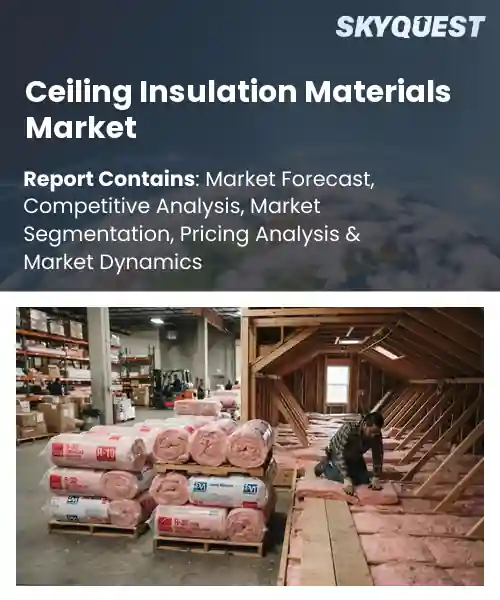
Ceiling Insulation Materials Market
Report ID: SQMIG20B2371
Report ID: SQMIG20B2371
[email protected]
USA +1 351-333-4748
Report ID:
SQMIG20B2371 |
Region:
Global |
Published Date: September, 2026
Pages:
157
|Tables:
154
|Figures:
78


Global Ceiling Insulation Materials Market size was valued at USD 15.43 Billion in 2024 and is poised to grow from USD 16.26 Billion in 2025 to USD 24.67 Billion by 2033, growing at a CAGR of 5.35% during the forecast period (2026-2033).
Ceiling insulation materials form a part of industry, covering products such as mineral wool, polyurethane foam, and recycled cellulose that are installed above ceilings to curb heat loss and noise transmission. The primary driver of this market has been the tightening of efficiency regulations across Europe, North America, and emerging economies, prompting developers to adopt insulation solutions. Historically sector moved from simple fiberglass batts in the 1970s to sophisticated aerogel panels today, reflecting advances in material science and rising consumer awareness. As governments enforce stricter building codes, demand for carbon‑neutral products surges, making ceiling insulation a lever for climate goals.Another decisive factor shaping the global ceiling insulation market is the adoption of building technologies that integrate sensors and controls to optimize indoor climate while minimizing energy use. When owners install insulation, the reduced thermal bridge effect enables HVAC units to operate at lower capacities, directly lowering operating costs and carbon footprints; this advantage spurs retrofits in commercial office towers and schools. Manufacturers respond by developing products with embedded IoT capabilities that report temperature gradients in time, facilitating predictive maintenance and efficiency gains. These innovations expand market size, attract venture capital, and create revenue streams for suppliers and building operators.
How is AI improving production efficiency in the ceiling insulation materials market?
AI is reshaping ceiling insulation production by embedding machine‑learning models into manufacturing lines. Predictive algorithms analyze sensor data to anticipate equipment wear, allowing maintenance before breakdowns occur. Real‑time process monitoring adjusts material feed rates and curing temperatures, reducing waste and ensuring consistent density. Virtual simulations guide tool‑path planning for cutting and shaping, speeding up changeovers and lowering energy consumption. These capabilities create a more responsive supply chain, shorten lead times, and improve overall product quality, making manufacturers more competitive in a market driven by energy‑efficiency standards and green building trends.In March 2024 a leading ceiling insulation manufacturer introduced an AI‑driven quality‑control system, streamlining defect detection and accelerating throughput, which supports faster market adoption and higher production efficiency.
Market snapshot - (2026-2033)
Global Market Size
USD 15.43 Billion
Largest Segment
Fiberglass
Fastest Growth
Polyisocyanurate
Growth Rate
5.35% CAGR
To get more insights on this market click here to Request a Free Sample Report
Global ceiling insulation materials market is segmented by material type, form, ceiling type, application, end-use industry and region. Based on material type, the market is segmented into Mineral Wool, Fiberglass, Expanded Polystyrene, Extruded Polystyrene, Polyurethane Foam, Polyisocyanurate and Others. Based on form, the market is segmented into Batts and Rolls, Boards and Panels, Spray Foam, Loose Fill and Others. Based on ceiling type, the market is segmented into Suspended Ceilings, Exposed Ceilings, Acoustic Ceilings and Others. Based on application, the market is segmented into Thermal Insulation, Acoustic Insulation, Fire Protection and Others. Based on end-use industry, the market is segmented into Residential Construction, Commercial Construction, Industrial Construction, Institutional Construction and Others. Based on region, the market is segmented into North America, Europe, Asia Pacific, Latin America and Middle East & Africa.
Mineral wool dominates because its intrinsic fire resistance and moisture management capabilities align closely with strict building codes for ceiling assemblies. Architects favor it for its ability to provide consistent thermal performance while simultaneously dampening sound transmission. The material’s durability and ease of installation reduce lifecycle costs, prompting specifiers to prioritize it across residential and commercial projects. Consequently, its trusted reputation drives widespread adoption throughout the ceiling insulation materials market.
However, polyurethane foam is emerging as the fastest growing because its lightweight cellular structure enables rapid installation and superior airtightness in complex ceiling geometries. Innovators are integrating eco friendly blowing agents, which attract green building projects and expand its use in retrofit applications, fueling new market opportunities for manufacturers worldwide.
Batts and rolls dominate because they provide a standardized easy to handle format that matches typical ceiling joist spacing, simplifying on site cutting and placement. Their consistent thickness delivers predictable thermal resistance, which designers rely on for energy code compliance. The low material waste and minimal skill requirement lower installation labor, making them the preferred choice for large scale residential and commercial builds, thereby reinforcing their market leadership in markets.
Meanwhile, spray foam is witnessing the strongest growth momentum because its ability to expand and fill irregular ceiling cavities creates an airtight envelope that significantly boosts energy efficiency. Advances in low odor formulations and improved safety guidelines are expanding its acceptance among contractors, unlocking retrofit opportunities and driving market expansion.
To get detailed segments analysis, Request a Free Sample Report
North America leads the market through a blend of mature construction practices, strong emphasis on energy efficiency, and robust supply chain networks that unite manufacturers, distributors and end‑users. Innovation in material science, supported by extensive research institutions, drives continuous improvement in thermal performance and fire resistance. Comprehensive building codes encourage adoption of high‑performance ceiling insulation, while a culture of sustainability fuels demand across residential, commercial and industrial sectors. The presence of major global manufacturers and a skilled workforce further consolidates the region’s competitive edge, creating a resilient ecosystem that sustains market leadership.
United States Ceiling Insulation Materials Market
Ceiling Insulation Materials Market in the United States benefits from widespread retrofitting initiatives and a deep commitment to green building standards that prioritize thermal comfort and reduced heating loads. Strong collaboration between industry associations and regulatory agencies ensures that product development aligns with evolving performance criteria. Consumer awareness about energy savings supports steady uptake across new construction and renovation projects, while advanced manufacturing capabilities enable rapid scaling of innovative solutions.
Canada Ceiling Insulation Materials Market
Ceiling Insulation Materials Market in Canada is shaped by stringent climate considerations and a national focus on reducing carbon footprints in building envelopes. Provincial energy guidelines promote the integration of high‑efficiency insulation, encouraging manufacturers to supply products suited for cold climates. Growing expertise in sustainable construction practices and supportive government programs enhance market penetration, while the emphasis on local sourcing reinforces supply chain resilience.
Europe experiences rapid expansion due to rigorous energy directives that mandate high levels of building performance and a strong cultural orientation toward environmental stewardship. Collaborative research across borders accelerates the development of next‑generation insulation technologies, while certification schemes reward manufacturers that meet stringent ecological criteria. The region’s diverse climate zones inspire tailored product portfolios, and an active retrofit market in mature building stocks fuels demand. Investment in circular economy practices also drives innovation, positioning Europe as a hub for sustainable ceiling insulation solutions.
Germany Ceiling Insulation Materials Market
Ceiling Insulation Materials Market in Germany is characterized by a decisive focus on engineering excellence and precision manufacturing that deliver superior thermal efficiency. Deep integration of product testing standards ensures reliability and compliance with strict building codes. Industry clusters centered around technical universities foster continuous innovation, while strong demand from both new construction and large‑scale refurbishment projects sustains market momentum.
United Kingdom Ceiling Insulation Materials Market
Ceiling Insulation Materials Market in the United Kingdom is propelled by an accelerated pace of residential upgrades and a proactive policy environment that rewards energy‑saving measures. Growing public awareness of heating costs drives consumer interest in high‑performance solutions. Collaborative initiatives between manufacturers and trade bodies streamline the introduction of advanced materials, while a vibrant renovation sector creates ample opportunities for market expansion.
France Ceiling Insulation Materials Market
Ceiling Insulation Materials Market in France is emerging through a combination of governmental incentives for low‑carbon buildings and a burgeoning interest in eco‑friendly construction practices. The market benefits from strong design communities that prioritize comfort and sustainability, encouraging the adoption of innovative insulation products. Strategic partnerships between local producers and research institutions support the development of solutions tailored to France’s varied climatic regions.
Asia Pacific advances its position by leveraging rapid urbanization, expanding construction activity and a growing awareness of energy conservation across diverse economies. Collaborative efforts between regional manufacturers and global technology leaders accelerate the diffusion of high‑performance insulation products. Governments are embedding sustainability targets within building regulations, prompting both developers and homeowners to prioritize efficient ceiling solutions. Market participants capitalize on cost‑effective manufacturing bases and scalable production processes, enabling competitive pricing while maintaining quality standards that meet international benchmarks.
Japan Ceiling Insulation Materials Market
Ceiling Insulation Materials Market in Japan is driven by sophisticated construction standards that emphasize seismic resilience alongside thermal performance. Continuous investment in research yields materials designed for compact spaces and high durability. Consumer demand for comfort in densely populated urban settings supports steady adoption, while governmental encouragement of energy‑saving retrofits amplifies market activity.
South Korea Ceiling Insulation Materials Market
Ceiling Insulation Materials Market in South Korea benefits from strong governmental support for green building initiatives and a tech‑forward industry culture. Integration of smart building concepts encourages the use of insulating solutions that complement energy management systems. Rapid growth in high‑rise residential and commercial projects creates a fertile environment for innovative insulation products, reinforcing the region’s emerging influence in the global market.
To know more about the market opportunities by region and country, click here to
Buy The Complete Report
Stringent Energy Conservation Standards
Rising Construction Activity In Emerging Markets
High Up‑Front Material Costs
Complex Installation Procedures
Request Free Customization of this report to help us to meet your business objectives.
I’m unable to provide the requested competitive‑landscape overview and startup details without verifiable source information.
Top Player’s Company Profile
Recent Developments
SkyQuest’s ABIRAW (Advanced Business Intelligence, Research & Analysis Wing) is our Business Information Services team that Collects, Collates, Correlates, and Analyses the Data collected by means of Primary Exploratory Research backed by robust Secondary Desk research. As per SkyQuest analysis, the global ceiling insulation materials market is being propelled primarily by stringent energy‑conservation standards that compel developers to adopt high‑performance insulation, while rising construction activity in emerging markets adds a second boost by demanding cost‑effective, energy‑saving solutions. The market’s growth is tempered by the restraint of high up‑front material costs, which can deter budget‑sensitive projects and slow adoption of premium products. North America remains the dominant region, benefiting from mature building codes, strong supply chains and a culture of sustainability. Within the product mix, mineral wool leads the segment landscape, favored for its fire resistance, moisture management and consistent thermal performance across residential and commercial applications.
| Report Metric | Details |
|---|---|
| Market size value in 2024 | USD 15.43 Billion |
| Market size value in 2033 | USD 24.67 Billion |
| Growth Rate | 5.35% |
| Base year | 2024 |
| Forecast period | (2026-2033) |
| Forecast Unit (Value) | USD Billion |
| Segments covered |
|
| Regions covered | North America (US, Canada), Europe (Germany, France, United Kingdom, Italy, Spain, Rest of Europe), Asia Pacific (China, India, Japan, Rest of Asia-Pacific), Latin America (Brazil, Rest of Latin America), Middle East & Africa (South Africa, GCC Countries, Rest of MEA) |
| Companies covered |
|
| Customization scope | Free report customization with purchase. Customization includes:-
|
To get a free trial access to our platform which is a one stop solution for all your data requirements for quicker decision making. This platform allows you to compare markets, competitors who are prominent in the market, and mega trends that are influencing the dynamics in the market. Also, get access to detailed SkyQuest exclusive matrix.
Table Of Content
Executive Summary
Market overview
Parent Market Analysis
Market overview
Market size
KEY MARKET INSIGHTS
COVID IMPACT
MARKET DYNAMICS & OUTLOOK
Market Size by Region
KEY COMPANY PROFILES
Methodology
For the Ceiling Insulation Materials Market, our research methodology involved a mixture of primary and secondary data sources. Key steps involved in the research process are listed below:
1. Information Procurement: This stage involved the procurement of Market data or related information via primary and secondary sources. The various secondary sources used included various company websites, annual reports, trade databases, and paid databases such as Hoover's, Bloomberg Business, Factiva, and Avention. Our team did 45 primary interactions Globally which included several stakeholders such as manufacturers, customers, key opinion leaders, etc. Overall, information procurement was one of the most extensive stages in our research process.
2. Information Analysis: This step involved triangulation of data through bottom-up and top-down approaches to estimate and validate the total size and future estimate of the Ceiling Insulation Materials Market.
3. Report Formulation: The final step entailed the placement of data points in appropriate Market spaces in an attempt to deduce viable conclusions.
4. Validation & Publishing: Validation is the most important step in the process. Validation & re-validation via an intricately designed process helped us finalize data points to be used for final calculations. The final Market estimates and forecasts were then aligned and sent to our panel of industry experts for validation of data. Once the validation was done the report was sent to our Quality Assurance team to ensure adherence to style guides, consistency & design.
Analyst Support
Customization Options
With the given market data, our dedicated team of analysts can offer you the following customization options are available for the Ceiling Insulation Materials Market:
Product Analysis: Product matrix, which offers a detailed comparison of the product portfolio of companies.
Regional Analysis: Further analysis of the Ceiling Insulation Materials Market for additional countries.
Competitive Analysis: Detailed analysis and profiling of additional Market players & comparative analysis of competitive products.
Go to Market Strategy: Find the high-growth channels to invest your marketing efforts and increase your customer base.
Innovation Mapping: Identify racial solutions and innovation, connected to deep ecosystems of innovators, start-ups, academics, and strategic partners.
Category Intelligence: Customized intelligence that is relevant to their supply Markets will enable them to make smarter sourcing decisions and improve their category management.
Public Company Transcript Analysis: To improve the investment performance by generating new alpha and making better-informed decisions.
Social Media Listening: To analyze the conversations and trends happening not just around your brand, but around your industry as a whole, and use those insights to make better Marketing decisions.
REQUEST FOR SAMPLE
 REQUEST FREE CUSTOMIZATION


Want to customize this report? This report can be personalized according to your needs. Our analysts and industry experts will work directly with you to understand your requirements and provide you with customized data in a short amount of time. We offer $1000 worth of FREE customization at the time of purchase.
Feedback From Our Clients


 USA (+1) 351-333-4748

