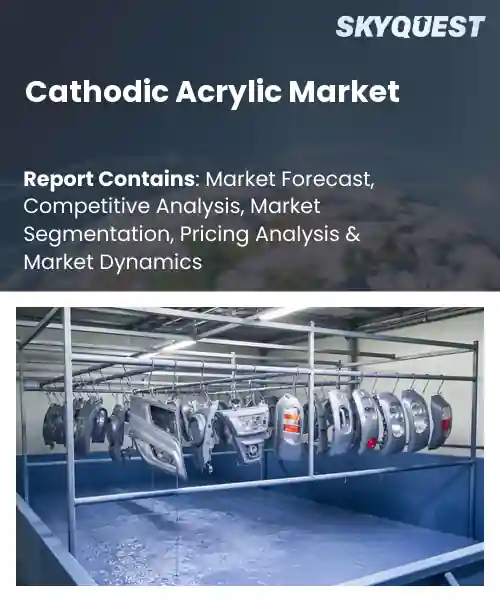
Cathodic Acrylic Market
Report ID: SQMIG15E3704
Report ID: SQMIG15E3704
[email protected]
USA +1 351-333-4748
Report ID:
SQMIG15E3704 |
Region:
Global |
Published Date: June, 2026
Pages:
157
|Tables:
120
|Figures:
77


Global Cathodic Acrylic Market size was valued at USD 2.5 Billion in 2024 and is poised to grow from USD 2.63 Billion in 2025 to USD 3.88 Billion by 2033, growing at a CAGR of 5.0% during the forecast period (2026-2033).
The primary driver for the cathodic acrylic market growth is the corrosion protection demand is going up, especially across automotive and industrial coatings, and it started as a small thing then turned into broad, common adoption across infrastructure builds and OEM finishes. The market itself is made of resins that are formulated to support cathodic protection via electrochemical barrier mechanisms, and it matters because it can extend asset life, cut maintenance routines , and reduce overall cost over time.
In addition, the added regulatory pressure, along with electrification trends, is a major reason adoption is speeding up globally because tighter emissions standards push companies to replace solvent-borne anticorrosives with low-VOC waterborne cathodic acrylic systems. So, manufacturers are investing more in waterborne resin technologies that keep conductivity plus film integrity, which then enables large-scale usage like EV chassis coatings and offshore wind turbine components, where long term durability is the whole point. This transition also opens up chances for formulation partnerships, retrofit support, and coatings customized for specific regions, like saline or harsh industrial air—so the aftermarket demand grows, maintenance intervals get longer, and resilience improves.
AI is enhancing corrosion protection in the cathodic acrylic industry by mixing predictive modelling with richer material information and online monitoring, rather than just relying on older test cycles. One big part is machine learning driven predictions of how corrosion might behave, and then simulation assisted design that treats the coating like it belongs to a bigger system , not just a decorative finish. So, current practice is moving away from reactive fixing toward proactive picking of cathodic acrylics based on forecasts of environmental effects and material interaction. AI also helps with formulation screening and even process control during electrocoating, so the film build and curing are steadier. Because of that, coatings tend to perform more reliably in complex assemblies which can minimize development timelines while also improving field performance and maintenance planning.
Market snapshot - (2026-2033)
Global Market Size
USD 2.5 Billion
Largest Segment
Waterborne Cathodic Acrylic
Fastest Growth
Waterborne Cathodic Acrylic
Growth Rate
5.0% CAGR
To get more insights on this market click here to Request a Free Sample Report
The global cathodic acrylic market is segmented by type, technology, application, end-use industry and region. Based on type, the market is segmented into Waterborne Cathodic Acrylic, Solventborne Cathodic Acrylic and Powder Cathodic Acrylic. Based on technology, the market is segmented into Emulsion Polymerization, Solution Polymerization and Suspension Polymerization. Based on application, the market is segmented into Industrial Protective Coatings, Automotive Transportation, Marine Protective Coatings and Architectural Coatings. Based on end-use industry, the market is segmented into Automotive OEM, Automotive Aftermarket, Construction, Industrial Manufacturing and Aerospace & Defense. Based on region, the market is segmented into North America, Europe, Asia Pacific, Latin America and Middle East & Africa.
As per the cathodic acrylic market analysis, the Waterborne Cathodic Acrylic basically keeps winning, since environmental rules and what customers ask for have moved formulators toward low VOC, water based setups that just fit into cathodic electrodeposition workflows. And because it plays well with emulsion polymerization, producers can get films that look more even, with better bonding or adhesion, so corrosion risk drops and there is less rework later. Also the lower flammability, and waste cleanup that is somewhat simpler, together help drag down the full cost of ownership, which is why OEMs and industrial buyers often lean toward waterborne cathodic acrylics for protective coatings.
However, the Powder Cathodic Acrylic is showing up as the fastest growing option too, mainly due to the rising interest in solvent-free, very durable coatings that cure into thick, tough films. Powder formulation and curing advances mean it can cover heavy industrial substrates more easily, so manufacturers can reduce VOC exposure and also enter segments where people want strong, low-maintenance finishes that do not act up.
According to the cathodic acrylic market forecast, the emulsion polymerization category leads, because it makes stable acrylic latexes with fine dispersion, and those match cathodic electrodeposition chemistry along with the day to day production routines. This method gives formulators tighter control over particle size, and where functional groups land on the polymer chain. That improves how the film forms, how corrosion protection works, and how well the coating sticks to tricky, complex surfaces. Plus, it scales relatively well, and is usually cost-efficient, so companies can keep delivering repeatable performance while still staying inside regulatory limits. That’s why emulsion polymerization ends up as the go-to production route for a lot of cathodic acrylic manufacturers.
Still, Solution Polymerization is expanding quickly, because more formulators want high solids specialty acrylics, with engineered molecular architecture aimed at extreme performance uses. The route lets them add novel monomers and specific functional additives, so they can build advanced corrosion inhibitors plus adhesion promoters. That opens up new chances in demanding end uses, and premium coatings too, where custom features justify a higher price point, even if it is not the lowest cost approach.
To get detailed segments analysis, Request a Free Sample Report
As per the cathodic acrylic market regional forecast, Asia Pacific is commanding the leading role in the market, mostly because the industrial demand is concentrated, the coating supply chains feel mature, and the manufacturing ecosystems are solid in key markets. There are integrated value chains that stretch from raw material sourcing all the way to specialized application development, so adoption of newer cathodic acrylic formulations happens fast. And then, there is this ongoing collaboration between material producers, coating formulators, and bigger end users which helps produce tailored solutions for corrosion protection, needs that vary a lot. On top of that, regional policy backing for infrastructure, transportation projects , plus steady pull from electronics and automotive sectors, reinforces market depth and keeps investment moving toward production capacity and technical capability. Local research institutions and industry consortia keep pushing formulation improvements and application testing forward, while being close to upstream polymer and pigment producers also chops down lead times and reduces cost pressures, in a way that’s practical. Overall, these structural advantages create a competitive environment where both volume production and specialized, high performance cathodic acrylic products can coexist.
Japan Cathodic Acrylic Market
The Cathodic Acrylic sector in Japan benefits from advanced materials research, and from very close collaboration between manufacturers and automotive plus electronics integrators, with a strong leaning toward high quality surface protection. Well established specialty chemical producers , along with application laboratories, help enable rapid scale up of tailored formulations. Demand comes from rigorous performance standards, long product lifecycles, and the emphasis on durable corrosion protection for infrastructure as well as precision equipment. This pushes refinement of coating technologies, plus the application processes.
South Korea Cathodic Acrylic Market
The Cathodic Acrylic Market in South Korea is shaped by a tight integration between petrochemical feedstock suppliers and advanced coating formulators. That setup enables efficient production cycles and a responsive innovation when needs shift. Heavy industry and shipbuilding still require durable anticorrosion systems, while electronics and automotive sectors want compact, high performance coatings. There’s also a national emphasis on manufacturing competitiveness, and an export oriented production approach, which supports partnerships that speed up application testing and adoption. As a result, the region sustains a robust ecosystem for specialized cathodic acrylic solutions.
North America cathodic acrylic market penetration is driven by a mix of diversified end use demand, active formulation work, and strategic investments in coating technology adoption. Maintenance and refurbishment programs across infrastructure, energy, and transportation generate steady requirements for protective coatings. Meanwhile, industrial OEMs build partnerships to validate cathodic acrylic performance across different service environments. Supply chain agility and easier access to specialty resin producers also support localized manufacturing and quicker customer response. Regulatory attention on long term asset protection and lifecycle cost reduction encourages the selection of high performance anticorrosion systems. Joint pilot projects between formulators and large end users help refine specs and accelerate qualification for broader commercial adoption. Regional industry groups and testing laboratories matter here too, because they establish application protocols, while manufacturers keep adjusting supply conditions to meet difficult lead time requirements, and help reduce total cost of ownership for customers.
United States Cathodic Acrylic Market
The Cathodic Acrylic Market in the United States benefits from diverse industrial demand, an established specialty chemical base, and a clear focus on infrastructure refurbishment. Collaboration between formulators and OEMs helps generate application specific solutions for transportation and energy sectors. The emphasis on lifecycle cost and asset protection tends to favor high performance coatings. Strong logistics and technical service support speed up qualification and expand deployment of cathodic acrylic systems across different operating environments and applications.
Canada Cathodic Acrylic Market
The Cathodic Acrylic Market in Canada is influenced by the need for resource sector durability, the upkeep of transportation assets, and a manufacturing base that depends on protective coatings. Local producers and technical service providers work closely with end users to adapt formulations for cold climate behavior, and for long term corrosion resistance. With focus on total cost management plus regional supply reliability, customers are more likely to adopt robust cathodic acrylic systems across industrial repair and new builds.
Europe is reinforcing its role in the cathodic acrylic sector, via concentrated technical know-how, strict application standards, and some coordinated industry efforts that basically aim at product reliability. There is also a notable footprint of specialty chemical firms, plus advanced coating labs that keep pushing progressive formulation work, and cross sector testing as well. The attention on durability and environmental compliance nudges the development of more efficient application techniques and long lasting systems for infrastructure, marine, and industrial uses. Interregional collaboration between manufacturers, certifying bodies and large end users helps smooth out the specifications, and it speeds up market take up for refined cathodic acrylic solutions across different operating contexts. Investment in application engineering makes validation possible even under tricky service conditions, while being close to polymer and pigment suppliers shortens the development cycle. On top of that, a stronger aftermarket and repair ecosystem, together with careful specification practices, encourages long term adoption for protective maintenance. Taken together, these capabilities build a resilient regional base, with standardized offerings and some niche high performance products that fit demanding end use environments.
Germany Cathodic Acrylic Market
The Cathodic Acrylic Market in Germany benefits from strong chemical manufacturing capability , rigorous industry standards, and a deep well of industrial coating expertise. Collaboration between formulators and automotive, machinery, and infrastructure operators supports application specific development that is a bit more practical than theory alone. Priority on quality assurance, and long service life, makes it easier for proven anticorrosion systems to gain preference. Strong technical service networks, along with testing facilities, helps qualify and adapt cathodic acrylic products for tough industrial and transport related environments.
United Kingdom Cathodic Acrylic Market
The Cathodic Acrylic Market in the United Kingdom leans on a consultative industry culture, plus solid coating research centers, and a repair sector that keeps maritime and infrastructure applications moving forward. There is a strong emphasis on specification clarity and performance validation , which supports the adoption of dependable cathodic acrylic solutions. Suppliers and large asset owners tend to work close together, so they can run tailored testing programs and share application guidance, leading to broader acceptance across sectors that demand durable anticorrosion protection even in hard operating conditions.
France Cathodic Acrylic Market
The Cathodic Acrylic Market in France leans into specialty chemical knowledge, coating laboratories, and a clear focus on marine and infrastructure protection. Cooperation between material scientists and application engineers is tight, which supports customizing for complicated substrates and different exposure scenarios. Emphasis on testing and certification , combined with a service repair network, improves the odds that durable cathodic acrylic systems get specified. This whole environment also encourages innovation in formulation and application methods, especially for demanding preservation and maintenance needs.
To know more about the market opportunities by region and country, click here to
Buy The Complete Report
Rising Demand From Protective Coatings
Advancements In Formulation Technologies
Stringent Environmental Regulation Challenges
Raw Material Price Volatility
Request Free Customization of this report to help us to meet your business objectives.
Competitive landscape is a bit packed, dominated by multinational formulators and regional specialists, all vying on resin innovation, low VOC chemistry and e coat process compatibility. The bigger incumbents keep pushing capacity and capability investments, plus partnerships , to stand out, like Axalta’s AquaEC product line and Sherwin Williams’ Vectrogard 2000 cathodic acrylic. Meanwhile PPG seems to be doubling down too, with coatings capacity expansion and acquisitions, to broaden its electrocoat and powder platforms.
Top Player’s Company Profile
Recent Developments in the Cathodic Acrylic Market
SkyQuest’s ABIRAW (Advanced Business Intelligence, Research & Analysis Wing) is our Business Information Services team that Collects, Collates, Correlates, and Analyses the Data collected by means of Primary Exploratory Research backed by robust Secondary Desk research.
As per SkyQuest analysis, the global cathodic acrylic market is moving forward because demand keeps rising for corrosion protection in automotive and industrial coatings, and that translates into longer asset life and lower upkeep bills. Another driver is regulatory pressure, and electrification trends that keep accelerating the shift toward low VOC waterborne systems. One main restraint is that environmental rules are getting tighter, forcing reformulation away from solventborne chemistries, and that also tends to raise development complexity. Asia Pacific currently leads the market, partly due to integrated supply chains, strong manufacturing ecosystems, and a lot of industrial demand concentrated in the region. For segments, waterborne cathodic acrylic is the dominating one, often chosen for compatibility with electrodeposition, reduced VOC levels and practical cost advantages, while powder systems are showing faster growth for heavy industrial applications.
| Report Metric | Details |
|---|---|
| Market size value in 2024 | USD 2.5 Billion |
| Market size value in 2033 | USD 3.88 Billion |
| Growth Rate | 5.0% |
| Base year | 2024 |
| Forecast period | (2026-2033) |
| Forecast Unit (Value) | USD Billion |
| Segments covered |
|
| Regions covered | North America (US, Canada), Europe (Germany, France, United Kingdom, Italy, Spain, Rest of Europe), Asia Pacific (China, India, Japan, Rest of Asia-Pacific), Latin America (Brazil, Rest of Latin America), Middle East & Africa (South Africa, GCC Countries, Rest of MEA) |
| Companies covered |
|
| Customization scope | Free report customization with purchase. Customization includes:-
|
To get a free trial access to our platform which is a one stop solution for all your data requirements for quicker decision making. This platform allows you to compare markets, competitors who are prominent in the market, and mega trends that are influencing the dynamics in the market. Also, get access to detailed SkyQuest exclusive matrix.
Table Of Content
Executive Summary
Market overview
Parent Market Analysis
Market overview
Market size
KEY MARKET INSIGHTS
COVID IMPACT
MARKET DYNAMICS & OUTLOOK
Market Size by Region
KEY COMPANY PROFILES
Methodology
For the Cathodic Acrylic Market, our research methodology involved a mixture of primary and secondary data sources. Key steps involved in the research process are listed below:
1. Information Procurement: This stage involved the procurement of Market data or related information via primary and secondary sources. The various secondary sources used included various company websites, annual reports, trade databases, and paid databases such as Hoover's, Bloomberg Business, Factiva, and Avention. Our team did 45 primary interactions Globally which included several stakeholders such as manufacturers, customers, key opinion leaders, etc. Overall, information procurement was one of the most extensive stages in our research process.
2. Information Analysis: This step involved triangulation of data through bottom-up and top-down approaches to estimate and validate the total size and future estimate of the Cathodic Acrylic Market.
3. Report Formulation: The final step entailed the placement of data points in appropriate Market spaces in an attempt to deduce viable conclusions.
4. Validation & Publishing: Validation is the most important step in the process. Validation & re-validation via an intricately designed process helped us finalize data points to be used for final calculations. The final Market estimates and forecasts were then aligned and sent to our panel of industry experts for validation of data. Once the validation was done the report was sent to our Quality Assurance team to ensure adherence to style guides, consistency & design.
Analyst Support
Customization Options
With the given market data, our dedicated team of analysts can offer you the following customization options are available for the Cathodic Acrylic Market:
Product Analysis: Product matrix, which offers a detailed comparison of the product portfolio of companies.
Regional Analysis: Further analysis of the Cathodic Acrylic Market for additional countries.
Competitive Analysis: Detailed analysis and profiling of additional Market players & comparative analysis of competitive products.
Go to Market Strategy: Find the high-growth channels to invest your marketing efforts and increase your customer base.
Innovation Mapping: Identify racial solutions and innovation, connected to deep ecosystems of innovators, start-ups, academics, and strategic partners.
Category Intelligence: Customized intelligence that is relevant to their supply Markets will enable them to make smarter sourcing decisions and improve their category management.
Public Company Transcript Analysis: To improve the investment performance by generating new alpha and making better-informed decisions.
Social Media Listening: To analyze the conversations and trends happening not just around your brand, but around your industry as a whole, and use those insights to make better Marketing decisions.
REQUEST FOR SAMPLE
 REQUEST FREE CUSTOMIZATION
Global Cathodic Acrylic Market size was valued at USD 2.5 Billion in 2024 and is poised to grow from USD 2.63 Billion in 2025 to USD 3.88 Billion by 2033, growing at a CAGR of 5.0% during the forecast period (2026-2033).
Competitive landscape is concentrated among multinational formulators and regional specialists competing on resin innovation, low VOC chemistry and e coat process compatibility. Incumbents pursue capacity and capability investments and partnerships for differentiation, for example Axalta’s AquaEC product line and Sherwin Williams’ Vectrogard 2000 cathodic acrylic, while PPG has expanded coatings capacity and acquisitions to broaden its electrocoat and powder platforms. 'BASF SE', 'PPG Industries', 'Axalta Coating Systems', 'Nippon Paint Holdings', 'The Sherwin-Williams Company', 'KCC Corporation', 'AkzoNobel', 'Arkema', 'Allnex', 'Jotun', 'Kansai Paint', 'Noroo Paint & Coatings', 'Luvata Oy', 'Metokote Corporation', 'Hawking Electrotechnology', 'Valspar', 'Plastic Coatings Ltd', 'Tatung Fine Chemicals', 'Shenzhen Zhibang Technology', 'Koch Membrane Systems'
The increasing need for durable, long-lasting protective coatings in industries exposed to corrosive environments directly supports demand for cathodic acrylic formulations. These materials offer strong adhesion, flexible film formation, and compatibility with cathodic protection systems, enabling formulators to extend service life of metal assets and reduce maintenance cycles. Preference among specifiers for coatings that integrate with sacrificial or impressed current protection further encourages innovation and procurement of acrylic cathodic products, fostering steady market adoption and expansion across multiple end-use sectors.
Sustainable Performance Demand: Rising customer and industry preference for long-lasting, low-maintenance cathodic acrylic solutions is pushing manufacturers to prioritize eco-efficient formulations, renewable feedstocks, and improved corrosion resistance. Demand emphasizes lifecycle performance, ease of application, and compatibility with complementary protective systems, prompting R&D partnerships and product portfolio shifts toward greener chemistries and higher durability. Suppliers are focusing on transparency, certifications, and service offerings that demonstrate reduced total cost of ownership, enabling broader adoption across infrastructure, marine, and industrial maintenance segments seeking sustainable asset protection.
Why does Asia Pacific Dominate the Global Cathodic Acrylic Market? |@12


Want to customize this report? This report can be personalized according to your needs. Our analysts and industry experts will work directly with you to understand your requirements and provide you with customized data in a short amount of time. We offer $1000 worth of FREE customization at the time of purchase.
Feedback From Our Clients


 USA (+1) 351-333-4748

