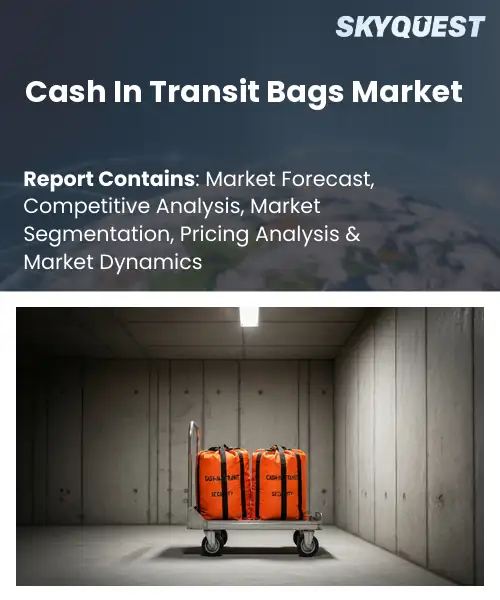
Cash In Transit Bags Market
Report ID: SQMIG15H2222
Report ID: SQMIG15H2222
[email protected]
USA +1 351-333-4748
Report ID:
SQMIG15H2222 |
Region:
Global |
Published Date: June, 2026
Pages:
157
|Tables:
118
|Figures:
77


Global Cash In Transit Bags Market size was valued at USD 1.22 Billion in 2024 and is poised to grow from USD 1.3 Billion in 2025 to USD 2.22 Billion by 2033, growing at a CAGR of 6.91% during the forecast period (2026-2033).
The global Cash-in-Transit (CIT) Bag market is made up of secure bags and containers that are used for the safe collection, storage, and transport of cash, checks, coins, and other valuables from one place to another. This includes transporting such valuable items to and from banks, retail outlets, ATMs, cash processing facilities, and governments. The bags are a crucial part of the cash logistics chain, as they ensure the security of the chain-of-custody management and reduce any risks of theft or tampering.
The industry has come a long way from conventional lockable cash bags to sophisticated tampering-resistant products that utilize RFID tagging, barcodes, GPS tracking, and smart sealing features. Increasing worries about the security of cash, along with regulation and efficiency issues, have contributed to the use of technologically savvy CIT bags that can offer real-time visibility and accountability while in transit. In addition, rising needs for reliable cash management solutions in developing countries, where cash still plays a significant role in transactions, have helped the market grow.
In spite of the exponential increase in the use of digital payment methods, the use of cash continues to be an integral means of exchange in several industries and areas and creates a need for safe transport and management of such cash.Continued development of retail systems, ATMs, banks, and cash logistics, along with advancements in intelligent security measures, will ensure that the future of the global CIT bag industry is promising.
How is IoT-enabled Tracking Improving Security in the Cash‑in‑Transit Bag Market?
With IoT-based tracking, GPS, cellular and sensor technologies can be incorporated into the money bags for real-time location tracking and any kind of interference detection. The information stream goes to the secure cloud service, where the operator gets instant notification of deviation or any other type of intrusion. The benefit is that such systems protect against any kind of theft and help in quicker resolution of incidents and decrease insurance fees. As the amount of cash grows in developing countries, companies start replacing old steel money bags with new IoT solutions which also track temperature and impacts.
Market snapshot - (2026-2033)
Global Market Size
USD 1.22 Billion
Largest Segment
Tamper-Evident Bags
Fastest Growth
High-Security Bags
Growth Rate
6.91% CAGR
To get more insights on this market click here to Request a Free Sample Report
Global cash in transit bags market is segmented by type, material, end-user, distribution and region. Based on type, the market is segmented into Tamper-Evident Bags, Deposit Bags, Coin Bags and High-Security Bags. Based on material, the market is segmented into Polythene/Polyethylene, Woven Polypropylene and Nylon. Based on end-user, the market is segmented into Banks & Financial Institutions, Retail Chains and CIT (Cash-in-Transit) Companies. Based on distribution, the market is segmented into Direct to Banks, Security Companies and Distributors. Based on region, the market is segmented into North America, Europe, Asia Pacific, Latin America and Middle East & Africa.
The Tamper Evident Bags are leading segment owing to their inherent feature of instant visual evidence of tampering required for protecting valuables while transporting. The sealing feature and transparent window of this segment make it possible to check the bag without opening and hence reducing the chances of risk and delay. This inherent advantage makes it suitable as per the requirements of the industry and that's why these bags are chosen over other types by banks and security agencies for cash collection and transportation.
However, the fastest growing segment becomes the Deposit Bags because they are designed to hold a higher number of banknotes and can be stored safely overnight. Their sturdy panels and locking tops make them attractive for logistics firms for bulk handling and hence create a new demand.
The Woven Polypropylene segment holds a leading position since it possesses interlaced fibers with excellent tensile strength which cannot tear or be punctured. It is important for safe transport of money through rough handling. Moreover, Woven Polypropylene resists moisture and temperature changes, improving durability of the bags, and lowering the frequency of replacements for end users. Functional properties of the material make it popular among banks and security companies seeking reliable, cost-effective carriers.
On the other hand, Nylon segment witnesses the fastest growth potential since producers use innovative light and cut-resistant materials conforming to new security requirements. Dyeability of the fabric into bright colors allows for visual identification of assets while RFID pockets are attractive to technologically oriented logistics providers.
To get detailed segments analysis, Request a Free Sample Report
North America occupies a prominent position in the industry because of the combination of complex logistics, strict security laws, and developed financial sectors that require reliable security products. It is possible to use the potential of research and development to integrate the latest materials and technologies into the process of cash handling. Cooperation between the producers, transportation companies, and security services makes it possible to combine innovations and the requirements for safety. North America has developed a system of distribution that makes it possible to implement cash handling devices quickly and effectively.
United States Cash in Transit Bags Market is driven by the sheer size of the retail and banking sector which favors security solutions of high quality. The emphasis is made on lightweight materials and tamper proof qualities in the design process to ensure performance at the highest level. Collaboration with tech companies results in a higher degree of use of real-time monitoring and biometric access control technologies, improving operator safety. Customer needs for ergonomics and fast response time push suppliers to improve their products.
Market for Cash in Transit Bags in Canada is an example of the importance of compliance and environmentalism when developing products in the country. Recyclability and energy efficiency are considered by manufacturers in conjunction with strict theft prevention requirements. Cooperation with provincial safety organizations makes sure that the products are created about different weather and transport conditions, existing throughout large areas. Customization of solutions offered by the market provides an opportunity for choosing different sizes and ways of accessing cash.
The fast growth of Europe stems from its use of unified security requirements, increasing focus on sustainable production processes, and increasing demand for secure management of cash in the retail and banking industries. Europe is fortunate enough to enjoy a long-standing history of engineering and continuous development of new materials such as high-strength plastics and non-metallic composites that match environmental concerns. Cross-border business and logistic networks make the need for an integrated solution evident, whereas successful cooperation between the state and private business contributes to the implementation of the latest technology in tracking and authentication.
The Cash in Transit Bags Market in Germany is known for its emphasis on precise engineering and quality assurance that has set the standards for the entire continent. Cutting-edge material science techniques are used to manufacture cash bags that offer better puncture resistance and are designed with ergonomics in mind. Cooperation with banking groups ensures compliance with all security standards, and sustainable practices ensure recycling materials are used. Such reliability and excellence in technology have helped establish Germany as a leading exporter of cash bags.
United Kingdom Cash in Transit Bags Market stands out due to its quick integration of advanced security technologies. Firms are focusing on bags that are light but strong for use on frequent collection trips within the urbanized environment. Working in collaboration with technology companies helps integrate GPS monitoring and tampering alert systems. Awareness of increasing risks leads to such developments. Quick adaptation of digital features coupled with the requirement of strength ensures the swift growth of the market.
France’s Cash in Transit Bags Market is being developed due to a combination of regulatory backing along with the increased importance given to eco-friendly production. The companies within France are experimenting with the use of biomaterials and eco-friendly manufacturing processes to meet the country’s sustainability goals. Importance is being given to modular designs so that they can change their capacities as per the volume of cash. They collaborate with security experts so that their products can meet changing security requirements.
The strength of Asia Pacific comes from its capacity to use the opportunities brought about by urbanization, its retail infrastructure, and an increasing focus on high security logistics. In the region, there is an advantage due to the availability of the manufacturing sector that focuses on manufacturing through low cost and high-quality processes which ensure efficiency in scale of operation without compromising safety. Research and development activities have increased the use of light weight composites and electronic tracking systems as per the requirements of the densely populated countries and emerging economies.
Cash In Transit Bags Market in Japan stresses the importance of precision engineering along with the latest materials technology to cater to high security requirements. The manufacturers give high importance to designing bags which not only have small and ergonomic designs for narrow streets but also possess high anti-theft technologies. Close association with top electronics companies ensures the implementation of real-time monitoring systems. This ensures high reliability in their cash protection systems.
South Korean Cash in Transit Bags Market thrives from a combination of technological advancement and production flexibility. There is an emphasis on producing extremely lightweight bags that contain intelligent sensors and secure means of communication. Working hand in hand with logistics companies is crucial in ensuring that specifications suit the fast delivery systems common within the market. It is through the incorporation of innovative technological features together with durable designs that South Korea becomes a progressive nation in the security equipment industry.
To know more about the market opportunities by region and country, click here to
Buy The Complete Report
Heightened Security Concerns
Increasing security issues in the banking, retail, and logistics industries create demand for sturdy cash in transit bags, with the need to ensure that there is protection against theft and manipulation. With the improved features in terms of materials used and locking, companies are increasingly adopting the use of these bags. The need to ensure the safety of cash and other valuable materials results in the replacement of old equipment, and therefore increased market size.
Technological Advancements in Materials
New technology with regard to lightweight materials and tamper proofing composites ensures that it becomes possible to make cash-in-transit bags that are durable as well as easy to handle. This makes the work of the operators less strenuous and hence improves efficiency while still retaining the level of security required. With the focus on ergonomics and longevity by customers, the new bags become more attractive, hence encouraging replacement of old bags with new ones. Therefore, advances in material science play a major role in market growth.
Stringent Regulatory Requirements
The strict regulatory constraints related to the movement of money affect the bag design process, marking, and tests, increasing time needed to develop the product and compliance costs. This means that manufacturers will have to invest in meeting those requirements, and hence their products will be late entering the market. There is also a requirement for certification and auditing, which acts as a deterrent to small firms entering the market. This will limit the number of options available to consumers.
High Production Costs
The high cost of production resulting from security innovations like the use of strong steel alloy and multi-layered fabrics that provide security makes the bag expensive and thus out of reach for price-sensitive consumers. In considering the budgetary allocation of an organization, the cost of acquiring high-quality bags may be compared with other means of ensuring security, which might cause the delay or lack of purchase of the bags. The high price will, therefore, hinder its growth in the market.
Request Free Customization of this report to help us to meet your business objectives.
The competitive environment is influenced by incumbent players widening their product range through mergers and alliances, for example, incorporating RFID technologies into their products through alliances with security companies, while new firms utilize composite materials to distinguish themselves. The latest examples of mergers and acquisitions include a major player in the industry of cash handling equipment buying a smaller firm specializing in manufacturing bags in order toexpand its offering of safe transportation solutions, as well as cooperation of logistics firms with technology start-ups.
In 2024, the security packaging company Mega Fortris introduced new tamper-evident bags for cash-in-transit purposes that were designed specifically for integration with RFID and GPS tracking technology. This development was intended to increase traceability, chain-of-custody control, and prevention of theft in cash transportation and illustrates the increasing use of smart security technologies among the manufacturers of CIT bags.
Digital Integration Driving Adoption: There has been a rapid development of IoT sensors, GPS tracking, and remote monitoring software on cash in transit bags that allow the company to monitor routes, temperatures, and any form of tampering from remote locations. Connectivity allows for improved security processes, faster incident response, and an audit trail for clients. In light of increasing accountability requirements by banks, manufacturers have developed a smart bag solution that can be integrated with enterprise management systems and provide value differentiation to the company.
Sustainable Materials Gain Traction: Sustainability is increasingly becoming a fundamental criterion for those who are looking to operate responsibly from an environmental perspective. Companies are increasingly moving towards the use of recycled polymers, biodegradable coating, and lightweight composites that reduce carbon footprint while maintaining high durability standards. It is in line with the efforts that companies undertake through ESG principles as well as an effort to satisfy consumers who want green processes. Through the promotion of green cash-in-transit bags, companies will be able to distinguish themselves and get into new contracts.
SkyQuest’s ABIRAW (Advanced Business Intelligence, Research & Analysis Wing) is our Business Information Services team that Collects, Collates, Correlates, and Analyses the Data collected by means of Primary Exploratory Research backed by robust Secondary Desk research.
As per SkyQuest analysis, the growth drivers of the global cash-in-transit bags market are mainly driven by increased security threats that compel banks, retail organizations, and logistics companies to invest in secure and tamper-evident containers, with progress in lightweight polymers and composites acting as another driver for increasing durability and efficiency. One key restriction that is associated with the market is the presence of rigorous regulatory frameworks, which increases the time taken to launch innovative products and also increases the cost of compliance. North America continues to be the largest region because of its highly advanced logistics system and stringent security regulations, with tamper-evident bags continuing to dominate the market hierarchy.
| Report Metric | Details |
|---|---|
| Market size value in 2024 | USD 1.22 Billion |
| Market size value in 2033 | USD 2.22 Billion |
| Growth Rate | 6.91% |
| Base year | 2024 |
| Forecast period | (2026-2033) |
| Forecast Unit (Value) | USD Billion |
| Segments covered |
|
| Regions covered | North America (US, Canada), Europe (Germany, France, United Kingdom, Italy, Spain, Rest of Europe), Asia Pacific (China, India, Japan, Rest of Asia-Pacific), Latin America (Brazil, Rest of Latin America), Middle East & Africa (South Africa, GCC Countries, Rest of MEA) |
| Companies covered |
|
| Customization scope | Free report customization with purchase. Customization includes:-
|
To get a free trial access to our platform which is a one stop solution for all your data requirements for quicker decision making. This platform allows you to compare markets, competitors who are prominent in the market, and mega trends that are influencing the dynamics in the market. Also, get access to detailed SkyQuest exclusive matrix.
Table Of Content
Executive Summary
Market overview
Parent Market Analysis
Market overview
Market size
KEY MARKET INSIGHTS
COVID IMPACT
MARKET DYNAMICS & OUTLOOK
Market Size by Region
KEY COMPANY PROFILES
Methodology
For the Cash In Transit Bags Market, our research methodology involved a mixture of primary and secondary data sources. Key steps involved in the research process are listed below:
1. Information Procurement: This stage involved the procurement of Market data or related information via primary and secondary sources. The various secondary sources used included various company websites, annual reports, trade databases, and paid databases such as Hoover's, Bloomberg Business, Factiva, and Avention. Our team did 45 primary interactions Globally which included several stakeholders such as manufacturers, customers, key opinion leaders, etc. Overall, information procurement was one of the most extensive stages in our research process.
2. Information Analysis: This step involved triangulation of data through bottom-up and top-down approaches to estimate and validate the total size and future estimate of the Cash In Transit Bags Market.
3. Report Formulation: The final step entailed the placement of data points in appropriate Market spaces in an attempt to deduce viable conclusions.
4. Validation & Publishing: Validation is the most important step in the process. Validation & re-validation via an intricately designed process helped us finalize data points to be used for final calculations. The final Market estimates and forecasts were then aligned and sent to our panel of industry experts for validation of data. Once the validation was done the report was sent to our Quality Assurance team to ensure adherence to style guides, consistency & design.
Analyst Support
Customization Options
With the given market data, our dedicated team of analysts can offer you the following customization options are available for the Cash In Transit Bags Market:
Product Analysis: Product matrix, which offers a detailed comparison of the product portfolio of companies.
Regional Analysis: Further analysis of the Cash In Transit Bags Market for additional countries.
Competitive Analysis: Detailed analysis and profiling of additional Market players & comparative analysis of competitive products.
Go to Market Strategy: Find the high-growth channels to invest your marketing efforts and increase your customer base.
Innovation Mapping: Identify racial solutions and innovation, connected to deep ecosystems of innovators, start-ups, academics, and strategic partners.
Category Intelligence: Customized intelligence that is relevant to their supply Markets will enable them to make smarter sourcing decisions and improve their category management.
Public Company Transcript Analysis: To improve the investment performance by generating new alpha and making better-informed decisions.
Social Media Listening: To analyze the conversations and trends happening not just around your brand, but around your industry as a whole, and use those insights to make better Marketing decisions.
REQUEST FOR SAMPLE
 REQUEST FREE CUSTOMIZATION
Global Cash In Transit Bags Market size was valued at USD 1.22 Billion in 2024 and is poised to grow from USD 1.3 Billion in 2025 to USD 2.22 Billion by 2033, growing at a CAGR of 6.91% during the forecast period (2026-2033).
The competitive landscape is shaped by incumbents expanding product lines through strategic acquisitions and partnerships, such as integrating RFID tracking technology via joint ventures with security firms, while new entrants leverage lightweight composite materials to differentiate offerings. Recent M&A activity includes a leading cash‑handling equipment provider acquiring a niche bag manufacturer to broaden its secure transport portfolio, and collaborations between logistics companies and technology startups to embed real‑time monitoring solutions, intensifying competition and accelerating innovation. 'Performa Solutions', 'Nelmar Security Packaging', 'Versapak International', 'Harcor Security Seals', 'Proactive Group', 'AMPAC Packaging', 'TamperGuard (Tamper-evident)', 'Brink's Company', 'G4S (Allied Universal)', 'Giesecke+Devrient', 'Crane Currency', 'De La Rue plc', 'Globe-Bag', 'Deposita (Cash Connect)', 'Armor Express', 'TransAct Technologies', 'Glory Global Solutions', 'Hypar Corporation', 'Neopost (Quadient)', 'NBS Technologies (Nautilus Hyosung)'
Heightened security concerns across banking, retail, and logistics sectors drive demand for robust cash in transit bags, as organizations seek solutions that protect assets from theft and tampering. Advanced materials and locking mechanisms provide enhanced resistance, encouraging adoption among service providers. This focus on safeguarding cash and valuables prompts companies to upgrade legacy equipment, thereby expanding the market. The perceived risk mitigation and regulatory compliance benefits reinforce purchasing decisions, fostering sustained growth in the global cash in transit bags industry.
Digital Integration Driving Adoption: The industry is rapidly embedding IoT sensors, GPS tracking, and real‑time monitoring platforms into cash‑in‑transit bags, enabling operators to oversee routes, temperature, and tamper events remotely. This connectivity enhances security protocols, reduces response times to incidents, and provides clients with transparent audit trails. As financial institutions demand higher accountability, manufacturers are prioritising smart‑bag solutions that integrate seamlessly with enterprise management systems, creating a differentiated value proposition that fuels market expansion and customer loyalty across global logistics networks and service providers.
Why does North America Dominate the Global Cash In Transit Bags Market? |@12


Want to customize this report? This report can be personalized according to your needs. Our analysts and industry experts will work directly with you to understand your requirements and provide you with customized data in a short amount of time. We offer $1000 worth of FREE customization at the time of purchase.
Feedback From Our Clients


 USA (+1) 351-333-4748

