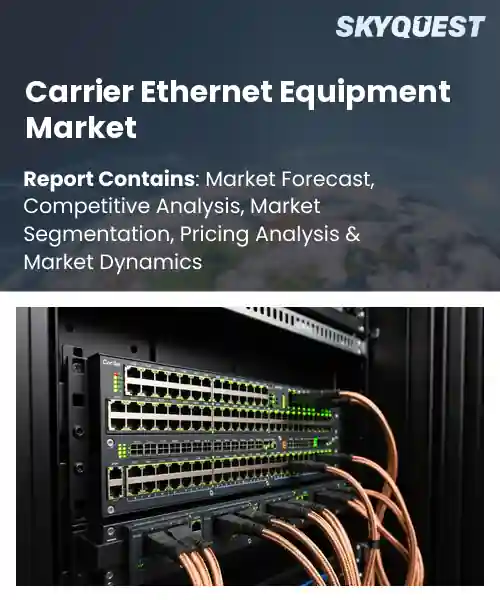
Carrier Ethernet Equipment Market
Report ID: SQMIG45H2208
Report ID: SQMIG45H2208
[email protected]
USA +1 351-333-4748
Report ID:
SQMIG45H2208 |
Region:
Global |
Published Date: June, 2026
Pages:
157
|Tables:
157
|Figures:
78


Global Carrier Ethernet Equipment Market size was valued at USD 15.3 Billion in 2024 and is poised to grow from USD 15.9 Billion in 2025 to USD 21.57 Billion by 2033, growing at a CAGR of 3.89% during the forecast period (2026-2033).
The primary driver of the carrier ethernet equipment industry is rising demand for high capacity, low latency connectivity as service providers modernize networks to support cloud, video and IoT. This market includes switches, routers, aggregation systems and management platforms that enable scalable metro and long haul transport, and it matters because standardized ethernet reduces cost and enables rapid provisioning. Over the past decade legacy TDM infrastructures were largely replaced by packet oriented metro architectures; examples such as mobile backhaul moving to ethernet and the adoption of MEF service specifications by global operators show how technology shifts accelerated market adoption.
As mobile operators deploy small cells and network slicing, they require timing aware aggregation switches and low latency optical links, causing vendors to prioritize platforms with carrier grade OAM and scalable 100 gigabit interfaces. Similarly enterprises and cloud providers demand elastic ethernet for data center interconnect and metro connectivity, creating opportunities for disaggregated hardware, software defined control and managed end to end services that enable faster monetization.
How is AI transforming the Carrier Ethernet equipment market?
AI is reshaping carrier ethernet equipment by embedding intelligence into switches and transport systems. Key aspects include predictive maintenance that anticipates failures, adaptive traffic steering that optimizes paths as demand shifts, and automated orchestration that reduces manual provisioning. Today carriers are moving from pilots to broader deployments to improve uptime and accelerate service delivery. Market context shows rising bandwidth and latency demands from cloud and AI workloads which strain legacy architectures. Vendors are responding with AI ready control planes, smarter optics and analytics focused solutions to boost capacity and simplify operations while enabling new service models.
Nokia in May 2026, announced agentic AI for fixed and broadband networks, showing how AI improves fault detection, automates configuration and speeds service activation which supports Carrier Ethernet equipment adoption and operational efficiency.
Market snapshot - (2026-2033)
Global Market Size
USD 15.3 Billion
Largest Segment
Ethernet Switches
Fastest Growth
Optical Transport Equipment
Growth Rate
3.89% CAGR
To get more insights on this market click here to Request a Free Sample Report
Global carrier ethernet equipment market is segmented by component, service type, technology, bandwidth, end use industry and region. Based on component, the market is segmented into Ethernet Switches, Routers, Network Interface Devices (NIDs), Optical Transport Equipment and Others. Based on service type, the market is segmented into E-Line (Point-to-Point Services), E-LAN (Multipoint-to-Multipoint Services), E-Tree (Rooted Multipoint Services), E-Access Services and Others. Based on technology, the market is segmented into Ethernet over MPLS (EoMPLS), Ethernet over SDH/SONET (EoSDH/EoSONET), Ethernet over DWDM, Carrier-Grade Ethernet (CGE) and Others. Based on bandwidth, the market is segmented into Below 1 Gbps, 1 Gbps – 10 Gbps, 10 Gbps – 40 Gbps and Above 40 Gbps. Based on end use industry, the market is segmented into IT & Telecommunications, BFSI, Government & Defense, Healthcare, Retail & E-commerce, Media & Entertainment, Education, Manufacturing and Others. Based on region, the market is segmented into North America, Europe, Asia Pacific, Latin America and Middle East & Africa.
Ethernet switches segment dominates with large global carrier ethernet equipment market share because switches are the fundamental aggregation and access building blocks that deliver high port density, carrier class quality of service, and flexible fabric architectures required by service providers. Their evolution toward programmable, modular platforms enables traffic slicing, virtualization, and seamless interworking with legacy and IP domains, which drives operator investment in refresh cycles and simplifies multiservice transport while reducing operational complexity and cost.
As per global carrier ethernet equipment market outlook, routers are witnessing the strongest growth momentum as providers require more intelligent edge and core routing to support service convergence, segment routing, and scalable packet transport. Advances in software defined control, virtualization, and enhanced routing platforms boost deployment in metro and aggregation layers, creating opportunities for higher margin system upgrades and new managed services.
Carrier-grade ethernet (CGE) segment dominates because it provides the standardized reliability, advanced OAM, and policy driven service assurance that operators depend on for strict SLAs and multi tenant services. Its alignment with industry frameworks and emphasis on resilience, deterministic performance, and interoperability reduces integration risk, simplifies orchestration across transport layers, and underpins confidence for migrating legacy circuits to packet based Ethernet while preserving carrier operational models.
As per global carrier ethernet equipment market forecast, ethernet over DWDM is emerging as the key high growth segment because converging packet and optical layers meets soaring bandwidth and low latency demands. Innovations in coherent optics and pluggable DWDM modules enable operators to deliver higher capacity wavelengths, simplify wavelength provisioning for Ethernet services, and unlock new revenue streams from bandwidth hungry enterprise and wholesale customers.
To get detailed segments analysis, Request a Free Sample Report
North America region dominates the global carrier ethernet equipment market owing to the presence of modern network infrastructure, high demand from the corporate and service provider segments and a well-established ecosystem of technology vendors and integrators. The early growth of high capacity networks and investments in edge and core upgrading are enabling fast adoption of Ethernet solutions. Well-established regulatory frameworks and spectrum laws create fewer obstacles to large-scale rollouts and the competitive ecosystem among vendors drives innovation in transport, switching and orchestration capabilities. Integration of cloud and managed services further strengthens the market position, by matching equipment purchasing with operator strategy. Carriers, equipment vendors and system integrators working together strongly speeds up proof of concept initiatives and commercial deployments across many sectors. Robust investment in research and development, proximity to major cloud and content providers, and technology leadership and market depth are maintained.
As per carrier ethernet equipment market regional outlook, United States is defined by large-scale operator modernizations, vibrant vendor ecosystems, and close integration with hyperscale cloud and enterprise networking strategies. Service provider demand for higher-capacity transport, enhanced switching, and advanced orchestration capabilities fuels vendor innovation; a robust testing and certification environment supports commercial deployments across metro, regional, and long-haul network segments. Collaboration between carriers, integrators, and enterprises accelerates solution refinement and operational maturity.
As per carrier ethernet equipment market regional forecast, Canada reflects focused investments by national carriers, growing enterprise adoption, and collaboration with global vendors on interoperable solutions. Emphasis on resilient metro networks, scalable transport architectures, and managed service offerings drives procurement patterns. Policy clarity and operator partnerships enable trials of advanced orchestration, automation, and virtualization initiatives, improving service agility and regional connectivity. Vendor support for local deployment models enhances market readiness and uptake momentum.
The carrier ethernet equipment market is growing rapidly in Asia Pacific due to the synchronized investments in high-capacity mobile backhaul, dense metro networks and wide-scale fiber rollouts. Demand for scalable Ethernet switching and transport solutions is being driven by enterprise digitalization, cloud adoption and content delivery. Regional operators are prioritising low-latency connection, virtualisation and automated orchestration, leaving vendors to develop cost-effective systems and software-defined capabilities. Government initiatives to promote internet connectivity and public-private partnerships lower barriers to deployment, while local manufacturing and a competitive vendor base speed the localization of solutions.
Japan is shaped by a focus on high-reliability infrastructure, advanced vendor research and development, and tight integration with domestic enterprise and carrier requirements. Emphasis on energy-efficient designs, compact form-factors, and deterministic performance supports deployments in dense urban environments. Collaboration between suppliers, integrators, and service providers accelerates protocol alignment, interoperability testing, and operational maturity, enabling scalable metro and edge solutions across domestic networks and international deployments across markets.
South Korea benefits from aggressive carrier modernization, dense urban service footprints, and close ties between technology providers and major operators. Demand for low-latency transport, high-density switching, and programmable network control drives local customization of platforms. Trials that explore automation, virtualization, and open interfaces support rapid interoperability validation, enabling broader commercial adoption across metro and regional links. Strong vendor competition accelerates product refinement and deployment readiness.
Europe is positioning itself in the carrier ethernet equipment market through coordinated infrastructure upgrades, a focus on interoperability standards and collaborative innovation between manufacturers and operators. Investment priorities include robust metro fabrics, increased optical transport integration and automation to support sophisticated service portfolios. Regulatory attention on open access and cross-border connectivity drives harmonized deployment procedures and pan-regional trials foster multi-vendor interoperability and operational uniformity. Established service providers are collaborating with systems integrators and specialized suppliers to pilot programmable network capabilities and lifecycle management tools. Another important differentiator in Europe is the emphasis on sustainability and energy-efficient designs, with equipment purchases linked to corporate responsibility and operational cost minimization. Active collaboration with standards bodies and regional research institutions creates common frameworks for orchestration and testing, resulting in faster time to integration.
Germany is characterized by strong engineering expertise, focus on industrial application requirements, and close collaboration between carriers, vendors, and manufacturing partners. Demand emphasizes robust transport, precise performance metrics, and energy-efficient hardware. Active participation in interoperability trials, standards development, and local supply chain initiatives supports scalable deployments across urban and industrial network environments. Vendor partnerships accelerate customization and long-term operational support models across sectors and regions.
United Kingdom combines established operator networks, a strong financial and digital services sector, and active vendor innovation. Emphasis on open interfaces, automation, and service orchestration drives demand for programmable platforms and interoperable transport solutions. Collaboration between carriers, cloud providers, and systems integrators enables rapid validation, efficient deployment, and scalable service rollouts. Regulatory clarity and vendor support models further improve market readiness and commercial uptake.
France reflects strong operator modernization efforts, active vendor participation, and policy initiatives encouraging regional connectivity. Focus on optical integration, energy-efficient designs, and advanced orchestration supports scalable metro and intercity deployments. Collaboration between service providers, research institutions, and system integrators accelerates interoperability testing and commercial maturity. Local vendor ecosystems tailor platforms for enterprise and government use cases, enhancing operational efficiency and service differentiation across urban networks.
To know more about the market opportunities by region and country, click here to
Buy The Complete Report
Surging Demand For High Capacity
Expansion Of Cloud and Data Centers
High Initial Deployment Costs
Interoperability and Fragmented Standards
Request Free Customization of this report to help us to meet your business objectives.
Competitive intensity in the global carrier ethernet equipment industry is driven by operators demanding disaggregated, software defined Ethernet to support private 5G fronthaul and enterprise edge services. Vendors pursue inorganic consolidation and targeted alliances to add switching silicon and private wireless capabilities, for example Marvell’s acquisition of Innovium and Celona’s carrier partnerships to bundle enterprise 5G with Ethernet services.
SkyQuest’s ABIRAW (Advanced Business Intelligence, Research & Analysis Wing) is our Business Information Services team that Collects, Collates, Correlates, and Analyses the Data collected by means of Primary Exploratory Research backed by robust Secondary Desk research.
As per SkyQuest analysis, the global carrier ethernet equipment market growth is being driven by rising demand for high-capacity, low-latency connectivity as service providers modernize networks, while high initial deployment costs remain a key restraint limiting faster adoption among smaller operators. North America remains the dominating region due to advanced infrastructure and close ties with cloud and content providers, and Ethernet switches are the dominating segment because they provide the high-density, carrier-grade aggregation essential for scalable deployments. A second driver is rapid expansion of cloud platforms and data centers which fuels demand for elastic, low-latency metro and data center interconnects and accelerates vendor innovation in programmable, disaggregated solutions. The global carrier ethernet equipment market trend fueled by the rapid expansion of high-speed broadband networks, increasing adoption of 5G infrastructure, and rising demand for scalable, cost-effective enterprise connectivity solutions.
| Report Metric | Details |
|---|---|
| Market size value in 2024 | USD 15.3 Billion |
| Market size value in 2033 | USD 21.57 Billion |
| Growth Rate | 3.89% |
| Base year | 2024 |
| Forecast period | (2026-2033) |
| Forecast Unit (Value) | USD Billion |
| Segments covered |
|
| Regions covered | North America (US, Canada), Europe (Germany, France, United Kingdom, Italy, Spain, Rest of Europe), Asia Pacific (China, India, Japan, Rest of Asia-Pacific), Latin America (Brazil, Rest of Latin America), Middle East & Africa (South Africa, GCC Countries, Rest of MEA) |
| Companies covered |
|
| Customization scope | Free report customization with purchase. Customization includes:-
|
To get a free trial access to our platform which is a one stop solution for all your data requirements for quicker decision making. This platform allows you to compare markets, competitors who are prominent in the market, and mega trends that are influencing the dynamics in the market. Also, get access to detailed SkyQuest exclusive matrix.
Table Of Content
Executive Summary
Market overview
Parent Market Analysis
Market overview
Market size
KEY MARKET INSIGHTS
COVID IMPACT
MARKET DYNAMICS & OUTLOOK
Market Size by Region
KEY COMPANY PROFILES
Methodology
For the Carrier Ethernet Equipment Market, our research methodology involved a mixture of primary and secondary data sources. Key steps involved in the research process are listed below:
1. Information Procurement: This stage involved the procurement of Market data or related information via primary and secondary sources. The various secondary sources used included various company websites, annual reports, trade databases, and paid databases such as Hoover's, Bloomberg Business, Factiva, and Avention. Our team did 45 primary interactions Globally which included several stakeholders such as manufacturers, customers, key opinion leaders, etc. Overall, information procurement was one of the most extensive stages in our research process.
2. Information Analysis: This step involved triangulation of data through bottom-up and top-down approaches to estimate and validate the total size and future estimate of the Carrier Ethernet Equipment Market.
3. Report Formulation: The final step entailed the placement of data points in appropriate Market spaces in an attempt to deduce viable conclusions.
4. Validation & Publishing: Validation is the most important step in the process. Validation & re-validation via an intricately designed process helped us finalize data points to be used for final calculations. The final Market estimates and forecasts were then aligned and sent to our panel of industry experts for validation of data. Once the validation was done the report was sent to our Quality Assurance team to ensure adherence to style guides, consistency & design.
Analyst Support
Customization Options
With the given market data, our dedicated team of analysts can offer you the following customization options are available for the Carrier Ethernet Equipment Market:
Product Analysis: Product matrix, which offers a detailed comparison of the product portfolio of companies.
Regional Analysis: Further analysis of the Carrier Ethernet Equipment Market for additional countries.
Competitive Analysis: Detailed analysis and profiling of additional Market players & comparative analysis of competitive products.
Go to Market Strategy: Find the high-growth channels to invest your marketing efforts and increase your customer base.
Innovation Mapping: Identify racial solutions and innovation, connected to deep ecosystems of innovators, start-ups, academics, and strategic partners.
Category Intelligence: Customized intelligence that is relevant to their supply Markets will enable them to make smarter sourcing decisions and improve their category management.
Public Company Transcript Analysis: To improve the investment performance by generating new alpha and making better-informed decisions.
Social Media Listening: To analyze the conversations and trends happening not just around your brand, but around your industry as a whole, and use those insights to make better Marketing decisions.
REQUEST FOR SAMPLE
 REQUEST FREE CUSTOMIZATION
Global Carrier Ethernet Equipment Market size was valued at USD 15.3 Billion in 2024 and is poised to grow from USD 15.9 Billion in 2025 to USD 21.57 Billion by 2033, growing at a CAGR of 3.89% during the forecast period (2026-2033).
Competitive intensity in the global Carrier Ethernet equipment market is driven by operators demanding disaggregated, software defined Ethernet to support private 5G fronthaul and enterprise edge services. Vendors pursue inorganic consolidation and targeted alliances to add switching silicon and private wireless capabilities, for example Marvell’s acquisition of Innovium and Celona’s carrier partnerships to bundle enterprise 5G with Ethernet services. 'Cisco Systems, Inc.', 'Huawei Technologies Co., Ltd.', 'Nokia Corporation', 'Telefonaktiebolaget LM Ericsson', 'Juniper Networks, Inc.', 'Ciena Corporation', 'ZTE Corporation', 'ADVA Optical Networking SE', 'Infinera Corporation', 'Extreme Networks, Inc.', 'Arista Networks, Inc.', 'Hewlett Packard Enterprise Company', 'NEC Corporation', 'Fujitsu Limited', 'Ribbon Communications Inc.', 'Tellabs, Inc.', 'RAD Data Communications Ltd.', 'Allied Telesis, Inc.', 'D-Link Corporation', 'TP-Link Technologies Co., Ltd.'
Surging demand for high capacity connectivity from enterprises and service providers drives adoption of carrier Ethernet equipment by creating a need for scalable and flexible transport solutions that support varied traffic types and service level requirements. Providers prioritize platforms that enable rapid bandwidth provisioning, simplified management, and seamless integration with existing networks. This demand incentivizes vendors to innovate modular high density systems and virtualized functions, reducing time to market for advanced services and encouraging investment in Ethernet technologies across access, aggregation, and core segments and fostering broader ecosystem collaboration.
Edge And Distributed Cloud Integration: Carrier Ethernet is evolving to connect distributed cloud and edge compute, enabling low-latency application delivery and localized processing. Operators prioritize flexible, scalable transport to support enterprise multi-access edge computing, IoT aggregation, and immersive services. This trend emphasizes tighter integration with cloud ecosystems, API-driven orchestration, and simplified provisioning to reduce operational complexity. Vendors and service providers collaborate on reference architectures and edge-friendly product portfolios, focusing on deterministic performance, secure segmentation, and seamless service chaining across centralized and distributed infrastructure and resilience.
Why does North America Dominate the Global Carrier Ethernet Equipment Market? |@12


Want to customize this report? This report can be personalized according to your needs. Our analysts and industry experts will work directly with you to understand your requirements and provide you with customized data in a short amount of time. We offer $1000 worth of FREE customization at the time of purchase.
Feedback From Our Clients


 USA (+1) 351-333-4748

