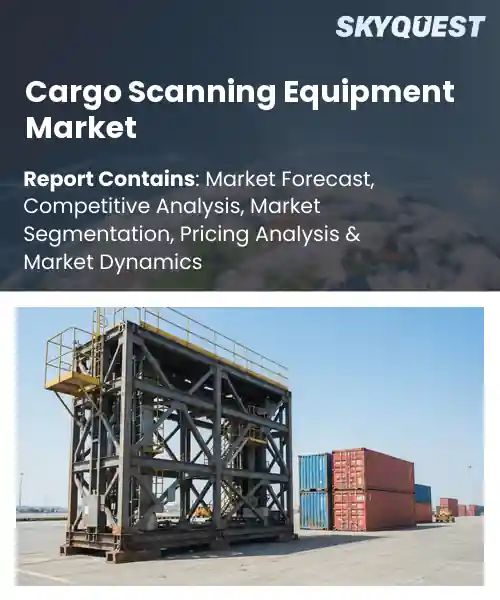
Cargo Scanning Equipment Market
Report ID: SQMIG20O2027
Report ID: SQMIG20O2027
[email protected]
USA +1 351-333-4748
Report ID:
SQMIG20O2027 |
Region:
Global |
Published Date: June, 2026
Pages:
157
|Tables:
97
|Figures:
76


Global Cargo Scanning Equipment Market size was valued at USD 4.02 Billion in 2024 and is poised to grow from USD 4.3 Billion in 2025 to USD 7.33 Billion by 2033, growing at a CAGR of 6.9% during the forecast period (2026-2033).
The primary driver of the cargo scanning equipment market is expanding global trade combined with heightened security mandates, which force governments and logistics operators to deploy non-intrusive inspection technologies. Cargo scanning includes X-ray, gamma, neutron, muon tomography and CT systems used at ports, airports and border crossings to find contraband, explosives and radiological threats while maintaining throughput. The market matters because it enables trade facilitation alongside interdiction of illicit flows; after 2001 regulatory tightening and the rise of containerized shipments accelerated technology adoption. For example, North Sea ports implemented automated X-ray lines and customs agencies in emerging markets use mobile scanners.
Building on that regulatory and trade-driven impetus, technological innovation and systems integration constitute the market's growth factor because advanced imaging and artificial intelligence directly improve detection rates while lowering inspection time. As volumes rise and threats diversify, demand for high-resolution CT, automated image analysis and remote monitoring increases, prompting vendors to invest in research and offer upgrades. This causes terminal operators to reduce dwell times and compliance costs, which in turn creates opportunities for subscription analytics, retrofit programs and predictive maintenance services. Real-world implementations include automated screening lanes at major container terminals and CT-based parcel inspection in e-commerce fulfillment centers.
How is AI Improving Detection Accuracy in the cCargo Scanning Equipment Market?
AI is improving detection accuracy in cargo scanning by combining smarter image analysis and contextual data fusion. Key aspects include machine learning models trained to recognize threat signatures in three dimensional CT images, automated anomaly highlighting that focuses operator attention, and sensor fusion that brings X ray, radiation, and manifest data together. The current market sees suppliers embedding these capabilities into new scanners to reduce false alarms and speed throughput while meeting stricter screening requirements. Examples of this trend appear in deployments of advanced 3D CT scanners and intelligent image review systems that help customs and airports scale screening without proportional staffing increases.
In December 2025, Smiths Detection's SDX 100100 DV HC was added to the TSA Air Cargo Screening Technology List signaling regulatory acceptance of AI enabled screening. That milestone shows how automated threat recognition and smarter image review lift detection accuracy and encourage wider procurement and operational efficiency.
Market snapshot - (2026-2033)
Global Market Size
USD 4.02 Billion
Largest Segment
X-Ray Scanners
Fastest Growth
Explosive Trace Detectors
Growth Rate
6.9% CAGR
To get more insights on this market click here to Request a Free Sample Report
Global cargo scanning equipment market is segmented by equipment type, cargo size, end-user and region. Based on equipment type, the market is segmented into X-ray scanners, non-computed tomography, explosive trace detectors, narcotics trace detectors, radiation detectors and others. Based on cargo size, the market is segmented into small parcels, break pallet cargo, oversized cargo and others. Based on end-user, the market is segmented into airports, railway stations, border control agencies, logistics and transportation, industrial and manufacturing facilities and others. Based on region, the market is segmented into North America, Europe, Asia Pacific, Latin America and Middle East & Africa.
Based on the global cargo scanning equipment market growth, X-Ray scanners segment dominates because their ability to deliver rapid, high resolution imaging addresses the core detection needs of cargo screening across diverse load types. Superior image clarity and mature integration with automated conveyance and threat recognition software reduce manual inspection, improving throughput and operator confidence. Procurement preferences favor established technologies with proven reliability, driving widespread deployment and creating entrenched supplier relationships that reinforce adoption and operational standardization.
However, non-computed tomography is witnessing the strongest growth as demand rises for flexible, lower cost inspection solutions for varied cargo types. Advances in portable detectors and software analytics enable rapid deployment in constrained or mobile checkpoints, attracting logistics operators and regulatory programs. This drives broader adoption and creates new commercial opportunities across inspection workflows.
Airports segment dominates because they operate high volume throughput corridors where security mandates and operator expectations demand integrated, high speed scanning solutions. Centralized checkpoints with predictable flows incentivize investment in fixed, automated systems that tie into baggage handling and cargo logistics platforms, creating economies of scale. Procurement cycles and long term maintenance contracts favor vendors offering turnkey solutions, accelerating technology standardization and continuous upgrades aligned with evolving threat detection requirements.
However, logistics and transportation is witnessing the fastest growth driven by demand for rapid parcel throughput and supply chain visibility. Adoption of mobile scanners, IoT enabled detectors and API driven data sharing enables real-time cargo verification across distribution hubs, prompting investment in scalable inspection fleets and software services that create operational efficiencies and new commercial models.
To get detailed segments analysis, Request a Free Sample Report
Based on the global cargo scanning equipment market share, North America dominates the industry through a combination of robust infrastructure, stringent regulatory frameworks, and concentrated demand at major air and seaport hubs. Procurement strategies favor integrated systems and reliable service ecosystems, encouraging suppliers to offer advanced imaging, automation and software integration. Strong vendor presence and ongoing collaboration between industry and government accelerate technology adoption and field validation. Emphasis on threat detection, operational efficiency and seamless logistics integration drives specification of high-end solutions. Mature maintenance and support networks reduce operational risk for adopters, while training programs and standards harmonization enable scalable deployments. The result is a market environment where innovation, capital availability and operational scale reinforce one another, sustaining leadership in both technology development and commercial deployment.
Cargo scanning equipment market in the United States is characterized by sophisticated logistics networks, port and airport operations, and procurement processes that prioritize integrated, reliable solutions. Public-private coordination supports deployments and operational validation, while a concentrated vendor ecosystem advances system customization and lifecycle services. Emphasis on interoperability, training and maintenance underpins adoption in complex supply chains, and demand is driven by a focus on security, throughput optimization and regulatory compliance.
Cargo scanning equipment market in Canada emphasizes adaptability to a dispersed geography, corridors and cross-border trade. Procurement often balances centralized standards with localized service capabilities, encouraging mobile and scalable scanning solutions. Collaboration between federal authorities and regional operators supports deployments and training, while vendor networks focus on maintenance and remote diagnostics. Operational priorities include reliability in variable environments, seamless integration with logistics systems and alignment with security and trade facilitation.
Based on the global cargo scanning equipment regional forecast, Europe is experiencing rapid expansion in industry driven by coordinated regulatory emphasis on supply chain security, modernization initiatives at major ports and airports, and growing prioritization of trade facilitation alongside threat detection. Cross-border trade complexity motivates harmonized standards and interoperable technologies, encouraging suppliers to offer modular, scalable systems that accommodate diverse logistics nodes. Strong competition among regional and global vendors stimulates product differentiation in imaging, analytics and automation. Public procurement and collaborative pilots with port authorities and freight operators accelerate adoption, while integrated solutions that reduce dwell times and support customs processes gain preference. Regional emphasis on sustainability and operational efficiency further shapes procurement specifications and long-term service relationships. Investment in digitalization and partnerships between technology providers, customs agencies and terminal operators enable higher-value offerings and practical deployments across diverse hubs. Emphasis on training and standardized certification supports scalable rollouts.
Cargo scanning equipment market in Germany benefits from a strong industrial base, engineering expertise and focus on system integration. Procurement favors high-specification solutions that can be tailored for terminal operations and rail interfaces. Collaboration between technology providers, port authorities and systems integrators supports deep customization and validation. After-sales networks and local manufacturing capacity underpin lifecycle support, while technical standards and training frameworks facilitate reliable deployments across key logistics hubs nationwide.
Cargo scanning equipment market in the United Kingdom features dynamic adoption, driven by modernizing ports, customs enhancements and private investment. Buyers favor flexible, deployable systems that integrate analytics and remote monitoring to address evolving trade patterns. Pilots between operators, technology firms and regulatory bodies validate performance, while an agile procurement environment and strong service networks encourage experimentation. Focus on throughput and operational resilience shapes vendor offerings and deployment choices nationwide.
Cargo scanning equipment market in France is emerging through targeted modernization at ports and customs integration with logistics networks. Procurement increasingly favors modular platforms that can be adapted for seaport, airport and road contexts, supporting flexibility. Collaboration with research centers and technology vendors fosters innovation in imaging and analytics, while service providers develop maintenance and training capabilities. Emphasis on interoperability and compliance with regional standards encourages adoption across transport nodes.
As per global cargo scanning equipment regional outlook, Asia Pacific is strengthening its position in the industry through concerted investment in port modernization, digital infrastructure and close collaboration between regional manufacturers and global technology providers. Strategic focus on smart port capabilities, automation and data-driven inspection workflows has elevated demand for integrated imaging, analytics and remote monitoring solutions tailored to dense trade corridors. Local vendors leverage manufacturing scale to deliver cost-competitive systems, while public-private partnerships accelerate pilot programs and practical validation. Regulatory harmonization across customs and transport authorities supports interoperability, and emphasis on workforce training, maintenance networks and localized service offerings ensures sustainable deployments. The combination of operational urgency, industrial capability and targeted innovation positions the region as an increasingly influential market for advanced cargo screening solutions.
Cargo scanning equipment market in Japan is driven by a strong technology ecosystem, precision manufacturing and focus on automation and reliability. Demand emphasizes integrated systems combining advanced imaging, analytics and connectivity with terminal operating platforms. Collaboration between manufacturers, research institutions and port operators advances innovation and validation. Emphasis on service agreements, local supply chains and workforce training supports dependable deployments, while customization addresses varied maritime and air cargo operational requirements.
Cargo scanning equipment market in South Korea benefits from strong electronics capability, advanced port automation and integration between technology firms and logistics operators. Demand favors compact scanners with sophisticated software for image analysis and remote diagnostics. Local manufacturers and system integrators collaborate with terminal operators to pilot solutions and tailor deployments. Emphasis on rapid maintenance response and interoperability with existing terminal systems supports regional adoption across diverse cargo handling environments.
To know more about the market opportunities by region and country, click here to
Buy The Complete Report
Rising Global Trade Security Concerns
Advancements In Detection Technology
High Capital Investment Requirements
Regulatory Complexity And Compliance
Request Free Customization of this report to help us to meet your business objectives.
The competitive landscape is marked by technology differentiation and procurement-led consolidation, with suppliers using targeted M&A, technology partnerships, and product innovation to win customs and logistics contracts. Recent examples include computed tomography product launches and vendor alliances with AI firms for automated threat recognition, plus private equity interest in modular AI-enabled inspection units, all driving faster adoption of advanced cargo scanning solutions.
Top Player’s Company Profile
Recent Developments
SkyQuest’s ABIRAW (Advanced Business Intelligence, Research & Analysis Wing) is our Business Information Services team that Collects, Collates, Correlates, and Analyses the Data collected by means of Primary Exploratory Research backed by robust Secondary Desk research.
As per SkyQuest analysis, the global cargo scanning equipment industry is driven primarily by expanding global trade and stricter security mandates that push governments and logistics operators to adopt non-intrusive inspection technologies, while North America leads demand supported by robust infrastructure and regulatory frameworks. X-Ray Scanners remain the dominant equipment segment due to fast, high-resolution imaging and integration with automated systems. A second key growth driver is rapid technological innovation, including AI-enabled image analysis and system integration that boost throughput and detection accuracy. However, adoption is constrained by high capital investment requirements for advanced scanners, installation, training and ongoing maintenance, which can slow deployments among smaller operators.
| Report Metric | Details |
|---|---|
| Market size value in 2024 | USD 4.02 Billion |
| Market size value in 2033 | USD 7.33 Billion |
| Growth Rate | 6.9% |
| Base year | 2024 |
| Forecast period | (2026-2033) |
| Forecast Unit (Value) | USD Billion |
| Segments covered |
|
| Regions covered | North America (US, Canada), Europe (Germany, France, United Kingdom, Italy, Spain, Rest of Europe), Asia Pacific (China, India, Japan, Rest of Asia-Pacific), Latin America (Brazil, Rest of Latin America), Middle East & Africa (South Africa, GCC Countries, Rest of MEA) |
| Companies covered |
|
| Customization scope | Free report customization with purchase. Customization includes:-
|
To get a free trial access to our platform which is a one stop solution for all your data requirements for quicker decision making. This platform allows you to compare markets, competitors who are prominent in the market, and mega trends that are influencing the dynamics in the market. Also, get access to detailed SkyQuest exclusive matrix.
Table Of Content
Executive Summary
Market overview
Parent Market Analysis
Market overview
Market size
KEY MARKET INSIGHTS
COVID IMPACT
MARKET DYNAMICS & OUTLOOK
Market Size by Region
KEY COMPANY PROFILES
Methodology
For the Cargo Scanning Equipment Market, our research methodology involved a mixture of primary and secondary data sources. Key steps involved in the research process are listed below:
1. Information Procurement: This stage involved the procurement of Market data or related information via primary and secondary sources. The various secondary sources used included various company websites, annual reports, trade databases, and paid databases such as Hoover's, Bloomberg Business, Factiva, and Avention. Our team did 45 primary interactions Globally which included several stakeholders such as manufacturers, customers, key opinion leaders, etc. Overall, information procurement was one of the most extensive stages in our research process.
2. Information Analysis: This step involved triangulation of data through bottom-up and top-down approaches to estimate and validate the total size and future estimate of the Cargo Scanning Equipment Market.
3. Report Formulation: The final step entailed the placement of data points in appropriate Market spaces in an attempt to deduce viable conclusions.
4. Validation & Publishing: Validation is the most important step in the process. Validation & re-validation via an intricately designed process helped us finalize data points to be used for final calculations. The final Market estimates and forecasts were then aligned and sent to our panel of industry experts for validation of data. Once the validation was done the report was sent to our Quality Assurance team to ensure adherence to style guides, consistency & design.
Analyst Support
Customization Options
With the given market data, our dedicated team of analysts can offer you the following customization options are available for the Cargo Scanning Equipment Market:
Product Analysis: Product matrix, which offers a detailed comparison of the product portfolio of companies.
Regional Analysis: Further analysis of the Cargo Scanning Equipment Market for additional countries.
Competitive Analysis: Detailed analysis and profiling of additional Market players & comparative analysis of competitive products.
Go to Market Strategy: Find the high-growth channels to invest your marketing efforts and increase your customer base.
Innovation Mapping: Identify racial solutions and innovation, connected to deep ecosystems of innovators, start-ups, academics, and strategic partners.
Category Intelligence: Customized intelligence that is relevant to their supply Markets will enable them to make smarter sourcing decisions and improve their category management.
Public Company Transcript Analysis: To improve the investment performance by generating new alpha and making better-informed decisions.
Social Media Listening: To analyze the conversations and trends happening not just around your brand, but around your industry as a whole, and use those insights to make better Marketing decisions.
REQUEST FOR SAMPLE
 REQUEST FREE CUSTOMIZATION
Global Cargo Scanning Equipment Market size was valued at USD 4.02 Billion in 2024 and is poised to grow from USD 4.3 Billion in 2025 to USD 7.33 Billion by 2033, growing at a CAGR of 6.9% during the forecast period (2026-2033).
The competitive landscape is marked by technology differentiation and procurement-led consolidation, with suppliers using targeted M&A, technology partnerships, and product innovation to win customs and logistics contracts. Recent examples include computed tomography product launches and vendor alliances with AI firms for automated threat recognition, plus private equity interest in modular AI-enabled inspection units, all driving faster adoption of advanced cargo scanning solutions. 'Leidos Holdings Inc.', 'Smiths Detection Group Ltd.', 'OSI Systems Inc.', 'Nuctech Company Limited', 'Teledyne Technologies', 'Rapiscan Systems Inc.', 'Analogic Corporation', 'Astrophysics Inc.', 'L3 Security & Detection Systems Inc.', 'Elbit Systems Ltd.', 'ADANI SRL', 'Kromek Group', 'VOTI Detection Inc.', 'Westminster International Ltd.', 'Vidisco Ltd.', 'Scanna MSC Ltd.', 'Gilardoni S.p.A.', 'Todd Research Ltd.', 'LIXI Inc.', 'IDEMIA'
Heightened concerns about illicit trafficking, contraband, and potential threats at ports and border crossings have prompted authorities and logistics operators to prioritize advanced screening solutions. This prioritization encourages procurement of modern cargo scanning equipment that can enhance inspection throughput while improving detection capabilities. Stakeholders perceive such systems as essential to maintain supply chain continuity and public safety, prompting investments in scanning infrastructure to mitigate security risks and avoid operational disruptions, which in turn supports market expansion as demand shifts toward reliable, automated screening technologies.
Ai Driven Threat Detection: Advances in machine learning and sensor fusion are enabling cargo scanning equipment to identify anomalies with greater contextual understanding and fewer false alarms. Vendors are focusing on adaptive algorithms that learn cargo signatures and prioritize operator attention to higher risk items, improving throughput while maintaining security. Integration of predictive analytics supports smarter alerting and resource allocation, fostering operational efficiencies. Stakeholders are adopting these capabilities to reduce manual inspection burden and enhance confidence in automated screening across diverse logistical environments worldwide.
Why does North America Dominate the Global Cargo Scanning Equipment Market? |@12


Want to customize this report? This report can be personalized according to your needs. Our analysts and industry experts will work directly with you to understand your requirements and provide you with customized data in a short amount of time. We offer $1000 worth of FREE customization at the time of purchase.
Feedback From Our Clients


 USA (+1) 351-333-4748

