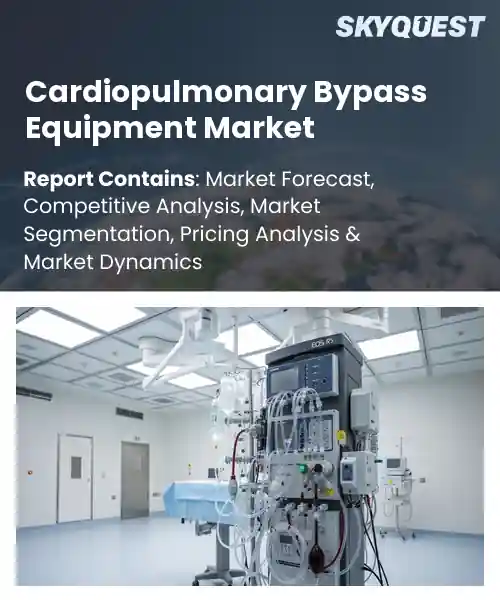
Cardiopulmonary Bypass Equipment Market
Report ID: SQMIG35A4059
Report ID: SQMIG35A4059
[email protected]
USA +1 351-333-4748
Report ID:
SQMIG35A4059 |
Region:
Global |
Published Date: July, 2026
Pages:
157
|Tables:
201
|Figures:
80


Global Cardiopulmonary Bypass Equipment Market size was valued at USD 2.1 Billion in 2024 and is poised to grow from USD 2.21 Billion in 2025 to USD 3.37 Billion by 2033, growing at a CAGR of 5.4% during the forecast period (2026-2033).
The cardiopulmonary bypass (CPB) equipment market growth is fueled by more cardiovascular diseases showing up that need open chest procedures, like coronary artery bypass grafting and valve swapping, plus fixing congenital heart defect issues. An older global population is part of it, but also obesity, diabetes and hypertension are climbing too, so more patients get pushed toward cardiac surgery. At the same time, the whole tech side has moved forward: heart-lung machines are better tuned, oxygenators are more efficient, arterial filters are refined and monitoring systems give steadier information. That whole mix helps make procedures safer and more precise, and the patients often do better.
In addition, more money is being put into dedicated cardiac care centers, and in some emerging countries people can access advanced surgical facilities more easily. On top of that, there is the growing use of less invasive heart methods, and even more intricate cardiac operations; plus people are paying more attention to early cardiovascular treatment, and healthcare budgets are not shrinking, which keeps supporting demand for cardiopulmonary bypass equipment.
AI-driven automation is reshaping the cardiopulmonary bypass equipment market outlook by placing intelligent control loops inside the system, and these loops continuously tweak flow, pressure, and temperature based on what the patient physiology is saying. Then machine-learning models look at sensor readings in real time, forecast likely complications, and warn perfusionists before things turn bad. Because of that, there is less dependence on hands-on tweaks, surgeries can finish faster , and overall patient safety improves. There are also connected platforms that automate paperwork, make inventory tracking smoother, and allow remote watching of how the equipment performs. When hospitals start using “smarter” operating rooms, manufacturers are embedding AI modules directly into bypass consoles. That creates smaller, easier-to-use systems, they help with clinical decisions while also reducing day to day operational expenses.
Market snapshot - (2026-2033)
Global Market Size
USD 2.1 Billion
Largest Segment
Heart-Lung Machines
Fastest Growth
Cannulae
Growth Rate
5.4% CAGR
To get more insights on this market click here to Request a Free Sample Report
The global cardiopulmonary bypass equipment market is segmented by product type, technology, application, end user, patient type, component type, usage type and region. Based on product type, the market is segmented into Heart-Lung Machines, Oxygenators, Blood Pumps, Cannulae, Tubing Sets & Circuits and Filters & Accessories. Based on technology, the market is segmented into Roller Pump Systems and Centrifugal Pump Systems. Based on application, the market is segmented into Coronary Artery Bypass Grafting (CABG), Heart Valve Surgery, Congenital Heart Defect Surgery, Heart & Lung Transplantation and Other Open-Heart Surgeries. Based on end user, the market is segmented into Hospitals, Cardiac Surgery Centers and Specialty Heart Institutes. Based on patient type, the market is segmented into Adult, Pediatric and Neonatal. Based on component type, the market is segmented into Equipment & Systems, Disposable Consumables and Accessories. Based on usage type, the market is segmented into Reusable Equipment and Single-Use Consumables. Based on region, the market is segmented into North America, Europe, Asia Pacific, Latin America and Middle East & Africa.
As per the cardiopulmonary bypass equipment market analysis, the heart-lung machines segment dominates because they bring together oxygenation with circulation in a single setup, so they end up being the main platform for a bypass procedure. Their overall design helps in reducing the equipment footprint a bit and also makes the intra-operative workflow calmer, which then pushes surgeon preference. There’s also reliability, lots of clinical verification, plus they can work with many accessory types. Together, that cements their top position in the market. Cost efficiency and solid training support, plus the fact that upgrades keep coming, also keep adoption steady across hospitals.
Meanwhile, the oxygenators segment feels like the rapidly expanding area in the cardiopulmonary bypass equipment market. New membrane technology that improves gas exchange performance, and the general move toward single‑use setups for better sterility, both are pulling demand upward. This whole momentum then creates room for new innovators, and it broadens use cases in more complicated procedures.
According to the cardiopulmonary bypass equipment market forecast, coronary artery bypass grafting (CABG, for short) tends to dominate since it’s linked to the highest volume of open-heart procedures, so demand stays consistent for dependable bypass systems. Surgeons lean on well-known protocols and equipment that already has proven results. That leads to higher bulk procurement and long-term service arrangements. The predictability of the procedure, plus the big pool of clinical evidence, makes suppliers feel more secure. As a result, they keep refining products, and that helps lock in its central role for market stability, revenue generation, and also pushes collaborative research initiatives so these systems become part of the usual care pathway.
On the other side, the congenital heart defect surgery segment is showing the strongest growth momentum in the cardiopulmonary bypass equipment market. Things like innovations in miniaturized circuits and pediatric-specific cannulae are expanding adoption, along with a growing focus on early surgical correction. This rise in surgeries creates stronger demand for specialized devices and it also encourages companies to diversify their product lines.
To get detailed segments analysis, Request a Free Sample Report
As per the cardiopulmonary bypass equipment market regional forecast, North America keeps dominating because of messy combination of established healthcare delivery systems , fast uptake of newer technologies, and a reimbursement setting that basically nudges hospitals to spend on upgraded surgical gear. There’s also a bunch of top equipment makers clustered in the region, and they get to work closely with top tier academic medical centers, which makes product changes happen quicker, along with faster clinical proofing. The regulatory routes are fairly straightforward so companies can enter sooner, and then financing options help hospitals move toward high‑performance bypass platforms. Add in an experienced cardiac surgery staff plus a big clinical trial backbone, and offer this self-repeating pattern where innovation leads to adoption, which then leads to more market growth.
United States Cardiopulmonary Bypass Equipment Market
The Cardiopulmonary Bypass Equipment market outlook in the United States is shaped by a tight net of major research hospitals that adopt the next‑generation devices early. Big manufacturers lean into partnerships with these institutions, to co create solutions that bring in advanced monitoring plus data analytics. Buying choices are increasingly tied to value based models, where clinical results and operational efficiency actually matter more. The whole scene is helped by a regulatory environment that tries to stay safety focused but also doesn’t block speed, so novel technologies can be introduced quickly while patient protection stays strict.
Canada Cardiopulmonary Bypass Equipment Market
In Canada, the Cardiopulmonary Bypass Equipment sector runs inside a universal system that leans toward cost effectiveness and fair access. Hospital networks often prefer equipment that shows reliable clinical outcomes, and they follow national procurement guidance that pushes bulk buying and standardization. Manufacturers also work alongside provincial health authorities, which helps new technology land in the market only if it passes stringent safety hurdles. Training and competency building show up a lot too, meaning surgical teams are ready to switch onto newer bypass platforms, and demand for dependable equipment stays steady, more or less.
Europe is expanding its cardiopulmonary bypass equipment market share because regulatory standards are more aligned, so products can move across borders with less hassle and manufacturers can think in one broader market. At the same time, an aging population, plus higher rates of complicated cardiac procedures, keeps boosting demand for more sophisticated bypass solutions. There’s also noticeable public and private funding for healthcare innovation, which supports research partnerships and helps produce devices with stronger safety elements and shorter procedure time. Sustainability concerns, including circular economy ideas, are starting to influence how devices are designed, while integrated procurement across member states helps scale newer equipment in a more cost-controlled way.
Germany Cardiopulmonary Bypass Equipment Market
The Cardiopulmonary Bypass Equipment industry in Germany benefits from an engineering tradition that values precision, steadiness, and real performance. Large volume cardiac centers want devices that keep hemodynamic control stable, so manufacturers adjust their offerings to strict clinical expectations. Industry and research groups are tightly connected, so improvements keep coming and new technologies get absorbed faster. Because the market favors premium, high-performance equipment, Germany tends to act like a quality benchmark across the European scene.
United Kingdom Cardiopulmonary Bypass Equipment Market
In the United Kingdom, the Cardiopulmonary Bypass Equipment Market is accelerating to national health actions aimed at refreshing surgical infrastructure. The NHS is pushing digital integration , and because procurement is more outcomes driven , suppliers get incentives to offer systems with better data connectivity and real time monitoring features. Private providers are also showing up more, adding competitive pressure, while joint research initiatives with leading universities feed ongoing innovation. With all that in place, the UK is positioned like a key growth engine within the larger European market.
France Cardiopulmonary Bypass Equipment Market
The Cardiopulmonary Bypass Equipment Market penetration in France is driven through increased public funding for cardiac care, plus a policy setup that encourages domestic manufacturing. French hospitals are gradually upgrading to devices that meet European safety and performance expectations, and they’re also paying attention to ergonomic design and ease of use. There are collaboration links connecting clinical specialists with equipment developers, so solutions can be tuned to match local practice patterns. This supporting ecosystem is slowly expanding, and it’s gradually widening France’s presence across the broader European market.
Asia Pacific keeps strengthening its stance, by syncing up the rising demand for cardiac surgery with some concerted government health initiatives and, also with substantial private‑sector investment. In practice the region’s middle‑class population is growing, and that tends to pull higher utilization of advanced medical services so hospitals try to source state of the art bypass technologies that try to juggle performance with cost, at the same time. Meanwhile, Indigenous R&D capacity is maturing, helped along through strategic alliances with global manufacturers, which speeds up technology transfer and all that. There is also more emphasis on smart, data rich devices plus training programs for surgical teams, which then improves clinical outcomes and makes the region look like a more influential participant in the global market
Japan Cardiopulmonary Bypass Equipment Market
The Cardiopulmonary Bypass Equipment market in Japan shows a long standing commitment to precision engineering and very meticulous clinical expectations. Japanese healthcare institutions typically want devices that integrate smoothly, with robotic assistance and full patient monitoring. There is rigorous regulatory oversight too, so the equipment has to meet exacting safety points, and because there’s a culture of ongoing refinement manufacturers keep adding small, incremental changes that boost reliability and make operation easier. All in all, this insistence on high quality solutions and technically sophisticated systems helps maintain Japan’s reputation as a leader in cardiac surgical equipment
South Korea Cardiopulmonary Bypass Equipment Market
The Cardiopulmonary Bypass Equipment market in South Korea is being pushed forward by a dynamic industrial foundation that blends advanced electronics know-how with medical device development. Government policies that encourage export-led manufacturing and also encourage collaboration with academic hospitals help accelerate the rollout of smart bypass platforms; these systems come with real-time analytics. On top of that, investment in training programs builds the surgical teams' confidence and capability to adopt these technologically enhanced systems. In other words, the combination of technological strength, supportive policy, and a rapidly expanding cardiac care network makes South Korea feel like it’s becoming a growing hub within the regional market.
To know more about the market opportunities by region and country, click here to
Buy The Complete Report
Rising Cardiac Surgery Volume
Integration Of Automated Monitoring Systems
High Capital Expenditure Costs
Regulatory Compliance Complexity
Request Free Customization of this report to help us to meet your business objectives.
The cardiopulmonary bypass equipment market looks fierce, because manufacturers keep pushing product differentiation , they also go after strategic partnerships and try to ride along with breakthrough technologies. This competition gets even louder when venture funding happens fast, so innovation keeps getting cash and momentum. Then on top of that, North American demand and these emerging accessory segments make companies scramble for exclusive distribution arrangements and co‑development agreements, which makes the market contestable overall.
Top Player’s Company Profile
Recent Developments in the Cardiopulmonary Bypass Equipment Market
SkyQuest’s ABIRAW (Advanced Business Intelligence, Research & Analysis Wing) is our Business Information Services team that Collects, Collates, Correlates, and Analyses the Data collected by means of Primary Exploratory Research backed by robust Secondary Desk research.
As per SkyQuest analysis, the global cardiopulmonary bypass equipment market is being pushed mainly by rising cardiac surgery volumes, which push hospitals to upgrade to more precise bypass systems. Then, the integration of automated monitoring systems gives another boost, because it improves safety and it shortens operative times. But high capital‑expenditure costs stay as a restraint, especially for providers in emerging economies, where budgets can be tight. North America still leads the market, mainly due to mature health‑care infrastructure and strong reimbursement support. And within the product mix, heart‑lung machines take the largest share, because they combine oxygenation and circulation functions into one platform, instead of separate components. These forces together are shaping the market outlook in the coming years.
| Report Metric | Details |
|---|---|
| Market size value in 2024 | USD 2.1 Billion |
| Market size value in 2033 | USD 3.37 Billion |
| Growth Rate | 5.4% |
| Base year | 2024 |
| Forecast period | (2026-2033) |
| Forecast Unit (Value) | USD Billion |
| Segments covered |
|
| Regions covered | North America (US, Canada), Europe (Germany, France, United Kingdom, Italy, Spain, Rest of Europe), Asia Pacific (China, India, Japan, Rest of Asia-Pacific), Latin America (Brazil, Rest of Latin America), Middle East & Africa (South Africa, GCC Countries, Rest of MEA) |
| Companies covered |
|
| Customization scope | Free report customization with purchase. Customization includes:-
|
To get a free trial access to our platform which is a one stop solution for all your data requirements for quicker decision making. This platform allows you to compare markets, competitors who are prominent in the market, and mega trends that are influencing the dynamics in the market. Also, get access to detailed SkyQuest exclusive matrix.
Table Of Content
Executive Summary
Market overview
Parent Market Analysis
Market overview
Market size
KEY MARKET INSIGHTS
COVID IMPACT
MARKET DYNAMICS & OUTLOOK
Market Size by Region
KEY COMPANY PROFILES
Methodology
For the Cardiopulmonary Bypass Equipment Market, our research methodology involved a mixture of primary and secondary data sources. Key steps involved in the research process are listed below:
1. Information Procurement: This stage involved the procurement of Market data or related information via primary and secondary sources. The various secondary sources used included various company websites, annual reports, trade databases, and paid databases such as Hoover's, Bloomberg Business, Factiva, and Avention. Our team did 45 primary interactions Globally which included several stakeholders such as manufacturers, customers, key opinion leaders, etc. Overall, information procurement was one of the most extensive stages in our research process.
2. Information Analysis: This step involved triangulation of data through bottom-up and top-down approaches to estimate and validate the total size and future estimate of the Cardiopulmonary Bypass Equipment Market.
3. Report Formulation: The final step entailed the placement of data points in appropriate Market spaces in an attempt to deduce viable conclusions.
4. Validation & Publishing: Validation is the most important step in the process. Validation & re-validation via an intricately designed process helped us finalize data points to be used for final calculations. The final Market estimates and forecasts were then aligned and sent to our panel of industry experts for validation of data. Once the validation was done the report was sent to our Quality Assurance team to ensure adherence to style guides, consistency & design.
Analyst Support
Customization Options
With the given market data, our dedicated team of analysts can offer you the following customization options are available for the Cardiopulmonary Bypass Equipment Market:
Product Analysis: Product matrix, which offers a detailed comparison of the product portfolio of companies.
Regional Analysis: Further analysis of the Cardiopulmonary Bypass Equipment Market for additional countries.
Competitive Analysis: Detailed analysis and profiling of additional Market players & comparative analysis of competitive products.
Go to Market Strategy: Find the high-growth channels to invest your marketing efforts and increase your customer base.
Innovation Mapping: Identify racial solutions and innovation, connected to deep ecosystems of innovators, start-ups, academics, and strategic partners.
Category Intelligence: Customized intelligence that is relevant to their supply Markets will enable them to make smarter sourcing decisions and improve their category management.
Public Company Transcript Analysis: To improve the investment performance by generating new alpha and making better-informed decisions.
Social Media Listening: To analyze the conversations and trends happening not just around your brand, but around your industry as a whole, and use those insights to make better Marketing decisions.
REQUEST FOR SAMPLE
 REQUEST FREE CUSTOMIZATION
Global Cardiopulmonary Bypass Equipment Market size was valued at USD 2.1 Billion in 2024 and is poised to grow from USD 2.21 Billion in 2025 to USD 3.37 Billion by 2033, growing at a CAGR of 5.4% during the forecast period (2026-2033).
The cardiopulmonary bypass equipment market is shaped by intense rivalry as manufacturers accelerate product differentiation, leverage strategic partnerships and chase breakthrough technologies. Competitive pressure is amplified by rapid venture funding that fuels innovation, while North American demand and emerging accessory segments drive firms to secure exclusive distribution agreements and co‑development deals, intensifying market contestability. 'Getinge AB', 'LivaNova PLC', 'Terumo Corporation', 'Medtronic plc', 'Xenios AG', 'Eurosets S.r.l.', 'Braile Biomedica', 'Nipro Corporation', 'Senko Medical Instrument Mfg. Co., Ltd.', 'Inspira Technologies OXY B.H.N. Ltd.', 'OriGen Biomedical, Inc.', 'Kewei (Jiangsu) Medical Equipment Co., Ltd.', 'Hemovent GmbH', 'Lepu Medical Technology (Beijing) Co., Ltd.', 'MicroPort Scientific Corporation', 'Xijian Medical Co., Ltd.', 'MC3 Cardiopulmonary', 'Medos Medizintechnik AG', 'Dongguan Kewei Medical Instrument Co., Ltd.', 'Tianjin Plastics Research Institute Co., Ltd.'
The growing prevalence of complex cardiac procedures drives hospitals to invest in advanced cardiopulmonary bypass equipment, ensuring precise blood management and improved patient outcomes. Surgeons rely on reliable machines to reduce intraoperative complications, while healthcare facilities seek to expand their service offerings to attract referrals. This demand stimulates manufacturers to innovate, leading to broader product portfolios and enhanced system reliability, which further encourages adoption across both established and emerging cardiac centers and supports the overall growth of the cardiopulmonary bypass market.
Ai‑Driven Perfusion Optimization: Healthcare providers are rapidly adopting artificial intelligence to enhance perfusion management during cardiopulmonary bypass. Machine‑learning models analyze real‑time physiological data, predicting optimal flow rates and oxygen delivery, thereby reducing intraoperative complications. Surgeons benefit from decision‑support dashboards that adjust parameters automatically, improving patient safety and shortening operative times. This shift toward data‑centric operating rooms also accelerates clinician training by providing actionable insights, fostering a culture of continuous improvement across cardiac surgery departments worldwide and elevating postoperative recovery while lowering complication rates.
Why does North America Dominate the Global Cardiopulmonary Bypass Equipment Market? |@12


Want to customize this report? This report can be personalized according to your needs. Our analysts and industry experts will work directly with you to understand your requirements and provide you with customized data in a short amount of time. We offer $1000 worth of FREE customization at the time of purchase.
Feedback From Our Clients


 USA (+1) 351-333-4748

