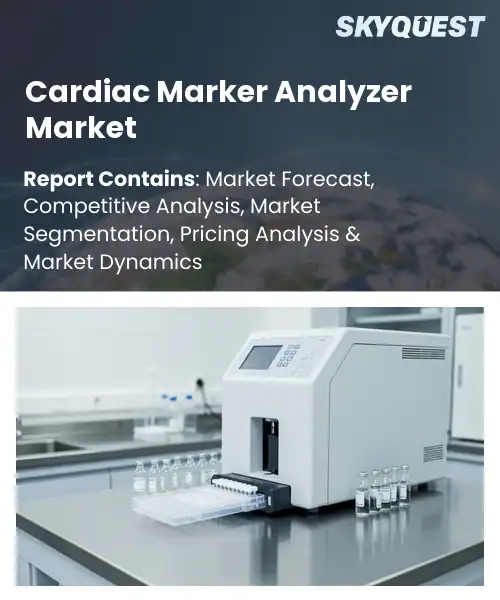
Cardiac Marker Analyzer Market
Report ID: SQMIG35A4159
Report ID: SQMIG35A4159
[email protected]
USA +1 351-333-4748
Report ID:
SQMIG35A4159 |
Region:
Global |
Published Date: July, 2026
Pages:
157
|Tables:
122
|Figures:
77


Global Cardiac Marker Analyzer Market size was valued at USD 1.01 Billion in 2024 and is poised to grow from USD 1.07 Billion in 2025 to USD 1.68 Billion by 2033, growing at a CAGR of 5.8% during the forecast period (2026-2033).
The increasing prevalence of cardiovascular diseases (CVDs), including myocardial infarction, heart failure, and acute coronary syndrome, is the primary driver of the Global Cardiac Marker Analyzer Market. As heart-related emergencies continue to rise due to aging populations, sedentary lifestyles, obesity, and diabetes, healthcare providers require rapid and accurate diagnosis to initiate timely treatment. Cardiac marker analyzers enable fast measurement of biomarkers such as troponin, CK-MB, and BNP, significantly reducing diagnosis time. This improves clinical decision-making, enhances patient survival rates, minimizes hospital stays, and ultimately drives greater adoption of advanced cardiac marker analyzers across hospitals and diagnostic laboratories.
The increasing adoption of high-sensitivity assays and fully automated cardiac marker analyzers is a key trend driving the global cardiac marker analyzer sector growth. Healthcare facilities are investing in advanced analyzers capable of delivering highly accurate results with minimal manual intervention, improving laboratory efficiency and reducing diagnostic errors. Integration with digital laboratory systems and AI-assisted data interpretation further enhances workflow and clinical confidence. As laboratories prioritize faster turnaround times, standardized testing, and improved operational efficiency, demand for automated cardiac marker analyzers continues to rise, supporting broader implementation in both centralized laboratories and point-of-care settings.
How is AI Improving Diagnostic Accuracy in the Cardiac Marker Analyzer Market?
AI is sharpening diagnostic accuracy in cardiac marker analyzers by embedding deep‑learning models that interpret complex biomarker patterns faster than human eyes. These models continuously learn from large clinical datasets, reducing false‑positive and false‑negative results. Real‑time AI algorithms flag subtle variations in troponin and BNP levels, prompting immediate clinician review. Integration with electronic health records allows the system to cross‑reference patient history, medication use, and comorbidities, creating a more holistic assessment. The technology also supports remote and point‑of‑care devices, expanding access while maintaining laboratory‑grade precision. As hospitals seek higher efficiency and confidence in cardiac risk stratification, AI‑driven analyzers are becoming central to modern cardiology workflows.
In August 2025, Eko Health expanded deployment of its AI-powered cardiac screening platform, enabling detection of heart failure, atrial fibrillation, and valvular heart disease from heart sounds and ECG signals in about 15 seconds. The advancement complements cardiac marker analyzers by improving early triage and supporting faster cardiovascular diagnostic decision-making.
Market snapshot - (2026-2033)
Global Market Size
USD 1.01 Billion
Largest Segment
Instruments
Fastest Growth
Services
Growth Rate
5.8% CAGR
To get more insights on this market click here to Request a Free Sample Report
Global cardiac marker analyzer market is segmented by component, testing type, biomarker type, end user and region. Based on component, the market is segmented into instruments, reagents, consumables and services. Based on testing type, the market is segmented into laboratory testing analyzers and point-of-care testing analyzers. Based on biomarker type, the market is segmented into troponin, CK-MB, myoglobin, brain natriuretic peptide, NT-proBNP and others. Based on end user, the market is segmented into hospitals, diagnostic laboratories, research institutes, cardiac care centers and others. Based on region, the market is segmented into North America, Europe, Asia Pacific, Latin America and Middle East & Africa.
Based on the global cardiac marker analyzer market growth, instruments segment dominates because cardiac marker analysis requires high precision hardware that integrates multiple assay technologies and providers prioritize robust platforms to ensure reliable detection across biomarker panels. The need for continuous uptime in acute care settings drives investment in advanced analyzers equipped with automated calibration and data management features. Consequently, hospitals and laboratories allocate the majority of their budgets to acquire and maintain sophisticated instrument suites.
However, consumables segment emerges as the key high growth area because the shift toward high throughput testing drives demand for larger volumes of reagents, specialty cartridges and quality control materials. Producers are innovating formulations that extend shelf life and improve assay stability, fueling repeat purchases across clinical sites and expanding market size.
Laboratory testing analyzers segment dominates because large hospitals and reference laboratories rely on high volume multiparameter platforms that deliver comprehensive cardiac biomarker panels with superior analytical precision. These systems integrate sophisticated sample handling and data management, meeting stringent accreditation requirements and supporting complex diagnostic algorithms. Consequently, procurement budgets heavily favor centralized laboratory instruments that can process numerous specimens each day while ensuring rapid turnaround times for critical care decisions.
Meanwhile, point-of-care testing analyzers segment emerges as the key high growth area because clinicians demand rapid bedside results to initiate timely therapeutic interventions. Advances in miniaturized sensor technology and connectivity enable compact devices to deliver accurate troponin and natriuretic peptide measurements within minutes. This convenience drives adoption across emergency units and ambulatory settings, expanding market reach and creating new revenue streams for manufacturers.
To get detailed segments analysis, Request a Free Sample Report
As per the global cardiac marker analyzer market share, North America retains leadership through a confluence of advanced healthcare infrastructure, extensive research ecosystems, and early adoption of sophisticated diagnostic technologies. The region benefits from deep integration of cardiac marker analysis within clinical pathways, driven by strong reimbursement frameworks and a culture of evidence‑based practice. Leading manufacturers maintain robust partnerships with prominent hospitals and academic centers, fostering continuous innovation and rapid product diffusion. Additionally, a highly skilled workforce and considerable investment in precision medicine reinforce the market’s maturity and reinforce North America’s position as the benchmark for global adoption.
Cardiac marker analyzer market in United States thrives on an extensive network of tertiary care centers that prioritize rapid cardiac diagnostics, supported by a robust regulatory environment that encourages innovation. Collaboration between industry and leading research institutions accelerates the development of next‑generation analyzers, while comprehensive insurance coverage ensures wide accessibility. The emphasis on personalized medicine and the presence of major technology providers create a fertile landscape for continuous product evolution and market depth.
Cardiac marker analyzer market in Canada is shaped by universal healthcare principles that emphasize equitable access to high‑quality cardiac diagnostics across provinces. Strong governmental support for medical research encourages the adoption of cutting‑edge analyzer technologies in both urban and regional hospitals. Partnerships between public health agencies and industry foster tailored solutions that address the nation’s diverse clinical needs, while a focus on cost‑effectiveness promotes sustainable market growth.
Based on global cardiac marker analyzer regional forecast, Europe’s expansion is propelled by harmonized regulatory standards that streamline market entry and foster cross‑border collaboration among manufacturers and research institutions. A heightened focus on cardiovascular disease prevention drives demand for early diagnostic tools, while public health initiatives prioritize the integration of cardiac marker analysis into routine care pathways. The region’s mature laboratory networks and a growing emphasis on digital health solutions further accelerate adoption, positioning Europe as a dynamic hub for both innovation and market penetration.
Cardiac marker analyzer market in Germany benefits from a strong industrial base and a deep commitment to research excellence, resulting in swift translation of scientific advances into commercial solutions. The nation’s extensive network of university hospitals and specialized laboratories champions early adoption of sophisticated analyzers, reinforcing its role as a dominant player within the European landscape. Collaborative ventures between academia and industry amplify the development of high‑performance diagnostic platforms.
Cardiac marker analyzer market in United Kingdom experiences brisk growth driven by proactive health policies that emphasize early detection of cardiac events. Integration of digital health frameworks within the National Health Service accelerates the deployment of portable and rapid‑response analyzers. The country’s vibrant biotech sector and strong emphasis on clinical research foster an environment where innovative diagnostic tools rapidly gain clinical acceptance.
Cardiac marker analyzer market in France is emerging through focused governmental incentives that promote advanced diagnostic technologies in public hospitals. Growing awareness of cardiovascular risk factors fuels demand for precise and timely marker analysis. Partnerships between French research institutes and international manufacturers nurture the introduction of novel analyzer systems, positioning the market as an ascending segment within the broader European context.
As per global cardiac marker analyzer regional outlook, Asia Pacific advances its industry stance by responding to rising cardiovascular disease prevalence with heightened investment in diagnostic capabilities. Nations in the region emphasize modernization of laboratory infrastructure and adoption of compact, high‑throughput analyzers suited to diverse healthcare settings. Government initiatives encourage technology transfer and local manufacturing, while expanding private‑sector laboratories drive competitive adoption. This confluence of clinical demand, policy support, and innovative collaboration propels the region toward greater market influence.
Cardiac marker analyzer market in Japan is underpinned by a sophisticated clinical environment that prioritizes precision diagnostics for an aging population. Strong collaboration between leading hospitals and technology firms facilitates the rollout of advanced analyzer platforms, while regulatory pathways support swift market entry. Emphasis on continuous quality improvement and integration with electronic health records enhances diagnostic efficiency and patient outcomes.
Cardiac marker analyzer market in South Korea benefits from vigorous governmental backing for healthcare technology adoption and a proactive private healthcare sector. Rapid digitalization of medical services and a focus on innovative diagnostic solutions accelerate the integration of cutting‑edge analyzers into clinical practice. Collaborative efforts between research universities and manufacturers nurture the development of compact, high‑performance systems that meet the region’s growing demand for timely.
To know more about the market opportunities by region and country, click here to
Buy The Complete Report
Rising Demand for Early Detection
Advancements in Portable Analyzer Technology
High Cost of Advanced Equipment
Regulatory Approval Complexity
Request Free Customization of this report to help us to meet your business objectives.
Intense rivalry among cardiac marker analyzer firms is driven by rising demand for rapid point‑of‑care testing, prompting players to pursue strategic M&A, venture‑backed partnerships and technology upgrades. For example, Trase secured a $40 million CVS venture investment to expand its AI‑enabled platform, while Axoff raised $55 million to launch microfluidic handheld devices, illustrating how capital infusion fuels product innovation and market penetration.
Top Player’s Company Profile
Recent Developments
SkyQuest’s ABIRAW (Advanced Business Intelligence, Research & Analysis Wing) is our Business Information Services team that Collects, Collates, Correlates, and Analyses the Data collected by means of Primary Exploratory Research backed by robust Secondary Desk research.
As per SkyQuest analysis, the global cardiac marker analyzer industry is driven primarily by the rising demand for early detection of cardiac events which pushes hospitals to adopt rapid, high‑precision analyzers. A second catalyst is the integration of AI‑driven diagnostics that sharpen assay accuracy and streamline result interpretation. The instruments segment remains the dominant component as clinicians prioritize robust platforms for multiplex testing, while North America continues to lead the market thanks to its advanced healthcare infrastructure and strong reimbursement models. However, the high cost of sophisticated equipment acts as a restraint, limiting adoption in budget‑constrained settings.
| Report Metric | Details |
|---|---|
| Market size value in 2024 | USD 1.01 Billion |
| Market size value in 2033 | USD 1.68 Billion |
| Growth Rate | 5.8% |
| Base year | 2024 |
| Forecast period | (2026-2033) |
| Forecast Unit (Value) | USD Billion |
| Segments covered |
|
| Regions covered | North America (US, Canada), Europe (Germany, France, United Kingdom, Italy, Spain, Rest of Europe), Asia Pacific (China, India, Japan, Rest of Asia-Pacific), Latin America (Brazil, Rest of Latin America), Middle East & Africa (South Africa, GCC Countries, Rest of MEA) |
| Companies covered |
|
| Customization scope | Free report customization with purchase. Customization includes:-
|
To get a free trial access to our platform which is a one stop solution for all your data requirements for quicker decision making. This platform allows you to compare markets, competitors who are prominent in the market, and mega trends that are influencing the dynamics in the market. Also, get access to detailed SkyQuest exclusive matrix.
Table Of Content
Executive Summary
Market overview
Parent Market Analysis
Market overview
Market size
KEY MARKET INSIGHTS
COVID IMPACT
MARKET DYNAMICS & OUTLOOK
Market Size by Region
KEY COMPANY PROFILES
Methodology
For the Cardiac Marker Analyzer Market, our research methodology involved a mixture of primary and secondary data sources. Key steps involved in the research process are listed below:
1. Information Procurement: This stage involved the procurement of Market data or related information via primary and secondary sources. The various secondary sources used included various company websites, annual reports, trade databases, and paid databases such as Hoover's, Bloomberg Business, Factiva, and Avention. Our team did 45 primary interactions Globally which included several stakeholders such as manufacturers, customers, key opinion leaders, etc. Overall, information procurement was one of the most extensive stages in our research process.
2. Information Analysis: This step involved triangulation of data through bottom-up and top-down approaches to estimate and validate the total size and future estimate of the Cardiac Marker Analyzer Market.
3. Report Formulation: The final step entailed the placement of data points in appropriate Market spaces in an attempt to deduce viable conclusions.
4. Validation & Publishing: Validation is the most important step in the process. Validation & re-validation via an intricately designed process helped us finalize data points to be used for final calculations. The final Market estimates and forecasts were then aligned and sent to our panel of industry experts for validation of data. Once the validation was done the report was sent to our Quality Assurance team to ensure adherence to style guides, consistency & design.
Analyst Support
Customization Options
With the given market data, our dedicated team of analysts can offer you the following customization options are available for the Cardiac Marker Analyzer Market:
Product Analysis: Product matrix, which offers a detailed comparison of the product portfolio of companies.
Regional Analysis: Further analysis of the Cardiac Marker Analyzer Market for additional countries.
Competitive Analysis: Detailed analysis and profiling of additional Market players & comparative analysis of competitive products.
Go to Market Strategy: Find the high-growth channels to invest your marketing efforts and increase your customer base.
Innovation Mapping: Identify racial solutions and innovation, connected to deep ecosystems of innovators, start-ups, academics, and strategic partners.
Category Intelligence: Customized intelligence that is relevant to their supply Markets will enable them to make smarter sourcing decisions and improve their category management.
Public Company Transcript Analysis: To improve the investment performance by generating new alpha and making better-informed decisions.
Social Media Listening: To analyze the conversations and trends happening not just around your brand, but around your industry as a whole, and use those insights to make better Marketing decisions.
REQUEST FOR SAMPLE
 REQUEST FREE CUSTOMIZATION
Global Cardiac Marker Analyzer Market size was valued at USD 1.01 Billion in 2024 and is poised to grow from USD 1.07 Billion in 2025 to USD 1.68 Billion by 2033, growing at a CAGR of 5.8% during the forecast period (2026-2033).
Intense rivalry among cardiac marker analyzer firms is driven by rising demand for rapid point‑of‑care testing, prompting players to pursue strategic M&A, venture‑backed partnerships and technology upgrades. For example, Trase secured a $40 million CVS venture investment to expand its AI‑enabled platform, while Axoff raised $55 million to launch microfluidic handheld devices, illustrating how capital infusion fuels product innovation and market penetration. 'Abbott Laboratories', 'F. Hoffmann-La Roche Ltd', 'Siemens Healthineers AG', 'Danaher Corporation', 'QuidelOrtho Corporation', 'bioMérieux S.A.', 'Sysmex Corporation', 'Becton, Dickinson and Company', 'Trinity Biotech plc', 'Luminex Corporation', 'Response Biomedical Corp.', 'Eurolyser Diagnostica GmbH', 'Randox Laboratories Ltd.', 'Mindray Medical International Limited', 'Boditech Med Inc.', 'Calbiotech, Inc.', 'Getein Biotech, Inc.', 'Wondfo Biotech Co., Ltd.', 'Radiometer Medical ApS', 'Fiore Diagnostics'
The growing emphasis on early detection of cardiac events drives hospitals and clinics to adopt advanced marker analyzers, as these devices enable rapid identification of myocardial injury, allowing timely therapeutic intervention and improved patient outcomes. Clinicians recognize that earlier diagnosis reduces complications, shortens hospital stays, and supports preventive care strategies, which collectively motivate procurement of sophisticated analytical platforms. Consequently, healthcare providers prioritize investments in technologies that enhance diagnostic speed and accuracy, reinforcing market expansion across global healthcare systems and research institutions.
Ai‑Driven Diagnostic Integration: The adoption of artificial‑intelligence algorithms within cardiac marker analyzers is reshaping clinical workflows. By continuously learning from vast patient datasets, AI models enhance signal detection, reduce false positives, and streamline result interpretation. Hospitals increasingly embed these intelligent platforms into electronic health records, enabling real‑time decision support and personalized treatment pathways. This convergence accelerates turnaround times, improves diagnostic confidence, and positions providers as leaders in precision cardiology, driving broader market acceptance of next‑generation analyzers across global healthcare systems today and future.
Why does North America Dominate the Global Cardiac Marker Analyzer Market? |@12


Want to customize this report? This report can be personalized according to your needs. Our analysts and industry experts will work directly with you to understand your requirements and provide you with customized data in a short amount of time. We offer $1000 worth of FREE customization at the time of purchase.
Feedback From Our Clients


 USA (+1) 351-333-4748

