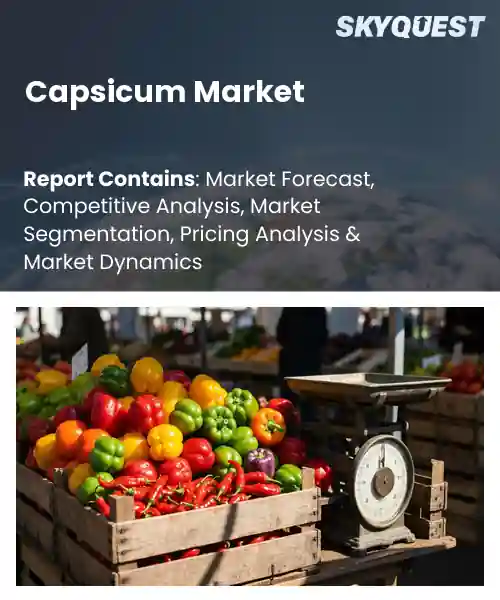
Capsicum Market
Report ID: SQMIG30H2399
Report ID: SQMIG30H2399
[email protected]
USA +1 351-333-4748
Report ID:
SQMIG30H2399 |
Region:
Global |
Published Date: May, 2026
Pages:
157
|Tables:
120
|Figures:
72


Global Capsicum Market size was valued at USD 52.52 Billion in 2024 and is poised to grow from USD 55.68 Billion in 2025 to USD 88.85 Billion by 2033, growing at a CAGR of 6.02% during the forecast period (2026-2033).
The primary driver of the capsicum market is evolving consumer demand for diverse, high-quality fresh and processed peppers, which has reshaped production, trade, and value chains over the last two decades. This represents an important connection between agricultural employment, food manufacturing, retail patterns and food nutrition. As consumer dietary habits evolve toward healthier options, consumers have been seeking higher quality foods that are full of vitamins. Farmers in the Netherlands and Spain are using greenhouses to grow increasing amounts of these vitamin-rich foods, while Mexico and India have increased their exports of peppers to other countries. Farmers have gained additional benefits due to advances in the cold chain refrigeration systems that help them supply peppers throughout the year instead of historically having to supply peppers only during certain seasons of the year.
A key trend driving the global capsicum industry growth is value-added processing, because converting perishable harvests into shelf-stable, higher-margin products aligns supply with retail and foodservice demand. Processors that create consistent inputs for users of ready-made meals and snacks have an incentive to encourage farmers to use the same type of plant species and improve their handling systems by installing frozen food production lines and producing standardized chilies. Quick-service restaurant chains, for example, buy pre-sliced bell peppers to reduce labor costs, while spice manufacturers combine different types of paprika from many areas to create a consistent flavor from batch to batch. These cause-and-effect relationships create additional opportunities for exporting product and investing in cold chain storage.
How is AI Improving Yield Forecasting in the Capsicum Market?
The use of artificial intelligence has allowed for a better way to predict crop yields through the integration of crop imagery, greenhouse sensor information, satellite observations and weather data into a machine-learning algorithm that learns how each type of pepper grows. Models now produce automated weekly predictions and probabilistic ranges with quantified uncertainty, replacing manual spreadsheets in many operations. In a market defined by seasonality and quality driven demand these tools give growers and buyers clearer supply signals, better harvest timing and reduced waste. Examples include computer vision to track fruit set and satellite informed soil moisture and sub seasonal weather guidance that together make forecasts more timely and actionable.
In April 2026, Source.ag launched an AI harvest forecasting tool for greenhouse peppers that automated weekly predictions and delivered significant reductions in forecast error in pilot trials, supporting smoother retailer commitments, improved labor scheduling and greater operational efficiency.
Market snapshot - (2026-2033)
Global Market Size
USD 52.52 Billion
Largest Segment
Fresh Capsicum/Peppers
Fastest Growth
Oleoresin
Growth Rate
6.02% CAGR
To get more insights on this market click here to Request a Free Sample Report
Global capsicum market is segmented by product type, variety, application, distribution and region. Based on product type, the market is segmented into Fresh Capsicum/Peppers, Dried/Powdered, Frozen, Canned/Processed and Oleoresin. Based on variety, the market is segmented into Bell Peppers, Chili Peppers, Paprika and Cayenne. Based on application, the market is segmented into Food Industry, Pharmaceuticals and Cosmetics. Based on distribution, the market is segmented into Retail, Food Service and Industrial B2B. Based on region, the market is segmented into North America, Europe, Asia Pacific, Latin America and Middle East & Africa.
Based on the global capsicum market growth, fresh capsicum/peppers segment dominates because fresh fruit offers the sensory intensity and versatility that food manufacturers, retailers, and chefs prioritize for premium applications. The main driver for investment in upstream operations-from harvesting practices to cold chain logistics to varietal selection-is the consumer demand for crisp texture, vibrant flavor and fresh attributes, thus ultimately bringing in fresh formats and positioning of products, channel support and long term procurement commitments across the capsicum market.
However, frozen segment is emerging as the most rapidly expanding area, propelled by demand for convenient, year round capsicum ingredients and improved freezing methods. Innovations in flash freezing and precut frozen formats help food service and industrial users scale consistent quality, reduce waste, and develop ready to cook formulations that unlock broader product opportunities.
Bell peppers segment dominates because their mild flavor, vibrant color range, and broad culinary acceptance make them a foundational ingredient across fresh produce, convenience foods, and value added offerings. Retailers and manufacturers consistently purchase due to the fact that these products can be produced in a number of ways and have a very consumer-friendly profile. This pushes the breeding focus and supply chain improvements to ensure continued leadership in formulation, retail positioning, and product innovation related to capsicum.
Conversely, chili peppers segment is witnessing the strongest growth momentum as demand for heat forward flavors and capsaicin driven functionalities rises across food, pharmaceutical, and personal care applications. Innovation in concentrated extracts, oleoresins, and spicy flavor systems, combined with culinary trends favoring bold taste profiles, is expanding formulation uses and opening new high value upstream and downstream opportunities in the capsicum market.
To get detailed segments analysis, Request a Free Sample Report
Based on the global capsicum market share, Asia Pacific dominance in the industry is rooted in a combination of climatic suitability, advanced cultivation technologies, and robust value chains that support consistent year-round supply. The widespread purchase of greenhouses, investments into controlled-environment farming, and the connection between commercial producers and research institutions lead to fast-paced innovations in the areas of new varieties of crops and new processes for growing crops. The wide variety of consumer tastes across all markets creates value-added products, and new improvements in the logistics of moving agricultural products within regions between growers their markets facilitate trade. In addition, government support through agricultural modernization and sustainability programs will continue to improve the competitiveness of the agriculture industry.
Capsicum market in Japan is characterized by a focus on premium quality, controlled-environment cultivation, and advanced postharvest handling to meet demanding retail and foodservice standards. Retailers have embraced packaging with value-added features and branding, while producers have taken advantage of variety development, flavor consistency and traceability through the use of those same packaging features and branding. The collaboration of pest management and yield optimization efforts via research and development (R&D) between growers and research institutes has allowed Japan to be a quality-focused participant and technology-driven participant in the market.
Capsicum market in South Korea is driven by high consumer demand for diverse flavors, premium fresh produce, and convenience formats. Growers are putting their emphasis on greenhouse production, varietal trials, and integrated pest management for quality and continuous supply. Retail channels emphasize branding, snackable formats, and food service partnerships. Cold chain logistics and digital traceability support improved transparency in the market. Furthermore, collaboration between the public and private sectors accelerates the use of precision agriculture as well as resource-efficient growing methods across different regions.
Based on the global capsicum regional outlook, rapid expansion of industry in North America reflects shifting consumer preferences toward fresh, flavorful produce, increasing incorporation of global cuisines, and heightened demand for convenience and ready-to-eat formats. With new advancements in the way we grow food, the investment into greenhouse technology, controlled-environment production, and mechanized harvesting has allowed for consistent and quality food supplies. Retailers and food service operators are pushing to see things done differently with innovation along with assortment diversification, private label creation, and value-added processing. A broad-based logistics network coupled with strong cold chain capabilities allow for greater distribution and improved shelf-life of produce. Working collectively through growers, distributors, and research institutions enhances cultivar development, as well as sustainable growing practices and positions North America as a vibrant market where the advancement of technology and consumer preferences for distinctiveness of products drive market growth.
Capsicum market in United States is shaped by diverse consumer demand across fresh retail, foodservice, and processing channels. Growers and packers emphasize year-round stability through greenhouse production and extended season programs. Premium convenience, branded goods and private-label products are the focus of retailers for consumers while foodservice channels are focusing on ethnic and spicy options. Mechanization, improvements in the cold chain, and the development of new crops have all contributed to increased efficiencies.
Capsicum market in Canada emphasizes greenhouse innovation, local sourcing, and sustainable production practices to meet discerning retail and foodservice demand. Fruit and vegetable producers partner with retail outlets to provide niche and organic as well as value-added products; processors create convenience-type packaging to make their products available to consumers. Investments in cold chain logistics and cooperation between producers and trading partners improve accessibility to the marketplace. Collaborative investigation efforts lead to greater efficiency and development of safety and traceability systems for produced goods.
As per global capsicum regional forecast, Europe is strengthening its role in industry through emphasis on quality differentiation, sustainability practices, and specialized product segments that cater to diverse consumer tastes. Greenhouse investment and seasonal production, combined with modern postharvest techniques, help provide a high-quality fresh supply. Retailers tend to prefer label provenance, organic foods and minimally processed foods; while processors have broadened their offerings of prepared vegetables and convenience foods. Regulatory systems, as well as industry-based sustainability initiatives promote resource-efficient growing and traceability. Coordination between research centres, producers and supply chain participants allows for rapid variety development and responsiveness to the market thus reinforcing Europe's position as an innovation and quality-oriented producer. Cross border trade and logistics allow for seasonal balance and offering a greater variety of products, while consolidation of retail and branded product strategies expand the availability of high-end products.
Capsicum market in Germany is characterized by strong retail demand for quality, traceability, and sustainable production. Producers give priority to methods of greenhouse and season extension. Usually processors produce convenience and ready-to-cook goods. Retailers emphasize provenance labels, organic lines and private label innovations for their products. Investments in cold chain logistics and certification systems support export and domestic credibility. Research institutions, grower organizations and supply chain partners work together to achieve varietal development and resource efficient production across geographical areas.
Capsicum market in United Kingdom is driven by consumer interest in fresh, flavorful, and convenience-oriented produce, supporting demand for peppers in retail and foodservice. Retailers are promoting premium, organic and ready-to-eat formats. Processors are developing prepared meal components. Growers are investing in protected cultivation, the development of new varieties, and product trials to provide product balance between quality and seasonality. Collaboration among industry members on topics such as sustainability, waste reduction and traceability creates additional strength in the supply chain and builds consumer trust for both branded and regional products.
Capsicum market in France emphasizes culinary quality, varietal diversity, and regional provenance that align with strong gastronomy-driven consumption. Field and protected production are the primary means of providing chefs and consumers with the unique flavors they desire. Produce retail strategies include seasonal, organic and artisanal offerings; while processors create high-end, pre-packaged foods. Investment in quality control, logistics and certification aids to set apart from competitors in the marketplace. Collaborative research and grower networks help to improve growing methods and greater coordination among growers.
To know more about the market opportunities by region and country, click here to
Buy The Complete Report
Rising Demand For Processed Foods
Increasing Interest In Functional Foods
Supply Chain Vulnerabilities
Stringent Regulatory And Quality Standards
Request Free Customization of this report to help us to meet your business objectives.
Competitive landscape in the global capsicum market outlook is shifting toward consolidation and vertical integration as ingredient processors and spice brands secure premium capsicum supply. Strategic moves are concrete and varied. Sensient expanded extraction capacity using supercritical CO2 in Spain. McCormick implemented targeted sustainable pepper sourcing programs in Latin America. Innovative partnerships formed by seed companies and sensor device manufacturers such as gardin agritech and bayer collaborate toward improving greenhouse efficiency, sustainability and profitability.
Top Player’s Company Profile
Recent Developments
SkyQuest’s ABIRAW (Advanced Business Intelligence, Research & Analysis Wing) is our Business Information Services team that Collects, Collates, Correlates, and Analyses the Data collected by means of Primary Exploratory Research backed by robust Secondary Desk research.
As per SkyQuest analysis, the global capsicum industry is primarily driven by evolving consumer demand for diverse, high-quality fresh and processed peppers, which has spurred investments in greenhouse cultivation and cold chain logistics, while growth is further supported by expanding value-added processing that turns perishable harvests into higher-margin frozen, powdered and prepared formats. However, supply chain vulnerabilities such as seasonality and inadequate cold storage remain a key restraint, creating variability in availability and quality. Asia Pacific maintains dominance due to favorable climate, technology-led cultivation and strong value chains, and fresh capsicum/peppers lead the market as the most important segment for premium sensory and retail applications.
| Report Metric | Details |
|---|---|
| Market size value in 2024 | USD 52.52 Billion |
| Market size value in 2033 | USD 88.85 Billion |
| Growth Rate | 6.02% |
| Base year | 2024 |
| Forecast period | (2026-2033) |
| Forecast Unit (Value) | USD Billion |
| Segments covered |
|
| Regions covered | North America (US, Canada), Europe (Germany, France, United Kingdom, Italy, Spain, Rest of Europe), Asia Pacific (China, India, Japan, Rest of Asia-Pacific), Latin America (Brazil, Rest of Latin America), Middle East & Africa (South Africa, GCC Countries, Rest of MEA) |
| Companies covered |
|
| Customization scope | Free report customization with purchase. Customization includes:-
|
To get a free trial access to our platform which is a one stop solution for all your data requirements for quicker decision making. This platform allows you to compare markets, competitors who are prominent in the market, and mega trends that are influencing the dynamics in the market. Also, get access to detailed SkyQuest exclusive matrix.
Table Of Content
Executive Summary
Market overview
Parent Market Analysis
Market overview
Market size
KEY MARKET INSIGHTS
COVID IMPACT
MARKET DYNAMICS & OUTLOOK
Market Size by Region
KEY COMPANY PROFILES
Methodology
For the Capsicum Market, our research methodology involved a mixture of primary and secondary data sources. Key steps involved in the research process are listed below:
1. Information Procurement: This stage involved the procurement of Market data or related information via primary and secondary sources. The various secondary sources used included various company websites, annual reports, trade databases, and paid databases such as Hoover's, Bloomberg Business, Factiva, and Avention. Our team did 45 primary interactions Globally which included several stakeholders such as manufacturers, customers, key opinion leaders, etc. Overall, information procurement was one of the most extensive stages in our research process.
2. Information Analysis: This step involved triangulation of data through bottom-up and top-down approaches to estimate and validate the total size and future estimate of the Capsicum Market.
3. Report Formulation: The final step entailed the placement of data points in appropriate Market spaces in an attempt to deduce viable conclusions.
4. Validation & Publishing: Validation is the most important step in the process. Validation & re-validation via an intricately designed process helped us finalize data points to be used for final calculations. The final Market estimates and forecasts were then aligned and sent to our panel of industry experts for validation of data. Once the validation was done the report was sent to our Quality Assurance team to ensure adherence to style guides, consistency & design.
Analyst Support
Customization Options
With the given market data, our dedicated team of analysts can offer you the following customization options are available for the Capsicum Market:
Product Analysis: Product matrix, which offers a detailed comparison of the product portfolio of companies.
Regional Analysis: Further analysis of the Capsicum Market for additional countries.
Competitive Analysis: Detailed analysis and profiling of additional Market players & comparative analysis of competitive products.
Go to Market Strategy: Find the high-growth channels to invest your marketing efforts and increase your customer base.
Innovation Mapping: Identify racial solutions and innovation, connected to deep ecosystems of innovators, start-ups, academics, and strategic partners.
Category Intelligence: Customized intelligence that is relevant to their supply Markets will enable them to make smarter sourcing decisions and improve their category management.
Public Company Transcript Analysis: To improve the investment performance by generating new alpha and making better-informed decisions.
Social Media Listening: To analyze the conversations and trends happening not just around your brand, but around your industry as a whole, and use those insights to make better Marketing decisions.
REQUEST FOR SAMPLE
 REQUEST FREE CUSTOMIZATION
Global Capsicum Market size was valued at USD 52.52 Billion in 2024 and is poised to grow from USD 55.68 Billion in 2025 to USD 88.85 Billion by 2033, growing at a CAGR of 6.02% during the forecast period (2026-2033).
Competitive landscape is shifting toward consolidation and vertical integration as ingredient processors and spice brands secure premium capsicum supply. Strategic moves are concrete and varied. Sensient expanded extraction capacity using supercritical CO2 in Spain. McCormick implemented targeted sustainable pepper sourcing programs in Latin America. Seed and sensor collaborations such as Gardin Agritech with Bayer aim to boost greenhouse efficiency and resilience. 'McCormick & Company', 'Heinz (Kraft Heinz)', 'Olam International', 'Conagra Brands', 'Del Monte Foods', 'Piquillo Peppers', 'Greenfire Capsicums', 'Sunpure Capsicums', 'Kalsec Inc.', 'Dohler Group', 'Synthite Industries', 'Universal Oleoresins', 'Paprika Szeged', 'Migros Group', 'Agropec Capsaicin'
Capsicum's versatility as a natural colorant, flavor enhancer, and source of vitamins makes it an attractive ingredient for food manufacturers meeting rising consumer preference for convenient, ready-to-eat products. Manufacturers incorporate capsicum derivatives to improve sensory appeal and perceived healthfulness of packaged meals and snacks, which encourages broader adoption across product lines. This expanded ingredient use in value-added foods strengthens procurement commitments from processors, stimulates cultivation and supply chain investments, and fosters product innovation, collectively supporting sustained market expansion through increased industrial consumption and formulation opportunities.
𝗣𝗿𝗲𝗺𝗶𝘂𝗺𝗶𝘇𝗮𝘁𝗶𝗼𝗻 𝗮𝗻𝗱 𝗗𝗶𝘃𝗲𝗿𝘀𝗶𝗳𝗶𝗰𝗮𝘁𝗶𝗼𝗻: Demand for higher-value capsicum varieties and value-added offerings is driving product innovation across the sector. Retailers and processors are prioritizing premium attributes such as novel color and flavor profiles, convenience formats, and branded, origin-linked products to meet evolving consumer preferences. This trend encourages investment in selective breeding, differentiated packaging, and collaborative marketing, enabling firms to capture price premiums and expand margins while addressing shopper desires for quality, novelty, and culinary versatility without relying solely on commodity volume and supply differentiation.
Why does Asia Pacific Dominate the Global Capsicum Market? |@12


Want to customize this report? This report can be personalized according to your needs. Our analysts and industry experts will work directly with you to understand your requirements and provide you with customized data in a short amount of time. We offer $1000 worth of FREE customization at the time of purchase.
Feedback From Our Clients


 USA (+1) 351-333-4748

