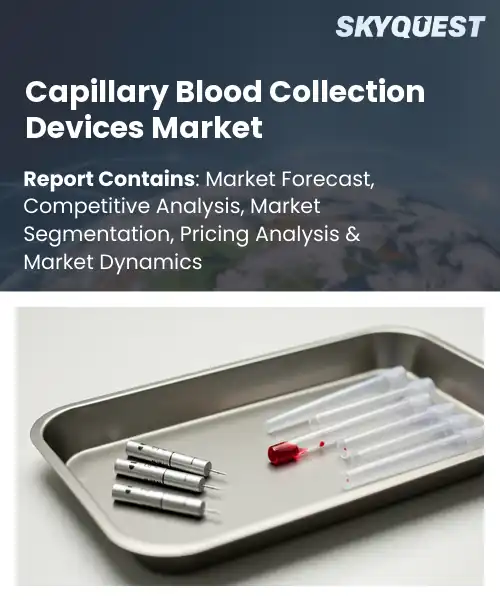
Capillary Blood Collection Devices Market
Report ID: SQMIG35A3829
Report ID: SQMIG35A3829
[email protected]
USA +1 351-333-4748
Report ID:
SQMIG35A3829 |
Region:
Global |
Published Date: June, 2026
Pages:
157
|Tables:
119
|Figures:
72


Global Capillary Blood Collection Devices Market size was valued at USD 1.82 Billion in 2024 and is poised to grow from USD 1.96 Billion in 2025 to USD 3.52 Billion by 2033, growing at a CAGR of 7.62% during the forecast period (2026-2033).
Capillary blood collection devices utilize tools that facilitate microsampling from fingertips for diagnostic and monitoring purposes. The main driving force behind the global market for capillary blood collection devices has been the trend towards decentralization and patient-centered care. Capillary blood collection is essential, as it will help to eliminate the barriers to testing for chronic illnesses and public health screening, while providing faster turnaround times and lower associated costs, which help to improve access. Over the past 10 years, capillary blood collection has transitioned from primarily being used for neonatal screening and diabetes management, into a method of at-home therapeutic monitoring, and finally into a method of collecting remote samples for infectious disease surveillance; this trend was accelerated by the COVID-19 pandemic, which illustrated the value of remote sampling and diagnostics to the world.
As decentralization continues to gain momentum, the most significant factor affecting beyond the initial trend is the innovation of technology related to microsampling, as improved sample quality and usage capabilities will give a larger number of clinical applications, such as the use of dried blood spots and volumetric absorptive microsampling to allow for increased analyte stability at ambient temperatures, thereby lowering logistics costs and allowing for the transportation of sample collections from rural clinics to central laboratories. Improved innovation has also prompted clinical studies to accept remote sampling as a means of expanding their participant demographics and has also led to increased interest by pharmaceutical companies in companion diagnostics that incorporate capillary blood sample collections. Together, these trends have created opportunities in emerging markets and telehealth partnerships; as capillary blood collection takes less sample volume and has simplified workflows, cost savings and increased patient compliance have been seen.
How is AI Enhancing Diagnostic Accuracy In The Capillary Blood Collection Devices Market?
Through enhanced signal extraction from very small samples and reduced preanalytical variability, AI improves diagnostic accuracy in capillary blood collection devices (CBCD). These key enhancements are accomplished through intelligent image/spectral processing, automatic QC, and machine learning algorithms that account for sample variability and interferences. The increased amount of AI utilized in point-of-care (POC) and home POC workflows has improved both reliability of test results and clinician confidence in their use. Combining a CBCD with an algorithm to provide actionable clinical data from a fingerstick sample is referred to as "algorithmic interpretation." AI-enabled hematology analyzers available for fingerstick testing are examples of this product availability and applicability, as well as the application of this technology to support the identification of new biomarkers in capillary samples.
In March 2026, MeMed’s BV Flex received Breakthrough Device designation from the FDA, an AI-powered host response test that uses a few drops from a capillary blood sample to provide the laboratory accuracy of traditional laboratory testing. This exemplifies how AI enables increased diagnostic signal extraction from small sample sizes and thereby facilitates increased speed of decision-making in terms of testing performance which enhances market acceptance and operational efficiency.
Market snapshot - (2026-2033)
Global Market Size
USD 1.82 Billion
Largest Segment
Lancets
Fastest Growth
Warming Devices
Growth Rate
7.62% CAGR
To get more insights on this market click here to Request a Free Sample Report
Global capillary blood collection devices market is segmented by product type, technology, application, end-user and region. Based on product type, the market is segmented into Lancets, Microtubes & Capillaries, Collection Systems and Warming Devices. Based on technology, the market is segmented into Safety Lancets, Contact-Activated Lancets and Adjustable-Depth Lancets. Based on application, the market is segmented into Blood Glucose Monitoring, Newborn Screening, Hemoglobin Testing and Point-of-Care Testing. Based on end-user, the market is segmented into Hospitals, Diagnostic Labs and Home Care. Based on region, the market is segmented into North America, Europe, Asia Pacific, Latin America and Middle East & Africa.
The Collection Systems category leads the market as these systems provide a way to collect, stabilize and transfer medical specimens through efficient systems that limit contamination risks and ensure the integrity of the samples. As the preferred choice in both Clinical and Point of Care environments, Collection Systems have the added benefit of simplifying laboratory throughput via compatibility with automated analyzers and standardized interfaces, leading to less uncertainty for procurement decisions and increased clinical adoption. Additionally, Collection Systems benefit from economies of scale created through high-volume manufacturing and are supported with many OEM Partners who help to facilitate additional Market penetration and trust in this segment of the market.
Whereas the Collection Systems segment dominates the marketplace, Lancets are quickly becoming the fastest growing product category within this marketplace due to user-friendly ergonomic designs, integrated safety features, and people testing at home. In addition, manufacturers are continuously innovating with respect to tip geometry and single-use disposable formats to improve consumer acceptance and expand applications beyond traditional testing methods and open new distribution channels that create new revenue from disposable goods, which increases the market opportunity.
Long-standing injury prevention measures that have been included in the Safety Lancets have led to increased demand by clinicians and patients, as well as meeting regulatory requirements, thereby minimizing both employment-related exposure risks and liability issues. By using the Safety Standard as their purchasing criteria, a majority of hospitals purchase their devices, which causes the manufacturers to implement and expand their efficiencies to manufacture them. The combination of regulatory pressures, supply procurement, and the ongoing innovation from manufacturers have resulted in the Safety Lancet being accepted as the primary method of choice within the industry.
Meanwhile, the Adjustable Depth Lancets are currently growing successfully due to the increased need for personalized blood sampling and less pain during the sampling process. Newer mechanisms for controlling the depth and user feedback have allowed for better sample quality and comfort for the patient. Consequently, as diagnostic companies begin to adopt these products, the numerous package possibilities created by the ongoing increase in use of these products, bundling of other devices, and agreements for subscription consumable products have also become a real possibility.
anics and clear user feedback improve sample quality and patient comfort, stimulating uptake by diagnostic suppliers and creating opportunities for bundled devices and subscription consumable models.
To get detailed segments analysis, Request a Free Sample Report
Due to advanced health care systems, concentrated diagnostic experience and consistent investment in medical technologies, North America accounts for most of the world market for capillary blood collection devices. There is strong collaboration between the research, manufacturing and clinical organisations, which helps to increase the speed of product development and clinical validation for capillary blood collection devices. Regulatory pathways and reimbursement systems help to ensure that products can be commercially developed in many different types of health care situations. The presence of a well-established distribution network, and market entry teams with extensive commercialisation experience, allows for fast and efficient access to market. The prevalence of physicians' use of minimally invasive sampler methods and continued efforts by public health agencies to promote the use of these samplers will further support continued adoption. The combination of local production, an innovation ecosystem and strategic partnerships have created an environment conducive to fast, efficient and effective filling, validation and scaling of capillary blood sampling devices.
The United States Capillary Blood Collection Devices Market has benefited from centralized innovation in the medical technology sector, vertical integration across supply chains, and broad acceptance within clinical settings such as primary care and community-based testing sites. Commercialization of capillary blood collection devices is supported through established reimbursement systems and through buying organizations like private payers. The ability to access and collaborate with research institutions has enabled accelerated clinical validation. Collaborative partnerships among manufacturers of devices, diagnostic companies, and healthcare systems are strengthening the distribution of capillary blood collection devices and enabling point-of-care integration, thereby maintaining demand for, and supporting the commercialization of, capillary blood collection devices.
The Capillary Blood Collection Devices Market in Canada is influenced by a publicly funded healthcare system with a focus on equity of access to capillary blood collection devices and centralized purchasing methods. The significant interest in technologies that support community-based care, in-home specimen collection, and rural access will continue to influence the evaluation and adoption of capillary blood collection devices by healthcare providers in Canada. Collaborative efforts among provincial health agencies, device manufacturers, and laboratories for diagnostic testing will facilitate the implementation of pilot projects. An emphasis on interoperability between laboratory workflows and the incorporation of capillary blood collection technology within the care continuum will contribute to an increase in the clinical acceptance of capillary blood collection devices and their use.
Europe is experiencing rapid expansion in capillary blood collection devices market driven by growing emphasis on decentralized diagnostics, supportive regulatory alignment, and active engagement by clinical laboratories and primary care networks. Demand is propelled by efforts to increase access to minimally invasive testing across community settings and to streamline sample collection for chronic disease management. Strong industrial capacity and a vibrant medtech supply chain enable local manufacturing and tailored product offerings. Cross border collaborations and pan European research initiatives foster clinical validation and harmonized standards. Reimbursement and procurement practices vary by market but evolving policies that recognize point of care and home testing contribute to broader adoption. Manufacturers are adapting device design and distribution strategies to meet diverse healthcare delivery models across the region.
Capillary Blood Collection Devices Market in Germany benefits from a strong medtech manufacturing base, established hospital and laboratory networks that support evaluation and clinical uptake. Clear regulatory pathways and organized procurement create reliable channels for market entry. Collaboration between device developers, clinical researchers and hospital procurement teams enables rigorous performance assessment. Emphasis on quality, precision engineering and local production capacity reinforces Germany position as regional leader and primary demand center.
Capillary Blood Collection Devices Market in United Kingdom features rapid adoption across primary care, community testing and home sampling, supported by active pilot programs and adaptive procurement approaches. Strong interest in digital health integration and workflows supports point of care expansion. Collaboration among healthcare providers, medtech startups and established manufacturers accelerates commercialization. Emphasis on patient centric models and scalable delivery pathways positions United Kingdom as a growth leader within Europe.
Capillary Blood Collection Devices Market in France is emerging with growing interest from hospitals, diagnostics laboratories and health authorities. Emphasis on expanding access to minimally invasive testing in community and primary care settings drives pilots and targeted procurement. Collaboration with medtech incubators and local manufacturers supports product refinement and clinical validation. Focus on compatibility with laboratory information systems and integration into care pathways builds clinician confidence and fosters market momentum.
Asia Pacific is strengthening its position in capillary blood collection devices market through intensified local innovation, expanding diagnostic infrastructure and growing collaboration between domestic manufacturers and international partners. Emphasis on precision engineering and miniaturization suits regional priorities for point of care and home sampling applications. Governments and healthcare organizations are increasingly receptive to technologies that improve access to diagnostics outside hospital settings, encouraging pilot programs and broader clinical evaluation. Robust supply chains and manufacturing capabilities support cost competitive production and faster time to market. Integration with digital health platforms and laboratory networks enhances usability and data capture. Strategic alliances, targeted regulatory engagement and focused commercialization strategies enable the region to move from niche deployment toward mainstream clinical adoption. Investment in training and quality assurance further supports clinical integration.
Capillary Blood Collection Devices Market in Japan benefits from advanced precision manufacturing and strong device quality focus. High clinician acceptance of minimally invasive sampling and outpatient networks support adoption in clinics and community settings. Collaboration with global partners facilitates technology transfer and product localization. Integration with laboratory systems and home monitoring aligns devices with local care models, reinforcing steady uptake and supportive regulatory frameworks promote clinical confidence.
Capillary Blood Collection Devices Market in South Korea leverages a strong technology manufacturing base and agile innovation ecosystem. Medical device developers benefit from close collaboration with electronics suppliers and digital health firms to produce compact, connected sampling solutions suited for point of care and home use. Hospital and clinic networks participate in trials and early adoption. Supportive public initiatives and export oriented strategies enable rapid commercialization and regional market expansion.
To know more about the market opportunities by region and country, click here to
Buy The Complete Report
Rising Point Of Care Testing Adoption
Technological Advances In Device Design
Limited Accuracy From Low Volumes
Stringent Regulatory Approval Processes
Request Free Customization of this report to help us to meet your business objectives.
Competition in the global capillary blood collection devices market is driven by decentralization and device miniaturization that intensify rivalry over home and retail testing channels. Strategic moves illustrate this: major deals such as Trajan acquiring Neoteryx and collaborations between device makers and laboratories push rivals toward targeted M and A, commercial partnerships and rapid product innovation including photonic lab on chip platforms and cartridge based home collection systems.
SkyQuest’s ABIRAW (Advanced Business Intelligence, Research & Analysis Wing) is our Business Information Services team that Collects, Collates, Correlates, and Analyses the Data collected by means of Primary Exploratory Research backed by robust Secondary Desk research.
As per SkyQuest analysis, the global capillary blood collection devices market is being driven by a shift toward decentralized, patient-centric care that expands home and point-of-care testing and improves access. North America dominates the market, and collection systems remain the leading product segment because they streamline sample capture, stabilization and transfer for clinical and point-of-care workflows. Rapid technological advances in microsampling, AI-enabled analytics and improved sample stabilization provide a second major growth driver by enhancing usability and expanding clinical applications. However limited accuracy from very low capillary volumes remains a key restraint, tempering clinician confidence and slowing adoption for high-stakes diagnostic use.
| Report Metric | Details |
|---|---|
| Market size value in 2024 | USD 1.82 Billion |
| Market size value in 2033 | USD 3.52 Billion |
| Growth Rate | 7.62% |
| Base year | 2024 |
| Forecast period | (2026-2033) |
| Forecast Unit (Value) | USD Billion |
| Segments covered |
|
| Regions covered | North America (US, Canada), Europe (Germany, France, United Kingdom, Italy, Spain, Rest of Europe), Asia Pacific (China, India, Japan, Rest of Asia-Pacific), Latin America (Brazil, Rest of Latin America), Middle East & Africa (South Africa, GCC Countries, Rest of MEA) |
| Companies covered |
|
| Customization scope | Free report customization with purchase. Customization includes:-
|
To get a free trial access to our platform which is a one stop solution for all your data requirements for quicker decision making. This platform allows you to compare markets, competitors who are prominent in the market, and mega trends that are influencing the dynamics in the market. Also, get access to detailed SkyQuest exclusive matrix.
Table Of Content
Executive Summary
Market overview
Parent Market Analysis
Market overview
Market size
KEY MARKET INSIGHTS
COVID IMPACT
MARKET DYNAMICS & OUTLOOK
Market Size by Region
KEY COMPANY PROFILES
Methodology
For the Capillary Blood Collection Devices Market, our research methodology involved a mixture of primary and secondary data sources. Key steps involved in the research process are listed below:
1. Information Procurement: This stage involved the procurement of Market data or related information via primary and secondary sources. The various secondary sources used included various company websites, annual reports, trade databases, and paid databases such as Hoover's, Bloomberg Business, Factiva, and Avention. Our team did 45 primary interactions Globally which included several stakeholders such as manufacturers, customers, key opinion leaders, etc. Overall, information procurement was one of the most extensive stages in our research process.
2. Information Analysis: This step involved triangulation of data through bottom-up and top-down approaches to estimate and validate the total size and future estimate of the Capillary Blood Collection Devices Market.
3. Report Formulation: The final step entailed the placement of data points in appropriate Market spaces in an attempt to deduce viable conclusions.
4. Validation & Publishing: Validation is the most important step in the process. Validation & re-validation via an intricately designed process helped us finalize data points to be used for final calculations. The final Market estimates and forecasts were then aligned and sent to our panel of industry experts for validation of data. Once the validation was done the report was sent to our Quality Assurance team to ensure adherence to style guides, consistency & design.
Analyst Support
Customization Options
With the given market data, our dedicated team of analysts can offer you the following customization options are available for the Capillary Blood Collection Devices Market:
Product Analysis: Product matrix, which offers a detailed comparison of the product portfolio of companies.
Regional Analysis: Further analysis of the Capillary Blood Collection Devices Market for additional countries.
Competitive Analysis: Detailed analysis and profiling of additional Market players & comparative analysis of competitive products.
Go to Market Strategy: Find the high-growth channels to invest your marketing efforts and increase your customer base.
Innovation Mapping: Identify racial solutions and innovation, connected to deep ecosystems of innovators, start-ups, academics, and strategic partners.
Category Intelligence: Customized intelligence that is relevant to their supply Markets will enable them to make smarter sourcing decisions and improve their category management.
Public Company Transcript Analysis: To improve the investment performance by generating new alpha and making better-informed decisions.
Social Media Listening: To analyze the conversations and trends happening not just around your brand, but around your industry as a whole, and use those insights to make better Marketing decisions.
REQUEST FOR SAMPLE
 REQUEST FREE CUSTOMIZATION
Global Capillary Blood Collection Devices Market size was valued at USD 1.82 Billion in 2024 and is poised to grow from USD 1.96 Billion in 2025 to USD 3.52 Billion by 2033, growing at a CAGR of 7.62% during the forecast period (2026-2033).
Competition in the global capillary blood collection devices market is driven by decentralization and device miniaturization that intensify rivalry over home and retail testing channels. Strategic moves illustrate this: major deals such as Trajan acquiring Neoteryx and collaborations between device makers and laboratories push rivals toward targeted M and A, commercial partnerships and rapid product innovation including photonic lab on chip platforms and cartridge based home collection systems. 'Becton Dickinson', 'Roche Diagnostics (Accu-Chek)', 'Greiner Bio-One', 'Sarstedt AG', 'Terumo Corporation', 'Medline Industries', 'Owen Mumford', 'ARKRAY Inc.', 'Improve Medical', 'Cardinal Health', 'Nipro Corporation', 'SteriLance Medical', 'Haselmeier GmbH', 'HTL-STREFA S.A.', 'Vitrex Medical'
Rising point of care testing adoption expands demand for capillary blood collection devices because tests performed outside central laboratories rely on facile, minimally invasive sampling methods that enable rapid patient throughput and decentralized clinical decision making. Healthcare providers and community clinics favor simple collection tools that integrate with portable analyzers and diagnostics workflows, which increases purchasing and stocking of single use devices. Patient preference for less invasive sampling and the convenience of bedside or home testing further stimulate procurement and routine use across care settings.
Home Testing Adoption: Increasing consumer preference for noninvasive diagnostics is driving demand for capillary blood collection systems designed for reliable use outside clinical settings. Manufacturers are focusing on ease of use, clear instructions, and compatibility with mail in or point of care workflows. This trend empowers patients to monitor chronic conditions, supports decentralized clinical trials, and encourages partnerships between device makers, telehealth providers, and laboratories. Emphasis on user experience, robust sample integrity, and scalable distribution models is shaping product development and access strategies.
Why does North America Dominate the Global Capillary Blood Collection Devices Market? |@12


Want to customize this report? This report can be personalized according to your needs. Our analysts and industry experts will work directly with you to understand your requirements and provide you with customized data in a short amount of time. We offer $1000 worth of FREE customization at the time of purchase.
Feedback From Our Clients


 USA (+1) 351-333-4748

