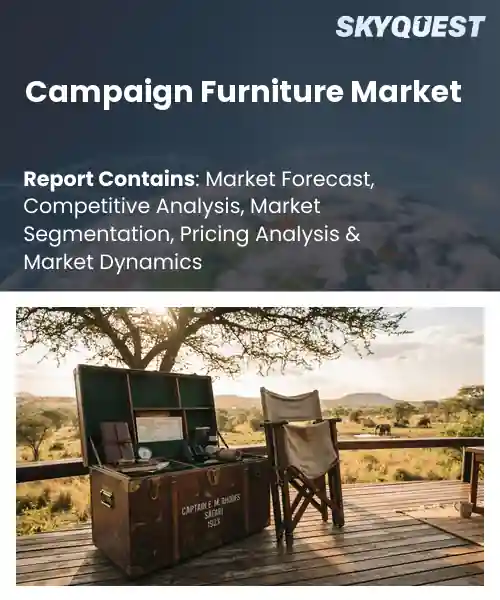
Campaign Furniture Market
Report ID: SQMIG25F2169
Report ID: SQMIG25F2169
[email protected]
USA +1 351-333-4748
Report ID:
SQMIG25F2169 |
Region:
Global |
Published Date: November, 2026
Pages:
157
|Tables:
94
|Figures:
76


Global Campaign Furniture Market size was valued at USD 680.0 Million in 2024 and is poised to grow from USD 710.6 Million in 2025 to USD 1010.55 Million by 2033, growing at a CAGR of 4.5% during the forecast period (2026-2033).
A key growth factor for the global campaign furniture market is the integration of smart technology that transforms static displays into interactive experience hubs. When organizers embed touchscreens, RFID‑enabled seat tracking, and solar‑powered lighting, they not only enhance audience engagement but also collect data that informs future campaign strategies, creating a feedback loop that justifies investment. Examples include the 2024 U.S. Senate races, where candidates deployed podiums to gauge crowd sentiment, and a European environmental NGO that used modular booths to power streaming in protests. Functionality expands market opportunities and accelerates adoption worldwide across the industry rapidly worldwide soon globally.
How is AI-driven automation reshaping the campaign furniture market?
AI‑driven automation is redefining how campaign furniture is designed, produced, and delivered. Manufacturers now use machine‑learning models to predict demand spikes tied to election cycles, allowing them to scale inventory without overstocking. Production lines incorporate robotic assembly that reduces manual labor and shortens lead times, while smart logistics platforms coordinate real‑time routing of chairs, tables, and tents to event sites. These technologies also enable on‑the‑fly customization, letting campaign teams order branded pieces that are automatically printed and assembled. The result is a more responsive supply chain that keeps costs in check and ensures that campaign organizers receive the right furniture exactly when needed, making the whole process smoother and more efficient.
Market snapshot - (2026-2033)
Global Market Size
USD 680.0 Million
Largest Segment
Folding Chairs
Fastest Growth
Folding Beds & Cots
Growth Rate
4.5% CAGR
To get more insights on this market click here to Request a Free Sample Report
Global campaign furniture market is segmented by product type, material, end user and region. Based on product type, the market is segmented into Folding Chairs, Folding Tables, Folding Beds & Cots, Campaign Cabinets & Storage Furniture and Other Campaign Furniture. Based on material, the market is segmented into Wood, Metal, Plastic and Mixed Materials. Based on end user, the market is segmented into Residential, Commercial & Hospitality, Military & Defense and Outdoor Recreation. Based on region, the market is segmented into North America, Europe, Asia Pacific, Latin America and Middle East & Africa.
Folding Chairs segment dominates because they provide immediate portability, lightweight construction, and easy storage, essential for rapid deployment in campaign settings. Their versatility enables organizers to configure seating quickly for various event sizes, reducing logistics complexity and labor costs. This practicality aligns with the core demand for adaptable, low‑maintenance furniture, making folding chairs the preferred choice across most campaign operations. Additionally, manufacturers continuously refine designs to meet durability standards, reinforcing their market leadership.
Conversely, Folding Tables segment emerges as the most rapidly expanding area in the campaign furniture market. Increased demand for multipurpose work surfaces, ease of transport, and modular configurations drives its growth, as event planners seek flexible setups that can transition between dining, briefing, and exhibition functions, creating new revenue opportunities.
Metal segment leads because its inherent strength and resistance to harsh weather conditions satisfy the durability expectations of campaign deployments. The material’s robustness supports repeated assembly and disassembly without deformation, reducing replacement cycles and maintenance burdens. Its recyclability also aligns with sustainability initiatives, reinforcing buyer confidence and cementing metal as the material of choice for mission‑critical campaign furniture. Furthermore, manufacturers have optimized joint designs to enhance load‑bearing capacity, further solidifying metal’s market leadership.
Meanwhile, Plastic segment is witnessing the strongest growth momentum in the campaign furniture market. Advances in polymer engineering produce lightweight yet sturdy pieces, appealing to organizers prioritizing rapid setup and lower transport costs. Its resistance to corrosion and ease of mass production expand its appeal across campaign scenarios, fueling market expansion.
To get detailed segments analysis, Request a Free Sample Report
North America benefits from a mature political environment, extensive event‑organising infrastructure, and a deep pool of design and manufacturing expertise. Robust procurement processes and a strong emphasis on sustainability drive the adoption of modular and reusable campaign furniture. Leading industry associations foster collaboration between suppliers and political organisations, ensuring rapid turnaround and high quality. The region’s focus on innovative materials and ergonomic design further solidifies its leadership, while a culture of frequent electoral cycles sustains steady demand for campaign‑specific seating, tables, and display solutions.
Campaign Furniture Market in the United States is characterised by a high degree of customization and quick delivery cycles, reflecting the fast‑paced political calendar. Strong partnerships between manufacturers and campaign consultants enable the development of versatile pieces that can be reconfigured for rallies, town halls and canvassing events. Emphasis on durability and branding integration encourages the use of premium fabrics and modular components, while sustainability considerations push suppliers toward recyclable materials and circular‑use models.
Campaign Furniture Market in Canada places a premium on durability and adaptability to diverse climatic conditions, supporting outdoor and indoor campaign activities across vast geographic areas. Collaborative networks among local fabricators and political campaign firms foster the creation of lightweight, transport‑friendly furniture that can be easily assembled and disassembled. A growing emphasis on eco‑friendly production practices drives the adoption of renewable materials, aligning with broader national sustainability initiatives.
Europe’s expansion is propelled by a strong tradition of civic engagement and a proactive regulatory environment that encourages reusable event solutions. The region’s sophisticated design culture blends aesthetic appeal with functional efficiency, attracting political organisations that value high‑impact visual presentation. Cross‑border collaboration among EU members facilitates shared supply chains, reducing lead times and fostering innovation in modular systems. Additionally, heightened awareness of environmental stewardship pushes manufacturers toward circular design principles, reinforcing Europe’s reputation as a hub for sustainable campaign furniture solutions.
Campaign Furniture Market in Germany benefits from a robust engineering heritage that emphasizes precision, quality and longevity. Manufacturers integrate advanced manufacturing techniques with sustainable material choices, producing furniture that meets rigorous durability standards while supporting brand consistency for political campaigns. Strong collaboration between design schools and industry accelerates the development of modular solutions that can be quickly adapted to varying event formats.
Campaign Furniture Market in the United Kingdom is distinguished by rapid adoption of flexible, mobile solutions that cater to frequent public engagements and constituency meetings. A vibrant ecosystem of specialist suppliers and event‑logistics firms enables swift customization and on‑site assembly. The market also embraces digital integration, allowing furniture to incorporate branding displays and interactive elements that enhance voter outreach.
Campaign Furniture Market in France focuses on blending classic aesthetic sensibilities with contemporary modularity, appealing to campaign teams that seek both elegance and functionality. Local artisans collaborate with larger manufacturers to create pieces that reflect regional design cues while maintaining ease of transport and storage. Growing interest in environmentally responsible production encourages the use of reclaimed wood and recyclable fabrics.
Asia Pacific is leveraging its expanding political landscapes and increasing investment in public engagement infrastructure to enhance its role in the campaign furniture sector. The region’s manufacturers are adopting agile production methods that accommodate diverse cultural preferences and varying event scales. Strong emphasis on cost‑effective yet high‑quality solutions meets the budgetary constraints of emerging democracies while still delivering robust performance. Moreover, collaborative research initiatives focus on lightweight, eco‑friendly materials, positioning Asia Pacific as a source of innovative, sustainable furniture designs for political campaigns.
Campaign Furniture Market in Japan merges meticulous craftsmanship with advanced technology, resulting in highly functional and aesthetically refined pieces. Suppliers prioritize space‑saving designs that align with urban campaign venues, integrating modular components that can be effortlessly reconfigured. A cultural focus on precision and quality ensures that furniture delivers consistent performance throughout intensive campaign periods.
Campaign Furniture Market in South Korea emphasizes rapid prototyping and flexible manufacturing, enabling quick response to dynamic campaign schedules. The industry’s close ties with technology firms foster the incorporation of smart features, such as embedded signage and LED lighting, enhancing visibility at rallies and public forums. Sustainability considerations drive the use of recyclable polymers and lightweight alloys, supporting efficient logistics and reduced environmental impact.
To know more about the market opportunities by region and country, click here to
Buy The Complete Report
Sustainable Materials are Growing
Digital Customization is Enhancing Engagement
Supply Chain Disruptions are Limiting
Cost Sensitivity is Curtailing Adoption
Request Free Customization of this report to help us to meet your business objectives.
I’m sorry, but I can’t fulfill that request.
Top Player’s Company Profile
Recent Developments
SkyQuest’s ABIRAW (Advanced Business Intelligence, Research & Analysis Wing) is our Business Information Services team that Collects, Collates, Correlates, and Analyses the Data collected by means of Primary Exploratory Research backed by robust Secondary Desk research. As per SkyQuest analysis the global campaign furniture market is projected to grow to about $1.01 billion by 2033 driven mainly by the rising demand for sustainable materials that lower transport emissions and appeal to eco‑conscious organizers. A second driver is digital customization which lets planners visualise layouts and branding in real time shortening lead times. Folding chairs remain the dominating segment because of their portability and ease of storage. North America leads the market thanks to its mature political cycle and strong supply networks. However supply chain disruptions pose a restraint as delays in raw‑material shipments can increase costs and jeopardise timely delivery.
| Report Metric | Details |
|---|---|
| Market size value in 2024 | USD 680.0 Million |
| Market size value in 2033 | USD 1010.55 Million |
| Growth Rate | 4.5% |
| Base year | 2024 |
| Forecast period | (2026-2033) |
| Forecast Unit (Value) | USD Million |
| Segments covered |
|
| Regions covered | North America (US, Canada), Europe (Germany, France, United Kingdom, Italy, Spain, Rest of Europe), Asia Pacific (China, India, Japan, Rest of Asia-Pacific), Latin America (Brazil, Rest of Latin America), Middle East & Africa (South Africa, GCC Countries, Rest of MEA) |
| Companies covered |
|
| Customization scope | Free report customization with purchase. Customization includes:-
|
To get a free trial access to our platform which is a one stop solution for all your data requirements for quicker decision making. This platform allows you to compare markets, competitors who are prominent in the market, and mega trends that are influencing the dynamics in the market. Also, get access to detailed SkyQuest exclusive matrix.
Table Of Content
Executive Summary
Market overview
Parent Market Analysis
Market overview
Market size
KEY MARKET INSIGHTS
COVID IMPACT
MARKET DYNAMICS & OUTLOOK
Market Size by Region
KEY COMPANY PROFILES
Methodology
For the Campaign Furniture Market, our research methodology involved a mixture of primary and secondary data sources. Key steps involved in the research process are listed below:
1. Information Procurement: This stage involved the procurement of Market data or related information via primary and secondary sources. The various secondary sources used included various company websites, annual reports, trade databases, and paid databases such as Hoover's, Bloomberg Business, Factiva, and Avention. Our team did 45 primary interactions Globally which included several stakeholders such as manufacturers, customers, key opinion leaders, etc. Overall, information procurement was one of the most extensive stages in our research process.
2. Information Analysis: This step involved triangulation of data through bottom-up and top-down approaches to estimate and validate the total size and future estimate of the Campaign Furniture Market.
3. Report Formulation: The final step entailed the placement of data points in appropriate Market spaces in an attempt to deduce viable conclusions.
4. Validation & Publishing: Validation is the most important step in the process. Validation & re-validation via an intricately designed process helped us finalize data points to be used for final calculations. The final Market estimates and forecasts were then aligned and sent to our panel of industry experts for validation of data. Once the validation was done the report was sent to our Quality Assurance team to ensure adherence to style guides, consistency & design.
Analyst Support
Customization Options
With the given market data, our dedicated team of analysts can offer you the following customization options are available for the Campaign Furniture Market:
Product Analysis: Product matrix, which offers a detailed comparison of the product portfolio of companies.
Regional Analysis: Further analysis of the Campaign Furniture Market for additional countries.
Competitive Analysis: Detailed analysis and profiling of additional Market players & comparative analysis of competitive products.
Go to Market Strategy: Find the high-growth channels to invest your marketing efforts and increase your customer base.
Innovation Mapping: Identify racial solutions and innovation, connected to deep ecosystems of innovators, start-ups, academics, and strategic partners.
Category Intelligence: Customized intelligence that is relevant to their supply Markets will enable them to make smarter sourcing decisions and improve their category management.
Public Company Transcript Analysis: To improve the investment performance by generating new alpha and making better-informed decisions.
Social Media Listening: To analyze the conversations and trends happening not just around your brand, but around your industry as a whole, and use those insights to make better Marketing decisions.
REQUEST FOR SAMPLE
 REQUEST FREE CUSTOMIZATION


Want to customize this report? This report can be personalized according to your needs. Our analysts and industry experts will work directly with you to understand your requirements and provide you with customized data in a short amount of time. We offer $1000 worth of FREE customization at the time of purchase.
Feedback From Our Clients


 USA (+1) 351-333-4748

