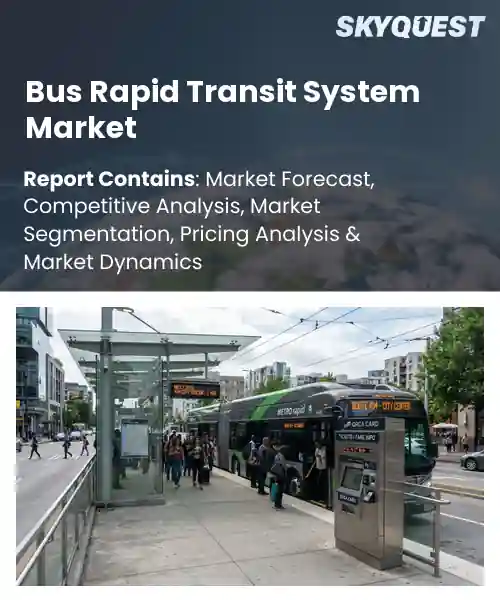
Bus Rapid Transit System Market
Report ID: SQMIG20U2045
Report ID: SQMIG20U2045
[email protected]
USA +1 351-333-4748
Report ID:
SQMIG20U2045 |
Region:
Global |
Published Date: September, 2026
Pages:
157
|Tables:
143
|Figures:
78


Global Bus Rapid Transit System Market size was valued at USD 248.6 Billion in 2024 and is poised to grow from USD 267.0 Billion in 2025 to USD 472.65 Billion by 2033, growing at a CAGR of 7.4% during the forecast period (2026-2033).
Urban congestion and the need for sustainable mobility have emerged as the primary driver of the global Bus Rapid Transit (BRT) system market. The market encompasses dedicated‑lane bus corridors, stations, and integrated ticketing platforms that deliver rail‑like performance at lower cost. Cities such as Bogotá, Guangzhou, and Lagos have illustrated how BRT solutions reduce travel times while curbing emissions, thereby validating the model’s relevance. Over the past two decades the sector has shifted from pilots to large‑scale deployments, supported by government incentives and financing. This evolution reflects a recognition that efficient surface transit can alleviate pressure on overburdened subway networks. Rapid urbanization combined with tightening emissions standards fuels demand for BRT extensions, creating a growth engine for the market. When municipalities adopt policies, they allocate funds to BRT projects, which in turn attract investors seeking returns from fare‑box revenues and ancillary commercial rentals. The success of the Orlando Orange County corridor demonstrates how land‑use planning can generate development, boosting property values and increasing ridership beyond forecasts. Consequently, technology providers see expanding opportunities to supply electric buses, signal‑priority systems, and analytics platforms that enhance efficiency. This cascade of incentives and innovation positions the global BRT market for expansion over the next decade.
How is IoT enhancing real-time passenger information in the Bus Rapid Transit market?
IoT connects buses, stations and passengers through a network of sensors and communication modules that feed live data into central platforms. In the BRT market this data powers accurate arrival predictions, crowd density displays and mobile alerts that keep riders informed and reduce wait anxiety. GPS trackers report vehicle location while door sensors count boarding and alighting, enabling dynamic schedule adjustments. Integrated digital signage at stations shows next bus times and occupancy levels, and smartphone apps push personalized updates based on the rider’s route. Operators use this insight to fine tune service frequency and improve overall reliability, making BRT a more attractive urban mobility option.Siemens Mobility announced in April 2024, an IoT enabled platform that streams live bus locations and passenger counts to station displays and mobile apps, delivering instant crowd information and precise arrival times. This rollout demonstrates how connected technology can boost rider confidence and support expansion of BRT networks.
Market snapshot - (2026-2033)
Global Market Size
USD 248.6 Billion
Largest Segment
Infrastructure
Fastest Growth
Services
Growth Rate
7.4% CAGR
To get more insights on this market click here to Request a Free Sample Report
Global bus rapid transit system market is segmented by component, bus type, application, end user, deployment and region. Based on component, the market is segmented into Infrastructure, Vehicles, Intelligent Transportation Systems and Services. Based on bus type, the market is segmented into Diesel, Electric, Hybrid and CNG. Based on application, the market is segmented into Urban Transit and Intercity Transit. Based on end user, the market is segmented into Public Transport Authorities and Private Transit Operators. Based on deployment, the market is segmented into New Projects and System Upgrades. Based on region, the market is segmented into North America, Europe, Asia Pacific, Latin America and Middle East & Africa.
Electric buses segment dominates because they directly address the growing demand for zero emission mobility while fitting the operational profile of rapid transit corridors. Their quiet operation and lower operating costs enhance passenger experience and reduce lifecycle expenses, prompting authorities to prioritize them in new deployments. Policy incentives and public environmental expectations further reinforce their central role, making electric propulsion the preferred choice for modern BRT networks across urban settings today.
Meanwhile, intelligent transportation systems segment emerges as the fastest growing area because advanced data analytics and real time passenger information enhance service reliability and operational efficiency. Integration of predictive maintenance and dynamic routing attracts investment, expanding the digital backbone of BRT networks and unlocking new revenue streams while supporting seamless multimodal connectivity.
Infrastructure segment dominates because dedicated lanes provide the physical certainty needed for high frequency service, reducing travel time variability and enhancing reliability. By separating buses from mixed traffic, they create a predictable operating environment that attracts riders and justifies higher fare structures. This tangible advantage drives authorities to allocate budget toward lane construction as a cornerstone of BRT development and long term sustainability considerations which also supports economic growth in surrounding areas.
Conversely, hybrid buses segment is witnessing the strongest growth momentum because they bridge the gap between full electrification and legacy diesel fleets, offering reduced emissions without requiring extensive charging infrastructure. Their flexible power architecture appeals to operators seeking incremental sustainability, prompting fleet upgrades and stimulating supplier innovation that expands market reach.
To get detailed segments analysis, Request a Free Sample Report
The Asia Pacific region commands a leading position in the global Bus Rapid Transit System market because it combines dense urban corridors with proactive policy frameworks that prioritize sustainable mobility. Governments across the region have embedded BRT into broader smart‑city agendas, encouraging integration with existing rail and metro networks. Strong public‑private partnerships provide the capital and technical expertise needed to deploy high‑capacity corridors quickly. Cultural acceptance of public transport, coupled with rising middle‑class demand for reliable travel, fuels consistent ridership. Moreover, the region’s focus on low‑emission technologies and digital ticketing enhances operational efficiency, making BRT an attractive alternative to car‑centric development. In addition, regional trade agreements facilitate the exchange of best practices and equipment, further accelerating deployment across member economies.
Bus Rapid Transit System Market in Japan benefits from a mature public‑transport culture and a strong emphasis on technological innovation. Integration with existing rail corridors allows seamless transfers, while advanced ticketing platforms enhance passenger convenience. Government incentives encourage low‑emission vehicle adoption, and local manufacturers supply high‑quality buses tailored to urban topography. Collaborative planning between municipalities and operators ensures routes align with dense commercial districts, supporting high ridership and operational reliability.
Bus Rapid Transit System Market in South Korea is propelled by coordinated urban development strategies that prioritize multimodal connectivity. Government commitment to green mobility drives deployment of electric and hybrid buses, while smart‑city initiatives embed real‑time monitoring and passenger information systems. Collaboration between city planners and private operators creates routes serving residential zones and business hubs. This synergy enhances service frequency and encourages a shift away from private car use.
The European Bus Rapid Transit System market is experiencing rapid expansion as policymakers seek to alleviate urban congestion while meeting stringent environmental objectives. Comprehensive transport strategies embed BRT within multimodal networks, ensuring seamless connections to rail and cycling infrastructure. Substantial public investment, often complemented by EU‑wide sustainability grants, supports the construction of dedicated lanes and the procurement of low‑emission vehicles. Cities prioritize passenger experience through digital ticketing and real‑time information, which boosts public acceptance. Moreover, strong engineering expertise across the continent facilitates the design of adaptable corridor solutions that can be retrofitted into historic cityscapes. This blend of regulatory support, financial mechanisms, and technical capability positions Europe as a leading arena for innovative BRT deployment. In addition, local authorities also engage communities in planning processes, fostering ownership and ensuring that routes address specific mobility needs.
Bus Rapid Transit System Market in Germany is anchored by federal transport policies that emphasize climate neutrality and efficient urban mobility. Funding streams enable construction of corridors integrated with existing tram and S‑bahn networks. German engineering firms supply modular station designs and signaling solutions, while local authorities prioritize passenger‑friendly amenities such as displays and fare collection. This coordinated approach sustains public ridership and supports the nation’s broader national sustainability agenda.
Bus Rapid Transit System Market in the United Kingdom is propelled by ambitious city‑level climate commitments and a focus on reducing road congestion. Public authorities allocate resources to develop dedicated lanes that connect key employment districts with residential suburbs. Integration with contactless payment platforms and real‑time passenger information encourages modal shift. Collaborative design processes involve local communities, ensuring that BRT routes reflect commuter preferences and support inclusive urban sustainable growth.
Bus Rapid Transit System Market in France is emerging as municipalities adopt BRT to complement dense tram networks and address growing suburban travel demand. National transport guidelines encourage the use of low‑emission buses and the implementation of smart ticketing solutions. Pilot projects in several mid‑size cities demonstrate the feasibility of integrating BRT corridors within historic urban fabrics. Ongoing stakeholder dialogue fosters tailored designs that prioritize accessibility and significant environmental performance.
The North American Bus Rapid Transit System market is strengthening its position through a combination of strategic public investment and innovative private‑sector participation. Cities prioritize BRT as a cost‑effective alternative to rail, enabling rapid deployment of high‑capacity corridors that alleviate congestion in sprawling metropolitan areas. Emphasis on clean‑energy propulsion, such as electric and hybrid buses, aligns with broader climate‑action goals and improves air quality. Advanced data platforms provide real‑time operational insights, enhancing service reliability and passenger satisfaction. Collaborative planning processes integrate BRT with existing transit networks, fostering seamless multimodal journeys. This convergence of policy support, technological advancement, and market‑driven solutions propels North America toward a more resilient and sustainable urban mobility landscape. Local governments also engage in public outreach campaigns to raise awareness of BRT benefits, further encouraging community adoption.
Bus Rapid Transit System Market in the United States is driven by initiatives that seek to balance population growth with sustainable transport solutions. Federal programs provide grant funding for corridor development, while state agencies promote low‑emission bus fleets. Integration with subway and commuter rail services creates seamless transfers, and fare systems simplify passenger experience. These efforts support high ridership and reinforce the role of BRT in diversified urban transit networks.
Bus Rapid Transit System Market in Canada benefits from a framework that prioritizes climate‑friendly mobility and access. Funding mechanisms encourage municipalities to develop dedicated BRT corridors that connect major activity centres with surrounding suburbs. Adoption of electric and hybrid buses aligns with national emissions reduction targets, while passenger information platforms improve service reliability. Planning processes engage local stakeholders, ensuring that BRT solutions reflect community needs and support sustainable urban growth.
To know more about the market opportunities by region and country, click here to
Buy The Complete Report
Urban Population Growth Fuels Demand
Government Policy Supports Sustainable Transport
High Capital Investment Requirements
Operational Complexity and Management
Request Free Customization of this report to help us to meet your business objectives.
The competitive landscape of the global Bus Rapid Transit (BRT) system market is shaped by intense rivalry among established manufacturers and emerging innovators, with market drivers such as city‑level demand for sustainable mobility and the need for cost‑effective infrastructure prompting aggressive strategies. Recent M&A activity includes Alstom’s acquisition of a leading BRT vehicle supplier to broaden its product portfolio, while Siemens has formed a partnership with a major Asian transit agency to co‑develop digital ticketing platforms, illustrating how firms leverage consolidation and collaboration to capture growth.
Top Player’s Company Profile
Recent Developments
SkyQuest’s ABIRAW (Advanced Business Intelligence, Research & Analysis Wing) is our Business Information Services team that Collects, Collates, Correlates, and Analyses the Data collected by means of Primary Exploratory Research backed by robust Secondary Desk research. As per SkyQuest analysis the global Bus Rapid Transit market is being propelled primarily by rapid urban population growth which pushes cities to seek high‑capacity, low‑cost transit corridors, while supportive government policies that prioritize sustainable mobility act as a second catalyst accelerating deployments. The Asia Pacific region leads the market thanks to dense corridors and proactive funding, and infrastructure – especially dedicated lanes – remains the dominant segment because it guarantees reliability and speed. However, the high upfront capital required for lane construction and vehicle acquisition poses a significant restraint that can delay projects, particularly in fiscally constrained municipalities and may affect overall network rollout timelines.
| Report Metric | Details |
|---|---|
| Market size value in 2024 | USD 248.6 Billion |
| Market size value in 2033 | USD 472.65 Billion |
| Growth Rate | 7.4% |
| Base year | 2024 |
| Forecast period | (2026-2033) |
| Forecast Unit (Value) | USD Billion |
| Segments covered |
|
| Regions covered | North America (US, Canada), Europe (Germany, France, United Kingdom, Italy, Spain, Rest of Europe), Asia Pacific (China, India, Japan, Rest of Asia-Pacific), Latin America (Brazil, Rest of Latin America), Middle East & Africa (South Africa, GCC Countries, Rest of MEA) |
| Companies covered |
|
| Customization scope | Free report customization with purchase. Customization includes:-
|
To get a free trial access to our platform which is a one stop solution for all your data requirements for quicker decision making. This platform allows you to compare markets, competitors who are prominent in the market, and mega trends that are influencing the dynamics in the market. Also, get access to detailed SkyQuest exclusive matrix.
Table Of Content
Executive Summary
Market overview
Parent Market Analysis
Market overview
Market size
KEY MARKET INSIGHTS
COVID IMPACT
MARKET DYNAMICS & OUTLOOK
Market Size by Region
KEY COMPANY PROFILES
Methodology
For the Bus Rapid Transit System Market, our research methodology involved a mixture of primary and secondary data sources. Key steps involved in the research process are listed below:
1. Information Procurement: This stage involved the procurement of Market data or related information via primary and secondary sources. The various secondary sources used included various company websites, annual reports, trade databases, and paid databases such as Hoover's, Bloomberg Business, Factiva, and Avention. Our team did 45 primary interactions Globally which included several stakeholders such as manufacturers, customers, key opinion leaders, etc. Overall, information procurement was one of the most extensive stages in our research process.
2. Information Analysis: This step involved triangulation of data through bottom-up and top-down approaches to estimate and validate the total size and future estimate of the Bus Rapid Transit System Market.
3. Report Formulation: The final step entailed the placement of data points in appropriate Market spaces in an attempt to deduce viable conclusions.
4. Validation & Publishing: Validation is the most important step in the process. Validation & re-validation via an intricately designed process helped us finalize data points to be used for final calculations. The final Market estimates and forecasts were then aligned and sent to our panel of industry experts for validation of data. Once the validation was done the report was sent to our Quality Assurance team to ensure adherence to style guides, consistency & design.
Analyst Support
Customization Options
With the given market data, our dedicated team of analysts can offer you the following customization options are available for the Bus Rapid Transit System Market:
Product Analysis: Product matrix, which offers a detailed comparison of the product portfolio of companies.
Regional Analysis: Further analysis of the Bus Rapid Transit System Market for additional countries.
Competitive Analysis: Detailed analysis and profiling of additional Market players & comparative analysis of competitive products.
Go to Market Strategy: Find the high-growth channels to invest your marketing efforts and increase your customer base.
Innovation Mapping: Identify racial solutions and innovation, connected to deep ecosystems of innovators, start-ups, academics, and strategic partners.
Category Intelligence: Customized intelligence that is relevant to their supply Markets will enable them to make smarter sourcing decisions and improve their category management.
Public Company Transcript Analysis: To improve the investment performance by generating new alpha and making better-informed decisions.
Social Media Listening: To analyze the conversations and trends happening not just around your brand, but around your industry as a whole, and use those insights to make better Marketing decisions.
REQUEST FOR SAMPLE
 REQUEST FREE CUSTOMIZATION


Want to customize this report? This report can be personalized according to your needs. Our analysts and industry experts will work directly with you to understand your requirements and provide you with customized data in a short amount of time. We offer $1000 worth of FREE customization at the time of purchase.
Feedback From Our Clients


 USA (+1) 351-333-4748

