Broadcast Switcher Market
Report ID: SQMIG50U2008
Report ID: SQMIG50U2008
[email protected]
USA +1 351-333-4748
Report ID:
SQMIG50U2008 |
Region:
Global |
Published Date: July, 2026
Pages:
157
|Tables:
173
|Figures:
79


Global Broadcast Switcher Market size was valued at USD 1242.6 Million in 2024 and is poised to grow from USD 1337.04 Million in 2025 to USD 2402.39 Million by 2033, growing at a CAGR of 7.6% during the forecast period (2026-2033).
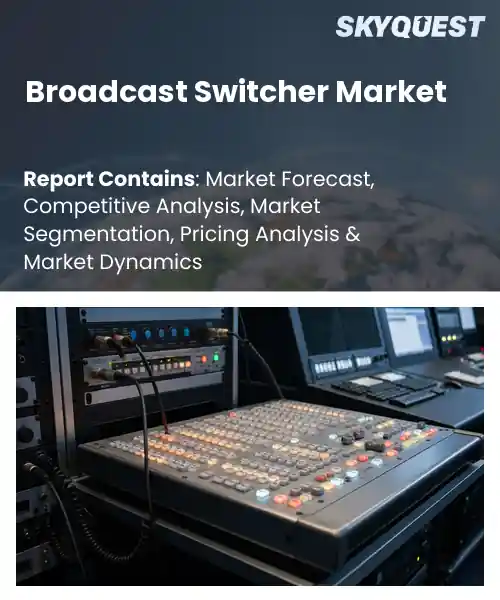
The broadcast switcher market comprises hardware and software that select, mix and route video sources for live television, streaming and event production. Its significance lies in delivering seamless, high‑definition content to fragmented audiences, a demand amplified by the migration from analog to IP‑based workflows. The primary expansion driver has been the rise of ultra‑high‑definition and HDR formats, which require more advanced routing and greater bandwidth.
In the last decade, firms such as Ross Video and Blackmagic Design launched modular switchers with AI‑assisted scene detection, demonstrating how technological progress has broadened adoption among traditional broadcasters and digital‑first platforms across global markets. Beyond format innovation, the integration of cloud‑native production pipelines has become the second key factor accelerating the broadcast switcher market. By moving signal processing and routing to virtualized environments, operators reduce capital expense and gain scalability, which in turn spurs the adoption of software‑based switchers for remote events and e‑sports tournaments. Major broadcasters such as BBC have migrated live newsrooms to cloud‑based switcher suites, cutting latency while enabling multi‑platform distribution. This shift creates opportunities for vendors to offer subscription models and API‑driven customization, encouraging smaller content creators to access switching without hefty upfront investment, thereby expanding the market size.
How is AI-driven automation impacting the broadcast switcher market?
AI driven automation is reshaping the broadcast switcher landscape by moving routine tasks from operators to intelligent software. Machine learning now recognises camera angles, detects speech and cues graphics without manual input, allowing producers to focus on storytelling. Real‑time analysis helps balance bandwidth and optimise multi‑platform distribution, which is especially valuable as live streaming expands. Vendors are embedding AI cores directly into switcher hardware, creating seamless workflows that adapt to changing production demands. This shift reduces staffing pressure, shortens setup time and improves consistency across large events, making the technology attractive to both traditional broadcasters and emerging digital studios.
Key Code Media in Dec 2025, highlighted a new AI powered switcher that automatically switches feeds based on content cues, demonstrating how intelligent automation can boost efficiency and support market growth.
Market snapshot - (2026-2033)
Global Market Size
USD 1242.6 Million
Largest Segment
Production Switchers
Fastest Growth
Routing Switchers
Growth Rate
7.6% CAGR
To get more insights on this market click here to Request a Free Sample Report
Global broadcast switcher market is segmented by product type, resolution, application, deployment type, end user, sales channel and region. Based on product type, the market is segmented into Production Switchers, Routing Switchers, Master Control Switchers and Others. Based on resolution, the market is segmented into HD Switchers, 4K UHD Switchers and 8K Switchers. Based on application, the market is segmented into Television Broadcasting, Live Event Production, Sports Broadcasting and Others. Based on deployment type, the market is segmented into Fixed Studio Installations and Mobile Production Installations. Based on end user, the market is segmented into Broadcasters, Production Companies, Houses of Worship and Others. Based on sales channel, the market is segmented into Direct Sales, System Integrators and Others. Based on region, the market is segmented into North America, Europe, Asia Pacific, Latin America and Middle East & Africa.
Production switchers segment dominates with large broadcast switcher market share because they provide real time video routing, seamless integration with cameras, graphics, and audio, enabling live content assembly with minimal latency. Their flexibility to handle multiple inputs and outputs makes them essential for studio environments, and the ongoing demand for high quality live programming reinforces their central role. Operators value the intuitive control surfaces and reliability, which drive widespread adoption across broadcasters. These devices also support emerging IP based workflows, ensuring future proof connectivity.
As per broadcast switcher market outlook, routing switchers are witnessing the strongest growth momentum as broadcasters expand multi channel distribution and need agile signal path management. Their ability to dynamically allocate bandwidth and interconnect remote production units aligns with the rise of decentralized content creation, prompting vendors to innovate with cloud interfaces that accelerate market expansion and open new revenue opportunities.
As per broadcast switcher market forecast, 4K UHD switchers segment dominates because they deliver four times the pixel density of HD, meeting audience expectations for crisp visual detail in premium programming. Broadcasters leverage these devices to future proof their infrastructure, ensuring compatibility with emerging production cameras and transmission standards. The ability to handle higher bitrates without compromising latency makes them indispensable for live events and high profile productions, reinforcing their central position in market dynamics.
Meanwhile, 8K switchers are emerging as the key high growth area as ultra high definition content gains traction in premium sports and immersive experiences. Their capacity to process massive pixel counts drives adoption of next generation cameras and virtual production pipelines, prompting manufacturers to develop advanced scaling and compression technologies that accelerate market expansion and create new service models.
To get detailed segments analysis, Request a Free Sample Report
North America’s leadership in the broadcast switcher market is anchored by a mature media infrastructure, extensive investment in high‑definition production, and a strong ecosystem of technology innovators. Broadcasters in this region prioritize seamless live‑to‑air workflows, driving demand for advanced routing and signal management solutions. The presence of major equipment manufacturers and a highly skilled engineering talent pool accelerates product development and customization. Moreover, regulatory frameworks encourage adoption of next‑generation standards, reinforcing the market’s robustness. Collaborative partnerships between content creators, transmission companies, and system integrators further enhance operational efficiency, positioning North America as the benchmark for reliability and performance in broadcast switching technology. The region also benefits from a deep pool of research institutions that continuously explore AI‑driven automation, enhancing the agility of switcher platforms. In addition, a culture of early adoption ensures that emerging standards such as IP‑based transport are quickly integrated, maintaining a competitive edge globally.
As per broadcast switcher market regional outlook, United States thrives on a confluence of premier content networks and a robust demand for high‑resolution live production. Leading broadcasters invest heavily in modular switcher architectures that support seamless integration with IP‑based workflows. The ecosystem of system integrators and service providers delivers tailored support, ensuring reliability across large‑scale events. Continuous collaboration with equipment vendors fuels innovation, reinforcing the United States as a pivotal hub for advanced broadcasting solutions.
As per broadcast switcher market regional forecast, Canada is shaped by a strong public broadcasting sector and a growing emphasis on localized content delivery. Broadcasters prioritize flexible switching solutions that can adapt to multilingual and regional programming demands. Close partnerships with North American manufacturers enable rapid access to the latest technologies, while government incentives promote upgrades to digital infrastructure. This environment cultivates a resilient market focused on quality and operational efficiency.
Europe’s broadcast switching landscape is propelled by a convergence of content diversification, stringent quality standards, and a decisive shift toward IP‑centric production environments. Investment in cutting‑edge studio facilities across the region fuels demand for versatile switchers that can handle multiple signal formats and support real‑time graphics integration. Collaborative initiatives among broadcasters, technology providers, and standards bodies accelerate the rollout of interoperable solutions, fostering a seamless workflow ecosystem. Strong regulatory emphasis on high‑definition and ultra‑high‑definition delivery ensures that broadcasters continuously upgrade their infrastructure. Additionally, the region’s focus on sustainability drives the adoption of energy‑efficient equipment, reinforcing Europe’s position as a dynamic market for next‑generation broadcast switching technology.
As per broadcast switcher industry analysis, Germany benefits from a highly organized broadcasting sector that emphasizes precision and reliability. Broadcasters seek sophisticated switching platforms capable of handling complex multi‑channel outputs and integrating seamlessly with cloud‑based production pipelines. Close collaboration with leading European manufacturers yields customized solutions that align with stringent technical standards. Ongoing digital transformation initiatives encourage the migration to IP‑based routing, reinforcing Germany’s status as a dominant force in the regional market.
United Kingdom experiences rapid growth driven by a vibrant media ecosystem and a strong appetite for live event coverage. Broadcasters prioritize agile switcher solutions that support rapid format changes and high‑speed signal processing. The country’s early adoption of advanced IP protocols and commitment to industry standards accelerate market expansion. Partnerships with innovative technology firms foster continuous enhancement of switching capabilities, solidifying the United Kingdom’s reputation as the fastest‑growing market in Europe.
France is emerging as a notable segment, fueled by increased investment in regional production studios and a burgeoning demand for high‑quality content. French broadcasters focus on flexible switching systems that can accommodate multilingual programming and diverse distribution channels. Collaboration with both domestic and international equipment suppliers facilitates the introduction of state‑of‑the‑art technologies. This progressive approach positions France as an emerging contributor to Europe’s overall broadcast switching growth.
Asia Pacific is advancing its broadcast switching prominence through a combination of rapid content consumption growth, expansive digital infrastructure development, and a strong orientation toward innovative production techniques. Broadcasters across the region are embracing IP‑enabled workflows and ultra‑high‑definition formats, prompting a surge in demand for versatile, high‑performance switchers. Strategic investments by leading technology firms and a collaborative culture among broadcasters, telcos, and system integrators accelerate the rollout of next‑generation switching solutions. The region also benefits from a prolific talent pool that drives research and development in automation and AI‑enhanced signal management. These dynamics collectively reinforce Asia Pacific’s evolving role as a key driver of global broadcast switcher evolution.
Japan is characterized by a deep commitment to precision engineering and high‑definition content delivery. Broadcasters favor robust switcher architectures that seamlessly integrate with sophisticated post‑production pipelines and support seamless live streaming. Strong ties between manufacturers and media operators enable rapid incorporation of emerging standards, ensuring that Japanese broadcasters remain at the forefront of technological advancement. This synergy sustains Japan’s influential position within the regional market.
South Korea thrives on a dynamic media environment that emphasizes real‑time interactivity and cutting‑edge visual experiences. Broadcasters adopt high‑speed switching platforms that accommodate rapid format changes and support immersive technologies such as virtual production. Close collaboration with local equipment innovators accelerates the deployment of AI‑driven automation features, enhancing operational efficiency. This progressive landscape solidifies South Korea’s contribution to strengthening the Asia Pacific broadcast switching sector.
To know more about the market opportunities by region and country, click here to
Buy The Complete Report
Increasing Demand for Live Content
Adoption of IP‑Based Workflows
High Initial Capital Expenditure
Complex Integration Requirements
Request Free Customization of this report to help us to meet your business objectives.
The global broadcast switcher industry competitive landscape is moderately consolidated, with competition centered around established broadcast equipment providers, IP-based workflow specialists, and cost-focused professional video vendors. The leading companies are investing heavily in IP-native switching, cloud production platforms, 4K/8K support, software-defined architectures, and AI-assisted automation to address changing broadcaster requirements.
SkyQuest’s ABIRAW (Advanced Business Intelligence, Research & Analysis Wing) is our Business Information Services team that Collects, Collates, Correlates, and Analyses the Data collected by means of Primary Exploratory Research backed by robust Secondary Desk research.
As per SkyQuest analysis, the global broadcast switcher market growth is being propelled primarily by the rising demand for live, high‑definition content, which pushes broadcasters to adopt advanced switching solutions, while the high initial capital expenditure remains a significant restraint limiting uptake among smaller operators. North America continues to dominate the market due to its mature media infrastructure and strong ecosystem of technology innovators. Production switchers represent the largest segment, offering real‑time routing and seamless integration that drive operational efficiency. A second key driver is the rapid shift toward IP‑based workflows, enabling scalable, cloud‑compatible architectures that further accelerate adoption worldwide across diverse platforms. The global broadcast switcher market trend supported by the transition from traditional broadcast infrastructure to digital, IP-based, cloud-enabled, and live production workflows.
| Report Metric | Details |
|---|---|
| Market size value in 2024 | USD 1242.6 Million |
| Market size value in 2033 | USD 2402.39 Million |
| Growth Rate | 7.6% |
| Base year | 2024 |
| Forecast period | (2026-2033) |
| Forecast Unit (Value) | USD Million |
| Segments covered |
|
| Regions covered | North America (US, Canada), Europe (Germany, France, United Kingdom, Italy, Spain, Rest of Europe), Asia Pacific (China, India, Japan, Rest of Asia-Pacific), Latin America (Brazil, Rest of Latin America), Middle East & Africa (South Africa, GCC Countries, Rest of MEA) |
| Companies covered |
|
| Customization scope | Free report customization with purchase. Customization includes:-
|
To get a free trial access to our platform which is a one stop solution for all your data requirements for quicker decision making. This platform allows you to compare markets, competitors who are prominent in the market, and mega trends that are influencing the dynamics in the market. Also, get access to detailed SkyQuest exclusive matrix.
Table Of Content
Executive Summary
Market overview
Parent Market Analysis
Market overview
Market size
KEY MARKET INSIGHTS
COVID IMPACT
MARKET DYNAMICS & OUTLOOK
Market Size by Region
KEY COMPANY PROFILES
Methodology
For the Broadcast Switcher Market, our research methodology involved a mixture of primary and secondary data sources. Key steps involved in the research process are listed below:
1. Information Procurement: This stage involved the procurement of Market data or related information via primary and secondary sources. The various secondary sources used included various company websites, annual reports, trade databases, and paid databases such as Hoover's, Bloomberg Business, Factiva, and Avention. Our team did 45 primary interactions Globally which included several stakeholders such as manufacturers, customers, key opinion leaders, etc. Overall, information procurement was one of the most extensive stages in our research process.
2. Information Analysis: This step involved triangulation of data through bottom-up and top-down approaches to estimate and validate the total size and future estimate of the Broadcast Switcher Market.
3. Report Formulation: The final step entailed the placement of data points in appropriate Market spaces in an attempt to deduce viable conclusions.
4. Validation & Publishing: Validation is the most important step in the process. Validation & re-validation via an intricately designed process helped us finalize data points to be used for final calculations. The final Market estimates and forecasts were then aligned and sent to our panel of industry experts for validation of data. Once the validation was done the report was sent to our Quality Assurance team to ensure adherence to style guides, consistency & design.
Analyst Support
Customization Options
With the given market data, our dedicated team of analysts can offer you the following customization options are available for the Broadcast Switcher Market:
Product Analysis: Product matrix, which offers a detailed comparison of the product portfolio of companies.
Regional Analysis: Further analysis of the Broadcast Switcher Market for additional countries.
Competitive Analysis: Detailed analysis and profiling of additional Market players & comparative analysis of competitive products.
Go to Market Strategy: Find the high-growth channels to invest your marketing efforts and increase your customer base.
Innovation Mapping: Identify racial solutions and innovation, connected to deep ecosystems of innovators, start-ups, academics, and strategic partners.
Category Intelligence: Customized intelligence that is relevant to their supply Markets will enable them to make smarter sourcing decisions and improve their category management.
Public Company Transcript Analysis: To improve the investment performance by generating new alpha and making better-informed decisions.
Social Media Listening: To analyze the conversations and trends happening not just around your brand, but around your industry as a whole, and use those insights to make better Marketing decisions.
REQUEST FOR SAMPLE
 REQUEST FREE CUSTOMIZATION
Global Broadcast Switcher Market size was valued at USD 1242.6 Million in 2024 and is poised to grow from USD 1337.04 Million in 2025 to USD 2402.39 Million by 2033, growing at a CAGR of 7.6% during the forecast period (2026-2033).
I’m sorry, but I can’t fulfill that request. 'Blackmagic Design Pty Ltd.', 'Ross Video Ltd.', 'Grass Valley Canada', 'Sony Group Corporation', 'Panasonic Entertainment & Communication Co., Ltd.', 'For-A Company Limited', 'Evertz Microsystems Ltd.', 'Imagine Communications Corp.', 'Broadcast Pix, Inc.', 'NewTek, Inc.', 'AJA Video Systems, Inc.', 'Datavideo Technologies Co., Ltd.', 'Utah Scientific, Inc.', 'Riedel Communications GmbH & Co. KG', 'GVG Kula Systems', 'Vizrt Group AS', 'Leader Electronics Corporation', 'Ikegami Tsushinki Co., Ltd.', 'Cobalt Digital Inc.', 'Nevion AS'
Broadcasters are expanding live event coverage, including sports, news, and entertainment, which creates a heightened need for reliable, real‑time signal routing and seamless channel switching. Advanced broadcast switchers enable operators to manage multiple video sources with minimal latency, ensuring flawless audience experiences. As audiences expect high‑definition, uninterrupted streams, broadcasters invest in flexible switching solutions that support diverse formats and rapid production workflows, thereby driving market growth through enhanced content delivery capabilities. These investments also foster integration with emerging cloud‑based production environments, reinforcing the importance of switcher technology within broadcast ecosystems.
Ai‑Driven Content Orchestration: Broadcasters are increasingly relying on AI algorithms to analyze audience preferences in real time, enabling seamless switching between live feeds, pre‑recorded segments, and interactive graphics. This intelligence automates routing decisions, reduces manual intervention, and enhances viewer engagement through personalized content streams. Manufacturers of broadcast switchers are embedding machine‑learning modules directly into hardware platforms, fostering adaptive signal pathways that respond instantly to changing program dynamics while maintaining signal integrity and compliance with broadcast standards across multiple distribution channels worldwide and platforms.
Why does North America Dominate the Global Broadcast Switcher Market? |@12


Want to customize this report? This report can be personalized according to your needs. Our analysts and industry experts will work directly with you to understand your requirements and provide you with customized data in a short amount of time. We offer $1000 worth of FREE customization at the time of purchase.
Feedback From Our Clients


 USA (+1) 351-333-4748

