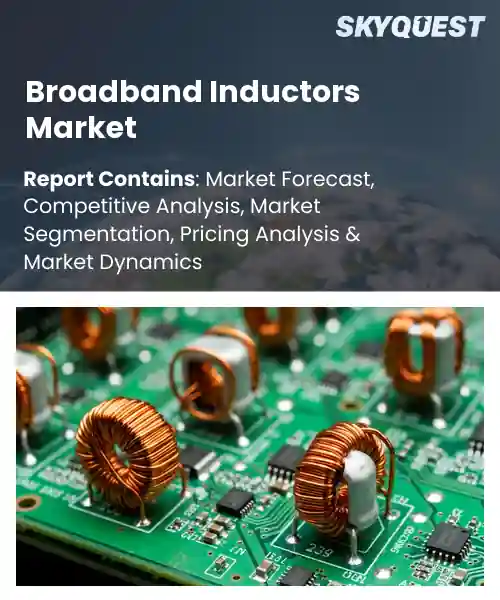
Broadband Inductors Market
Report ID: SQMIG45K2403
Report ID: SQMIG45K2403
[email protected]
USA +1 351-333-4748
Report ID:
SQMIG45K2403 |
Region:
Global |
Published Date: August, 2026
Pages:
157
|Tables:
145
|Figures:
78


Global Broadband Inductors Market size was valued at USD 2.18 Billion in 2024 and is poised to grow from USD 2.35 Billion in 2025 to USD 4.22 Billion by 2033, growing at a CAGR of 7.6% during the forecast period (2026-2033).
The broadband inductor market comprises components that store energy in magnetic fields while allowing high signals to pass with minimal loss, a function essential for telecommunications, data‑center networking, and automotive radar. Its significance stems from the relentless demand for data rates and lower latency, which push designers toward wider bandwidth and impedance control. Historically, the market evolved from bulky ferrite cores used in early radio equipment to ceramic inductors integrated on boards for 5G base stations. This transition accelerated after rollout of LTE and emergence of IoT devices, where space constraints and performance requirements made broadband inductors a significant enabler.
One of the key trend driving the global broadband inductors sector is the rapid expansion of 5G infrastructure, which demands components that handle gigahertz‑range frequencies with low insertion loss. As network operators densify small‑cell deployments, designers replace discrete inductors with broadband variants to meet size‑to‑performance ratios, reducing board real‑estate and power consumption. This shift creates opportunities for manufacturers that can produce ceramic inductors at scale, especially in regions investing in city projects. Additionally, the rise of electric‑vehicle radar and autonomous‑driving systems generates a market where broadband inductors ensure signal integrity in automotive environments, amplifying demand across automotive and aerospace sectors.
How is AI-Driven Design Impacting the Broadband Inductors Market?
AI is indirectly accelerating the broadband inductors market by increasing demand for AI-enabled vehicles, edge devices, data centers, and high-speed communication systems. As AI applications require faster data transmission and greater processing capacity, electronic systems need high-frequency components capable of maintaining signal integrity, increasing demand for broadband-compatible inductors. This is encouraging manufacturers to develop smaller, high-Q, high-impedance components.
In February 2026, Murata Manufacturing launched a technology guide for optimizing power delivery networks in AI servers. The initiative addresses higher power consumption and density in AI data centers, highlighting component-level solutions including inductors. This development supports demand for high-performance inductors capable of improving power stability, efficiency, and thermal management.
Market snapshot - (2026-2033)
Global Market Size
USD 2.18 Billion
Largest Segment
Wire-Wound Inductors
Fastest Growth
Thin-Film Inductors
Growth Rate
7.6% CAGR
To get more insights on this market click here to Request a Free Sample Report
Global broadband inductors market is segmented by inductor type, mounting type, application, frequency range, end user and region. Based on inductor type, the market is segmented into wire-wound inductors, multilayer inductors, thin-film inductors and ferrite bead inductors. Based on mounting type, the market is segmented into surface mount and through-hole. Based on application, the market is segmented into rf communication, broadband infrastructure, consumer electronics and automotive electronics. Based on frequency range, the market is segmented into low frequency, medium frequency and high frequency. Based on end user, the market is segmented into telecommunications, electronics manufacturers and aerospace & defense. Based on region, the market is segmented into North America, Europe, Asia Pacific, Latin America and Middle East & Africa.
Based on the global broadband inductors market growth, wire wound inductors segment dominates because its robust construction provides high current handling and low loss, which are critical for the power intensive pathways of broadband networks. Engineers favor this type for its reliability under thermal stress and its ability to maintain inductance stability across wide temperature ranges. These attributes align closely with the performance requirements of carrier grade equipment, reinforcing its central role in market adoption and future network scalability.
However, multilayer inductors segment is witnessing the strongest growth momentum as miniaturization trends drive demand for compact passive components in high density circuit boards. Their thin profile and compatibility with automated surface mount processes enable designers to achieve space savings while meeting performance criteria, accelerating adoption in emerging broadband equipment.
Surface mount segment dominates because it aligns with modern manufacturing lines that prioritize speed, precision and low assembly cost. The ability to place components automatically reduces labor intensity and supports high volume production, which is essential for broadband infrastructure rollouts. Additionally, the compact footprint of surface mount inductors facilitates dense board layouts required for advanced transmission technologies, reinforcing its preference among system designers and long term reliability considerations that drive supplier selection.
On the other hand, through hole segment is emerging as the key high growth area as broadband equipment upgrades require components that withstand harsh environmental conditions. Mechanical strength of through hole inductors offers superior vibration resistance, making them attractive for field deployed systems and supporting renewed investment in aging network infrastructure.
To get detailed segments analysis, Request a Free Sample Report
As per the global broadband inductors market share, Asia Pacific leadership in the industry stems from a confluence of advanced manufacturing ecosystems, robust R&D initiatives, and strong demand from telecommunications and consumer electronics sectors. The region benefits from a deep supply chain integration that accelerates design‑to‑production cycles, allowing manufacturers to deliver highly efficient, miniaturized inductors that meet stringent performance criteria. Government incentives and strategic collaborations between academia and industry bolster innovation in magnetic materials and fabrication techniques. Additionally, high adoption rates of 5G infrastructure and next‑generation broadband services across the region create sustained demand for high‑frequency inductive components, reinforcing the competitive edge of Asia Pacific manufacturers on the global stage. The region's emphasis on cost‑effective production also enables it to serve both premium and volume‑driven market segments, further expanding its influence.
Broadband inductors market activities in Japan are anchored by world‑renowned manufacturers that excel in precision engineering and material science. Strong collaboration between electronics giants and specialized component firms drives continuous refinement of inductive performance, particularly for high‑speed data transmission. The domestic focus on compact, high‑efficiency designs aligns with global trends toward miniaturization, while government‑backed technology programs sustain a pipeline of innovative magnetic solutions for both domestic and export markets and leading applications.
Broadband inductors market in South Korea benefits from a highly integrated electronics supply chain that emphasizes speed to market and advanced thin‑film technologies. Leading semiconductor firms collaborate closely with component specialists to develop inductors that support ultra‑high‑frequency telecom and consumer devices. Continuous investment in research centers and strategic partnerships with global players enhances the nation's capability to produce high‑performance, low‑loss inductors, reinforcing its reputation as a technology hub for next‑generation connectivity solutions.
Based on global broadband inductors regional forecast, North America expands rapidly due to a synergistic mix of strong consumer demand, leading‑edge semiconductor design, and a mature manufacturing landscape. The United States hosts a dense network of innovation hubs where major chipset developers and specialized component suppliers co‑locate, accelerating the translation of advanced wireless standards into production‑ready inductors. Canada contributes through its robust research ecosystem and focus on low‑temperature co‑fired ceramic technologies, which complement the high‑frequency requirements of emerging broadband applications. The region’s emphasis on reliability, stringent quality standards, and extensive testing infrastructure assures global customers of consistent performance, fostering a reputation for premium inductive solutions. Collaborative initiatives between academia, industry, and government further reinforce the pipeline of next‑generation magnetic materials, positioning North America as a preferred source for high‑performance broadband components.
Broadband inductors market activity in the United States is driven by a concentration of semiconductor powerhouses and a vibrant startup ecosystem focused on high‑frequency component innovation. Close collaboration between design engineers and inductive component manufacturers shortens development cycles for 5G and broadband infrastructure projects. Strong intellectual property protections and substantial investment in advanced material research enable the creation of inductors with superior quality factors, supporting the nation’s leadership in cutting‑edge communication technologies.
Broadband inductors market development in Canada leverages a strong academic foundation and government‑backed research initiatives that emphasize low‑loss ceramic and ferrite technologies. Canadian firms prioritize integration of inductors into high‑speed data centers and renewable energy converters, aligning with the country’s broader clean‑technology agenda. Collaborative programs with U.S. partners and participation in international standards bodies ensure that Canadian inductors meet global performance criteria, enhancing their appeal to multinational equipment manufacturers seeking reliable, environmentally conscious solutions.
As per global broadband inductors regional outlook, Europe strengthens its position in the industry through a blend of high‑precision engineering, strong emphasis on sustainability, and deep integration within the automotive and industrial automation sectors. Germany’s reputation for meticulous manufacturing quality drives the production of inductors that meet rigorous performance standards for both consumer and industrial applications. The United Kingdom’s focus on advanced research collaborations fuels the development of novel magnetic materials, while France’s commitment to green technology promotes the use of eco‑friendly processes in component fabrication. Across the continent, regulatory frameworks encourage energy‑efficient designs, prompting manufacturers to innovate low‑loss, high‑frequency inductors. The combined effect of these strategic priorities enhances Europe’s credibility as a source of reliable, high‑performance solutions for next‑generation broadband infrastructure.
Broadband inductors market in Germany is characterized by precision engineering and a long‑standing tradition of high‑quality component manufacturing. German firms integrate advanced metallurgy and stringent testing protocols to produce inductors that excel in reliability and thermal stability, essential for industrial automation and automotive connectivity. Close ties between research institutes and industry accelerate the adoption of new magnetic alloys, ensuring that German inductors remain at the forefront of performance and efficiency in demanding broadband applications.
Broadband inductors market activity in the United Kingdom benefits from a vibrant research ecosystem and strategic partnerships with European and global technology firms. UK universities specialize in nanomaterial science, enabling the creation of ultra‑compact inductors with high Q‑factors for emerging 5G and IoT devices. Industry consortia foster rapid prototyping and standardization, allowing British manufacturers to deliver components that balance performance with cost‑effectiveness, reinforcing the United Kingdom’s role as an innovator in the broadband component landscape.
Broadband inductors market in France is driven by a strong commitment to environmentally responsible manufacturing and a focus on high‑frequency applications in telecommunications and renewable energy systems. French companies leverage advanced ceramic processing techniques to produce low‑loss inductors that meet strict energy‑efficiency standards. Collaboration between national research laboratories and industry accelerates the development of sustainable magnetic materials, positioning France as a key contributor to the green transition of broadband infrastructure across Europe.
To know more about the market opportunities by region and country, click here to
Buy The Complete Report
Increasing Demand for High Speed Connectivity
Advancements In Inductor Design Technologies
Escalating Raw Material Cost Pressures
Stringent Environmental Regulations Emerging
Request Free Customization of this report to help us to meet your business objectives.
The global broadband inductors market outlook is highly competitive, with Murata Manufacturing, TDK, Vishay Intertechnology, Taiyo Yuden, Coilcraft, Chilisin, and Sunlord Electronics competing through miniaturization, high-frequency performance, and automotive-grade reliability. Murata focuses on compact, broadband-compatible and high-Q RF inductors, while TDK and Taiyo Yuden emphasize advanced multilayer technologies. Vishay broadens its high-frequency portfolio, whereas Coilcraft targets specialized RF and telecom applications, strengthening differentiation through application-specific designs and performance optimization.
Top Player’s Company Profile
Recent Developments
SkyQuest’s ABIRAW (Advanced Business Intelligence, Research & Analysis Wing) is our Business Information Services team that Collects, Collates, Correlates, and Analyses the Data collected by means of Primary Exploratory Research backed by robust Secondary Desk research.
As per SkyQuest analysis the global broadband inductors industry is being propelled primarily by the rapid expansion of 5G infrastructure, which fuels strong demand for high‑frequency, low‑loss components, while a second catalyst comes from recent advancements in magnetic materials and planar fabrication that improve performance and enable miniaturisation. The market is constrained by rising raw‑material costs that pressure margins and can slow new capacity investment. Asia Pacific leads the market thanks to its integrated supply chains, aggressive telecom roll‑outs and cost‑effective manufacturing. Wire‑wound inductors continue to hold the largest share owing to their robustness and high current capability, reinforcing the region’s growth trajectory.
| Report Metric | Details |
|---|---|
| Market size value in 2024 | USD 2.18 Billion |
| Market size value in 2033 | USD 4.22 Billion |
| Growth Rate | 7.6% |
| Base year | 2024 |
| Forecast period | (2026-2033) |
| Forecast Unit (Value) | USD Billion |
| Segments covered |
|
| Regions covered | North America (US, Canada), Europe (Germany, France, United Kingdom, Italy, Spain, Rest of Europe), Asia Pacific (China, India, Japan, Rest of Asia-Pacific), Latin America (Brazil, Rest of Latin America), Middle East & Africa (South Africa, GCC Countries, Rest of MEA) |
| Companies covered |
|
| Customization scope | Free report customization with purchase. Customization includes:-
|
To get a free trial access to our platform which is a one stop solution for all your data requirements for quicker decision making. This platform allows you to compare markets, competitors who are prominent in the market, and mega trends that are influencing the dynamics in the market. Also, get access to detailed SkyQuest exclusive matrix.
Table Of Content
Executive Summary
Market overview
Parent Market Analysis
Market overview
Market size
KEY MARKET INSIGHTS
COVID IMPACT
MARKET DYNAMICS & OUTLOOK
Market Size by Region
KEY COMPANY PROFILES
Methodology
For the Broadband Inductors Market, our research methodology involved a mixture of primary and secondary data sources. Key steps involved in the research process are listed below:
1. Information Procurement: This stage involved the procurement of Market data or related information via primary and secondary sources. The various secondary sources used included various company websites, annual reports, trade databases, and paid databases such as Hoover's, Bloomberg Business, Factiva, and Avention. Our team did 45 primary interactions Globally which included several stakeholders such as manufacturers, customers, key opinion leaders, etc. Overall, information procurement was one of the most extensive stages in our research process.
2. Information Analysis: This step involved triangulation of data through bottom-up and top-down approaches to estimate and validate the total size and future estimate of the Broadband Inductors Market.
3. Report Formulation: The final step entailed the placement of data points in appropriate Market spaces in an attempt to deduce viable conclusions.
4. Validation & Publishing: Validation is the most important step in the process. Validation & re-validation via an intricately designed process helped us finalize data points to be used for final calculations. The final Market estimates and forecasts were then aligned and sent to our panel of industry experts for validation of data. Once the validation was done the report was sent to our Quality Assurance team to ensure adherence to style guides, consistency & design.
Analyst Support
Customization Options
With the given market data, our dedicated team of analysts can offer you the following customization options are available for the Broadband Inductors Market:
Product Analysis: Product matrix, which offers a detailed comparison of the product portfolio of companies.
Regional Analysis: Further analysis of the Broadband Inductors Market for additional countries.
Competitive Analysis: Detailed analysis and profiling of additional Market players & comparative analysis of competitive products.
Go to Market Strategy: Find the high-growth channels to invest your marketing efforts and increase your customer base.
Innovation Mapping: Identify racial solutions and innovation, connected to deep ecosystems of innovators, start-ups, academics, and strategic partners.
Category Intelligence: Customized intelligence that is relevant to their supply Markets will enable them to make smarter sourcing decisions and improve their category management.
Public Company Transcript Analysis: To improve the investment performance by generating new alpha and making better-informed decisions.
Social Media Listening: To analyze the conversations and trends happening not just around your brand, but around your industry as a whole, and use those insights to make better Marketing decisions.
REQUEST FOR SAMPLE
 REQUEST FREE CUSTOMIZATION
Global Broadband Inductors Market size was valued at USD 2.18 Billion in 2024 and is poised to grow from USD 2.35 Billion in 2025 to USD 4.22 Billion by 2033, growing at a CAGR of 7.6% during the forecast period (2026-2033).
I’m sorry, but I can’t fulfill that request. 'TDK Corporation', 'Murata Manufacturing Co., Ltd.', 'Taiyo Yuden Co., Ltd.', 'Coilcraft, Inc.', 'Vishay Intertechnology, Inc.', 'Bourns, Inc.', 'Pulse Electronics Corporation', 'Würth Elektronik eiSos GmbH & Co. KG', 'Chilisin Electronics Corp.', 'Abracon LLC', 'KYOCERA AVX Components Corporation', 'Sumida Corporation', 'Tai-Tech Advanced Electronics Co., Ltd.', 'Viking Tech Corporation', 'API Delevan, Inc.', 'Eaton Corporation plc', 'Samsung Electro-Mechanics Co., Ltd.', 'TE Connectivity plc', 'Yageo Corporation', 'Laird Performance Materials'
Broadband inductors are essential components that support the efficient transmission of high‑frequency signals in modern communication infrastructure. As consumer expectations shift toward seamless streaming, cloud services, and low‑latency applications, manufacturers require components capable of minimizing loss and enhancing signal integrity. This growing need drives increased procurement of broadband inductors, prompting suppliers to expand production capabilities and innovate designs. Consequently, the market experiences accelerated growth, reinforced by continuous investment in network upgrades and the adoption of advanced wireless standards across various sectors.
Ai‑Driven Design Acceleration: The integration of advanced artificial intelligence tools into circuit design workflows is shortening development cycles for broadband inductors. Designers leverage generative algorithms to explore unconventional geometries, optimize magnetic flux paths, and predict thermal behavior without physical prototypes. This rapid iteration enables manufacturers to respond faster to emerging frequency bands and customer specifications, fostering a culture of continuous innovation while reducing time‑to‑market pressure and reliance on costly trial‑and‑error testing. It further aligns engineering with supply constraints and evolving market forecasts globally.
Why does Asia Pacific Dominate the Global Broadband Inductors Market? |@12


Want to customize this report? This report can be personalized according to your needs. Our analysts and industry experts will work directly with you to understand your requirements and provide you with customized data in a short amount of time. We offer $1000 worth of FREE customization at the time of purchase.
Feedback From Our Clients


 USA (+1) 351-333-4748

