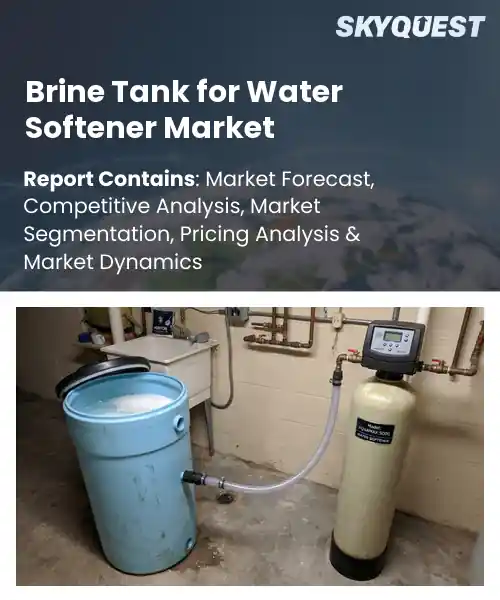
Brine Tank for Water Softener Market
Report ID: SQMIG20B2315
Report ID: SQMIG20B2315
[email protected]
USA +1 351-333-4748
Report ID:
SQMIG20B2315 |
Region:
Global |
Published Date: August, 2026
Pages:
157
|Tables:
178
|Figures:
79


Global Brine Tank For Water Softener Market size was valued at USD 1.86 Billion in 2024 and is poised to grow from USD 1.98 Billion in 2025 to USD 3.26 Billion by 2033, growing at a CAGR of 6.4% during the forecast period (2026-2033).
The global brine tank market for water softeners revolves around the demand for reliable ion‑exchange systems that protect residential and commercial plumbing from hardness‑induced scaling. As municipalities increase water‑hardness levels due to aging aquifers, homeowners seek solutions that prevent costly pipe corrosion and appliance failure. Historically, the market emerged in the 1970s when sodium‑based brine tanks replaced early calcium‑chloride designs, offering superior regeneration efficiency. Over the past decade, rising construction activity in North America and expanding middle‑class housing in Asia have accelerated installations, illustrating how regional water‑quality challenges directly fuel tank production and stimulate continued innovation across the supply chain. The most critical growth catalyst today is the integration of ecosystems that demand precise water‑softening performance and remote monitoring. When manufacturers embed sensors within brine tanks, they can transmit regeneration cycles to mobile apps, allowing users to adjust salt usage based on real‑time hardness readings. This data‑driven feedback reduces waste, cuts operating costs, and encourages larger residential adopters who value energy efficiency. Consequently, vendors such as XYZ Corp have launched IoT‑enabled tanks in Europe, reporting a 15 % increase in sales within six months. These successes highlight how connectivity fuels market expansion while creating upsell opportunities for service contracts and consumables.
How is IoT integration improving brine tank performance in the water softener market?
IoT integration is reshaping brine tank performance by embedding sensors that continuously track salt level, moisture and temperature. These data streams feed cloud platforms where algorithms predict regeneration timing, preventing over use and extending tank life. Manufacturers now offer mobile dashboards that alert homeowners before the tank runs low, reducing service calls. Real time analytics also enable manufacturers to fine tune resin efficiency across regions, aligning product performance with local water hardness. As households seek hassle free softening, the smart brine tank becomes a key differentiator that fuels adoption in a market that is expanding rapidly and meeting consumer expectations for convenience today globally as well.Culligan introduced an IoT connected brine tank in October 2025, offering automatic salt level monitoring and remote regeneration scheduling, which cuts downtime and improves efficiency, supporting broader market growth through smarter water softening solutions. Homeowners now receive real time alerts on their phones, and service providers can predict maintenance needs, reducing costs and enhancing user experience across the sector.
Market snapshot - (2026-2033)
Global Market Size
USD 1.86 Billion
Largest Segment
Round Brine Tanks
Fastest Growth
Cabinet-Style Brine Tanks
Growth Rate
6.4% CAGR
To get more insights on this market click here to Request a Free Sample Report
Global brine tank for water softener market is segmented by tank type, material, capacity, application, distribution channel, end user and region. Based on tank type, the market is segmented into Round Brine Tanks, Rectangular Brine Tanks, Cabinet-Style Brine Tanks, Two-Piece Brine Tanks and Others. Based on material, the market is segmented into Polyethylene, Fiberglass, Plastic Composites and Other Materials. Based on capacity, the market is segmented into Below 50 Gallons, 50–100 Gallons and Above 100 Gallons. Based on application, the market is segmented into Residential Water Softeners, Commercial Water Softeners, Industrial Water Softeners and Municipal Water Treatment. Based on distribution channel, the market is segmented into Direct Sales, Specialty Water Treatment Dealers, Home Improvement Stores, Online Retail and Others. Based on end user, the market is segmented into Residential, Commercial, Industrial and Municipal. Based on region, the market is segmented into North America, Europe, Asia Pacific, Latin America and Middle East & Africa.
Round Brine Tanks segment dominates because their cylindrical geometry simplifies manufacturing, reduces material stress, and enables uniform salt distribution during regeneration cycles. This design aligns with space constrained installations, allowing easier integration into residential and commercial units. The inherent structural strength minimizes leakage risk, enhancing reliability and extending service life, which drives preference among OEMs and end users seeking low maintenance solutions and cost effective operation through reduced downtime and simplified servicing procedures.
Meanwhile, Rectangular Brine Tanks segment emerges as the fastest growing because modular dimensions cater to larger capacity demands in commercial facilities and enable stackable configurations that maximize floor space. Innovative interior baffles improve salt flow efficiency, attracting system integrators focused on performance upgrades and new retrofit projects across diverse sectors.
Polyethylene segment dominates because its high chemical resistance prevents corrosion when exposed to salty regeneration solutions, ensuring long term structural integrity. The material’s lightweight nature simplifies transportation and installation, reducing handling costs for distributors and installers. Its moldability allows manufacturers to produce seamless tank walls, eliminating weld points that could leak, thereby enhancing reliability and fostering confidence among end users seeking low maintenance equipment while also supporting cost effective mass production techniques that keep retail prices competitive.
On the other hand, Fiberglass segment is witnessing the strongest growth because its superior rigidity enables larger tank designs without compromising structural stability. The material’s excellent thermal insulation properties reduce heat loss during regeneration, appealing to energy conscious operators. Emerging applications in industrial water treatment are driving demand for robust, high performance tanks.
To get detailed segments analysis, Request a Free Sample Report
North America leads the market through a combination of long‑standing consumer demand for high‑quality water treatment and a well‑established infrastructure that supports rapid product rollout. The region benefits from sophisticated manufacturing capabilities that deliver reliable and innovative brine tank designs, while stringent water quality regulations drive continuous improvement. Strong purchasing power and a cultural emphasis on home comfort encourage widespread residential adoption, and extensive distribution networks ensure broad market coverage. Additionally, a mature service ecosystem provides prompt maintenance and technical support, reinforcing consumer confidence and sustaining market leadership.
Brine Tank for Water Softener Market in the United States thrives on a deep awareness of water hardness issues and a proactive approach to home maintenance. Consumers prioritize reliable performance, prompting manufacturers to focus on durability and ease of service. Retail channels ranging from big‑box stores to specialized dealers facilitate broad accessibility, while a competitive landscape spurs ongoing product refinement. Technical expertise and responsive after‑sales support further cement the market’s robust position.
Brine Tank for Water Softener Market in Canada is shaped by a strong emphasis on environmental stewardship and water quality standards. Homeowners seek solutions that balance efficiency with minimal ecological impact, encouraging manufacturers to adopt sustainable materials and designs. Distribution through both urban and remote channels ensures reach across diverse communities, while knowledgeable service providers deliver tailored maintenance. The collaborative relationship between regulators and industry players fosters continual innovation, reinforcing market resilience.
Europe’s expansion is propelled by heightened consumer consciousness regarding water health and a regulatory environment that champions sustainable domestic solutions. The region’s emphasis on energy‑efficient technologies encourages manufacturers to integrate advanced brine management features that reduce waste and operational costs. Growing urbanization and renovation activity create fresh demand for compact, high‑performance units, while strong environmental policies stimulate the adoption of eco‑friendly designs. Collaborative research initiatives across the continent further accelerate product innovation, positioning Europe as a dynamic hub for market growth.
Brine Tank for Water Softener Market in Germany benefits from a tradition of engineering excellence and a rigorous approach to product quality. Consumers value precision and reliability, prompting manufacturers to deliver robust tanks with sophisticated control mechanisms. A well‑structured distribution network links manufacturers with both retail and professional installers, ensuring seamless market penetration. Ongoing collaboration with standards bodies sustains high performance and aligns offerings with evolving environmental expectations.
Brine Tank for Water Softener Market in the United Kingdom experiences rapid uptake as homeowners increasingly prioritize water softness for appliance longevity and health considerations. Market participants focus on compact designs that suit diverse housing types, while emphasizing ease of installation and maintenance. Retail presence across high‑street outlets and online platforms broadens consumer access, and a proactive service sector provides prompt technical assistance. The regulatory push toward water efficiency further fuels product refinement and market expansion.
Brine Tank for Water Softener Market in France is emerging as consumers become more attuned to the benefits of softened water for daily living. Manufacturers respond with aesthetically pleasing units that integrate seamlessly into modern interiors, while highlighting low‑maintenance attributes. Distribution through specialized home‑improvement chains and growing e‑commerce channels enhances visibility. Environmental guidelines encourage the development of recyclable components, positioning the market as both consumer‑friendly and ecologically responsible.
Asia Pacific advances its market position through a blend of rising urban living standards and a cultural shift toward proactive home care. Growing awareness of water quality issues drives demand for reliable brine tank solutions, prompting local manufacturers to adopt cutting‑edge technologies and improve product durability. Expanding middle‑class populations seek convenient, space‑efficient designs that fit compact living spaces, while government initiatives supporting water treatment infrastructure create favorable conditions for market growth. Cross‑border collaborations and knowledge transfer further enhance innovation, enabling the region to capture a larger share of the global market.
Brine Tank for Water Softener Market in Japan reflects a meticulous focus on compactness and precision engineering to meet the needs of densely populated urban environments. Consumers appreciate quiet operation and seamless integration with existing plumbing, driving manufacturers to refine design aesthetics and functionality. A well‑established network of specialty retailers and service providers ensures reliable distribution and after‑sales support. Continuous investment in research promotes the adoption of advanced materials that enhance longevity and performance.
Brine Tank for Water Softener Market in South Korea is shaped by a tech‑savvy consumer base that values smart home integration and efficient water management. Manufacturers incorporate digital monitoring features that align with broader smart‑home ecosystems, appealing to modern households. Robust retail channels, both offline and online, facilitate widespread product availability, while a responsive service sector offers rapid maintenance solutions. Government encouragement of water conservation practices further stimulates the development of environmentally conscious brine tank technologies.
To know more about the market opportunities by region and country, click here to
Buy The Complete Report
Rising Residential Water Softener Adoption
Industrial Process Water Management
High Initial Capital Investment
Regulatory Compliance Complexity
Request Free Customization of this report to help us to meet your business objectives.
Competition in the global brine‑tank segment is intensifying as venture capital pours into innovative entrants and incumbents accelerate product upgrades. The $36 million Series A secured by Gradiant in 2023 fuels its low‑salt regeneration technology, while the broader influx of $161.8 million across 366 water startups underscores a race to capture market share through advanced tank designs and strategic OEM collaborations.
Top Player’s Company Profile
Recent Developments
SkyQuest’s ABIRAW (Advanced Business Intelligence, Research & Analysis Wing) is our Business Information Services team that Collects, Collates, Correlates, and Analyses the Data collected by means of Primary Exploratory Research backed by robust Secondary Desk research. As per SkyQuest analysis the global brine‑tank market for water softeners is projected to rise to $3.26 billion by 2033, driven primarily by rising residential water‑softener adoption that pushes demand for larger, energy‑efficient tanks, while a second catalyst is the rapid integration of IoT sensors that enable real‑time monitoring, predictive regeneration and reduced operating costs. The market’s growth is tempered by the high initial capital outlay required for tank installation, which can deter cost‑sensitive buyers. North America remains the dominant region thanks to strong purchasing power, mature distribution channels and stringent water‑quality regulations. Within product categories, round brine tanks lead the segment share owing to their simple cylindrical design, low material stress and reliable performance.
| Report Metric | Details |
|---|---|
| Market size value in 2024 | USD 1.86 Billion |
| Market size value in 2033 | USD 3.26 Billion |
| Growth Rate | 6.4% |
| Base year | 2024 |
| Forecast period | (2026-2033) |
| Forecast Unit (Value) | USD Billion |
| Segments covered |
|
| Regions covered | North America (US, Canada), Europe (Germany, France, United Kingdom, Italy, Spain, Rest of Europe), Asia Pacific (China, India, Japan, Rest of Asia-Pacific), Latin America (Brazil, Rest of Latin America), Middle East & Africa (South Africa, GCC Countries, Rest of MEA) |
| Companies covered |
|
| Customization scope | Free report customization with purchase. Customization includes:-
|
To get a free trial access to our platform which is a one stop solution for all your data requirements for quicker decision making. This platform allows you to compare markets, competitors who are prominent in the market, and mega trends that are influencing the dynamics in the market. Also, get access to detailed SkyQuest exclusive matrix.
Table Of Content
Executive Summary
Market overview
Parent Market Analysis
Market overview
Market size
KEY MARKET INSIGHTS
COVID IMPACT
MARKET DYNAMICS & OUTLOOK
Market Size by Region
KEY COMPANY PROFILES
Methodology
For the Brine Tank for Water Softener Market, our research methodology involved a mixture of primary and secondary data sources. Key steps involved in the research process are listed below:
1. Information Procurement: This stage involved the procurement of Market data or related information via primary and secondary sources. The various secondary sources used included various company websites, annual reports, trade databases, and paid databases such as Hoover's, Bloomberg Business, Factiva, and Avention. Our team did 45 primary interactions Globally which included several stakeholders such as manufacturers, customers, key opinion leaders, etc. Overall, information procurement was one of the most extensive stages in our research process.
2. Information Analysis: This step involved triangulation of data through bottom-up and top-down approaches to estimate and validate the total size and future estimate of the Brine Tank for Water Softener Market.
3. Report Formulation: The final step entailed the placement of data points in appropriate Market spaces in an attempt to deduce viable conclusions.
4. Validation & Publishing: Validation is the most important step in the process. Validation & re-validation via an intricately designed process helped us finalize data points to be used for final calculations. The final Market estimates and forecasts were then aligned and sent to our panel of industry experts for validation of data. Once the validation was done the report was sent to our Quality Assurance team to ensure adherence to style guides, consistency & design.
Analyst Support
Customization Options
With the given market data, our dedicated team of analysts can offer you the following customization options are available for the Brine Tank for Water Softener Market:
Product Analysis: Product matrix, which offers a detailed comparison of the product portfolio of companies.
Regional Analysis: Further analysis of the Brine Tank for Water Softener Market for additional countries.
Competitive Analysis: Detailed analysis and profiling of additional Market players & comparative analysis of competitive products.
Go to Market Strategy: Find the high-growth channels to invest your marketing efforts and increase your customer base.
Innovation Mapping: Identify racial solutions and innovation, connected to deep ecosystems of innovators, start-ups, academics, and strategic partners.
Category Intelligence: Customized intelligence that is relevant to their supply Markets will enable them to make smarter sourcing decisions and improve their category management.
Public Company Transcript Analysis: To improve the investment performance by generating new alpha and making better-informed decisions.
Social Media Listening: To analyze the conversations and trends happening not just around your brand, but around your industry as a whole, and use those insights to make better Marketing decisions.
REQUEST FOR SAMPLE
 REQUEST FREE CUSTOMIZATION


Want to customize this report? This report can be personalized according to your needs. Our analysts and industry experts will work directly with you to understand your requirements and provide you with customized data in a short amount of time. We offer $1000 worth of FREE customization at the time of purchase.
Feedback From Our Clients


 USA (+1) 351-333-4748

