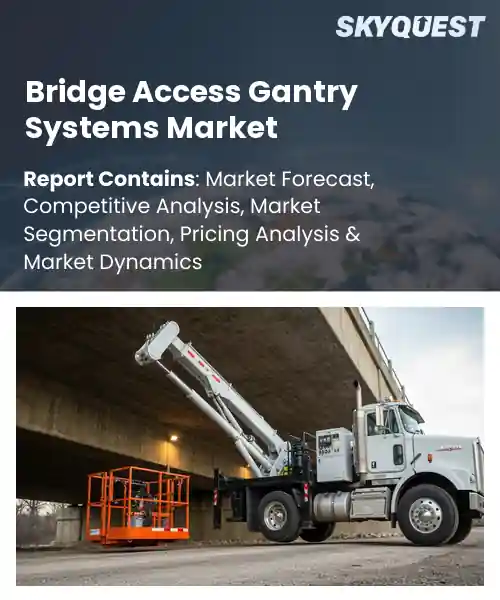
Bridge Access Gantry Systems Market
Report ID: SQMIG20B2193
Report ID: SQMIG20B2193
[email protected]
USA +1 351-333-4748
Report ID:
SQMIG20B2193 |
Region:
Global |
Published Date: June, 2026
Pages:
157
|Tables:
174
|Figures:
79


Global Bridge Access Gantry Systems Market size was valued at USD 486.3 Million in 2024 and is poised to grow from USD 513.05 Million in 2025 to USD 787.37 Million by 2033, growing at a CAGR of 5.5% during the forecast period (2026-2033).
Regulatory pressure for reduced traffic downtime drives market growth because tighter safety standards force owners to choose gantries that can be positioned and retracted within minutes. This pushes demand for automated, self‑propelled units with GPS‑guided leveling and real‑time load monitoring, allowing crews to finish repairs during windows and avoid costly detours.
Consequently, manufacturers focus on modular designs adaptable to various bridge geometries, as demonstrated by Dutch firm SPM’s rapid‑deployment gantry used on the Rotterdam Erasmus Bridge for a weekend repaint. The blend of regulations, technology and the need for efficiency opens opportunities for entrants and ventures delivering smart, low‑impact solutions.
How is AI-driven automation reshaping the bridge access gantry systems market?
AI driven automation is redefining bridge access gantry systems by embedding intelligent sensors and machine learning algorithms into the core structure. These technologies allow the equipment to anticipate wear, adjust lift parameters in real time and communicate status to central control rooms. Operators now benefit from remote diagnostics that highlight potential failures before they occur, which shortens downtime and improves safety on busy construction sites. The integration of digital twins creates a virtual replica that mirrors every movement, enabling planners to test configurations without physical trials. As a result the market is seeing faster project cycles and higher utilization rates across infrastructure projects.
Bridge Gantry Cranes in October 2025, introduced an AI enabled load balancing platform that continuously optimizes gantry positioning and reduces the need for manual adjustments, delivering smoother operations and faster turnaround on bridge projects
Market snapshot - (2026-2033)
Global Market Size
USD 486.3 Million
Largest Segment
Fastest Growth
Growth Rate
5.5% CAGR
To get more insights on this market click here to Request a Free Sample Report
Global bridge access gantry systems market is segmented by system type, bridge type, operation mode, end user, installation type, application, and region. Based on system type, the market is segmented into fixed gantry systems and mobile gantry systems. Based on bridge type, the market is segmented into railway bridges, highway bridges, suspension bridges, cable-stayed bridges, arch bridges, and others. Based on operation mode, the market is segmented into manual, semi-automatic, and fully automatic systems. Based on end user, the market is segmented into rail operators, construction firms, highway authorities, government agencies, and others. Based on installation type, the market is segmented into permanent installations and temporary installations. Based on application, the market is segmented into bridge inspection, bridge maintenance, bridge construction, bridge repair, and rehabilitation. Based on region, the market is segmented into North America, Europe, Asia Pacific, Latin America and Middle East & Africa.
Fixed gantry segment dominates with large As per bridge access gantry systems market share because its inherent structural rigidity provides consistent alignment and load bearing capacity essential for high traffic bridge access points. This reliability reduces maintenance downtime, which appeals to operators seeking uninterrupted service. Moreover, the simplicity of fixed installations integrates seamlessly with existing bridge architecture, lowering engineering complexity. Consequently, customers prioritize fixed gantry solutions to ensure safety, durability, and operational efficiency across the Bridge Access Gantry Systems Market.
As per bridge access gantry systems market outlook, mobile gantry segment is witnessing the strongest growth momentum as projects demand rapid deployment and reconfigurability. Its modular design enables quick relocation to accommodate temporary construction phases or emergency repairs, prompting wider adoption. This flexibility fuels market expansion by opening new opportunities where fixed infrastructure is impractical or cost prohibitive.
As per bridge access gantry systems market forecast, rail operators segment leads because they require high capacity gantry solutions that ensure punctual train movements and passenger safety. Their extensive networks demand standardized, robust access points, driving manufacturers to prioritize features such as precise positioning and real time monitoring. Additionally, regulatory compliance pressures compel rail operators to adopt advanced gantry systems, reinforcing their decisive role in shaping product development and market direction within the market.
Meanwhile, construction firms segment emerges as the key high growth area as infrastructure upgrades and new bridge projects boost demand for versatile gantry solutions. Their emphasis on cost effective, quickly assembled systems drives innovation in lightweight materials and modular engineering, expanding market reach into temporary works and large scale civil projects.
To get detailed segments analysis, Request a Free Sample Report
Asia Pacific dominance drives from a convergence of advanced engineering capabilities, extensive shipbuilding activity, and strong governmental investment in critical infrastructure. The region benefits from a mature supply chain that integrates precision manufacturing with innovative material technologies, enabling manufacturers to deliver high‑performance gantry solutions tailored to complex bridge projects. Strategic emphasis on safety standards and rapid urbanization fuels demand for reliable access systems, while collaborative research initiatives between industry and academia accelerate product enhancements. Additionally, the presence of global automotive and heavy‑equipment manufacturers in Japan and South Korea creates synergistic expertise that reinforces the region's ability to set technical benchmarks and capture a disproportionate share of global orders. This combination of technological depth and expanding construction portfolios ensures that Asia Pacific remains the primary driver of innovation and market leadership in bridge access solutions.
As per bridge access gantry systems market regional outlook, Japan is propelled by the nation’s longstanding expertise in precision engineering and a regulated construction environment. Domestic manufacturers leverage sophisticated robotics and high‑strength alloy production to deliver gantry solutions that meet safety and performance criteria. Ongoing infrastructure renewal programs, particularly in coastal and seismic‑prone zones, create a steady pipeline of projects that demand reliable access equipment, reinforcing Japan’s role as an innovation hub in the sector.
As per bridge access gantry systems market regional forecast, South Korea is driven by manufacturing infrastructure and partnerships focused on bridge modernization. Korean firms leverage expertise in steel fabrication and digital twin technologies to produce gantry systems that offer enhanced load management and quick deployment. The country's commitment to expanding coastal freight corridors and upgrading aging urban bridges sustains demand for access equipment, positioning South Korea as a key contributor to market dynamism.
North America’s rapid expansion is propelled by large‑scale infrastructure renewal initiatives, stringent safety mandates, and a thriving construction services sector that prioritizes efficiency and worker protection. Regulatory frameworks encourage adoption of advanced access equipment to mitigate risks associated with bridge repair and replacement. Significant capital allocation from federal and state programs fuels demand for robust gantry solutions, while private engineering firms drive innovation through integration of digital monitoring and modular design concepts. The region’s mature supply chain, characterized by strong steel manufacturing capabilities and a culture of continual workforce training, supports rapid deployment and customization of gantry systems across diverse bridge typologies, reinforcing North America’s position as a fast‑growing market. Additionally, the collaborative ecosystem between equipment manufacturers and academic research centers accelerates the introduction of lightweight, high‑performance gantry designs that further stimulate market momentum.
As per bridge access gantry systems industry analysis, United States is shaped by federal critical infrastructure programs and a safety culture that mandates access solutions for bridge projects. Manufacturers leverage engineering talent and material science to deliver gantry systems featuring modularity and monitoring. Investment in coastal and interstate bridge upgrades sustains a pipeline of projects, reinforcing the United States as a central hub for global innovation and supply in the sector.
Canada benefits from government funding for bridge rehabilitation and an emphasis on health standards. Domestic producers apply expertise in corrosion‑resistant alloys and modular design to meet demands of harsh climatic conditions across the country. Partnerships between engineering firms and research institutions develop lightweight, adaptable gantry solutions, while the nation's railway and highway networks generate a flow of bridge maintenance work that sustains market growth.
Europe is strengthening its position through a combination of engineering excellence, stringent environmental regulations, and a collaborative ecosystem that links manufacturers with leading research universities. The region’s focus on sustainable construction drives the development of lightweight, high‑strength gantry systems that reduce material consumption while enhancing load capacity. Harmonized safety standards across member states create a uniform market demand, encouraging manufacturers to adopt advanced digital twins and predictive maintenance technologies. Robust public‑private partnerships fund pilot projects aimed at modernising legacy bridges, while the strong presence of specialized steel producers ensures a reliable supply of premium alloys. Together, these factors foster continuous innovation and reinforce Europe’s reputation as a leader in efficient, eco‑conscious bridge access solutions. Furthermore, the integration of smart sensor networks into gantry structures enables real‑time performance monitoring, further differentiating European offerings in the global arena.
Germany is driven by precision engineering and a focus on sustainable construction. German manufacturers use advanced alloy technology and modular design to deliver gantry solutions that meet strict load and environmental criteria. Partnerships between industry and technical universities speed adoption of digital twins and automated fabrication, while investment in highway and rail bridge upgrades creates steady demand for high‑performance access equipment across the country.
United Kingdom is reinforced by a framework that prioritises safety and stewardship on bridge projects. British firms combine expertise in high‑strength steel fabrication with modular techniques to produce gantry systems that are adaptable. Partnerships with research councils speed integration of monitoring and predictive maintenance, while government programmes to modernise aging transport infrastructure generate a flow of contracts for access equipment across the nation.
France is supported by governmental focus on infrastructure renewal and innovative construction methods. French manufacturers use expertise in lightweight composite materials and precision welding to create gantry systems that balance high load capacity with reduced weight. Joint initiatives with technical institutes promote digital twins and health monitoring, while public programs targeting highway and river bridges sustain steady demand for sophisticated access solutions broad nationwide.
To know more about the market opportunities by region and country, click here to
Buy The Complete Report
Rising Demand For Sustainable Infrastructure
Advancements In Automation And Control
High Initial Capital Expenditure
Complex Regulatory Compliance Requirements
Request Free Customization of this report to help us to meet your business objectives.
The market is shaped by aggressive M&A activity, strategic partnerships between equipment manufacturers and construction firms, and rapid tech innovation such as AI‑driven load monitoring and modular gantry designs. Recent collaborations include a major crane maker integrating sensor‑fusion platforms from a robotics startup, while a leading construction conglomerate acquired a niche gantry‑automation company to accelerate its bridge‑building portfolio. These moves intensify competition and drive faster deployment of advanced bridge access solutions.
SkyQuest’s ABIRAW (Advanced Business Intelligence, Research & Analysis Wing) is our Business Information Services team that Collects, Collates, Correlates, and Analyses the Data collected by means of Primary Exploratory Research backed by robust Secondary Desk research.
As per SkyQuest analysis the global bridge access gantry systems market growth driven by rising demand for sustainable infrastructure which pushes owners toward efficient low‑impact gantries and further accelerated by advancements in automation and control that embed AI sensors and digital twins for predictive maintenance. The Asia Pacific region leads the market due to its advanced engineering base and strong infrastructure investment, while the fixed‑gantry segment remains the dominant choice because of its structural rigidity and reliability. However, high initial capital expenditure limits adoption among smaller operators, tempering overall expansion in the sector.
| Report Metric | Details |
|---|---|
| Market size value in 2024 | USD 486.3 Million |
| Market size value in 2033 | USD 787.37 Million |
| Growth Rate | 5.5% |
| Base year | 2024 |
| Forecast period | (2026-2033) |
| Forecast Unit (Value) | USD Million |
| Segments covered |
|
| Regions covered | North America (US, Canada), Europe (Germany, France, United Kingdom, Italy, Spain, Rest of Europe), Asia Pacific (China, India, Japan, Rest of Asia-Pacific), Latin America (Brazil, Rest of Latin America), Middle East & Africa (South Africa, GCC Countries, Rest of MEA) |
| Companies covered |
|
| Customization scope | Free report customization with purchase. Customization includes:-
|
To get a free trial access to our platform which is a one stop solution for all your data requirements for quicker decision making. This platform allows you to compare markets, competitors who are prominent in the market, and mega trends that are influencing the dynamics in the market. Also, get access to detailed SkyQuest exclusive matrix.
Table Of Content
Executive Summary
Market overview
Parent Market Analysis
Market overview
Market size
KEY MARKET INSIGHTS
COVID IMPACT
MARKET DYNAMICS & OUTLOOK
Market Size by Region
KEY COMPANY PROFILES
Methodology
For the Bridge Access Gantry Systems Market, our research methodology involved a mixture of primary and secondary data sources. Key steps involved in the research process are listed below:
1. Information Procurement: This stage involved the procurement of Market data or related information via primary and secondary sources. The various secondary sources used included various company websites, annual reports, trade databases, and paid databases such as Hoover's, Bloomberg Business, Factiva, and Avention. Our team did 45 primary interactions Globally which included several stakeholders such as manufacturers, customers, key opinion leaders, etc. Overall, information procurement was one of the most extensive stages in our research process.
2. Information Analysis: This step involved triangulation of data through bottom-up and top-down approaches to estimate and validate the total size and future estimate of the Bridge Access Gantry Systems Market.
3. Report Formulation: The final step entailed the placement of data points in appropriate Market spaces in an attempt to deduce viable conclusions.
4. Validation & Publishing: Validation is the most important step in the process. Validation & re-validation via an intricately designed process helped us finalize data points to be used for final calculations. The final Market estimates and forecasts were then aligned and sent to our panel of industry experts for validation of data. Once the validation was done the report was sent to our Quality Assurance team to ensure adherence to style guides, consistency & design.
Analyst Support
Customization Options
With the given market data, our dedicated team of analysts can offer you the following customization options are available for the Bridge Access Gantry Systems Market:
Product Analysis: Product matrix, which offers a detailed comparison of the product portfolio of companies.
Regional Analysis: Further analysis of the Bridge Access Gantry Systems Market for additional countries.
Competitive Analysis: Detailed analysis and profiling of additional Market players & comparative analysis of competitive products.
Go to Market Strategy: Find the high-growth channels to invest your marketing efforts and increase your customer base.
Innovation Mapping: Identify racial solutions and innovation, connected to deep ecosystems of innovators, start-ups, academics, and strategic partners.
Category Intelligence: Customized intelligence that is relevant to their supply Markets will enable them to make smarter sourcing decisions and improve their category management.
Public Company Transcript Analysis: To improve the investment performance by generating new alpha and making better-informed decisions.
Social Media Listening: To analyze the conversations and trends happening not just around your brand, but around your industry as a whole, and use those insights to make better Marketing decisions.
REQUEST FOR SAMPLE
 REQUEST FREE CUSTOMIZATION
Global Bridge Access Gantry Systems Market size was valued at USD 486.3 Million in 2024 and is poised to grow from USD 513.05 Million in 2025 to USD 787.37 Million by 2033, growing at a CAGR of 5.5% during the forecast period (2026-2033).
The market is shaped by aggressive M&A activity, strategic partnerships between equipment manufacturers and construction firms, and rapid tech innovation such as AI‑driven load monitoring and modular gantry designs. Recent collaborations include a major crane maker integrating sensor‑fusion platforms from a robotics startup, while a leading construction conglomerate acquired a niche gantry‑automation company to accelerate its bridge‑building portfolio. These moves intensify competition and drive faster deployment of advanced bridge access solutions. 'Mabey Bridge Limited', 'Safespan Platform Systems, Inc.', 'RMS Group Holding AG', 'Aspen Aerials Ltd.', 'Bridgespan Access Solutions Ltd.', 'Acrow Group', 'Waagner-Biro Bridge Systems AG', 'Doka GmbH', 'PERI SE', 'BrandSafway, Inc.', 'Altrad Group', 'Layher Holding GmbH & Co. KG', 'ULMA Construction', 'RMD Kwikform Ltd.', 'MJ-Gerüst GmbH', 'Kumkang Kind Co., Ltd.', 'Atlantic Pacific Equipment LLC', 'Delta Rigging & Tools', 'Afix Group NV', 'TuffBuilt Products Inc.'
The global push toward greener logistics is prompting ports and industrial facilities to adopt bridge access gantry systems that reduce emissions by enabling more efficient cargo handling, thereby attracting investment and fostering rapid deployment of such solutions across expanding trade corridors. Stakeholders view these systems as essential for meeting environmental regulations while maintaining high throughput, encouraging manufacturers to innovate and scale production, which in turn fuels market momentum and expands the customer base worldwide. Additionally, the integration with digital monitoring platforms enhances operational visibility, further reinforcing adoption incentives.
Sustainable Automation Gains Traction: Manufacturers are increasingly adopting eco‑friendly gantry designs that incorporate recyclable materials, low‑noise hydraulics, and energy‑recovery drives, aligning with corporate net‑zero pledges and client sustainability expectations. These green‑focused platforms also reduce operational carbon footprints, lower maintenance cycles, and enhance site approvals, making them attractive to infrastructure owners seeking to meet climate‑resilient standards. Consequently, vendors are prioritizing modular, lightweight frames and integrating sensors that optimize power consumption, positioning the sustainable automation trend as a decisive factor in contract awards and client relationships.
Why does Asia Pacific Dominate the Global Bridge Access Gantry Systems Market? |@12


Want to customize this report? This report can be personalized according to your needs. Our analysts and industry experts will work directly with you to understand your requirements and provide you with customized data in a short amount of time. We offer $1000 worth of FREE customization at the time of purchase.
Feedback From Our Clients


 USA (+1) 351-333-4748

