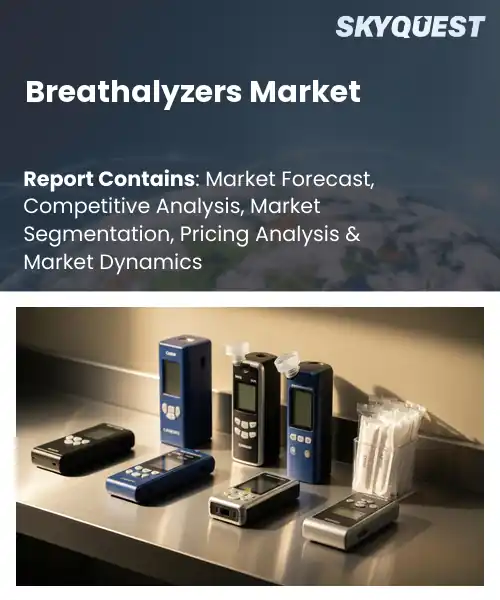
Breathalyzers Market
Report ID: SQMIG35A3917
Report ID: SQMIG35A3917
[email protected]
USA +1 351-333-4748
Report ID:
SQMIG35A3917 |
Region:
Global |
Published Date: June, 2026
Pages:
157
|Tables:
123
|Figures:
77


Global Breathalyzers Market size was valued at USD 1.7 Billion in 2024 and is poised to grow from USD 1.84 Billion in 2025 to USD 3.46 Billion by 2033, growing at a CAGR of 8.2% during the forecast period (2026-2033).
The global breathalyzer market comprises devices that estimate blood alcohol concentration through chemical or infrared sensors, serving law‑enforcement agencies, transportation companies, and private consumers. Its relevance stems from the escalating societal costs of alcohol‑related accidents and the tightening of zero‑tolerance legislation worldwide. Historically, the sector began with bulky tabletop units in the 1950s, evolved to portable electrochemical models in the 1990s, and now embraces Bluetooth‑enabled spectrometers that transmit results to smartphones. This technological progression has broadened adoption beyond police checkpoints to workplace testing, roadside assistance programs, and personal safety apps, thereby expanding the market’s addressable base for manufacturers and investors.
The convergence of breathalyzer technology with insurance incentive programs drives the market’s rapid expansion. Insurers embed alcohol‑monitoring data into underwriting models, so drivers earn premium discounts that spur widespread adoption of in‑vehicle sensors that log readings each trip. Lower insurance costs encourage consumers to accept the devices, generating richer datasets that insurers feed back into more precise risk algorithms. Real‑world examples include European fleet operators equipping trucks with Bluetooth breathalyzers that disable ignition when levels exceed limits, and U.S. rideshare firms providing subsidized personal devices to contractors. These initiatives boost hardware sales and create recurring revenue through subscription‑based analytics services.
How is AI Improving Accuracy in the Breathalyzer Market?
AI is reshaping breathalyzer technology by enhancing sensor interpretation and reducing false readings. Modern devices combine spectroscopic sensors with machine learning models that learn from thousands of breath samples, allowing them to distinguish alcohol from confounding compounds. This improves reliability for law enforcement, workplace testing and personal safety. The market is expanding rapidly as regulators demand higher precision and consumers seek trustworthy portable devices. Companies are integrating cloud based analytics that continuously update algorithms, ensuring devices stay current with new data patterns. These advances make breathalyzers more user friendly and reduce the need for costly hardware upgrades.
In May 2025, Cannabix Technologies advanced development of its AI-enabled BreathLogix alcohol screening platform by integrating intelligent analytics and automated data management features. The system enhances workplace alcohol testing through real-time monitoring, trend analysis, and compliance reporting. This innovation demonstrates how artificial intelligence is improving the efficiency, accuracy, and scalability of modern breathalyzer solutions.
Market snapshot - (2026-2033)
Global Market Size
USD 1.7 Billion
Largest Segment
Fuel Cell Technology
Fastest Growth
Infrared (IR) Spectroscopy
Growth Rate
8.2% CAGR
To get more insights on this market click here to Request a Free Sample Report
Global breathalyzers market is segmented by technology, product type, application, end user and region. Based on technology, the market is segmented into fuel cell technology, semiconductor sensor technology, infrared (IR) spectroscopy and other technologies. Based on product type, the market is segmented into handheld breathalyzers, portable breathalyzers and desktop/benchtop breathalyzers. Based on application, the market is segmented into law enforcement, workplace testing, personal use, healthcare & medical screening, substance abuse & rehabilitation monitoring and other applications. Based on end user, the market is segmented into government & law enforcement agencies, enterprises & industrial organizations, hospitals & healthcare facilities, rehabilitation centers and individual consumers. Based on region, the market is segmented into North America, Europe, Asia Pacific, Latin America and Middle East & Africa.
Fuel cell technology segment dominates because it delivers the highest accuracy and rapid response, which are critical for legally defensible results. Its electrochemical detection reliably quantifies blood alcohol concentration, earning trust among authorities and courts. This reliability drives procurement preferences, while the technology’s low drift and calibration stability reduce operational costs. Consequently, manufacturers prioritize fuel‑cell designs, reinforcing its market leadership in the breathalyzers market across both public and private sectors.
Meanwhile, semiconductor sensor technology segment emerges as the most rapidly expanding area because its miniaturized design enables integration into smartphones and wearables, attracting a new wave of tech‑savvy consumers. Continuous advancements lower power consumption and improve detection limits, spurring broader adoption and creating fresh growth opportunities for developers in the market.
Law enforcement application segment leads because it requires the most rigorous accuracy and evidentiary standards, prompting agencies to adopt certified devices that can withstand judicial scrutiny. The critical nature of DUI enforcement creates sustained procurement budgets, and statutory mandates compel regular field testing, reinforcing demand. Consequently, manufacturers focus on compliance features, durability, and data integrity, cementing this application’s preeminence in the breathalyzers market across global jurisdictions and operational contexts for law enforcement.
On the other hand, workplace testing application segment is witnessing the strongest growth momentum because employers increasingly implement zero‑tolerance alcohol policies to enhance safety and productivity. Advances in portable devices simplify on‑site screening, while insurance incentives and regulatory guidance encourage routine monitoring, driving rapid expansion and opening new market channels.
To get detailed segments analysis, Request a Free Sample Report
The dominance of North America stems from a confluence of rigorous safety regulations, sophisticated law‑enforcement integration, and a mature consumer health consciousness. Extensive deployment of breathalyzer devices across traffic monitoring, workplace sobriety programs, and personal safety applications creates a broad demand base. Strong research and development ecosystems, supported by leading technology firms and academic institutions, accelerate innovation in sensor accuracy and connectivity. Established distribution networks and a well‑aligned insurance and legal framework further reinforce market depth, while public awareness campaigns sustain high adoption rates. Together these elements generate a resilient environment that continuously propels North America ahead of other regions.
Breathalyzers market in the United States benefits from a comprehensive legal framework that mandates device usage in commercial and public safety contexts. Advanced manufacturing capabilities and a culture of early technology adoption encourage rapid integration of cutting‑edge sensors and mobile connectivity. Collaboration between federal agencies, private enterprises, and academic labs fuels ongoing product refinement, while consumer awareness initiatives promote personal ownership for safety monitoring.
Breathalyzers market in Canada is reinforced by stringent road safety legislation and proactive public health strategies that prioritize impaired‑driving prevention. Strong partnerships between government bodies and technology providers facilitate widespread availability of reliable devices across urban and rural areas. A focus on research collaboration within Canadian innovation hubs drives continuous improvement in device precision and user‑friendly design, supporting steady market expansion.
Europe’s rapid expansion is driven by a unified emphasis on road safety, harmonized regulatory standards, and a growing cultural shift toward personal responsibility for sobriety. Collaborative policy frameworks across member states promote consistent adoption of breathalyzer technology in law‑enforcement and private sectors. Investment in digital health ecosystems and connectivity solutions enhances the appeal of smart breathalyzers, while robust consumer education campaigns stimulate demand for personal safety devices. Combined with a strong manufacturing base that leverages precision engineering expertise, these factors position Europe as a fast‑moving hub for market growth and innovation.
Breathalyzers market in Germany enjoys a leading position due to strict traffic safety regulations and a reputation for engineering excellence. German manufacturers integrate high‑precision sensor technology with durable design, meeting both professional and consumer expectations. Collaboration between regulatory agencies and industry groups ensures alignment with European standards, fostering confidence among users and accelerating market uptake.
Breathalyzers market in the United Kingdom is characterized by swift adoption fueled by proactive legislative measures and heightened public awareness of impaired‑driving consequences. The UK’s vibrant tech sector drives development of connected breathalyzer solutions that interface with mobile platforms, appealing to both law‑enforcement agencies and individual users seeking personal safety tools.
Breathalyzers market in France is emerging through targeted safety campaigns and supportive policy incentives that encourage broader device deployment. French innovators focus on compact, user‑friendly designs that resonate with a growing consumer base interested in preventive health monitoring. Partnerships with healthcare providers further embed breathalyzer use in preventive strategies.
Asia Pacific is strengthening its position by capitalizing on expanding urban mobility, heightened safety consciousness, and rapid digital transformation. Governments across the region are introducing stricter drunk‑driving penalties and encouraging technology integration within traffic enforcement frameworks. Growing consumer interest in personal health monitoring, combined with advances in miniaturized sensor technology, supports a surge in smart breathalyzer adoption. Collaborative research initiatives between local manufacturers and international partners accelerate product innovation, while burgeoning e‑commerce channels broaden market reach across diverse demographic segments.
Breathalyzers market in Japan benefits from a strong culture of safety and a sophisticated electronics manufacturing sector that delivers high‑accuracy, compact devices. Government initiatives promote the inclusion of breathalyzer technology in public transportation safety protocols, while consumer interest in personal health gadgets drives retail demand.
Breathalyzers market in South Korea is propelled by aggressive technology integration and a proactive stance on road safety. Domestic firms leverage expertise in semiconductor sensors to create highly responsive devices, and widespread mobile connectivity facilitates seamless integration of breathalyzer data into user applications, fostering robust market growth.
To know more about the market opportunities by region and country, click here to
Buy The Complete Report
Increasing Road Safety Awareness
Growing Demand For Personal Devices
Stringent Regulatory Approval Processes
High Cost Of Advanced Devices
Request Free Customization of this report to help us to meet your business objectives.
The global breathalyzer market is intensely competitive, with manufacturers accelerating product innovation and strategic collaborations to capture expanding demand for personal safety devices. Notably, BACtrack introduced a next‑generation wireless personal breathalyzer in August 2025, leveraging Bluetooth connectivity to enhance user experience. Companies are also pursuing M&A and partnership deals to broaden distribution channels and integrate advanced sensor technologies.
Top Player’s Company Profile
Recent Developments
SkyQuest’s ABIRAW (Advanced Business Intelligence, Research & Analysis Wing) is our Business Information Services team that Collects, Collates, Correlates, and Analyses the Data collected by means of Primary Exploratory Research backed by robust Secondary Desk research.
As per SkyQuest analysis, the global breathalyzer market is driven primarily by increasing road safety awareness that fuels adoption in law‑enforcement, workplace and personal use. A second driver is the rapid growth in demand for personal devices enabled by advances in semiconductor sensors and miniaturisation. The market is restrained by stringent regulatory approval processes that lengthen time‑to‑market and raise development costs. North America dominates the market, benefiting from rigorous safety regulations and strong R&D ecosystems worldwide. Fuel‑cell technology leads as the dominant segment, continuing to deliver the highest accuracy required for legally defensible results.
| Report Metric | Details |
|---|---|
| Market size value in 2024 | USD 1.7 Billion |
| Market size value in 2033 | USD 3.46 Billion |
| Growth Rate | 8.2% |
| Base year | 2024 |
| Forecast period | (2026-2033) |
| Forecast Unit (Value) | USD Billion |
| Segments covered |
|
| Regions covered | North America (US, Canada), Europe (Germany, France, United Kingdom, Italy, Spain, Rest of Europe), Asia Pacific (China, India, Japan, Rest of Asia-Pacific), Latin America (Brazil, Rest of Latin America), Middle East & Africa (South Africa, GCC Countries, Rest of MEA) |
| Companies covered |
|
| Customization scope | Free report customization with purchase. Customization includes:-
|
To get a free trial access to our platform which is a one stop solution for all your data requirements for quicker decision making. This platform allows you to compare markets, competitors who are prominent in the market, and mega trends that are influencing the dynamics in the market. Also, get access to detailed SkyQuest exclusive matrix.
Table Of Content
Executive Summary
Market overview
Parent Market Analysis
Market overview
Market size
KEY MARKET INSIGHTS
COVID IMPACT
MARKET DYNAMICS & OUTLOOK
Market Size by Region
KEY COMPANY PROFILES
Methodology
For the Breathalyzers Market, our research methodology involved a mixture of primary and secondary data sources. Key steps involved in the research process are listed below:
1. Information Procurement: This stage involved the procurement of Market data or related information via primary and secondary sources. The various secondary sources used included various company websites, annual reports, trade databases, and paid databases such as Hoover's, Bloomberg Business, Factiva, and Avention. Our team did 45 primary interactions Globally which included several stakeholders such as manufacturers, customers, key opinion leaders, etc. Overall, information procurement was one of the most extensive stages in our research process.
2. Information Analysis: This step involved triangulation of data through bottom-up and top-down approaches to estimate and validate the total size and future estimate of the Breathalyzers Market.
3. Report Formulation: The final step entailed the placement of data points in appropriate Market spaces in an attempt to deduce viable conclusions.
4. Validation & Publishing: Validation is the most important step in the process. Validation & re-validation via an intricately designed process helped us finalize data points to be used for final calculations. The final Market estimates and forecasts were then aligned and sent to our panel of industry experts for validation of data. Once the validation was done the report was sent to our Quality Assurance team to ensure adherence to style guides, consistency & design.
Analyst Support
Customization Options
With the given market data, our dedicated team of analysts can offer you the following customization options are available for the Breathalyzers Market:
Product Analysis: Product matrix, which offers a detailed comparison of the product portfolio of companies.
Regional Analysis: Further analysis of the Breathalyzers Market for additional countries.
Competitive Analysis: Detailed analysis and profiling of additional Market players & comparative analysis of competitive products.
Go to Market Strategy: Find the high-growth channels to invest your marketing efforts and increase your customer base.
Innovation Mapping: Identify racial solutions and innovation, connected to deep ecosystems of innovators, start-ups, academics, and strategic partners.
Category Intelligence: Customized intelligence that is relevant to their supply Markets will enable them to make smarter sourcing decisions and improve their category management.
Public Company Transcript Analysis: To improve the investment performance by generating new alpha and making better-informed decisions.
Social Media Listening: To analyze the conversations and trends happening not just around your brand, but around your industry as a whole, and use those insights to make better Marketing decisions.
REQUEST FOR SAMPLE
 REQUEST FREE CUSTOMIZATION
Global Breathalyzers Market size was valued at USD 1.7 Billion in 2024 and is poised to grow from USD 1.84 Billion in 2025 to USD 3.46 Billion by 2033, growing at a CAGR of 8.2% during the forecast period (2026-2033).
The global breathalyzer market is intensely competitive, with manufacturers accelerating product innovation and strategic collaborations to capture expanding demand for personal safety devices. Notably, BACtrack introduced a next‑generation wireless personal breathalyzer in August 2025, leveraging Bluetooth connectivity to enhance user experience. Companies are also pursuing M&A and partnership deals to broaden distribution channels and integrate advanced sensor technologies. 'Drägerwerk AG & Co. KGaA', 'Lifeloc Technologies, Inc.', 'Intoximeters, Inc.', 'BACtrack', 'Andatech Pty Ltd', 'Alcolizer Technology', 'Lion Laboratories Limited', 'Alcohol Countermeasure Systems Corp.', 'Abbott Toxicology', 'Quest Products, LLC', 'EnviteC-Wismar GmbH', 'Bedfont Scientific Ltd', 'CMI, Inc.', 'AK GlobalTech Corporation', 'Shenzhen Well Electric Co., Ltd.', 'Sentech Korea Corp.', 'Tanita Corporation', 'Guth Laboratories, Inc.', 'AlcoPro, Inc.', 'Tianjin LKC Technologies Co., Ltd.'
The rising emphasis on road safety has encouraged individuals and organizations to adopt proactive measures, prompting broader acceptance of breathalyzer technology. As drivers seek reliable tools to prevent impaired driving incidents, the perceived value of portable and vehicle‑integrated devices increases, fostering stronger market demand. This cultural shift supports product innovation and expands distribution channels, reinforcing growth momentum across consumer and commercial segments. Regulatory bodies also endorse educational campaigns, further amplifying consumer confidence and encouraging widespread adoption of these safety solutions. Overall, this environment cultivates sustained expansion.
Connected Device Integration: Manufacturers are embedding breathalyzer sensors into smartphones and wearable devices, creating seamless, on‑the‑go testing capabilities. This convergence enhances user convenience, widens market reach, and drives adoption among younger, tech‑savvy consumers. Integration with cloud platforms enables real‑time data analytics, personalized feedback, and remote monitoring for law‑enforcement and occupational safety programs. Consequently, product portfolios are expanding beyond standalone units to multifunctional health and safety ecosystems, fostering brand differentiation and opening new revenue streams through subscription‑based analytics services for both commercial and private.
Why does North America Dominate the Global Breathalyzers Market? |@12


Want to customize this report? This report can be personalized according to your needs. Our analysts and industry experts will work directly with you to understand your requirements and provide you with customized data in a short amount of time. We offer $1000 worth of FREE customization at the time of purchase.
Feedback From Our Clients


 USA (+1) 351-333-4748

