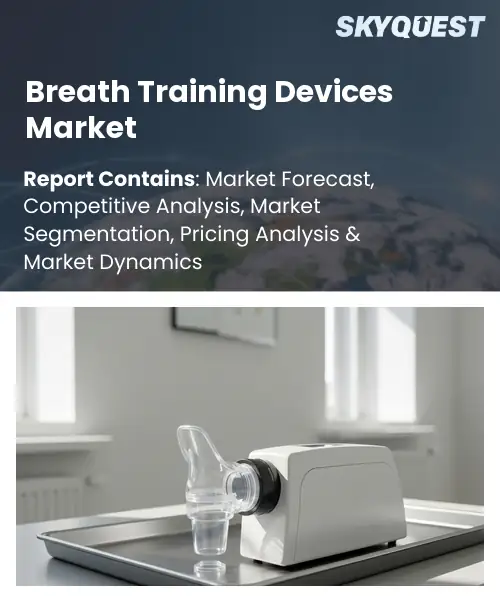
Breath Training Devices Market
Report ID: SQMIG35A4252
Report ID: SQMIG35A4252
[email protected]
USA +1 351-333-4748
Report ID:
SQMIG35A4252 |
Region:
Global |
Published Date: July, 2026
Pages:
157
|Tables:
118
|Figures:
77


Global Breath Training Devices Market size was valued at USD 286.7 Million in 2024 and is poised to grow from USD 309.06 Million in 2025 to USD 563.63 Million by 2033, growing at a CAGR of 7.8% during the forecast period (2026-2033).
The global breath training devices market includes portable and stationary units designed to improve respiratory strength, endurance and control for athletes, patients and wellness seekers. Its relevance stems from rising awareness of lung health and the expanding role of respiratory training in sports performance, chronic disease management and stress reduction. Historically the market was confined to clinical settings, but the early 2010s saw a surge of consumer‑grade devices such as PowerBreathe and SpiroTiger, propelled by digital integration and fitness‑app ecosystems. This evolution from niche therapy to mainstream wellness has created a broad customer base and set the stage for accelerated growth. Demand for breath training devices is now driven primarily by the convergence of health‑tech investment and the growing need for home‑based rehabilitation after the COVID‑19 pandemic. As hospitals reduced in‑person visits, patients with COPD, asthma and post‑viral sequelae turned to portable trainers that provide measurable resistance and real‑time feedback via smartphone dashboards. This shift spurred manufacturers to embed AI‑guided programs that adapt pressure settings to individual progress, exemplified by the recent launch of the RespiFit Pro series. Consequently, insurers are beginning to reimburse these devices, opening new revenue streams and encouraging fitness centers to incorporate them into group classes, thereby expanding the market’s addressable segments.
How is AI enhancing personalization in the breath training devices market?
AI is reshaping breath training devices by embedding adaptive algorithms that learn a user’s inhalation patterns, lung capacity and recovery speed. Sensors capture real‑time airflow and pressure, feeding the data into models that suggest personalized session lengths, breathing rhythms and intensity levels. The devices now move beyond static programs, offering dynamic feedback that adjusts as the user improves, making training more engaging and effective. This shift aligns with a broader push for smart health tools that respond to individual needs, positioning breath trainers as integral components of personalized wellness ecosystems.September 2025, the market saw the rollout of AI‑driven breath training modules that automatically tailor exercises to each user, reinforcing the trend toward customized care and driving broader adoption.
Market snapshot - (2026-2033)
Global Market Size
USD 286.7 Million
Largest Segment
Inspiratory Muscle Trainers
Fastest Growth
Expiratory Muscle Trainers
Growth Rate
7.8% CAGR
To get more insights on this market click here to Request a Free Sample Report
Global breath training devices market is segmented by product type, application, portability, end user and region. Based on product type, the market is segmented into Inspiratory Muscle Trainers, Expiratory Muscle Trainers and Combined Breathing Trainers. Based on application, the market is segmented into Sports Performance, Pulmonary Rehabilitation, Respiratory Therapy and Wellness. Based on portability, the market is segmented into Portable and Stationary. Based on end user, the market is segmented into Hospitals, Rehabilitation Centers, Sports Training Centers and Home Care. Based on region, the market is segmented into North America, Europe, Asia Pacific, Latin America and Middle East & Africa.
Inspiratory Muscle Trainers segment dominates because they directly target the primary muscle groups responsible for breath intake, delivering measurable performance gains for athletes and patients alike. Their simplicity, proven efficacy, and alignment with clinical protocols encourage widespread adoption across sports and healthcare settings. Manufacturers benefit from scalable designs and low maintenance, reinforcing supply chain confidence and fostering strong brand loyalty among professionals seeking reliable respiratory conditioning tools in training programs.
However, Combined Breathing Trainers segment emerges as the key high growth area because integrated devices address both inspiratory and expiratory conditioning, appealing to multidisciplinary users. Their innovative feedback systems and adaptable resistance levels attract tech savvy consumers and clinicians, accelerating product diversification and creating new revenue streams for manufacturers in the market.
Pulmonary Rehabilitation segment dominates because it directly supports recovery protocols for chronic respiratory patients, delivering clinically validated outcomes that improve lung capacity and quality of life. Health institutions prioritize these devices for evidence based therapy, and insurance reimbursements reinforce procurement, leading to deep integration into treatment pathways and sustained demand across care settings. Additionally, continuous clinical evidence shows reduced hospitalizations, and dedicated training programs boost clinician confidence, reinforcing its pivotal role in therapy.
Meanwhile, Wellness segment experiences the strongest growth momentum because consumer interest in preventive health drives demand for at home breath trainers. Brands leverage sleek designs, gamified interfaces, and integration with fitness ecosystems, attracting an audience seeking stress reduction and performance optimization. This user base fuels innovation and opens distribution channels, propelling market expansion.
To get detailed segments analysis, Request a Free Sample Report
North America combines a mature health‑care infrastructure with strong consumer awareness of preventive wellness practices. A culture that embraces fitness technology and a well‑established network of clinical providers accelerate adoption across both consumer and professional segments. Robust research ecosystems and partnerships between device manufacturers and academic institutions fuel continuous product innovation. Moreover, favorable reimbursement frameworks in certain therapeutic areas help embed breath training solutions within standard care pathways. The region also benefits from a high level of digital connectivity, enabling seamless integration of devices with mobile platforms and telehealth services, which in turn reinforces user engagement and market penetration. These converging forces create a resilient ecosystem that supports sustained leadership in the global market.
Breath Training Devices Market in the United States is propelled by a strong emphasis on holistic health and a thriving ecosystem of wellness startups. Consumer appetite for wearable solutions that support stress management and respiratory conditioning drives broad retail presence. Clinical acceptance is reinforced by collaborations with leading health systems that incorporate breath training into rehabilitation protocols. Integration with digital health platforms enhances data analytics capabilities, fostering personalized user experiences. The combination of robust distribution channels, advanced research collaborations, and a tech‑savvy population sustains the market’s leading position.
Breath Training Devices Market in Canada is shaped by a proactive public health approach that encourages preventive interventions. Government health programs and professional associations promote respiratory health, creating a receptive environment for device adoption. Collaborative initiatives between manufacturers and research institutions support product refinement tailored to local needs. Retail networks and online platforms expand accessibility, while a growing community of health‑focused consumers drives demand for home‑based training solutions. The supportive regulatory landscape and emphasis on evidence‑based practices underpin steady market growth.
Europe benefits from a strong regulatory framework that emphasizes evidence‑based health technologies, encouraging confidence among clinicians and consumers alike. Deeply integrated health‑care systems across the region facilitate the inclusion of breath training devices in preventive and therapeutic pathways. A rising consciousness of mental well‑being and stress reduction fuels consumer interest, while robust research institutions drive innovation tailored to regional health priorities. Cross‑border collaboration within the European market enables swift dissemination of best practices and technology standards, reinforcing market cohesion. Additionally, increasing focus on respiratory health in response to lifestyle changes and environmental factors heightens demand for effective training solutions, positioning Europe as a dynamic growth hub.
Breath Training Devices Market in Germany reflects a strong tradition of medical innovation combined with rigorous clinical validation. Leading hospitals and rehabilitation centers integrate breath training into multidisciplinary treatment plans, reinforcing credibility. Consumer uptake is bolstered by a culture that values precision health tools and supports premium wellness experiences. Collaboration between device firms and research universities accelerates product refinements aligned with German health standards. Extensive distribution through both specialist retailers and e‑commerce channels ensures broad market reach.
Breath Training Devices Market in the United Kingdom is experiencing accelerated adoption driven by a heightened focus on mental resilience and workplace wellness. Public health campaigns highlight the benefits of breath control for stress mitigation, influencing consumer behavior. Clinical pathways incorporate breath training into physiotherapy and chronic disease management, enhancing credibility. Entrepreneurial activity in the digital health sector fuels integration of devices with mobile applications, delivering data‑rich experiences. Demand from both private and public health sectors supports a vibrant ecosystem of providers and suppliers.
Breath Training Devices Market in France is emerging as a promising segment supported by growing interest in integrative health approaches. French wellness culture places emphasis on preventive practices, encouraging exploration of breath training as a complementary tool. Academic collaborations focus on validating therapeutic benefits, strengthening acceptance among health professionals. Boutique retail outlets and online platforms expand consumer access, while pilot programs within community health settings demonstrate practical applications. The evolving regulatory environment facilitates market entry for innovative solutions.
Asia Pacific leverages rapid digital adoption and a burgeoning middle‑class population that prioritizes personal health optimization. Strong governmental initiatives promoting preventive health care create conducive policy environments for breath training technologies. Regional innovation hubs in key economies nurture design of culturally adapted devices that align with local wellness practices. Integration with mobile ecosystems and popular health apps enhances user engagement, while expanding telehealth services provide new channels for clinical endorsement. Collaborative networks among manufacturers, research institutes, and healthcare providers accelerate knowledge transfer and product iteration, positioning the region as an increasingly influential player in the global landscape.
Breath Training Devices Market in Japan benefits from a societal emphasis on longevity and preventive health. Integration of breath training into traditional practices such as mindfulness and martial arts resonates with cultural values. Leading medical institutions incorporate devices into cardiac and pulmonary rehabilitation, reinforcing clinical credibility. Advanced technology adoption rates support seamless connectivity between devices and health monitoring platforms. Retail distribution through both specialty stores and tech‑focused e‑commerce channels expands consumer access, fostering steady market maturation.
Breath Training Devices Market in South Korea is propelled by a tech‑forward consumer base and strong governmental support for digital health innovation. Integration of breath training features into popular wearable ecosystems enhances visibility and user uptake. Healthcare providers increasingly adopt devices for stress management and respiratory therapy, guided by evidence‑based protocols. Collaborative ventures between device manufacturers and local research centers accelerate product customization for Korean consumer preferences. Rapid e‑commerce growth and strategic partnerships with wellness influencers amplify market penetration.
To know more about the market opportunities by region and country, click here to
Buy The Complete Report
Increasing Awareness of Respiratory Health
Adoption of Wearable Training Technology
High Cost of Advanced Devices
Regulatory Approval Complexity
Request Free Customization of this report to help us to meet your business objectives.
The competitive landscape is shaped by aggressive product innovation and strategic partnerships, with companies leveraging seed funding and collaborations to accelerate market entry. Recent examples include Respiratory Health Technologies securing seed capital to scale its SinuSauna device and forming distribution agreements, while RDS in France raised additional seed funding to advance its novel medical device, highlighting a race to capture emerging breath‑training niches through technology‑driven growth.
Top Player’s Company Profile
Recent Developments
SkyQuest’s ABIRAW (Advanced Business Intelligence, Research & Analysis Wing) is our Business Information Services team that Collects, Collates, Correlates, and Analyses the Data collected by means of Primary Exploratory Research backed by robust Secondary Desk research. As per SkyQuest analysis, the global breath training devices market is projected to rise to $563.6 million by 2033, driven primarily by growing awareness of respiratory health that encourages both consumers and clinicians to adopt lung‑strengthening tools, while the integration of breath training into wearable platforms expands reach and engagement. The inspiratory muscle trainer segment leads the market thanks to its proven efficacy and broad clinical use, and North America remains the dominant region due to its advanced healthcare infrastructure and strong consumer adoption. However, the high cost of advanced devices limits accessibility, especially in price‑sensitive markets, tempering overall growth in the near term.
| Report Metric | Details |
|---|---|
| Market size value in 2024 | USD 286.7 Million |
| Market size value in 2033 | USD 563.63 Million |
| Growth Rate | 7.8% |
| Base year | 2024 |
| Forecast period | (2026-2033) |
| Forecast Unit (Value) | USD Million |
| Segments covered |
|
| Regions covered | North America (US, Canada), Europe (Germany, France, United Kingdom, Italy, Spain, Rest of Europe), Asia Pacific (China, India, Japan, Rest of Asia-Pacific), Latin America (Brazil, Rest of Latin America), Middle East & Africa (South Africa, GCC Countries, Rest of MEA) |
| Companies covered |
|
| Customization scope | Free report customization with purchase. Customization includes:-
|
To get a free trial access to our platform which is a one stop solution for all your data requirements for quicker decision making. This platform allows you to compare markets, competitors who are prominent in the market, and mega trends that are influencing the dynamics in the market. Also, get access to detailed SkyQuest exclusive matrix.
Table Of Content
Executive Summary
Market overview
Parent Market Analysis
Market overview
Market size
KEY MARKET INSIGHTS
COVID IMPACT
MARKET DYNAMICS & OUTLOOK
Market Size by Region
KEY COMPANY PROFILES
Methodology
For the Breath Training Devices Market, our research methodology involved a mixture of primary and secondary data sources. Key steps involved in the research process are listed below:
1. Information Procurement: This stage involved the procurement of Market data or related information via primary and secondary sources. The various secondary sources used included various company websites, annual reports, trade databases, and paid databases such as Hoover's, Bloomberg Business, Factiva, and Avention. Our team did 45 primary interactions Globally which included several stakeholders such as manufacturers, customers, key opinion leaders, etc. Overall, information procurement was one of the most extensive stages in our research process.
2. Information Analysis: This step involved triangulation of data through bottom-up and top-down approaches to estimate and validate the total size and future estimate of the Breath Training Devices Market.
3. Report Formulation: The final step entailed the placement of data points in appropriate Market spaces in an attempt to deduce viable conclusions.
4. Validation & Publishing: Validation is the most important step in the process. Validation & re-validation via an intricately designed process helped us finalize data points to be used for final calculations. The final Market estimates and forecasts were then aligned and sent to our panel of industry experts for validation of data. Once the validation was done the report was sent to our Quality Assurance team to ensure adherence to style guides, consistency & design.
Analyst Support
Customization Options
With the given market data, our dedicated team of analysts can offer you the following customization options are available for the Breath Training Devices Market:
Product Analysis: Product matrix, which offers a detailed comparison of the product portfolio of companies.
Regional Analysis: Further analysis of the Breath Training Devices Market for additional countries.
Competitive Analysis: Detailed analysis and profiling of additional Market players & comparative analysis of competitive products.
Go to Market Strategy: Find the high-growth channels to invest your marketing efforts and increase your customer base.
Innovation Mapping: Identify racial solutions and innovation, connected to deep ecosystems of innovators, start-ups, academics, and strategic partners.
Category Intelligence: Customized intelligence that is relevant to their supply Markets will enable them to make smarter sourcing decisions and improve their category management.
Public Company Transcript Analysis: To improve the investment performance by generating new alpha and making better-informed decisions.
Social Media Listening: To analyze the conversations and trends happening not just around your brand, but around your industry as a whole, and use those insights to make better Marketing decisions.
REQUEST FOR SAMPLE
 REQUEST FREE CUSTOMIZATION


Want to customize this report? This report can be personalized according to your needs. Our analysts and industry experts will work directly with you to understand your requirements and provide you with customized data in a short amount of time. We offer $1000 worth of FREE customization at the time of purchase.
Feedback From Our Clients


 USA (+1) 351-333-4748

