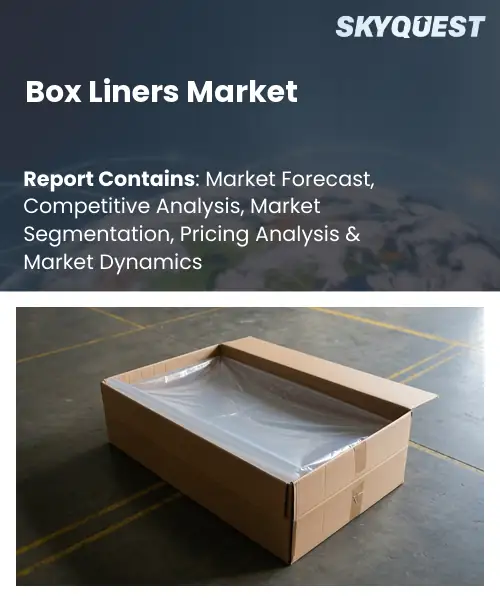
Box Liners Market
Report ID: SQMIG20I2897
Report ID: SQMIG20I2897
[email protected]
USA +1 351-333-4748
Report ID:
SQMIG20I2897 |
Region:
Global |
Published Date: April, 2026
Pages:
157
|Tables:
89
|Figures:
76


Global Box Liners Market size was valued at USD 984.6 Million in 2024 and is poised to grow from USD 1034.81 Million in 2025 to USD 989.1 Million by 2033, growing at a CAGR of 5.1% during the forecast period (2026-2033).
The primary driver of the box liners market is the rapid expansion of e-commerce and omni-channel retailing, which has increased demand for robust secondary protection during long-distance transport. Box liners are internal flexible inserts used to protect goods, control moisture, and enable safe packaging of liquids, foodstuffs, and fragile items, and their importance has risen as logistics networks have grown more complex. Historically the market evolved from waxed paper and basic polyethylene films toward multi-layer barrier and recyclable solutions as manufacturers responded to higher damage-cost pressures and sustainability mandates, for example shifting from single-use polyethylene to compostable liner options today.Building on rising demand from e-commerce and longer supply chains, sustainability regulations and innovation constitute the key factor shaping the global box liners market by forcing suppliers to balance protective performance with environmental impact. As stricter single-use plastic restrictions take effect, manufacturers invest in multi-layer recyclable films and compostable polymers, which reduces landfill disposal and appeals to retailers; for instance bag-in-box liners for wine and edible oil minimize oxygen ingress and extend shelf life, cutting returns and waste. Consequently these technological shifts create growth opportunities in cold-chain liners, foodservice disposables and markets where reduced damage rates translate into cost savings.
How is automation improving efficiency in the box liners market?
Automation is reshaping the box liners market by connecting robotics, automated filling and sealing, machine vision and predictive maintenance into coherent production flows. Key aspects include faster more consistent forming and bag insertion reduced manual handling and greater compatibility with e commerce sizing demands. Many converters now use flexible robotic cells and inline inspection to cut material waste and shorten changeover time. These changes improve product quality and reduce dependence on manual labor while making it easier to meet tighter lead times and sustainability goals. Examples include automated bag in box filling lines and robotic palletizers that smooth handoffs to warehouse systems.Smurfit Westrock March 2026, completed a major upgrade at its Florence linerboard mill that improved machine reliability and board quality boosting consistency on automated converting lines and reducing maintenance interruptions which helps box liner manufacturers scale automated filling and packing and sustain higher throughput with less manual intervention.
Market snapshot - (2026-2033)
Global Market Size
USD 984.6 Million
Largest Segment
Nestable & Stackable Crates (Space Saving)
Fastest Growth
Foldable/Collapsible HDPE Crates
Growth Rate
5.1% CAGR
To get more insights on this market click here to Request a Free Sample Report
Global box liners market is segmented by design configuration, application vertical, capacity range and region. Based on design configuration, the market is segmented into Nestable & Stackable Crates (Space Saving), Foldable/Collapsible HDPE Crates and Solid/Rigid Wall Crates. Based on application vertical, the market is segmented into Food & Beverage (Agriculture/Dairy/Meat), Retail & E-commerce Logistics and Others (Pharmaceuticals & Industrial Parts). Based on capacity range, the market is segmented into Small & Medium Capacity and Large/Bulk Handling Crates. Based on region, the market is segmented into North America, Europe, Asia Pacific, Latin America and Middle East & Africa.
Nestable & Stackable Crates segment dominates because their space-optimizing design reduces idle volume in transit and storage, simplifying liner staging and retrieval workflows for handlers. The predictable geometry and repeatable stacking patterns minimize liner shifting and damage, lowering the need for excessive protective packing. These operational efficiencies lead procurement teams to prefer liners tailored for nesting systems, reinforcing broad use across distribution networks.
However, Foldable/Collapsible HDPE Crates are the most rapidly expanding sub-segment because their returnable compact form reduces reverse logistics costs and enables repeated liner reuse. Improved collapse mechanisms and material resilience broaden applications across omnichannel fulfillment, accelerating adoption by logistics operators seeking space-efficient, sustainable liner systems and unlocking new commercial service models.
Foldable/Collapsible HDPE Crates segment leads because their collapse-after-use capability sharply lowers return shipment volume and storage burden, making liner recovery and reuse economically practical for continuous liner programs. Robust material properties preserve liner compatibility through many collapse cycles, reducing replacement frequency and operational interruptions. The resulting cost and handling advantages encourage logistics providers to integrate foldable crate-compatible liners into standard operating procedures.
Meanwhile, Nestable & Stackable Crates are emerging as the fastest growing area because growing demand for compact transport and quick liner insertion reduces handling time. Standard pallet compatibility and low storage footprint appeal to high throughput operations, prompting vendors to enhance liner fastening and modular options that broaden box liner application in distribution workflows.
To get detailed segments analysis, Request a Free Sample Report
Asia Pacific commands the box liners landscape due to converging supply chain sophistication, dense manufacturing hubs, and strong consumer markets that elevate packaging demand. A well established industrial base supports high volume production and local innovation in liner materials and design, while proximity to major exporters creates continuous demand for protective secondary packaging. Regional policy emphasis on logistics efficiency and investments in cold chain infrastructure reinforce demand for specialized liners. A diverse mix of small and large packaging firms fosters competitive pricing and rapid product adaptation to sector needs such as food, electronics, and chemicals. Cross border trade dynamics and clustering of suppliers and converters create an ecosystem where scale, logistical advantage, and localized innovation combine to sustain leadership in the global market.
Box Liners Market in Japan benefits from advanced manufacturing techniques, high quality standards, and focus on material innovation. Demand from electronics, automotive, and food packaging sectors drives development of tailored liner solutions. A mature logistics network and emphasis on sustainable materials encourage conversion to recyclable and high performance liners. Close collaboration between converters and end users accelerates product refinement, supporting a market environment where premium and specialized liners gain preference.
Box Liners Market in South Korea is shaped by rapid industrial scaling, strong electronics and chemical sectors, and an emphasis on high barrier and performance liners. Domestic converters collaborate with material suppliers to meet stringent transport and export requirements. Advanced manufacturing capabilities facilitate prototypes and niche products, while logistics hubs support distribution. Sustainability initiatives and demand for lightweight, protective packaging foster innovation and broaden application across food and industrial segments.
North America experiences rapid expansion in the box liners market driven by integrated logistics networks, a mature retail ecosystem, and strong emphasis on food safety and goods protection across supply chains. Large distribution centers and advanced cold chain systems increase demand for specialized liners that ensure product integrity. Innovation by material producers and converters supports development of sustainable and performance oriented solutions, while regulatory focus on packaging safety and recyclability prompts adoption of new liner formats. Collaboration between retailers, third party logistics providers, and packaging suppliers accelerates product testing and scaling. Market dynamics favor customization for e commerce, temperature sensitive shipments, and industrial packaging, reinforcing the region in its role as a sophisticated adopter of advanced liner technologies. Robust supplier networks and investment in research and development enable rapid commercialization of novel liner formulations tailored to regional logistics challenges.
Box Liners Market in the United States is driven by e commerce, food distribution, and industrial demand for reliable protection and temperature control. Emphasis on packaging innovation and sustainable material options fosters collaboration between converters, material suppliers, and logistics providers. Extensive distribution infrastructure and a culture of product differentiation encourage development of specialized liners for varied transport conditions. Regulatory focus on food safety and recyclability shapes product design and uptake.
Box Liners Market in Canada reflects demand from food processing, cold chain logistics, and trade that necessitate protective, temperature resilient liners. Emphasis on sustainability and circular packaging drives trials of recyclable and compostable liner materials. Collaboration between converters and logistics operators supports tailored solutions for long distance transport. Investment in automation and quality assurance strengthens consistency in liner performance and encourages adoption across retail and industrial channels and seasonal demand.
Europe is strengthening its position in the box liners market through a combination of regulatory focus on sustainability, strong research capabilities, and collaborative industry initiatives that drive material innovation. Emphasis on recyclable materials and reduction of packaging waste compels converters and material scientists to develop circular solutions compatible with existing recycling streams. Robust manufacturing expertise and proximity of suppliers to major consumer markets allow rapid iteration and customization. Investment in advanced barrier technologies and bio based materials addresses diverse needs across food, pharmaceuticals, and industrial goods. Cross border standards and certification efforts further enhance confidence in new liner formats, enabling wider commercial acceptance and positioning the region as a leader in environmentally conscious and technically sophisticated liner solutions. Strong distribution networks support efficient roll out.
Box Liners Market in Germany reflects advanced engineering and precision manufacturing with collaboration between material innovators and converters. Demand from automotive supply chains and food processing drives development of high performance, specialized liners. Emphasis on process optimization and quality control supports adoption of automated production and rigorous testing. Sustainability priorities and efficient logistics encourage exploration of recyclable and bio based materials, promoting a focus on durable, high quality liner solutions.
Box Liners Market in United Kingdom is shaped by a retail sector, e commerce growth, and stringent waste reduction policies that drive packaging innovation. Converters and material scientists collaborate on recyclable and compostable liner options tailored for urban distribution and last mile logistics. Investment in lightweight, high barrier solutions addresses diverse protection needs while certification schemes and retailer initiatives support adoption. Market prefers adaptable liners meeting performance and sustainability requirements.
Box Liners Market in France reflects strong food and beverage, high standards for protection, and growing sustainability expectations among manufacturers and retailers. Collaboration between converters and research institutions advances development of bio based and recyclable liner solutions. Demand for high barrier, hygiene focused liners encourages innovation in material blends and sealing technologies. Efficient logistics and emphasis on compliance and certification support adoption of liner formats for domestic distribution and export.
To know more about the market opportunities by region and country, click here to
Buy The Complete Report
Increasing Demand For Protective Packaging
Box liners reduce transit damage and improve pallet stability, encouraging manufacturers and distributors to adopt them as part of packaging strategies. By providing additional cushioning and containment, liners help protect diverse goods against moisture, abrasion, and shifting during handling and storage. This direct reduction in product losses and customer complaints supports wider specification of liners in supply chains and prompts packaging engineers to integrate liners into standard corrugated solutions, thereby elevating procurement preference for packaged systems that include protective internal components.
Growth In Ecommerce and Logistics
Rapid expansion of ecommerce channels and evolving logistics requirements increase demand for secure, efficient packaging, making box liners an attractive solution. Liners facilitate standardized inner packaging that simplifies packing operations, reduces damage during multi modal transport, and enhances presentation for end customers, encouraging retailers and third party logistics providers to specify liner use. The operational benefits of reduced handling complexity and improved load stability motivate supply chain decision makers to include liners as part of packaging policies and sourcing choices, supporting steady adoption across distribution networks.
Raw Material Price Volatility
Fluctuations in costs of polymers, films, and specialty additives increase uncertainty for box liner manufacturers and buyers, constraining market expansion. When material prices rise unpredictably, producers face margin pressure that can lead to higher product prices or reduced investment in production capacity, which in turn discourages some customers from specifying liners. The need to frequently renegotiate contracts and manage supply chain risk can slow procurement cycles and limit adoption, as buyers prioritize more predictable or lower-cost packaging alternatives until cost stability returns.
Limited Recycling Infrastructure Availability
In many regions inadequate collection, sorting, and recycling capacity for composite liner materials diminishes the appeal of box liners, particularly where sustainability commitments influence purchasing. Customers and regulators seeking recyclable or circular packaging may avoid liners that are difficult to separate from corrugated boards or that require specialized processing, reducing demand. Manufacturers face additional compliance burden and limited end of life solutions that complicate product development and marketing, causing some firms to delay introduction of new liner formats or to invest cautiously until recycling systems are more widely established.
Request Free Customization of this report to help us to meet your business objectives.
The competitive landscape of the global box liners market is shaped by consolidation and technology driven differentiation: large packaging groups have pursued M&A to secure film and liner capabilities, such as Amcor's acquisition of Bemis and Berry Global's acquisition of RPC, producers have invested in recycled linerboard capacity through projects like Cascades Bear Island conversion, and material innovators are advancing biodegradable barrier films to win retailer and foodservice contracts.
Top Player’s Company Profile
Recent Developments
SkyQuest’s ABIRAW (Advanced Business Intelligence, Research & Analysis Wing) is our Business Information Services team that Collects, Collates, Correlates, and Analyses the Data collected by means of Primary Exploratory Research backed by robust Secondary Desk research. As per SkyQuest analysis, rapid expansion of e-commerce and omni-channel retailing is the key driver boosting demand for box liners as retailers and logistics providers seek robust internal protection for longer, more complex supply chains. Sustainability regulations and material innovation act as a second driver, pushing suppliers toward recyclable and compostable liner solutions. Raw material price volatility is a notable restraint that can pressure margins and slow adoption. Asia Pacific dominates the market thanks to dense manufacturing hubs and export-oriented logistics, while design configuration led by Nestable and Stackable Crates remains the dominant segment because space-saving, predictable geometry and handling efficiencies reduce damage and improve liner integration in automated fulfillment environments.
| Report Metric | Details |
|---|---|
| Market size value in 2024 | USD 984.6 Million |
| Market size value in 2033 | USD 989.1 Million |
| Growth Rate | 5.1% |
| Base year | 2024 |
| Forecast period | (2026-2033) |
| Forecast Unit (Value) | USD Million |
| Segments covered |
|
| Regions covered | North America (US, Canada), Europe (Germany, France, United Kingdom, Italy, Spain, Rest of Europe), Asia Pacific (China, India, Japan, Rest of Asia-Pacific), Latin America (Brazil, Rest of Latin America), Middle East & Africa (South Africa, GCC Countries, Rest of MEA) |
| Companies covered |
|
| Customization scope | Free report customization with purchase. Customization includes:-
|
To get a free trial access to our platform which is a one stop solution for all your data requirements for quicker decision making. This platform allows you to compare markets, competitors who are prominent in the market, and mega trends that are influencing the dynamics in the market. Also, get access to detailed SkyQuest exclusive matrix.
Table Of Content
Executive Summary
Market overview
Parent Market Analysis
Market overview
Market size
KEY MARKET INSIGHTS
COVID IMPACT
MARKET DYNAMICS & OUTLOOK
Market Size by Region
KEY COMPANY PROFILES
Methodology
For the Box Liners Market, our research methodology involved a mixture of primary and secondary data sources. Key steps involved in the research process are listed below:
1. Information Procurement: This stage involved the procurement of Market data or related information via primary and secondary sources. The various secondary sources used included various company websites, annual reports, trade databases, and paid databases such as Hoover's, Bloomberg Business, Factiva, and Avention. Our team did 45 primary interactions Globally which included several stakeholders such as manufacturers, customers, key opinion leaders, etc. Overall, information procurement was one of the most extensive stages in our research process.
2. Information Analysis: This step involved triangulation of data through bottom-up and top-down approaches to estimate and validate the total size and future estimate of the Box Liners Market.
3. Report Formulation: The final step entailed the placement of data points in appropriate Market spaces in an attempt to deduce viable conclusions.
4. Validation & Publishing: Validation is the most important step in the process. Validation & re-validation via an intricately designed process helped us finalize data points to be used for final calculations. The final Market estimates and forecasts were then aligned and sent to our panel of industry experts for validation of data. Once the validation was done the report was sent to our Quality Assurance team to ensure adherence to style guides, consistency & design.
Analyst Support
Customization Options
With the given market data, our dedicated team of analysts can offer you the following customization options are available for the Box Liners Market:
Product Analysis: Product matrix, which offers a detailed comparison of the product portfolio of companies.
Regional Analysis: Further analysis of the Box Liners Market for additional countries.
Competitive Analysis: Detailed analysis and profiling of additional Market players & comparative analysis of competitive products.
Go to Market Strategy: Find the high-growth channels to invest your marketing efforts and increase your customer base.
Innovation Mapping: Identify racial solutions and innovation, connected to deep ecosystems of innovators, start-ups, academics, and strategic partners.
Category Intelligence: Customized intelligence that is relevant to their supply Markets will enable them to make smarter sourcing decisions and improve their category management.
Public Company Transcript Analysis: To improve the investment performance by generating new alpha and making better-informed decisions.
Social Media Listening: To analyze the conversations and trends happening not just around your brand, but around your industry as a whole, and use those insights to make better Marketing decisions.
REQUEST FOR SAMPLE
 REQUEST FREE CUSTOMIZATION


Want to customize this report? This report can be personalized according to your needs. Our analysts and industry experts will work directly with you to understand your requirements and provide you with customized data in a short amount of time. We offer $1000 worth of FREE customization at the time of purchase.
Feedback From Our Clients


 USA (+1) 351-333-4748

