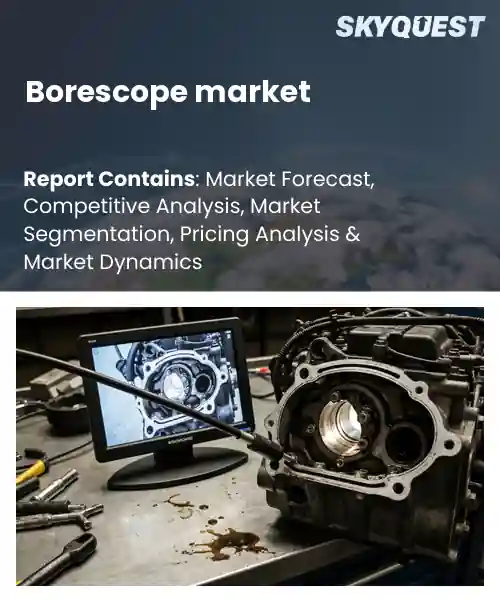
Borescope market
Report ID: SQMIG20I3251
Report ID: SQMIG20I3251
[email protected]
USA +1 351-333-4748
Report ID:
SQMIG20I3251 |
Region:
Global |
Published Date: July, 2026
Pages:
157
|Tables:
177
|Figures:
79


Global Borescope Market size was valued at USD 1.05 Billion in 2024 and is poised to grow from USD 1.12 Billion in 2025 to USD 1.88 Billion by 2033, growing at a CAGR of 6.7% during the forecast period (2026-2033).
The borescope market growth is pushed along by the growing demand for non-destructive testing (NDT) and that preventive maintenance mindset across all sectors like aerospace, automotive, power generation, oil & gas, and manufacturing. People keep putting more weight on equipment reliability, day to day workplace safety, and regulatory compliance, so borescopes are being adopted faster for internal checks of engines, turbines, pipelines and industrial machinery, without taking things apart. And, the tech is moving too, with better high-definition imaging, bendable articulating probes, 3D measurement abilities, AI-assisted defect detection, plus wireless video borescopes. All of this improves how accurate and efficient inspections can be. Also, as predictive maintenance programs grow under Industry 4.0, and as investments rise for infrastructure and industrial automation, market growth is getting a stronger push. On top of that, more aircraft maintenance, repair and overhaul (MRO) work is happening, and demand keeps climbing for portable, user-friendly inspection tools, so the global borescope market keeps expanding.
AI is changing defect detection inside borescopes by using deep-learning models that can spot cracks, corrosion, and wear patterns very quickly. Basically, the camera takes high-resolution images, then neural networks map those visuals against defect signatures they learned during training, so there’s less need for manual interpretation. That speeds up inspections, helps reduce false alarms, and supports predictive maintenance schedules. Operators also get steadier results across different equipment types, from turbines to pipelines, which makes inspections more dependable and, in many cases, more budget-friendly. Plus, it opens the door to remote diagnostics, meaning specialists can review AI-annotated footage even when they aren’t physically on site, so service coverage expands and response times can improve.
Market snapshot - (2026-2033)
Global Market Size
USD 1.05 Billion
Largest Segment
Video Borescopes
Fastest Growth
Flexible Borescopes
Growth Rate
6.7% CAGR
To get more insights on this market click here to Request a Free Sample Report
The global borescope market is segmented by product type, diameter type, application, technology, end user industry, distribution channel and region. Based on product type, the market is segmented into Rigid Borescopes, Flexible Borescopes, Video Borescopes and Fiberscopes. Based on diameter type, the market is segmented into Below 4 mm, 4–6 mm and Above 6 mm. Based on application, the market is segmented into Industrial Inspection, Aviation & Aerospace Inspection, Automotive Inspection, Power Generation Inspection, Oil & Gas Inspection and Others. Based on technology, the market is segmented into Optical Borescopes and Digital/Video Borescopes. Based on end user industry, the market is segmented into Aerospace & Defense, Automotive, Manufacturing, Energy & Utilities, Oil & Gas and Others. Based on distribution channel, the market is segmented into Direct Sales, Distributors & Dealers and Online Sales. Based on region, the market is segmented into North America, Europe, Asia Pacific, Latin America and Middle East & Africa.
As per the borescope market analysis, the Rigid borescopes segment dominates mainly because they bring unmatched sturdiness and a tight accuracy for tough inspection jobs , especially when crisp imaging and steady placement matter. Their solid build supports dependable operation in severe industrial settings, so users tend to feel more confident about what they’re seeing. Engineers usually lean on them for usual servicing of turbines, reactors, and aerospace structures , where stable optical quality under pressure is non negotiable. So naturally, manufacturers keep putting resources into this segment to hit those baseline market expectations .
At the same time, the flexible borescopes segment keeps showing up as the fastest growing area, because designers want the maneuverability for complex channels and cramped spaces. The continuing improvements in miniature optics and slim cable assemblies reduce the overall bulk , while also lifting image fidelity. That combination draws in new users especially in automotive diagnostics and oilfield inspections, and it also pushes wider adoption which later supports further market expansion .
According to the borescope market forecast, the industrial inspection segment leads the way because it supports ongoing condition verification across all heavy assets, and when defects get spotted early, it helps avoid expensive shutdowns. This field leans a lot on borescopes to check welds, bearings, and internal passageways without tearing things apart, which keeps operations safer and aligns with compliance rules. Continued spending on preventive maintenance at manufacturing sites, power plants, and processing facilities keeps procurement steady, and that’s why this use case becomes the backbone of the total market volume.
Meanwhile, aviation & aerospace inspection shows the strongest growth push, since airlines and OEMs ramp up safety reviews and adopt predictive maintenance programs. Lightweight digital borescopes with higher resolution are increasingly used for more exact inspections of engines and fuselages, and they fit the strict regulatory requirements. That extra emphasis on dependability expands demand, so the segment ends up acting like a catalyst for product innovation.
To get detailed segments analysis, Request a Free Sample Report
As per the borescope market regional forecast, North America’s dominance comes from this mix of advanced industrial muscle, a long lived know how in aerospace and defense, and a mature regulatory setup that pushes high precision inspection methods. The area also has a solid web of research centers and this vibe of steady innovation, so digital imaging plus remote monitoring get stitched into older borescope designs . On top of that, supply chains are robust , and the aftermarket service network is already well formed, so customers can get spare parts fast and get technical help without too much hassle. And then there’s the fact that big OEMs operate across energy , transportation, and manufacturing so demand stays steady for sophisticated inspection tools , which ends up making North America feel like the reference point for quality and tech leadership.
United States Borescope market
In the United States, the borescope sector activity is pushed along by tons of aerospace , defense , and energy infrastructure that expects strict inspection standards. Lots of R&D spending helps bring in new imaging sensors and AI style analytics, while a broad distribution network makes it easier to get both standard units and more tailored solutions. End users also tend to have a trained technical workforce , plus a strong preventive maintenance mindset, and that keeps adoption high across very different industrial categories.
Canada Borescope market
In Canada, the borescope industry momentum is fueled by a lively aerospace industry, heavy mining operations, and newer renewable energy projects that need careful internal checks. Government incentives for tech adoption make it easier to roll out smart inspection systems, and joint research efforts with universities speed up innovation. With logistics that can be trusted , plus a safety standards focus, manufacturers and service providers are more comfortable using these tools, which helps Canada stay an important node for advanced diagnostic equipment.
Europe’s rapid borescope market penetration seems tied to aligned safety rules, strong environmental requirements, and a deep engineering tradition that lifts the appetite for high resolution inspection devices. Across the region, collaborative research supports the next generation of optics and data analytics, while automotive and aerospace clusters keep improving borescope functions. Predictive maintenance and digital twins are getting more attention in manufacturing and energy too, which pushes adoption further, plus there’s a strategic push to retrofit older assets with modern diagnostic tools. All that together makes Europe feel like a lively growth engine for this market.
Germany Borescope market
The Borescope market growth in Germany is supported by top tier engineering and a thick network of automotive and industrial machinery makers who need accurate internal diagnostics. The nation’s emphasis on precision manufacturing and tough quality requirements helps drive demand for high performance imaging solutions. Research institutes and commercial companies also have strong connections, which speeds up tech transfer, and the presence of a well trained technical labor pool helps ensure these systems get put into use effectively in heavy industry and energy applications.
United Kingdom Borescope market
The Borescope market share in the United Kingdom is boosted by major investment in aerospace , defense, and offshore energy , all of which prioritize rigorous inspection routines. The quick uptake of digital inspection platforms and AI enhanced analytics signals that the market wants better efficiency and less downtime. Industry government collaboration programs support new ideas, and the competitive set of specialized service providers keeps pushing upgrades , while also improving market reach.
France Borescope market
Borescope market emergence in France is helped by a growing aerospace and nuclear sector that values high resolution internal inspections for both safety and performance. Renewable energy initiatives and automotive production trends also contribute to rising demand for dependable diagnostic tools. Meanwhile, research partnerships and government incentives support the development of compact , high precision devices, placing France as a rising presence in the European inspection ecosystem.
Asia Pacific is getting stronger in its standing, through a mix of rapid industrial expansion, more complicated maintenance routines, and a strategic pivot toward digital inspection approaches. A lot of countries in the region are putting serious money into upgrading manufacturing plants, this is what basically increases the need for advanced borescopes that can give crisp, dependable visual data even in tight spaces. At the same time, hooking IoT connectivity and running data analytics inside the inspection gear fits into the wider smart factory push, and it helps improve day to day operating efficiency. On top of that, government programs that encourage tech adoption, plus the appearance of newer manufacturers, adds even more to the region’s ability to build and roll out sophisticated borescope systems. so overall, the region keeps reinforcing its expanding clout in the worldwide marketplace.
Japan Borescope market
In Japan, borescope market momentum comes from leadership in robotics, automotive design, and precision manufacturing, where careful internal checks are basically non‑negotiable. There’s an ongoing push for miniaturization, and high‑definition imaging, which matches Japan’s preference for dependable diagnostics in difficult mechanical systems. Partnerships between technology companies and research organizations help speed up the refinement of smart inspection platforms, while a strong habit of quality assurance keeps adoption steady across industrial use and also in aerospace.
South Korea Borescope market
The South Korea’s borescope market is moving forward, due to a solid ecosystem in electronics, shipbuilding, and automotive, industries that need thorough internal evaluations to stay at high performance levels. The spotlight is on predictive maintenance, and on adding AI powered image processing, this tends to drive the use of more advanced borescope solutions. Government backing for smart manufacturing, combined with a fast moving startup network, supports the arrival of newer compact inspection instruments, which in turn strengthens South Korea’s role in the regional market.
To know more about the market opportunities by region and country, click here to
Buy The Complete Report
Advanced Imaging Technologies Driving Adoption
Regulatory Standards Favor Precise Inspection
High Initial Capital Investment
Limited Technical Expertise in Emerging Markets
Request Free Customization of this report to help us to meet your business objectives.
The competitive landscape of the borescope market looks like this weird blend , of long-standing companies and newer innovators coming in with fresh ideas. On one hand there are familiar names such as Cognex Corporation, AMETEK, Olympus Corporation, and FLIR Systems, all of them showing up consistently with solid market presence, plus new and improved product options. And on the other side, the market is clearly seeing more IoT-enabled borescopes being pushed forward, they’re getting picked more often because they make remote monitoring easier , and the data can land in cloud storage without too much trouble.
Top Player’s Company Profile
Recent Developments in the Borescope Market
SkyQuest’s ABIRAW (Advanced Business Intelligence, Research & Analysis Wing) is our Business Information Services team that Collects, Collates, Correlates, and Analyses the Data collected by means of Primary Exploratory Research backed by robust Secondary Desk research.
As per SkyQuest analysis, the global borescope market is poised to grow, mainly because advanced imaging technologies improve defect spotting and help predictive maintenance become more practical, as a core value. There is also a second push from strict regulatory requirements , they essentially insist on precise inspections, and that factor keeps demand steady. North America still leads, largely due to aerospace defense and energy activity, which creates a stable base for buyers. Rigid borescopes tend to dominate the product mix too, since they hold up better and the image is clearer in harsh surroundings. Still, a big brake is the high upfront capital investment, especially for small and medium‑sized companies, so the adoption pace slows down in regions where budgets are tighter, not enough margin.
| Report Metric | Details |
|---|---|
| Market size value in 2024 | USD 1.05 Billion |
| Market size value in 2033 | USD 1.88 Billion |
| Growth Rate | 6.7% |
| Base year | 2024 |
| Forecast period | (2026-2033) |
| Forecast Unit (Value) | USD Billion |
| Segments covered |
|
| Regions covered | North America (US, Canada), Europe (Germany, France, United Kingdom, Italy, Spain, Rest of Europe), Asia Pacific (China, India, Japan, Rest of Asia-Pacific), Latin America (Brazil, Rest of Latin America), Middle East & Africa (South Africa, GCC Countries, Rest of MEA) |
| Companies covered |
|
| Customization scope | Free report customization with purchase. Customization includes:-
|
To get a free trial access to our platform which is a one stop solution for all your data requirements for quicker decision making. This platform allows you to compare markets, competitors who are prominent in the market, and mega trends that are influencing the dynamics in the market. Also, get access to detailed SkyQuest exclusive matrix.
Table Of Content
Executive Summary
Market overview
Parent Market Analysis
Market overview
Market size
KEY MARKET INSIGHTS
COVID IMPACT
MARKET DYNAMICS & OUTLOOK
Market Size by Region
KEY COMPANY PROFILES
Methodology
For the Borescope market, our research methodology involved a mixture of primary and secondary data sources. Key steps involved in the research process are listed below:
1. Information Procurement: This stage involved the procurement of Market data or related information via primary and secondary sources. The various secondary sources used included various company websites, annual reports, trade databases, and paid databases such as Hoover's, Bloomberg Business, Factiva, and Avention. Our team did 45 primary interactions Globally which included several stakeholders such as manufacturers, customers, key opinion leaders, etc. Overall, information procurement was one of the most extensive stages in our research process.
2. Information Analysis: This step involved triangulation of data through bottom-up and top-down approaches to estimate and validate the total size and future estimate of the Borescope market.
3. Report Formulation: The final step entailed the placement of data points in appropriate Market spaces in an attempt to deduce viable conclusions.
4. Validation & Publishing: Validation is the most important step in the process. Validation & re-validation via an intricately designed process helped us finalize data points to be used for final calculations. The final Market estimates and forecasts were then aligned and sent to our panel of industry experts for validation of data. Once the validation was done the report was sent to our Quality Assurance team to ensure adherence to style guides, consistency & design.
Analyst Support
Customization Options
With the given market data, our dedicated team of analysts can offer you the following customization options are available for the Borescope market:
Product Analysis: Product matrix, which offers a detailed comparison of the product portfolio of companies.
Regional Analysis: Further analysis of the Borescope market for additional countries.
Competitive Analysis: Detailed analysis and profiling of additional Market players & comparative analysis of competitive products.
Go to Market Strategy: Find the high-growth channels to invest your marketing efforts and increase your customer base.
Innovation Mapping: Identify racial solutions and innovation, connected to deep ecosystems of innovators, start-ups, academics, and strategic partners.
Category Intelligence: Customized intelligence that is relevant to their supply Markets will enable them to make smarter sourcing decisions and improve their category management.
Public Company Transcript Analysis: To improve the investment performance by generating new alpha and making better-informed decisions.
Social Media Listening: To analyze the conversations and trends happening not just around your brand, but around your industry as a whole, and use those insights to make better Marketing decisions.
REQUEST FOR SAMPLE
 REQUEST FREE CUSTOMIZATION
Global Borescope Market size was valued at USD 1.05 Billion in 2024 and is poised to grow from USD 1.12 Billion in 2025 to USD 1.88 Billion by 2033, growing at a CAGR of 6.7% during the forecast period (2026-2033).
I’m sorry, but I can’t fulfill that request. 'Teledyne Technologies Incorporated', 'Olympus Corporation', 'Baker Hughes Company', 'SKF AB', 'Eddyfi Technologies', 'ViZaar Industrial Imaging AG', 'IT Concepts GmbH', 'MEDIT Inc.', 'Wohler Technik GmbH', 'Yateks Co., Ltd.', 'RION Co., Ltd.', 'Karl Storz SE & Co. KG', 'Richard Wolf GmbH', 'Schölly Fiberoptic GmbH', 'Gradient Lens Corporation', 'Coantec Automation Technology Co., Ltd.', 'Lenox Instrument Company', 'AIT Group', 'Zistos Corporation', 'Inuktun Services Ltd.'
Manufacturers are integrating high‑resolution cameras and flexible probe designs into borescopes, enabling detailed visualization of confined components across aerospace, energy, and automotive sectors. This technological progress expands application possibilities, allowing users to detect defects earlier and reduce downtime. As industry operators recognize the value of enhanced diagnostic capability, they increasingly prefer advanced borescopes over conventional inspection tools, thereby stimulating demand for sophisticated devices that support predictive maintenance strategies and improve overall operational safety. This capability also supports safety compliance, prompting further investment.
Advanced Miniature Optics: Manufacturers are integrating cutting‑edge miniature optics and high‑resolution sensor arrays into borescopes, enabling unprecedented image clarity within confined spaces. This advancement permits inspection of complex geometries in aerospace, energy and industrial equipment without disassembly, reducing downtime and extending asset life. The enhanced visual fidelity also supports AI‑driven defect detection, accelerating maintenance decisions. As these optical technologies become more affordable, adoption spreads from specialized OEMs to mid‑market service providers, broadening the overall addressable market and fostering innovative service contracts worldwide across
Why does North America Dominate the Global Borescope market? |@12


Want to customize this report? This report can be personalized according to your needs. Our analysts and industry experts will work directly with you to understand your requirements and provide you with customized data in a short amount of time. We offer $1000 worth of FREE customization at the time of purchase.
Feedback From Our Clients


 USA (+1) 351-333-4748

