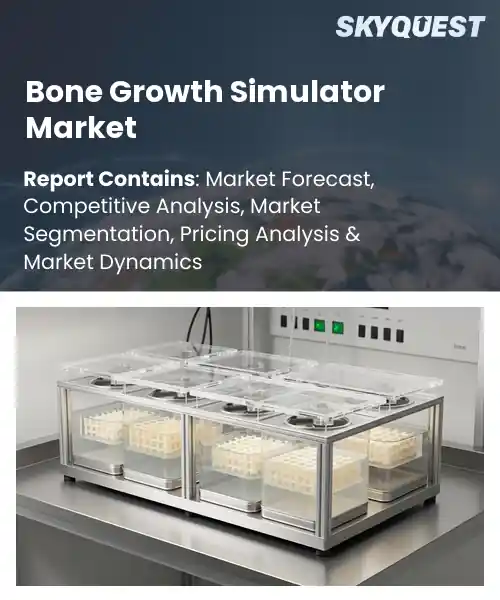
Bone Growth Simulator Market
Report ID: SQMIG20I2838
Report ID: SQMIG20I2838
[email protected]
USA +1 351-333-4748
Report ID:
SQMIG20I2838 |
Region:
Global |
Published Date: April, 2026
Pages:
157
|Tables:
117
|Figures:
77


Global Bone Growth Simulator Market size was valued at USD 1.32 Billion in 2024 and is poised to grow from USD 1.39 Billion in 2025 to USD 1.3 Billion by 2033, growing at a CAGR of 5.4% during the forecast period (2026-2033).
Bone growth simulator market centers on software systems that model osteogenesis to support research, surgical planning, and implant design, becoming critical as clinicians and developers seek predictive tools to improve patient outcomes. The primary driver is the rising burden of musculoskeletal disorders in aging populations and active lifestyles, which increases demand for personalized simulations capable of forecasting fusion success or implant integration. Historically the market progressed from finite element analyses in academic labs to integrated clinical platforms widely used in preclinical testing and intraoperative decision support, with practical examples including simulators for spinal fusion planning and dental implant osseointegration assessment.Advances in imaging integration and modeling form a key factor driving market expansion because CT and MRI data enable accurate simulations that translate into better surgical planning and reduced revision rates. As algorithms incorporate machine learning to predict bone remodeling, developers and clinicians can iterate implant designs faster, which lowers preclinical costs and accelerates time to market. In practice hospitals use simulators to rehearse complex spinal fusions and dental rehabilitations, while manufacturers validate porous implant geometries to enhance osseointegration. Consequently collaboration between imaging vendors, software firms and implant makers creates significant commercial opportunities tied to measurable clinical and economic benefits.
How is AI improving predictive accuracy in the bone growth simulator market?
AI improves predictive accuracy in bone growth simulation by combining data driven learning with physics based models. Key aspects include patient specific imaging integration machine learning guided finite element analysis and mechanobiological modeling. The current state shows smarter parameter estimation better handling of variability and clearer uncertainty estimates. In market context vendors are focusing on clinical decision support virtual testing and personalized implant planning to meet demand for safer predictable outcomes. Examples include imaging fed models that distinguish new bone from graft material and hybrid workflows that let engineers refine simulations faster while keeping them clinically interpretable.Sawbones and Numalogics May 2025, announced FDA qualification of an orthopedic finite element model which illustrates how AI enabled simulation raises predictive confidence for implant behavior and bone response. This regulatory milestone supports wider adoption and accelerates market efficiency by reducing reliance on lengthy physical testing.
Market snapshot - (2026-2033)
Global Market Size
USD 1.32 Billion
Largest Segment
Electromagnetic Bone Growth Simulators
Fastest Growth
Ultrasonic Bone Growth Simulators (LIPUS)
Growth Rate
5.4% CAGR
To get more insights on this market click here to Request a Free Sample Report
Global bone growth simulator market is segmented by product type, application vertical, distribution channel, modality and region. Based on product type, the market is segmented into Electromagnetic Bone Growth Simulators, Ultrasonic Bone Growth Simulators (LIPUS) and Capacitive & Inductive Coupling Devices. Based on application vertical, the market is segmented into Spinal Fusion Enhancement, Delayed Union & Non-union Fractures, Oral & Maxillofacial Reconstruction and Stress & Acute Fracture Management. Based on distribution channel, the market is segmented into Orthopedic Clinics & Trauma Centers, Online Medical Device Marketplaces and Hospitals & Retail Pharmacies. Based on modality, the market is segmented into External Bone Growth Simulators and Implantable Bone Growth Simulators. Based on region, the market is segmented into North America, Europe, Asia Pacific, Latin America and Middle East & Africa.
Electromagnetic Bone Growth Simulators segment dominates because clinicians rely on established electromagnetic therapies across a wide range of indications, and their noninvasive delivery combined with a substantial evidence base drives preference among hospitals and specialty centers. Familiar treatment protocols and compatibility with existing implants reduce clinical barriers, while reimbursement clarity and commercial partnerships increase procurement, reinforcing their position as a default therapy in many care pathways.
However, Ultrasonic Bone Growth Simulators (LIPUS) are emerging as the most rapidly expanding area because miniaturization and portability boost outpatient use and patient adherence. Continued device innovation and growing clinical interest for fracture and non union management drive new trials and commercial collaborations, opening novel adoption channels and creating opportunities for newer entrants in the market.
External Bone Growth Simulators segment dominates because their noninvasive profile and versatility make them the preferred initial therapy for many clinicians, enabling treatment without additional surgery and smooth integration into outpatient care pathways. Ease of application, lower immediate infection risk, and alignment with standard postoperative protocols encourage adoption, while manufacturers refine device ergonomics and service models to support broad clinical deployment across indications.
Conversely, Implantable Bone Growth Stimulators are emerging as the key high growth area because improvements in biointegration and power delivery enable durable targeted therapy for complex non unions and spinal fusion consolidation. Integration with fixation devices and bundled surgical solutions improve adherence and generate predictable long term returns that accelerate clinical adoption.
To get detailed segments analysis, Request a Free Sample Report
North America dominates the global bone growth simulator market due to a confluence of structural advantages across clinical, industrial and regulatory dimensions. Extensive clinical research infrastructure and leading academic medical centers drive early evaluation and clinical validation of simulation technologies, while large medical device firms and specialized startups translate innovations into commercial offerings. A favorable regulatory environment with clear pathways for device assessment encourages investment and adoption in hospitals and training centers. Reimbursement mechanisms and institutional procurement practices support integration into clinical workflows. Strong collaboration between industry, clinicians and payers, coupled with robust distribution channels and a vibrant investor community, accelerates commercialization and scale. The result is a mature ecosystem that both generates technological advances and fosters widespread clinical uptake relative to other regions.
Bone Growth Simulator Market benefits from concentration of medical device manufacturers, pioneering clinical research in orthopedics, and a comprehensive ecosystem for clinical adoption and commercialization. Academic medical centers collaborate with industry to validate technologies and refine simulation protocols. Reimbursement frameworks and institutional procurement practices favor integration into training and product development cycles, while a mature investment community and established distribution networks support rapid scaling and cross sector partnerships.
Bone Growth Simulator Market in Canada is shaped by accessible universal healthcare settings that prioritize evidence based interventions, integration with provincial procurement systems, and collaborative networks between technology providers and research hospitals. Emphasis on translational research and clinician training promotes adoption for pre clinical testing and educational use. Regional centers of excellence and policy support encourage partnerships that streamline evaluation cycles and promote localized implementation pathways.
Rapid expansion of the bone growth simulator market in Europe is driven by coordinated innovation policies, strong clinical research networks, and an active medtech industry that collectively lower barriers to clinical evaluation and adoption. Cross country collaboration and harmonized regulatory frameworks enable manufacturers to pursue region wide validation and commercialization strategies. National health systems and major hospitals increasingly incorporate simulation tools for clinician training, device testing and procedural planning, supported by targeted funding and pilot programs. Established medical device clusters in central Europe and dynamic startup ecosystems in western regions foster technology development and commercialization. The combination of clinical demand for safer, more effective orthopedic therapies and institutional willingness to pilot novel solutions positions Europe as a fast expanding market with differentiated regional strengths.
Bone Growth Simulator Market in Germany benefits from a strong domestic medtech manufacturing base and integrated hospital research networks that prioritize orthopedic innovation. Regional centers provide rigorous clinical validation and collaboration between device makers and academic institutes drives product refinement. Established procurement channels within hospital systems, combined with a culture of clinical training and technology evaluation, support adoption for both training and product development use cases and sustained industry engagement.
Bone Growth Simulator Market in United Kingdom is driven by proactive procurement programs within national health services, focused initiatives to modernize clinician training, and strong partnerships between universities and industry. Fast paced adoption is supported by demonstrator projects and streamlined evaluation pathways that encourage piloting in major hospitals. A favorable innovation climate and targeted funding mechanisms foster startup activity and cross sector collaborations that accelerate commercialization and clinical integration nationally.
Bone Growth Simulator Market in France is emerging through public private partnerships and a growing medtech community focused on orthopedic simulation. Regional innovation clusters and translational research support pilot studies and clinician engagement. Healthcare institutions and research hospitals increasingly pursue collaborative evaluation, while national digital health programs create pathways for startups to refine offerings and align solutions with clinical practice and procurement priorities and encourage public procurement pilots across regions.
Asia Pacific is strengthening its position in the bone growth simulator market through concerted investment in clinical research capacity, advanced medical technologies and collaborative industry ecosystems. Countries across the region prioritize integration of high fidelity imaging, robotics and digital platforms with simulation tools to support surgical training and device evaluation. Local manufacturers and agile startups leverage strong engineering capabilities and supportive public programs to accelerate product development and pilot deployments in specialty hospitals. Cross border partnerships and export oriented strategies enable regional scaling while academic hospitals provide rigorous validation and clinician feedback. This combination of technical expertise, industry collaboration and targeted policy support is raising regional competitiveness and expanding the range of clinically relevant solutions. Market actors combine localized product development with strategic partnerships to meet diverse clinical workflows across markets, increasing practical utility and adoption.
Bone Growth Simulator Market in Japan is propelled by advanced imaging and robotics integration, established medical research institutions, and major device manufacturers that invest in simulation technologies. Clinical centers emphasize rigorous validation and incremental integration into surgical training and product development workflows. Strong collaboration between industry and hospitals supports localization of solutions to meet clinical needs, while national innovation initiatives and export focused strategies help scale technologies across regional markets.
Bone Growth Simulator Market in South Korea is advancing through a strong technology ecosystem that links startups, established medical device firms and highly equipped clinical centers. Emphasis on digital health and rapid prototyping enables iterative development and localized testing. Public sector programs and strategic industry partnerships support pilot deployments within specialty hospitals, while export oriented manufacturers adapt simulation platforms for broader regional adoption and collaboration with international research partners effectively.
To know more about the market opportunities by region and country, click here to
Buy The Complete Report
Advancements In Simulation Technology
Rising Demand For Personalized Therapies
High Development and Implementation Costs
Regulatory Uncertainty and Compliance Challenges
Request Free Customization of this report to help us to meet your business objectives.
Competitive dynamics in the global bone growth simulator market are driven by rapid technology differentiation and clinical validation, with startups using digital twins and device integrations to win hospital pilots. For example OSORA ran a digital twin proof of concept with ComeBack Mobility and implant-simulator demonstrations have appeared at AAOS. Firms deploy partnerships clinical pilots and targeted integrations to secure OEM and hospital agreements.
Top Player’s Company Profile
Recent Developments
SkyQuest’s ABIRAW (Advanced Business Intelligence, Research & Analysis Wing) is our Business Information Services team that Collects, Collates, Correlates, and Analyses the Data collected by means of Primary Exploratory Research backed by robust Secondary Desk research. As per SkyQuest analysis, the global bone growth simulator market is propelled primarily by a rising burden of musculoskeletal disorders among aging and active populations driving demand for predictive, personalized solutions, while advances in imaging integration and modeling further improve simulation accuracy and clinical utility. High development and implementation costs remain a key restraint, limiting adoption among smaller hospitals and research centers. North America retains market dominance due to strong research infrastructure, favorable regulatory pathways and established commercialization channels, and electromagnetic bone growth simulators lead product adoption given their substantial evidence base and noninvasive delivery. Continued collaboration across imaging, software and implant makers will shape near term growth.
| Report Metric | Details |
|---|---|
| Market size value in 2024 | USD 1.32 Billion |
| Market size value in 2033 | USD 1.3 Billion |
| Growth Rate | 5.4% |
| Base year | 2024 |
| Forecast period | (2026-2033) |
| Forecast Unit (Value) | USD Billion |
| Segments covered |
|
| Regions covered | North America (US, Canada), Europe (Germany, France, United Kingdom, Italy, Spain, Rest of Europe), Asia Pacific (China, India, Japan, Rest of Asia-Pacific), Latin America (Brazil, Rest of Latin America), Middle East & Africa (South Africa, GCC Countries, Rest of MEA) |
| Companies covered |
|
| Customization scope | Free report customization with purchase. Customization includes:-
|
To get a free trial access to our platform which is a one stop solution for all your data requirements for quicker decision making. This platform allows you to compare markets, competitors who are prominent in the market, and mega trends that are influencing the dynamics in the market. Also, get access to detailed SkyQuest exclusive matrix.
Table Of Content
Executive Summary
Market overview
Parent Market Analysis
Market overview
Market size
KEY MARKET INSIGHTS
COVID IMPACT
MARKET DYNAMICS & OUTLOOK
Market Size by Region
KEY COMPANY PROFILES
Methodology
For the Bone Growth Simulator Market, our research methodology involved a mixture of primary and secondary data sources. Key steps involved in the research process are listed below:
1. Information Procurement: This stage involved the procurement of Market data or related information via primary and secondary sources. The various secondary sources used included various company websites, annual reports, trade databases, and paid databases such as Hoover's, Bloomberg Business, Factiva, and Avention. Our team did 45 primary interactions Globally which included several stakeholders such as manufacturers, customers, key opinion leaders, etc. Overall, information procurement was one of the most extensive stages in our research process.
2. Information Analysis: This step involved triangulation of data through bottom-up and top-down approaches to estimate and validate the total size and future estimate of the Bone Growth Simulator Market.
3. Report Formulation: The final step entailed the placement of data points in appropriate Market spaces in an attempt to deduce viable conclusions.
4. Validation & Publishing: Validation is the most important step in the process. Validation & re-validation via an intricately designed process helped us finalize data points to be used for final calculations. The final Market estimates and forecasts were then aligned and sent to our panel of industry experts for validation of data. Once the validation was done the report was sent to our Quality Assurance team to ensure adherence to style guides, consistency & design.
Analyst Support
Customization Options
With the given market data, our dedicated team of analysts can offer you the following customization options are available for the Bone Growth Simulator Market:
Product Analysis: Product matrix, which offers a detailed comparison of the product portfolio of companies.
Regional Analysis: Further analysis of the Bone Growth Simulator Market for additional countries.
Competitive Analysis: Detailed analysis and profiling of additional Market players & comparative analysis of competitive products.
Go to Market Strategy: Find the high-growth channels to invest your marketing efforts and increase your customer base.
Innovation Mapping: Identify racial solutions and innovation, connected to deep ecosystems of innovators, start-ups, academics, and strategic partners.
Category Intelligence: Customized intelligence that is relevant to their supply Markets will enable them to make smarter sourcing decisions and improve their category management.
Public Company Transcript Analysis: To improve the investment performance by generating new alpha and making better-informed decisions.
Social Media Listening: To analyze the conversations and trends happening not just around your brand, but around your industry as a whole, and use those insights to make better Marketing decisions.
REQUEST FOR SAMPLE
 REQUEST FREE CUSTOMIZATION


Want to customize this report? This report can be personalized according to your needs. Our analysts and industry experts will work directly with you to understand your requirements and provide you with customized data in a short amount of time. We offer $1000 worth of FREE customization at the time of purchase.
Feedback From Our Clients


 USA (+1) 351-333-4748

