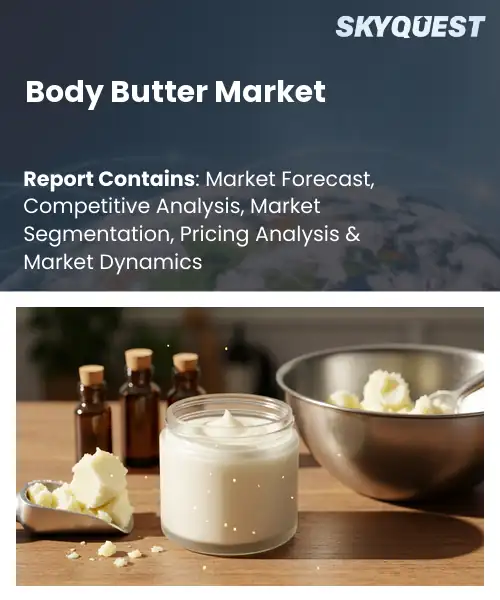
Body Butter Market
Report ID: SQMIG30L2428
Report ID: SQMIG30L2428
[email protected]
USA +1 351-333-4748
Report ID:
SQMIG30L2428 |
Region:
Global |
Published Date: July, 2026
Pages:
157
|Tables:
143
|Figures:
78


Global Body Butter Market size was valued at USD 3.52 Billion in 2024 and is poised to grow from USD 3.77 Billion in 2025 to USD 6.52 Billion by 2033, growing at a CAGR of 7.12% during the forecast period (2026-2033).
The body butter market fits into consumer products meant to deliver intense moisturization, usually with rich emollients like shea, cocoa, and mango butter. It matters because skin health and self-care spending have started to sit at the center of wider wellness economies. The main push is that people keep shifting their tastes toward nourishing, natural, and sensorial formulas, so both mainstream and indie makers end up reformulating and talking up provenance.
Now, as consumers show a stronger pull for natural sensorial moisturizers, ingredient provenance and sustainability are the major factors shaping the global body butter market outlook, and it also creates these different growth routes. When brands source certified shea or use upcycled fruit oils, shoppers tend to reward transparency and sustainability with premium pricing, so companies basically invest in traceable supply chains and eco-minded packaging to win share. As a result, there are real differentiation opportunities like fragrance-free therapeutic lines for dry skin, limited edition scent collaborations with lifestyle labels, and subscription services that smooth out revenue consistency; retailers then adjust too, they allocate shelf space for differentiated SKUs that look like they will actually sell.
AI is reshaping personalization by connecting individual skin signals, ingredient science, and retail moments. Some key parts include AI-driven skin analysis, recommendation engines that match texture and scent preferences, and adaptive supply that allows smaller targeted production runs. Right now, the model blends in-store consultations with online configurators where brands propose near-bespoke formulations and layering routines. This setup reduces that annoying trial and error, and it helps consumers feel a better product fit. This can be seen in virtual skin scans and interactive scent quizzes that take personal data and turn it into tailored body butter suggestions, which also deepens engagement.
Market snapshot - (2026-2033)
Global Market Size
USD 3.52 Billion
Largest Segment
Shea Butter-Based
Fastest Growth
Whipped Body Butters
Growth Rate
7.12% CAGR
To get more insights on this market click here to Request a Free Sample Report
The global body butter market is segmented by type, distribution, consumer, formulation, packaging and region. Based on type, the market is segmented into Shea Butter-Based, Cocoa Butter-Based, Mango Butter-Based and Whipped Body Butters. Based on distribution, the market is segmented into Online Retail, Beauty Specialty Stores and Supermarkets. Based on consumer, the market is segmented into Women, Men and Baby & Kids. Based on formulation, the market is segmented into Natural/Organic and Conventional. Based on packaging, the market is segmented into Jars and Tubes. Based on region, the market is segmented into North America, Europe, Asia Pacific, Latin America and Middle East & Africa.
As per the body butter market analysis, the Shea Butter-Based segment dominates because it pairs strong consumer recognition with flexible, functional outcomes that match the usual body butter promises, like deep moisturization, plus skin barrier repair. People see it everywhere, from bigger established brands to smaller indie labels, so there’s this general formulation familiarity and it also helps with scaling, which in turn boosts both shelf placement and online visibility. Then the whole marketing storyline, natural origin and multiuse applications, keeps reinforcing consumer trust, so preference stays more steady and retailers are more likely to prioritize the assortment.
However, the Whipped Body Butters are moving with the strongest growth momentum, because many consumers want a lighter texture but still something indulgent in feel. They also like how it looks, like, the social media friendly aesthetic, so it gets shared more. Brands respond by leaning into formulation innovation and doing faster product releases, mostly to attract younger demographics. This makes trial easier, through influencer driven sampling, plus the premium experiential packaging, which opens new use occasions and can push higher purchase frequency too.
According to the body butter market forecast, the Online Retail segment leads because digital channels give this huge assortment range, and also direct-to-consumer pathways that let niche body butter brands reach the right people fast. E-commerce supports personalized merchandising, subscription options, and customer reviews, and all of that reduces that initial trial friction. On top of that, platform promotions plus influencer collaborations amplify discovery, so people actually find the products without as much searching. Overall, these advantages lower go-to-market barriers and support rapid SKU proliferation, which makes online the main growth engine for body butter distribution.
Meanwhile, Beauty Specialty Stores are showing up as the key high-growth area, mostly due to the experiential in-store setup, staff expertise, and curated assortments that help premium conversions for artisanal and higher-end body butters. In-store sampling and tailored consultations create loyalty, and then strategic omnichannel partnerships plus exclusive launches add visibility. That creates real opportunities for niche brand scaling, even when the brand is still relatively small or new.
To get detailed segments analysis, Request a Free Sample Report
As per the body butter market regional forecast, North America dominates the market because a mature consumer base, with more sophisticated tastes, along with solid retail infrastructure and this huge presence of well known personal care brands who keep pouring money into product development , and marketing . There’s also high awareness of skincare routines, plus a big pull toward natural but still functional ingredients, and then distribution is everywhere, mass , specialty, and online channels, which locks in the leadership. Private label activity is also strong, not to mention experimentation with textures, formulations, and sustainable packaging, so brands can almost tailor what they offer for different consumer groups. On top of that, regulations around product safety and claims are fairly supportive, and marketing ecosystems basically amplify the trend cycles, so premium as well as niche lines can scale fast, and keep North America at the front in terms of product variety and how readily consumers adopt new options, broadly speaking.
United States Body Butter Market
The Body Butter sector in United States is mostly defined by high consumer awareness of skincare routines, strong demand for premium and natural formulations, and a steady stream of innovation from big brands plus indie players. There are plenty of specialty stores , and specialty counters, along with e commerce platforms, so people can stumble on new products easily. Influencer led trend waves and targeted campaigns help novel textures and ingredients get accepted quickly. Sustainability credentials, and clean label positioning, are increasingly part of the purchasing logic for many consumer groups and the latest trends.
Canada Body Butter Market
The Body Butter industry in Canada shows real interest in natural and sustainably sourced formulations, with a balance between premium names and more approachable brands. Retail is a mix of specialty beauty boutiques, pharmacy chains, and online platforms, which supports experimentation and repeat trials. Product claims around hydration, texture feel, and ingredient transparency tend to land well with shoppers. Also, regional preferences and climate conditions shape how products are positioned and promoted, and manufacturers keep pushing ethical sourcing plus recyclable packaging to match what consumers care about.
The European body butter market penetration comes from a growing consumer curiosity about specialized skincare, premiumization, and basically a strong beauty innovation culture across different countries. The pull is toward formulations that blend natural extracts with multifunctional benefits, and also have sensory appeal, which helps brands stand out in crowded aisles. Retail is advanced too, with diverse specialty retailers, selective department stores, and digital specialists, so brands can target positioning more precisely. Regulatory attention on ingredient transparency, along with more consumer education on formulation performance, builds trust. Local manufacturing power and artisanal labels add texture to competition, while multinationals keep momentum, leading to a landscape where brand narratives, sustainability claims, and tailored marketing across languages and cultural groups pushes faster category growth. Cross border e commerce , plus influencer driven discovery, helps new products reach people sooner, and the emphasis on botanical ingredients and sustainable packaging keeps brand appeal and trial activity moving.
Germany Body Butter Market
The Body Butter Market in Germany is shaped by discerning shoppers who lean toward efficacy first, then ingredient provenance, and then broad quality standards. Interest is especially high for botanical and dermatologically tested formulations, so brands that push clinical credibility , and natural positioning, gain traction. Specialty retailers, pharmacy counters, and online platforms make it easier for consumers to decide with more information. Sustainability, recyclable packaging, and transparent supply chains also matter a lot and stay on the radar of purchasers. Manufacturers use local R&D and work with dermatologists to back up claims, and they use that as a real differentiator against other offerings.
United Kingdom Body Butter Market
The Body Butter Market in the United Kingdom comes across as trend forward, with solid digital engagement, and a lively indie brand scene that champions fresh formulations, textures and sensory upgrades. E commerce , together with social media , speeds up discovery, so consumers try products faster and niche positioning grows more visible. Retail partnerships and pop ups add extra exposure for premium and artisanal lines. Buyers often prioritize sustainable sourcing, multifunctional benefits, and inclusive marketing, and that basically anchors brand strategies and encourages ongoing innovation , plus wider assortments.
France Body Butter Market
The Body Butter Market growth in France is influenced by deep beauty culture, a preference for sensorial textures, and a high standard for ingredient origin plus craftsmanship. Boutique perfumeries, department stores, and online platforms support a premium angle. Consumers tend to respond to botanical storytelling, artisanal methods, and refined sensory moments. Brands usually lean into elegant packaging, clean formulations, and regional sourcing, which helps match local expectations. Collaborations with beauty editors , and retail partnerships, also strengthen visibility and desirability, in a very consistent way.
Asia Pacific is enhancing its body butter market share via a mix of more sophisticated beauty cultures, faster product innovation, and that overall premium push in key markets. People seem interested in textures that feel light but still intensely hydrating, and they want it to match local skin concerns, so brands keep adjusting formulas , and doing ingredient localization. At the same time, E commerce keeps growing, plus omnichannel strategies , which expands access for both global players and smaller specialists. There’s also this rising focus on clean beauty, botanical actives, and more refined sensory profiles, then paired with sharper marketing moves, and celebrity endorsements, it all makes the category feel more relevant. Local R&D options matter too, and partnerships between multinational corporations and local firms help speed up adaptation to regional preferences, so the market presence becomes more specific and nuanced. And local beauty rituals , plus K beauty and J beauty trends, guide product look and marketing messaging, while sustainability pledges and premium packaging bump up the perceived value.
Japan Body Butter Market
The Body Butter Market in Japan is shaped by careful consumers who tend to favor delicate textures, subtle scents, and formulations that behave well in different climates. A big deal is made of layering skincare, using gentle but still effective components, plus more advanced formulation technologies, so product refinement keeps moving forward. Department stores, beauty counters, and e commerce platforms help shoppers discover and try products, even if only briefly. Limited drops, influencer collaborations, and detailed packaging aesthetics help products stay desirable, while the premium stance continues, and ingredient origin gets highlighted consistently.
South Korea Body Butter Market
In South Korea, the Body Butter Market gets a boost from strong K beauty influence, quick trend cycles, and consumers who enjoy innovative textures and functional actives. Most brands lean toward lightweight yet nourishing formulations, because they’re supposed to layer smoothly within the usual skincare routine. Online shopping habits, beauty tech platforms, and influencer communities make discovery happen quicker, and they also boost launch momentum. Packaging innovation and collaborations create that extra buzz. Manufacturers usually stress ingredient efficacy, clinical like validation, and strong visual presentation, since customers expect both performance and a clean, polished look.
To know more about the market opportunities by region and country, click here to
Buy The Complete Report
Rising Demand For Natural Ingredients
Premiumization In Personal Care
High Cost Of Formulation
Regulatory And Labeling Complexities
Request Free Customization of this report to help us to meet your business objectives.
The global body butter competitive market is shaped by consolidation, and this targeted differentiation thing too. Big groups go for strategic M&A to lock in premium portfolios, like L’Oréal’s 2023 acquisition of Aesop, and Natura’s consolidation moves, meanwhile major retailers keep putting money into formulation and digital transformation… for example Bath & Body Works’ 2024 tech partnership with Accenture, to reformulate and modernize how they engage customers. At the same time, independent brands are leaning into DTC, clinical positioning, plus smaller niche product drops, to grab shelf space and keep real consumer loyalty, not just quick attention.
Top Player’s Company Profile
Recent Developments in the Body Butter Market
SkyQuest’s ABIRAW (Advanced Business Intelligence, Research & Analysis Wing) is our Business Information Services team that Collects, Collates, Correlates, and Analyses the Data collected by means of Primary Exploratory Research backed by robust Secondary Desk research.
As per SkyQuest analysis, the global body butter market is set up for steady growth, mainly because consumers keep asking for natural ingredients and for that second big driver, premiumization in personal care , which makes people even more interested in indulgent textures and higher-margin SKUs. One restraint is still clear , though: the high cost of formulation, it can reduce accessibility and slow down new product launches. North America keeps leading as the dominant region due to mature consumer routines and solid retail infrastructure. Meanwhile, the Shea Butter-Based segment leads the category, because it has broad consumer recognition and multifaceted benefits. Brands that blend provenance, sustainability, and targeted personalization will likely grab the strongest share.
| Report Metric | Details |
|---|---|
| Market size value in 2024 | USD 3.52 Billion |
| Market size value in 2033 | USD 6.52 Billion |
| Growth Rate | 7.12% |
| Base year | 2024 |
| Forecast period | (2026-2033) |
| Forecast Unit (Value) | USD Billion |
| Segments covered |
|
| Regions covered | North America (US, Canada), Europe (Germany, France, United Kingdom, Italy, Spain, Rest of Europe), Asia Pacific (China, India, Japan, Rest of Asia-Pacific), Latin America (Brazil, Rest of Latin America), Middle East & Africa (South Africa, GCC Countries, Rest of MEA) |
| Companies covered |
|
| Customization scope | Free report customization with purchase. Customization includes:-
|
To get a free trial access to our platform which is a one stop solution for all your data requirements for quicker decision making. This platform allows you to compare markets, competitors who are prominent in the market, and mega trends that are influencing the dynamics in the market. Also, get access to detailed SkyQuest exclusive matrix.
Table Of Content
Executive Summary
Market overview
Parent Market Analysis
Market overview
Market size
KEY MARKET INSIGHTS
COVID IMPACT
MARKET DYNAMICS & OUTLOOK
Market Size by Region
KEY COMPANY PROFILES
Methodology
For the Body Butter Market, our research methodology involved a mixture of primary and secondary data sources. Key steps involved in the research process are listed below:
1. Information Procurement: This stage involved the procurement of Market data or related information via primary and secondary sources. The various secondary sources used included various company websites, annual reports, trade databases, and paid databases such as Hoover's, Bloomberg Business, Factiva, and Avention. Our team did 45 primary interactions Globally which included several stakeholders such as manufacturers, customers, key opinion leaders, etc. Overall, information procurement was one of the most extensive stages in our research process.
2. Information Analysis: This step involved triangulation of data through bottom-up and top-down approaches to estimate and validate the total size and future estimate of the Body Butter Market.
3. Report Formulation: The final step entailed the placement of data points in appropriate Market spaces in an attempt to deduce viable conclusions.
4. Validation & Publishing: Validation is the most important step in the process. Validation & re-validation via an intricately designed process helped us finalize data points to be used for final calculations. The final Market estimates and forecasts were then aligned and sent to our panel of industry experts for validation of data. Once the validation was done the report was sent to our Quality Assurance team to ensure adherence to style guides, consistency & design.
Analyst Support
Customization Options
With the given market data, our dedicated team of analysts can offer you the following customization options are available for the Body Butter Market:
Product Analysis: Product matrix, which offers a detailed comparison of the product portfolio of companies.
Regional Analysis: Further analysis of the Body Butter Market for additional countries.
Competitive Analysis: Detailed analysis and profiling of additional Market players & comparative analysis of competitive products.
Go to Market Strategy: Find the high-growth channels to invest your marketing efforts and increase your customer base.
Innovation Mapping: Identify racial solutions and innovation, connected to deep ecosystems of innovators, start-ups, academics, and strategic partners.
Category Intelligence: Customized intelligence that is relevant to their supply Markets will enable them to make smarter sourcing decisions and improve their category management.
Public Company Transcript Analysis: To improve the investment performance by generating new alpha and making better-informed decisions.
Social Media Listening: To analyze the conversations and trends happening not just around your brand, but around your industry as a whole, and use those insights to make better Marketing decisions.
REQUEST FOR SAMPLE
 REQUEST FREE CUSTOMIZATION
Global Body Butter Market size was valued at USD 3.52 Billion in 2024 and is poised to grow from USD 3.77 Billion in 2025 to USD 6.52 Billion by 2033, growing at a CAGR of 7.12% during the forecast period (2026-2033).
The competitive landscape for global body butter is marked by consolidation and targeted differentiation. Large groups use strategic M&A to secure premium portfolios, exemplified by L’Oréal’s 2023 acquisition of Aesop and Natura’s consolidation moves, while major retailers invest in formulation and digital transformation such as Bath & Body Works’ 2024 technology partnership with Accenture to reformulate and modernize customer engagement. Independent brands pursue DTC clinical positioning and niche product launches to win shelf space and consumer loyalty. 'The Body Shop (Natura &Co)', 'SheaMoisture (Unilever)', 'Palmer's (E.T. Browne Drug)', 'Vaseline (Unilever)', 'Jergens (Kao Corporation)', 'Aveeno (J&J)', 'CeraVe (L'Oréal)', 'Burt's Bees (Clorox)', 'Solgar (NBTY)', 'Queen Helene (Chattem)', 'Nubian Heritage (Sundial Brands/Unilever)', 'Maui Moisture (Helen of Troy)', 'Gold Bond (Chattem)', 'Dove (Unilever)', 'Nivea (Beiersdorf)', 'St. Ives (Unilever)', 'Victoria's Secret (L Brands)', 'Bath & Body Works (L Brands)', 'Carol's Daughter (L'Oréal)', 'OGX (Johnson & Johnson)'
Consumers increasingly prefer body butter formulations that emphasize natural and plant-derived components because they perceive these ingredients as gentler and more nourishing for diverse skin types. This shift encourages manufacturers to reformulate products, expand botanical portfolios, and highlight ingredient provenance and sustainability in marketing narratives. Retailers respond by allocating shelf space and promoting lines that meet shopper expectations. As a result, brand differentiation and consumer trust strengthen, creating market momentum for products that leverage natural ingredient claims and premium positioning.
Sustainable Ingredient Demand: Brands increasingly prioritize ethically sourced natural and biodegradable ingredients to align with consumer expectations for environmental responsibility and provenance. This drives transparent supply chains, collaborations with small suppliers, and reformulations that favor plant-based butters and oils. Retailers and manufacturers highlight traceability and minimal processing in communications to strengthen trust. Sustainable positioning shapes product development, packaging selection, pricing strategies and stimulates cross-functional collaboration among procurement, research and development, and marketing teams to integrate environmental credentials across the product lifecycle globally today.
Why does North America Dominate the Global Body Butter Market? |@12


Want to customize this report? This report can be personalized according to your needs. Our analysts and industry experts will work directly with you to understand your requirements and provide you with customized data in a short amount of time. We offer $1000 worth of FREE customization at the time of purchase.
Feedback From Our Clients


 USA (+1) 351-333-4748

