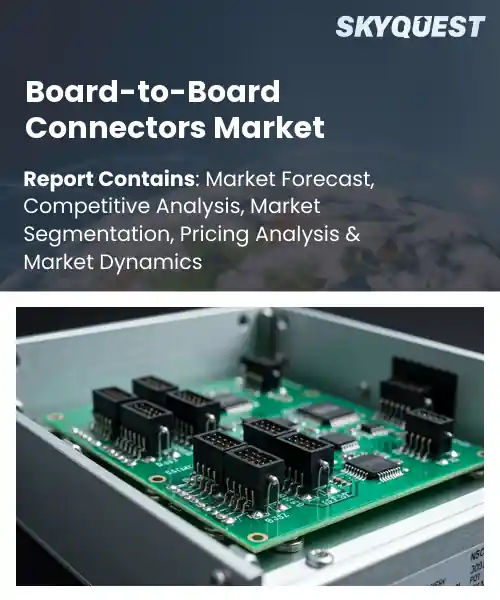
Board-to-Board Connectors Market
Report ID: SQMIG45K2261
Report ID: SQMIG45K2261
[email protected]
USA +1 351-333-4748
Report ID:
SQMIG45K2261 |
Region:
Global |
Published Date: May, 2026
Pages:
157
|Tables:
119
|Figures:
77


Global Board-To-Board Connectors Market size was valued at USD 4.52 Billion in 2024 and is poised to grow from USD 4.78 Billion in 2025 to USD 7.52 Billion by 2033, growing at a CAGR of 5.82% during the forecast period (2026-2033).
Rising demand for compact electronic devices, increasing adoption of high-speed data transmission technologies, rising deployment of 5G and edge computing infrastructure, advancements in connector miniaturization, and expansion of automotive and industrial electronics applications are driving demand for board-to-board connectors.
Growing deployment of 5G infrastructure, edge servers, automotive ADAS systems, and modular consumer electronics is also expected to help bolster the demand for board-to-board connectors. Growth in the usage of portable medical devices, industrial control systems, and advanced high-performance computers is also providing new business prospects. Adoption of fine pitch mezzanine connectors, blind mate connectors, flexible interposers, and fast stacking boards in smartphone handsets, servers, industrial controls, automotive electronics, medical imaging systems, and communication equipment is also helping the market grow. Electronics manufacturing firms and connector suppliers are focusing on precise plating processes, robust connectors, advanced tooling techniques, and fast signaling technologies to differentiate themselves from competitors. Increasing need for high-density and miniaturized electronic assemblies around the world coupled with increasing emphasis on signal integrity and high-speed connectivity are expected to primarily drive board-to-board connectors market growth.
On the contrary, high manufacturing complexity associated with miniaturized connectors, rising raw material and precision tooling costs, signal interference challenges in high-speed applications, and stringent reliability and compliance requirements are anticipated to slow down board-to-board connectors market penetration through 2033.
How is IoT Driving Demand For High-density Board-to-board Connectors?
IoT is creating an ever-increasing need for high-density board-to-board connectors because connectivity devices need higher functionality in reduced form factors. Fine pitch mezzanine connectors, along with stacked boards technology have become widely popular among manufacturers as it helps achieve signal integrity and compact form factor along with maximizing board space usage. These are now essential components of today’s connected electronic systems. The use of IoT board-to-board connectors has increased significantly among edge gateways, industrial sensors, automobile cameras, wearables, and smart home hubs, wherein there is a need for multiple boards to interact with each other inside a small form factor device.
Market snapshot - (2026-2033)
Global Market Size
USD 4.52 Billion
Largest Segment
Mezzanine Connectors
Fastest Growth
Board-to-Board Stacking Connectors
Growth Rate
5.82% CAGR
To get more insights on this market click here to Request a Free Sample Report
Global board-to-board connectors market is segmented by type, pitch, application, end-use, and region. Based on type, the market is segmented into card-edge connectors, board-to-board stacking connectors, mezzanine connectors, and wire-to-board. Based on pitch, the market is segmented into below 0.5 mm, 0.5-1.25 mm, and above 1.25 mm. Based on application, the market is segmented into consumer electronics, telecom, medical devices, and industrial. Based on end-use, the market is segmented into smartphones & tablets, PCs & servers, and automotive electronics. Based on region, the market is segmented into North America, Europe, Asia Pacific, Latin America, and Middle East & Africa.
The mezzanine connectors segment is predicted to lead the global board-to-board connectors market revenue generation over the coming years. The mezzanine architecture offers vertical connectivity density, meeting contemporary requirements for stacking boards. The reliability of the mezzanine is attributed to its physical stability and ability to handle signal integrity despite the proximity of components. As designers continue to emphasize modularity and thermal issues in their systems, mezzanine solutions make routing easier and improve manufacturing processes, solidifying its dominance in the market.
Nevertheless, the highest growth momentum is registered by the board-to-board stacking connectors segment owing to the quest for extremely thin connectors as well as flexible interconnect spacing for electronics modules. Technological innovations that have resulted in thinner connectors along with the ability to integrate with automation processes enhance their adoption in successive design iterations.
The 0.5 to 1.25 mm segment is slated to account for the highest global board-to-board connectors market share going forward. This pitch ratio achieves the best compromise between high contact density and easy production processes in board-level interconnections. The tolerance levels can support automatic component placement and strong soldering, maintaining physical and functional performance throughout various operating environments. Well-established tooling processes and relationships with suppliers minimize technical obstacles, enabling designers to settle on this pitch for multiple module designs.
Meanwhile, below 0.5 mm is emerging as the key high-growth segment as per this board-to-board connectors industry analysis. With further advancement of device miniaturization and the requirement for ultra-thin form factors leading to increasingly sophisticated interconnections, new applications can be derived from this category. Precision manufacturing, better contact materials, and micro-assembly techniques are driving demand from applications in small consumer electronics and medical devices.
To get detailed segments analysis, Request a Free Sample Report
Advanced electronics manufacturing, extensive component supply chains, and a culture of rapid product iteration are helping this region hold sway over others. Increasing demand from various end-user markets including, but not limited to, industrial automation, consumer electronics, and telecommunications, creates an ongoing refinement of connector designs. Local manufacturers also have many cumulative years of experience using miniaturization and high-density interconnections and maintain collaborative working relationships with system integrators to further establish customization and rapid adoption to related industries. Rising investments in quality manufacturing combined with high levels of compliance to established reliability standards help to solidify the Asia-Pacific region's leadership position in the market and strengthen/cultivate positive cross-border partner opportunities. Integrated R&D, precise manufacturing, and component sourcing ecosystems create small-form-factor, high-reliability solutions for demanding applications. The close proximity between OEMs and connector manufacturers allows for reduced development cycles, thereby enabling cost-effective scaling.
Board-to-board connectors market in Japan is characterized by a strong emphasis on precision engineering, reliability, and long term relationships between connector suppliers and system manufacturers. Japanese firms prioritize meticulous quality control, miniaturized high-density interconnects, and tailored solutions for automotive and industrial electronics. A close relationship with suppliers promotes innovation and rigorous testing to ensure that products maintain a high level of quality to guarantee dependability under strict environmental conditions and precise assembly standards.
Board-to-board connector demand in South Korea is driven by a dynamic electronics ecosystem focused on rapid innovation, scale manufacturing, and integration with semiconductor and display industries. Efficiency in production, product quality management, and logistics lead to timely deliveries of tailor-made connectors. Korea has demonstrated its strength in developing miniature but highly efficient connectors for mobile phone and network applications through its fast prototyping capability made possible by close cooperation with design engineers of the OEMs.
Advanced system design needs, strong demand across data centers, aerospace, medical, and automotive electrification sectors, and an entrepreneurial landscape are helping boost adoption of board-to-board connectors in this region. The increasing focus on high-speed signal integrity, thermal management, and miniaturization, in turn, creates a need for specialized interconnect solutions. The combined efforts of connector manufacturers and OEMs in the design for manufacturability process allow for faster time to prototype and faster iteration of updated designs. Continued growth of U.S. based supply chains, as well as investment in the development of materials science and testing capabilities continues to support increased production of application specific connectors. The end result is a customized, reliable, and collaborative market environment that meets the many application requirements of a wide variety of industries.
Board-to-board connectors market in the United States reflects a blend of cutting-edge research, system-level integration needs, and demand from data-intensive sectors. United States suppliers and OEMs collaborate on high-performance, high-reliability interconnects that address signal integrity and thermal constraints for aerospace and defense platforms. An ecosystem of manufacturers and design houses supports rapid prototyping, validation, and tailored connector solutions aligned with stringent industry certifications and customer specifications.
Reliability and adaptability concerns within the industries of telecommunications, healthcare equipment, and energy infrastructure are driving the demand for board-to-board connectors in Canada. The market is dependent on a seasoned cadre of engineers and requires ruggedized products, which are easily integrated into existing equipment. Collaboration within the country with original equipment manufacturers and local partners facilitates customization and certification of products, while contract manufacturers can manufacture products per their specifications.
Emphasis on high quality engineering, regulatory compliance, and sectoral collaboration that addresses demanding industrial, automotive, and energy applications shapes market development in Europe. Rigorous testing, standardization and environmentally friendly manufacturing processes are emphasized to provide a high-quality product while differentiating suppliers within their respective markets. There are many precision component manufacturers or systems integrators that are located together in regional clusters can take ideas of new advanced connectors and develop them into viable manufacturing processes, focusing on both reliability and long-term performance throughout the lifecycle of the end user. Additionally, cross-border partnerships, greater use of digital design tools, and close relationships between universities and businesses have all increased the speed of innovation within the connector industry. Together, these characteristics create a resilient supply network, create specialized niches for high-performance and extreme environment interconnects, and help the region support complex customer requirements for a variety of end-user markets.
Precision engineering, process discipline, and close ties to automotive and industrial automation sectors are shaping manufacturing of board-to-board connectors in Germany. End users favor the design of connectors that offer ease of maintenance and can be easily integrated into automated processes. Connectors are manufactured using stringent testing and production procedures to ensure they fulfill their demanding standards of reliability and durability. Collaborations between manufactures, integrators, and end-users lead to innovations that provide solutions tailored for heavy-duty uses.
Design capabilities, electronics industry strengths, along with specialized suppliers providing connector solutions make it possible to achieve good results in board-to-board connectors’ sales within the United Kingdom. Reliable testing is a must when ensuring that only top-quality components from high-quality suppliers are used for specific applications. Collaboration with system engineers at a very close level makes it possible to design applications quickly. Local suppliers specialize in making small interconnections, taking signal integrity and EMC into account.
Aerospace and automotive sectors, where reliability and environmental resilience are paramount support consistent demand for board-to-board connectors in France. Engineering is made possible by a supplier base of manufacturers, whereas certification and traceability form the foundation of the market. Research organizations working with the industry lead to innovations and methodologies related to material development. French suppliers prioritize customized connector designs that meet challenges posed by vibration and temperature variation.
To know more about the market opportunities by region and country, click here to
Buy The Complete Report
Rising Demand For Miniaturization
Expansion Of Automotive Electronics
Supply Chain Material Shortages
Complex Compliance And Qualification
Request Free Customization of this report to help us to meet your business objectives.
Competitive dynamics in the global board-to-board connectors market are driven by consolidation and technology-led differentiation. Recent M&A by Amphenol acquiring Carlisle Interconnect Technologies and TE Connectivity acquiring Harger expanded portfolios and channel reach, while incumbents introduced ultra-dense product families such as Molex quad-row connectors. Startups are advancing materials and interconnect PHY innovation to challenge incumbents and enable new module and board-level architectures.
SkyQuest’s ABIRAW (Advanced Business Intelligence, Research & Analysis Wing) is our Business Information Services team that Collects, Collates, Correlates, and Analyses the Data collected by means of Primary Exploratory Research backed by robust Secondary Desk research.
As per SkyQuest analysis, rising demand for compact electronic devices and increasing adoption of high-speed data transmission technologies are anticipated to drive the demand for board-to-board connectors going forward. However, high manufacturing complexity associated with miniaturized connectors and signal interference challenges in high-speed applications are slated to slow down the adoption of board-to-board connectors in the future. Asia Pacific is slated to spearhead the demand for board-to-board connectors owing to strong consumer electronics manufacturing, rapid expansion of 5G infrastructure, and increasing production of automotive and industrial electronic systems. Development of fine-pitch high-density connectors and increasing integration of high-speed signal integrity technologies are anticipated to be key trends driving the board-to-board connectors industry going forward.
| Report Metric | Details |
|---|---|
| Market size value in 2024 | USD 4.52 Billion |
| Market size value in 2033 | USD 7.52 Billion |
| Growth Rate | 5.82% |
| Base year | 2024 |
| Forecast period | (2026-2033) |
| Forecast Unit (Value) | USD Billion |
| Segments covered |
|
| Regions covered | North America (US, Canada), Europe (Germany, France, United Kingdom, Italy, Spain, Rest of Europe), Asia Pacific (China, India, Japan, Rest of Asia-Pacific), Latin America (Brazil, Rest of Latin America), Middle East & Africa (South Africa, GCC Countries, Rest of MEA) |
| Companies covered |
|
| Customization scope | Free report customization with purchase. Customization includes:-
|
To get a free trial access to our platform which is a one stop solution for all your data requirements for quicker decision making. This platform allows you to compare markets, competitors who are prominent in the market, and mega trends that are influencing the dynamics in the market. Also, get access to detailed SkyQuest exclusive matrix.
Table Of Content
Executive Summary
Market overview
Parent Market Analysis
Market overview
Market size
KEY MARKET INSIGHTS
COVID IMPACT
MARKET DYNAMICS & OUTLOOK
Market Size by Region
KEY COMPANY PROFILES
Methodology
For the Board-to-Board Connectors Market, our research methodology involved a mixture of primary and secondary data sources. Key steps involved in the research process are listed below:
1. Information Procurement: This stage involved the procurement of Market data or related information via primary and secondary sources. The various secondary sources used included various company websites, annual reports, trade databases, and paid databases such as Hoover's, Bloomberg Business, Factiva, and Avention. Our team did 45 primary interactions Globally which included several stakeholders such as manufacturers, customers, key opinion leaders, etc. Overall, information procurement was one of the most extensive stages in our research process.
2. Information Analysis: This step involved triangulation of data through bottom-up and top-down approaches to estimate and validate the total size and future estimate of the Board-to-Board Connectors Market.
3. Report Formulation: The final step entailed the placement of data points in appropriate Market spaces in an attempt to deduce viable conclusions.
4. Validation & Publishing: Validation is the most important step in the process. Validation & re-validation via an intricately designed process helped us finalize data points to be used for final calculations. The final Market estimates and forecasts were then aligned and sent to our panel of industry experts for validation of data. Once the validation was done the report was sent to our Quality Assurance team to ensure adherence to style guides, consistency & design.
Analyst Support
Customization Options
With the given market data, our dedicated team of analysts can offer you the following customization options are available for the Board-to-Board Connectors Market:
Product Analysis: Product matrix, which offers a detailed comparison of the product portfolio of companies.
Regional Analysis: Further analysis of the Board-to-Board Connectors Market for additional countries.
Competitive Analysis: Detailed analysis and profiling of additional Market players & comparative analysis of competitive products.
Go to Market Strategy: Find the high-growth channels to invest your marketing efforts and increase your customer base.
Innovation Mapping: Identify racial solutions and innovation, connected to deep ecosystems of innovators, start-ups, academics, and strategic partners.
Category Intelligence: Customized intelligence that is relevant to their supply Markets will enable them to make smarter sourcing decisions and improve their category management.
Public Company Transcript Analysis: To improve the investment performance by generating new alpha and making better-informed decisions.
Social Media Listening: To analyze the conversations and trends happening not just around your brand, but around your industry as a whole, and use those insights to make better Marketing decisions.
REQUEST FOR SAMPLE
 REQUEST FREE CUSTOMIZATION
Global Board-To-Board Connectors Market size was valued at USD 4.52 Billion in 2024 and is poised to grow from USD 4.78 Billion in 2025 to USD 7.52 Billion by 2033, growing at a CAGR of 5.82% during the forecast period (2026-2033).
Competitive dynamics in the global board-to-board connectors market are driven by consolidation and technology-led differentiation. Recent M&A by Amphenol acquiring Carlisle Interconnect Technologies and TE Connectivity acquiring Harger expanded portfolios and channel reach, while incumbents introduced ultra-dense product families such as Molex quad-row connectors. Startups are advancing materials and interconnect PHY innovation to challenge incumbents and enable new module and board-level architectures. 'TE Connectivity', 'Molex LLC (Koch)', 'Amphenol Corporation', 'JAE (Japan Aviation Electronics)', 'Hirose Electric', 'Samtec Inc.', 'I-PEX Inc.', 'Kyocera Corporation', 'HARTING Technology Group', 'Phoenix Contact', 'Yamaichi Electronics', 'Vishay Intertechnology', 'CUI Global (Bel Fuse)', 'Nicomatic SA', 'Glenair Inc.', 'Radiall SA', 'LEMO SA', 'Souriau (Esterline)', 'Positronic Industries', 'Smiths Interconnect'
Rising demand for smaller, lighter electronic products has pushed designers to seek compact, high-density board-to-board connectors that enable closer component placement and efficient interconnection within constrained enclosures. This pressure encourages connector manufacturers to innovate form factors and materials that preserve signal integrity and mechanical robustness while occupying minimal space. As product makers prioritize portability and sleek profiles, demand for specialized board-to-board solutions grows because these connectors facilitate modular assembly, serviceability, and flexible stacking options that support evolving device architectures and enable differentiation.
Miniaturization And High Density: Electronics designers are prioritizing smaller footprints and higher interconnect density, driving connector form factors toward micro, stacked, and fine pitch solutions. This trend supports compact consumer devices, advanced wearables, and densely populated server boards by enabling greater functionality per unit area. Suppliers are adapting materials, plating, and precision assembly to preserve signal integrity, thermal performance, and mechanical reliability at reduced scales. Close collaboration between OEMs and connector manufacturers accelerates customized solutions balancing manufacturability with long term serviceability and repairability requirements.
Why does Asia Pacific Dominate the Global Board-to-Board Connectors Market? |@12


Want to customize this report? This report can be personalized according to your needs. Our analysts and industry experts will work directly with you to understand your requirements and provide you with customized data in a short amount of time. We offer $1000 worth of FREE customization at the time of purchase.
Feedback From Our Clients


 USA (+1) 351-333-4748

