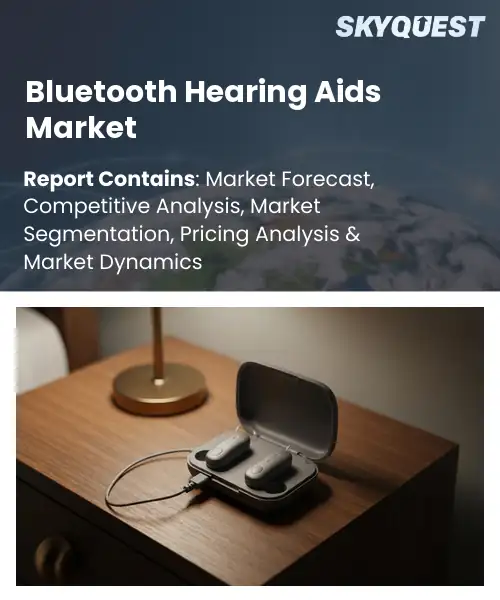
Bluetooth Hearing Aids Market
Report ID: SQMIG45E2749
Report ID: SQMIG45E2749
[email protected]
USA +1 351-333-4748
Report ID:
SQMIG45E2749 |
Region:
Global |
Published Date: April, 2026
Pages:
157
|Tables:
116
|Figures:
77


Global Bluetooth Hearing Aids Market size was valued at USD 8.92 Billion in 2024 and is poised to grow from USD 9.64 Billion in 2025 to USD 8.9 Billion by 2033, growing at a CAGR of 8.1% during the forecast period (2026-2033).
The Bluetooth hearing aids market centers on smart devices that integrate wireless connectivity to stream audio, enable app control and support remote adjustments, which matters because aging populations and rising hearing loss have made hearing accessibility a health and economic priority. Historically the sector evolved from analog aids to digital signal processing and then to connectivity enabled products; pioneers like Phonak and ReSound introduced direct streaming and smartphone apps, accelerating adoption. Its primary driver is consumer demand for seamless multimedia integration and telehealth, which reduced stigma and improved satisfaction, prompting faster product cycles and broader distribution through clinics and ecommerce.Building on increasing consumer demand, interoperability and smartphone integration represent the key factor driving global Bluetooth hearing aid growth because they expand functionality and lower barriers to adoption. When manufacturers support universal Bluetooth Low Energy protocols and robust companion apps, clinicians can remotely fine tune settings and users can stream calls and media, which increases daily utility and adherence; for example, older adults using teleaudiology report fewer clinic visits and better hearing aid retention. This interoperability enables partnerships with OEMs and app developers, creating service based revenue streams and opening emerging markets where smartphone penetration outpaces traditional audiology infrastructure globally.
How is AI enhancing personalization in the Bluetooth hearing aids market?
AI driven personalization in Bluetooth hearing aids means devices learn from the wearer and the listening environment to tailor sound in real time. Key aspects include adaptive noise suppression, scene classification, and user preference learning through on device models and cloud updates. The market is shifting toward tighter integration of low energy Bluetooth audio and intelligent processors so fitting and streaming feel seamless. Manufacturers are deploying dedicated neural processing and partnering with platform providers to simplify pairing and broadcast audio. These advances make everyday use more natural and reduce the need for clinic visits by enabling remote fine tuning and automatic profile shifts.Starkey January 2026, the company expanded its Omega AI connectivity with Auracast and Google Fast Pair which ties AI based personalization to smoother Bluetooth streaming and easier setup, helping hearing aid adoption and user satisfaction by making tailored listening immediate and more efficient.
Market snapshot - (2026-2033)
Global Market Size
USD 8.92 Billion
Largest Segment
Receiver-in-the-Canal (RIC)
Fastest Growth
Receiver-in-the-Canal (RIC)
Growth Rate
8.1% CAGR
To get more insights on this market click here to Request a Free Sample Report
Global bluetooth hearing aids market is segmented by product design, connectivity feature, technology generation, end-user segment and region. Based on product design, the market is segmented into Behind-the-Ear (BTE) Bluetooth Aids, Receiver-in-the-Canal (RIC) and In-the-Ear (ITE) & Completely-in-Canal (CIC). Based on connectivity feature, the market is segmented into MFi (Made for iPhone) Integrated, ASHA (Android Streaming) Compatible and Multi-device Pairing & App-controlled. Based on technology generation, the market is segmented into Conventional Bluetooth (Classic) and Bluetooth Low Energy (BLE) & Auracast (LE Audio). Based on end-user segment, the market is segmented into Adult & Geriatric Population, Pediatric Population and Professional/Institutional Sales (Audiology Centers). Based on region, the market is segmented into North America, Europe, Asia Pacific, Latin America and Middle East & Africa.
Receiver-in-the-Canal segment dominates because it combines discreet cosmetics with a natural sound delivery that aligns well with bluetooth streaming expectations, making it a preferred choice for many users. Its off-ear receiver design reduces occlusion and improves speech clarity when paired with wireless protocols, driving strong clinician recommendation and consumer preference. The form factor enables effective amplification, comfortable wear and simpler wireless antenna placement, which collectively support broad market appeal.
However, Behind-the-Ear segment is rapidly expanding because its larger batteries and flexible housings support more powerful bluetooth radios and prolonged streaming, meeting demand for rechargeable, feature-rich devices. Simpler handling and preferred fit by many professionals speed clinical adoption, enabling deployment of advanced connectivity and creating new commercial opportunities that drive market growth.
Auracast (LE Audio) segment leads because it introduces broadcast-capable low-energy audio that redefines how multiple users and devices receive the same stream, offering better spectral efficiency and improved hearing-specific codecs that enhance clarity and battery life. Standardized broadcast profiles simplify public and private audio delivery, prompting manufacturers to integrate new receiver capabilities and firmware pathways, which catalyzes ecosystem investments and accelerates feature-rich product roadmaps across the market.
Meanwhile, Bluetooth Low Energy (BLE) is the most rapidly expanding connectivity approach because its low power profile enables always-on links and seamless background pairing that enhance continuous hearing support. Broader chipset availability and streamlined firmware paths reduce integration costs for manufacturers, enabling feature updates and wider device compatibility that drive adoption across multiple hearing aid designs.
To get detailed segments analysis, Request a Free Sample Report
North America dominates the global Bluetooth hearing aids market due to a convergence of advanced healthcare infrastructure, strong reimbursement frameworks, and high adoption of consumer electronics that integrate with personal health devices. Established manufacturers and a robust network of audiology professionals drive innovation cycles and product validation through clinical practice. Well developed distribution channels, including specialty audiology clinics and large retail chains, facilitate rapid product availability and informed buyer journeys. Regulatory clarity and supportive standards encourage interoperability with mobile platforms and accessories. An informed patient population that values connectivity and convenience sustains demand for feature rich devices. Collaborative initiatives between technology firms and health providers accelerate trials and clinical integration, reinforcing North America position at the forefront of product development and commercialization.
Bluetooth Hearing Aids Market in the United States benefits from a dense ecosystem of audiology specialists, technology developers, and patient advocacy that drives adoption of connected features. Consumer familiarity with mobile platforms and preference for seamless audio streaming encourages manufacturers to prioritize interoperability. Clinical resources support product validation and clinician education, while retail and teleaudiology channels enable accessible fitting and servicing. This environment sustains innovation and competitive differentiation among suppliers.
Bluetooth Hearing Aids Market in Canada features integrated healthcare delivery, established clinical networks, and patient interest in connected assistive technologies. Partnerships between clinics and technology providers improve fitting accuracy and personalized care. Consumers value compatibility with mobile devices, prompting suppliers to emphasize seamless connectivity and simple controls. Clear regulatory guidance and professional training bolster clinician confidence in advanced devices in practice, supporting market maturity and adoption across regional care settings.
Europe expansion is driven by harmonized regulatory frameworks, growing patient awareness of assistive connectivity, and a competitive manufacturing base that blends audiology expertise with consumer electronics design. Strong national reimbursement models in key markets and increasing integration of teleaudiology services enable wider access and personalized care. Cross border collaborations among technology firms, audiology institutions, and standardization bodies accelerate device interoperability and user experience improvements. Market dynamics differ by country, with Germany serving as a technology and clinical validation hub, the United Kingdom emerging through digital health initiatives and retail innovation, and France witnessing rapid uptake driven by proactive public health programs and patient demand for modern features. Investment in clinical research centers and an expanding service ecosystem for aftercare support strengthen consumer confidence. Localized product adaptations and multilingual support further facilitate adoption across diverse markets.
Bluetooth Hearing Aids Market in Germany benefits from a strong clinical ecosystem, research facilities, and a manufacturing base that emphasizes quality and interoperability. Audiology professionals engage in rigorous device evaluation while collaborative initiatives between technology firms and healthcare providers drive innovation. Strong distribution networks and professional training ensure reliable fitting and aftercare. These factors position Germany as a dominant market for connected hearing solutions grounded in clinical validation and excellence.
Bluetooth Hearing Aids Market in the United Kingdom is emerging through digital health initiatives, expanding teleaudiology services, and innovative retail models that broaden consumer access. Technology firms collaborate with healthcare providers to pilot connected services and user centric designs. Emphasis on digital fitting tools and mobile platform compatibility accelerates acceptance among consumers. Professional training programs and evolving service models support clinicians in effectively integrating connected devices into routine care pathways.
Bluetooth Hearing Aids Market in France is experiencing uptake driven by public health programs, growing patient demand for connected features, and initiatives to expand access. Manufacturers tailor products to local needs while service providers emphasize simplified fitting and multilingual support. Clinical outreach and retail innovation lower barriers and encourage consumers to adopt modern assistive devices. This environment supports swift market movement toward connected solutions and accessible aftercare across diverse settings.
Asia Pacific is strengthening its position through a combination of advanced consumer electronics capabilities, targeted clinical research, and growing investment in hearing healthcare services. Regional manufacturers leverage expertise in miniaturization and low power wireless technologies to deliver compact, feature rich devices tailored to varied consumer preferences. Expansion of telehealth platforms and growing audiology training programs improve access beyond major urban centers. Collaboration between technology companies and healthcare institutions facilitates clinical validation and localized product development. Japan contributes deep engineering know how and established healthcare networks, while South Korea emphasizes rapid integration of mobile connectivity and user experience design, together enhancing the region role in global product innovation and market diversification. Local supply chain strengths and supportive policy measures enable scalable production and tailored pricing strategies. Increasing consumer familiarity with wearable tech and focused marketing further encourage adoption across diverse demographic groups.
Bluetooth Hearing Aids Market in Japan leverages strong engineering capabilities, advanced manufacturing, and established healthcare networks to support development of integrated devices. Emphasis on miniaturization, battery efficiency, and audio quality aligns with consumer expectations for discreet and reliable solutions. Collaborations between universities, research centers, and industry drive clinical validation and refinement. Robust aftercare services and a mature distribution ecosystem enable effective fitting and maintenance, reinforcing Japan role in technological leadership.
Bluetooth Hearing Aids Market in South Korea is propelled by strong mobile technology integration, advanced user experience design, and tight collaboration between consumer electronics firms and audiology specialists. Emphasis on seamless pairing, app driven controls, and compact form factors resonates with tech oriented consumers. Clinical partnerships and pilot programs validate performance in practice settings, while efficient supply chains and service models enable quick product iteration and responsive aftercare across centers.
To know more about the market opportunities by region and country, click here to
Buy The Complete Report
Integration With Smart Devices
Enhanced Battery Life And Processing
High Cost And Limited Affordability
Interoperability And Compatibility Concerns
Request Free Customization of this report to help us to meet your business objectives.
The competitive landscape is driven by consolidation and tech led differentiation, with recent M&A and partnerships reshaping market positions. For example Eargo merged with hearX to form LXE Hearing and MED-EL partnered with Starkey to improve Bluetooth experiences. Startups and incumbents race to adopt LE Audio Auracast and OTC direct to consumer routes to capture streaming focused users.
Top Player’s Company Profile
Recent Developments
SkyQuest’s ABIRAW (Advanced Business Intelligence, Research & Analysis Wing) is our Business Information Services team that Collects, Collates, Correlates, and Analyses the Data collected by means of Primary Exploratory Research backed by robust Secondary Desk research. As per SkyQuest analysis, one key driver is interoperability and smartphone integration, which expands device functionality, enables remote fitting and increases daily utility. A second driver is AI-driven personalization that adapts sound in real time, reduces clinic visits and improves user satisfaction. One restraint is high cost and limited affordability, which constrains uptake despite clear benefits. North America is the dominating region, supported by advanced healthcare infrastructure, reimbursement mechanisms and strong consumer electronics integration. Receiver-in-the-Canal (RIC) is the dominating segment because its discreet design and natural sound delivery align with streaming expectations and clinician preferences, sustaining its leadership as connectivity features advance.
| Report Metric | Details |
|---|---|
| Market size value in 2024 | USD 8.92 Billion |
| Market size value in 2033 | USD 8.9 Billion |
| Growth Rate | 8.1% |
| Base year | 2024 |
| Forecast period | (2026-2033) |
| Forecast Unit (Value) | USD Billion |
| Segments covered |
|
| Regions covered | North America (US, Canada), Europe (Germany, France, United Kingdom, Italy, Spain, Rest of Europe), Asia Pacific (China, India, Japan, Rest of Asia-Pacific), Latin America (Brazil, Rest of Latin America), Middle East & Africa (South Africa, GCC Countries, Rest of MEA) |
| Companies covered |
|
| Customization scope | Free report customization with purchase. Customization includes:-
|
To get a free trial access to our platform which is a one stop solution for all your data requirements for quicker decision making. This platform allows you to compare markets, competitors who are prominent in the market, and mega trends that are influencing the dynamics in the market. Also, get access to detailed SkyQuest exclusive matrix.
Table Of Content
Executive Summary
Market overview
Parent Market Analysis
Market overview
Market size
KEY MARKET INSIGHTS
COVID IMPACT
MARKET DYNAMICS & OUTLOOK
Market Size by Region
KEY COMPANY PROFILES
Methodology
For the Bluetooth Hearing Aids Market, our research methodology involved a mixture of primary and secondary data sources. Key steps involved in the research process are listed below:
1. Information Procurement: This stage involved the procurement of Market data or related information via primary and secondary sources. The various secondary sources used included various company websites, annual reports, trade databases, and paid databases such as Hoover's, Bloomberg Business, Factiva, and Avention. Our team did 45 primary interactions Globally which included several stakeholders such as manufacturers, customers, key opinion leaders, etc. Overall, information procurement was one of the most extensive stages in our research process.
2. Information Analysis: This step involved triangulation of data through bottom-up and top-down approaches to estimate and validate the total size and future estimate of the Bluetooth Hearing Aids Market.
3. Report Formulation: The final step entailed the placement of data points in appropriate Market spaces in an attempt to deduce viable conclusions.
4. Validation & Publishing: Validation is the most important step in the process. Validation & re-validation via an intricately designed process helped us finalize data points to be used for final calculations. The final Market estimates and forecasts were then aligned and sent to our panel of industry experts for validation of data. Once the validation was done the report was sent to our Quality Assurance team to ensure adherence to style guides, consistency & design.
Analyst Support
Customization Options
With the given market data, our dedicated team of analysts can offer you the following customization options are available for the Bluetooth Hearing Aids Market:
Product Analysis: Product matrix, which offers a detailed comparison of the product portfolio of companies.
Regional Analysis: Further analysis of the Bluetooth Hearing Aids Market for additional countries.
Competitive Analysis: Detailed analysis and profiling of additional Market players & comparative analysis of competitive products.
Go to Market Strategy: Find the high-growth channels to invest your marketing efforts and increase your customer base.
Innovation Mapping: Identify racial solutions and innovation, connected to deep ecosystems of innovators, start-ups, academics, and strategic partners.
Category Intelligence: Customized intelligence that is relevant to their supply Markets will enable them to make smarter sourcing decisions and improve their category management.
Public Company Transcript Analysis: To improve the investment performance by generating new alpha and making better-informed decisions.
Social Media Listening: To analyze the conversations and trends happening not just around your brand, but around your industry as a whole, and use those insights to make better Marketing decisions.
REQUEST FOR SAMPLE
 REQUEST FREE CUSTOMIZATION


Want to customize this report? This report can be personalized according to your needs. Our analysts and industry experts will work directly with you to understand your requirements and provide you with customized data in a short amount of time. We offer $1000 worth of FREE customization at the time of purchase.
Feedback From Our Clients


 USA (+1) 351-333-4748

