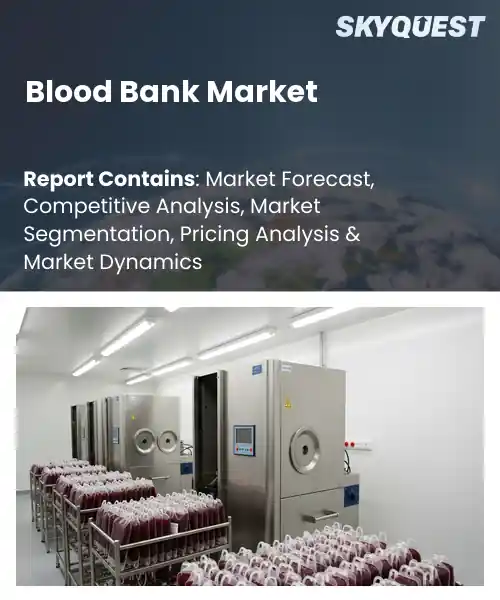
Blood Bank Market
Report ID: SQMIG35D2428
Report ID: SQMIG35D2428
[email protected]
USA +1 351-333-4748
Report ID:
SQMIG35D2428 |
Region:
Global |
Published Date: May, 2026
Pages:
157
|Tables:
178
|Figures:
79


Global Blood Bank Market size was valued at USD 17.5 Billion in 2024 and is poised to grow from USD 18.46 Billion in 2025 to USD 28.33 Billion by 2033, growing at a CAGR of 5.5% during the forecast period (2026-2033).
The blood bank market encompasses collection, testing, processing, storage and distribution of whole blood and components, serving hospitals and specialty clinics. There is a growing demand for safe transfusion services due to the aging population, and the increase in surgical and oncological care is adding to the volume of transfusions and increasing investment in infrastructure to support those additional volumes through transfusion services. As a result, the market for transfusion services has transitioned from being mostly disparate local donation centers into integrated regional systems that use automated testing and have cold chain logistics, which is evident in the modernization efforts of national blood services in many countries including India and the United Kingdom.
Building on that modernization, a key trend driving the global blood bank sector is technological integration, which drives improved safety and operational efficiency and therefore unlocks growth opportunities for providers and device manufacturers. By using nucleic acids for testing and having automated inventory systems, there is a decrease in the number of times Pathogens are transmitted, and by optimising your shelf-life to minimise wastage, hospitals can cut costs and reallocate their budgets to advanced therapy. This ‘causal chain’ creates more private investment in both chilled storage and cloud-based traceability solutions. As evidenced by several case studies from regional networks in Brazil and Germany, they experienced lower stock-outs of products, and have been able expand the capacity of elective surgeries and oncology services.
How is AI Enhancing Inventory Management in the Blood Bank Market?
The application of AI technology in blood bank inventory management has provided greater accuracy in forecasted demand for blood as well as improved timely delivery of blood to hospitals through enhanced shipment processing and extended use of blood components by better managing inventory levels. By using predictive analytics from both clinical scheduling and donor data, blood banks can automate the distribution of blood rather than relying on manual methods for tracking blood from collection through to delivery to hospitals, enabling real-time visibility from the point of collection through to delivery to hospitals. The combination of the blood bank's computerized systems with the use of AI provides blood bank staff with improved ability to make timely decisions relative to patient safety and waste reduction.
In January 2026, IT Synergistics went live with bexWISE at Stanford Blood Center and enabled an FDA cleared API that creates continuous operational data. This real time data feed strengthens AI driven forecasting and inventory allocation, lowering waste and improving unit availability for hospitals which supports more efficient market growth.
Market snapshot - (2026-2033)
Global Market Size
USD 17.5 Billion
Largest Segment
Blood Components
Fastest Growth
Blood Collection Consumables
Growth Rate
5.5% CAGR
To get more insights on this market click here to Request a Free Sample Report
Global blood bank market is segmented by by product type, by collection type, by application, by end user, by storage type, by distribution channel and region. Based on by product type, the market is segmented into Whole Blood, Blood Components, Blood Collection Consumables and Blood Bank Equipment. Based on by collection type, the market is segmented into Voluntary Blood Donation, Replacement Blood Donation, Autologous Blood Donation and Apheresis Donation. Based on by application, the market is segmented into Trauma & Emergency Care, Surgeries, Cancer Treatment, Hematological Disorders, Organ Transplantation and Others. Based on by end user, the market is segmented into Hospitals, Independent Blood Banks, Diagnostic Laboratories, Research Institutes and Others. Based on by storage type, the market is segmented into Refrigerated Storage, Frozen Storage and Room Temperature Storage. Based on by distribution channel, the market is segmented into Hospital-based Distribution, Regional Blood Centers and National Blood Services. Based on region, the market is segmented into North America, Europe, Asia Pacific, Latin America and Middle East & Africa.
Based on the global blood bank market growth, voluntary blood donation segment dominates because it establishes a predictable and screened donor base that underpins consistent blood availability across the blood bank market. Sustained public awareness initiatives and organized donor programs create steady inflows that enable routine processing, efficient inventory rotation and robust safety screening. This reliability reduces dependence on emergency replacements, supports centralized collection planning and allows blood services to align supply with hospital demand and clinical protocols.
However, apheresis donation is the fastest growing area as targeted collection yields high value therapeutic components tailored to specific patient needs. Technological advances in apheresis devices and improved donor scheduling enhance collection efficiency and donor experience. Expanding clinical indications and growing demand for specialized products drive investment in apheresis capacity and open new service and partnership opportunities for blood providers.
Blood components segment dominates because clinicians favor tailored transfusion therapy that matches red cells, platelets and plasma to precise patient indications, improving outcomes and conserving resources. Using a component processing approach allows for the separation of a donation into multiple therapeutic units which reduces waste and allows for more flexible inventory management. A well-established infrastructure for processing, with clinical guidelines that permit the use of components, creates demand for components throughout surgery, oncology and hematology, and facilitates the centralized distribution of components to hospitals.
Meanwhile, blood bank equipment is the fastest growing area as automation and rapid testing enhance safety and throughput. Investment in cold storage and integrated laboratory systems boosts procurement and operational efficiency. Regulatory emphasis on equipment validation and serviceability accelerates adoption, creating aftermarket revenue and enabling broader modernization and technological upgrades across blood services.
To get detailed segments analysis, Request a Free Sample Report
As per the global blood bank market share, North America maintains a dominant position due to integrated healthcare infrastructure, advanced laboratory and transfusion technologies, strong regulatory and accreditation ecosystems, and mature public and private blood collection networks. High-quality screening, inventory control and traceability from the supply chain through to the patient is made possible through the extensive investment in the automation, diagnostic and information systems that have been developed over many years. Research and development of new blood products/therapies has been largely driven by the collaborating of academic institutions, industry and governments. The reimbursement models and established hospital networks support consistent demand and facilitate effective and efficient distribution of blood products. Strong focus on donor recruitment, quality assurance and emergency preparedness creates a foundation for a resilient blood supply.
Blood bank market benefits from concentrated centers of research, large hospital systems, and widespread adoption of automation and advanced testing. A consistent supply can be ensured through solid donor recruitment and a culture that encourages philanthropy. Advanced logistics and electronic inventory systems allow for timely distribution. In addition, an innovative culture is fostered through strong regulatory oversight and collaboration between the private and public sectors when it comes to how blood products are collected and processed.
Blood bank market combines provincial collection networks with centralized processing to serve diverse population centers and remote communities. Reliable public health integration and targeted donor outreach ensure investments in cold chain transportation and mobile collection are used to expand the reach of blood programs. Collaborations between hospitals and research institutions improve the overall quality of both testing and components. Equity, regulatory alignment and operational co-ordination are important to ensure supply continuity and compliance with safety and traceability standards across provinces.
Based on global blood bank regional forecast, Europe has experienced rapid expansion driven by intensified regulatory harmonization, integration of advanced transfusion diagnostics, and strategic consolidation of blood services across national health systems. We have seen improving safety of our product as a result of investments into immunology, more efficient/improved pathogen elimination systems and networks to provide cross border collaborative procurement frameworks to help in providing greater reliability and consistency of supply. Our focus on providing more custom blood therapies, along with specialized components (e.g., 'jumbo-sized' platelets) has helped drive new technologies and approaches from both the clinical and supply chain communities. By creating awareness through advertising campaigns to the public, donors will continue to be recruited through cooperative mobilization programs designed to help keep open channels for donors.
Blood bank market in Germany is marked by centralized regional services, strong integration with hospital transfusion systems, and a developed manufacturing and laboratory ecosystem. Consistency of quality standards, accreditation, and pathogen inactivation technologies guarantee product safety. The collaboration among academic centers, research institutions, and industry is accelerating the adoption of automated processing and novel components. An efficient logistics system augmented by a strong donor program, and preparing for emergencies help in ensuring a reliable supply and continuity of operation throughout the regional networks.
Blood bank market in United Kingdom reflects modernization of collection and processing systems, adoption of digital inventory and donor management platforms, and growth of mobile and community collection models. Partnerships among health services, research centers, and private providers stimulate innovation in transfusion approaches. Community outreach has focused on increasing donors, which will increase the number of supplies needed for diverse populations. Using automation/investments in central testing will improve efficiency and allow for the same levels of operations regardless of the location or type of operation.
Blood bank market in France is emerging through modernization of collection networks, enhanced laboratory capacity. Standardization and quality assurance are promoted by national bodies while a regional network of accessible centres extend the reach to both urban and rural communities. The regional networks of urban and rural agencies work collaboratively with the biotechnology and academic research sectors to develop specific supply chain components and enhance screening operations. Public education and targeted outreach to donors aim to increase the diversity of the overall supply.
As per global blood bank regional forecast, Asia Pacific is strengthening its position through targeted investments in collection and processing infrastructure, adoption of advanced immunohematology diagnostics, and expansion of centralized laboratory networks that enhance regional capacity. Government health agencies, private providers, and academics are increasingly working together to quickly transfer technology and develop local systems for processing blood components. There is more focus on mobile collections, better cold chain logistics and traceability digitally that will help to provide blood components into diverse geographic areas. Increased focus on accreditation, quality control, and workforce training will improve operational standards of blood component collection and processing operations. Local and international manufacturers are interested in these efforts and are supporting research on new components and ways to reduce pathogen contamination.
Blood bank market in Japan is driven by advanced laboratory diagnostics, widespread implementation of automated processing, and strong integration with national healthcare systems. Focus on high safety standards, accreditation, and novel pathogen mitigation technologies supports product reliability. Collaboration between industry and research institutions promotes development of specialized blood components and refinements in screening methods. Emphasis on efficient logistics, centralized testing facilities, and donor outreach contributes to supply improvement and resilience.
Blood bank market in South Korea reflects adoption of cutting edge diagnostics, automation in processing, and coordinated national blood services. Hospital-linked health systems are accelerating the adoption of advanced pathogen reduction and screening services by leveraging the resources of the biopharmaceutical industry and university-based research institutions. Digital traceability, supply chain excellence and workforce training have all contributed to improving the integrity of healthcare providers’ supply chains. Targeted recruitment campaigns for blood donors and mobile collection efforts are helping to expand access to these services.
To know more about the market opportunities by region and country, click here to
Buy The Complete Report
Rising Demand For Blood Transfusions
Advancements In Blood Screening Technology
Complex Regulatory Compliance Requirements
High Operational and Logistical Costs
Request Free Customization of this report to help us to meet your business objectives.
Competition in the global blood bank market outlook is intensifying as incumbents pursue technology led consolidation and partnerships to secure component supply and operational resilience. Recent M&A by Haemonetics and deployment of whole blood automation by Terumo BCT with regional centers illustrate incumbents buying capabilities and scaling automation. Startups like HemostOD and Healthbotics are challenging incumbents through platelet engineering and digital logistics, leading to significant collaboration and licensing agreements.
Top Player’s Company Profile
Recent Developments
SkyQuest’s ABIRAW (Advanced Business Intelligence, Research & Analysis Wing) is our Business Information Services team that Collects, Collates, Correlates, and Analyses the Data collected by means of Primary Exploratory Research backed by robust Secondary Desk research.
As per SkyQuest analysis, the global blood bank industry is being propelled by rising demand for blood transfusions as a key driver while complex regulatory compliance requirements act as a major restraint. North America remains the dominating region owing to advanced infrastructure and integrated systems, and voluntary blood donation is the dominating segment because it underpins predictable screened supplies. A second driver is rapid technological integration including AI-enabled inventory management, automated testing and cold chain improvements that boost safety and reduce waste. Overall the market shows steady, technology-led modernization with growing apheresis and component demand balanced against high operating costs and regulatory pressures.
| Report Metric | Details |
|---|---|
| Market size value in 2024 | USD 17.5 Billion |
| Market size value in 2033 | USD 28.33 Billion |
| Growth Rate | 5.5% |
| Base year | 2024 |
| Forecast period | (2026-2033) |
| Forecast Unit (Value) | USD Billion |
| Segments covered |
|
| Regions covered | North America (US, Canada), Europe (Germany, France, United Kingdom, Italy, Spain, Rest of Europe), Asia Pacific (China, India, Japan, Rest of Asia-Pacific), Latin America (Brazil, Rest of Latin America), Middle East & Africa (South Africa, GCC Countries, Rest of MEA) |
| Companies covered |
|
| Customization scope | Free report customization with purchase. Customization includes:-
|
To get a free trial access to our platform which is a one stop solution for all your data requirements for quicker decision making. This platform allows you to compare markets, competitors who are prominent in the market, and mega trends that are influencing the dynamics in the market. Also, get access to detailed SkyQuest exclusive matrix.
Table Of Content
Executive Summary
Market overview
Parent Market Analysis
Market overview
Market size
KEY MARKET INSIGHTS
COVID IMPACT
MARKET DYNAMICS & OUTLOOK
Market Size by Region
KEY COMPANY PROFILES
Methodology
For the Blood Bank Market, our research methodology involved a mixture of primary and secondary data sources. Key steps involved in the research process are listed below:
1. Information Procurement: This stage involved the procurement of Market data or related information via primary and secondary sources. The various secondary sources used included various company websites, annual reports, trade databases, and paid databases such as Hoover's, Bloomberg Business, Factiva, and Avention. Our team did 45 primary interactions Globally which included several stakeholders such as manufacturers, customers, key opinion leaders, etc. Overall, information procurement was one of the most extensive stages in our research process.
2. Information Analysis: This step involved triangulation of data through bottom-up and top-down approaches to estimate and validate the total size and future estimate of the Blood Bank Market.
3. Report Formulation: The final step entailed the placement of data points in appropriate Market spaces in an attempt to deduce viable conclusions.
4. Validation & Publishing: Validation is the most important step in the process. Validation & re-validation via an intricately designed process helped us finalize data points to be used for final calculations. The final Market estimates and forecasts were then aligned and sent to our panel of industry experts for validation of data. Once the validation was done the report was sent to our Quality Assurance team to ensure adherence to style guides, consistency & design.
Analyst Support
Customization Options
With the given market data, our dedicated team of analysts can offer you the following customization options are available for the Blood Bank Market:
Product Analysis: Product matrix, which offers a detailed comparison of the product portfolio of companies.
Regional Analysis: Further analysis of the Blood Bank Market for additional countries.
Competitive Analysis: Detailed analysis and profiling of additional Market players & comparative analysis of competitive products.
Go to Market Strategy: Find the high-growth channels to invest your marketing efforts and increase your customer base.
Innovation Mapping: Identify racial solutions and innovation, connected to deep ecosystems of innovators, start-ups, academics, and strategic partners.
Category Intelligence: Customized intelligence that is relevant to their supply Markets will enable them to make smarter sourcing decisions and improve their category management.
Public Company Transcript Analysis: To improve the investment performance by generating new alpha and making better-informed decisions.
Social Media Listening: To analyze the conversations and trends happening not just around your brand, but around your industry as a whole, and use those insights to make better Marketing decisions.
REQUEST FOR SAMPLE
 REQUEST FREE CUSTOMIZATION
Global Blood Bank Market size was valued at USD 17.5 Billion in 2024 and is poised to grow from USD 18.46 Billion in 2025 to USD 28.33 Billion by 2033, growing at a CAGR of 5.5% during the forecast period (2026-2033).
Competition in the global blood bank market is intensifying as incumbents pursue technology led consolidation and partnerships to secure component supply and operational resilience. Recent M&A by Haemonetics and deployment of whole blood automation by Terumo BCT with regional centers illustrate incumbents buying capabilities and scaling automation. Startups such as HemostOD and Healthbotics are pressuring incumbents with platelet engineering and digital logistics, prompting focused alliances and licensing deals. 'Grifols', 'CSL Behring', 'Terumo Corporation', 'Haemonetics Corporation', 'Fresenius Kabi', 'Macopharma', 'Immucor', 'Ortho Clinical Diagnostics', 'Cerus Corporation', 'Abbott Laboratories', 'Becton Dickinson', 'Bio-Rad Laboratories', 'Kawasumi Laboratories', 'SARSTEDT', 'Nipro Corporation', 'QIAGEN', 'Roche Diagnostics', 'Sysmex Corporation', 'Thermo Fisher Scientific', 'Danaher Corporation'
Rising demand for blood transfusions and component therapies, driven by aging populations, surgical procedures, and chronic disease management, expands the need for reliable blood supplies and services. This increased clinical requirement encourages investment in donor recruitment, storage infrastructure, and distribution networks, stimulating growth across collection centers and processing facilities. The focus on ensuring safe, available blood promotes capacity building and service diversification, creating sustained demand for blood banking solutions and supporting market expansion through enhanced operational activity and wider adoption of blood management practices.
Digital Integration Of Services: Healthcare providers and blood banks increasingly adopt interoperable digital systems to enhance donor recruitment, inventory visibility, and traceability across the supply chain. Electronic donor records, connected testing platforms, and AI-assisted quality monitoring streamline workflows, reduce manual errors, and support real-time decision making. Digital scheduling and remote screening improve donor experience and retention, while standardized data exchange facilitates collaboration among hospitals, laboratories, manufacturers. The shift toward integrated digital ecosystems enables predictive capacity planning and alignment with patient blood management programs, improving service reliability.
Why does North America Dominate the Global Blood Bank Market? |@12


Want to customize this report? This report can be personalized according to your needs. Our analysts and industry experts will work directly with you to understand your requirements and provide you with customized data in a short amount of time. We offer $1000 worth of FREE customization at the time of purchase.
Feedback From Our Clients


 USA (+1) 351-333-4748

