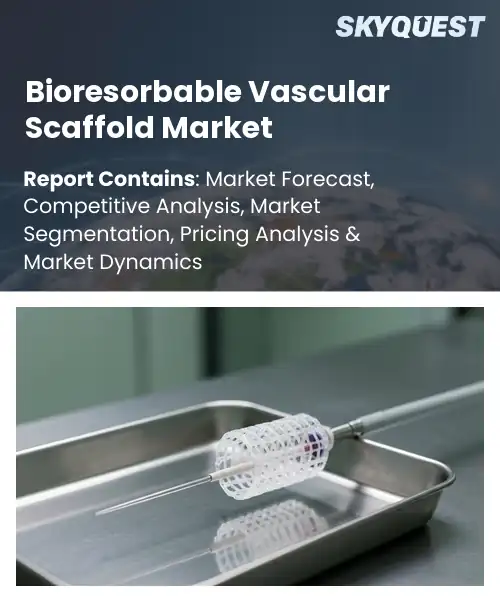
Bioresorbable Vascular Scaffold Market
Report ID: SQMIG35A4210
Report ID: SQMIG35A4210
[email protected]
USA +1 351-333-4748
Report ID:
SQMIG35A4210 |
Region:
Global |
Published Date: July, 2026
Pages:
157
|Tables:
176
|Figures:
79


Global Bioresorbable Vascular Scaffold Market size was valued at USD 301.0 Million in 2024 and is poised to grow from USD 331.4 Million in 2025 to USD 715.57 Million by 2033, growing at a CAGR of 10.1% during the forecast period (2026-2033).
High prevalence of cardiovascular diseases, increasing preference for minimally invasive cardiac procedures, rising demand for bioresorbable implant technologies, advancements in scaffold materials, and growing emphasis on improving long-term patient outcomes are driving demand for bioresorbable vascular scaffolds.
Increased incidence of coronary artery disease around the world coupled with increasing adoption of minimally invasive cardiovascular interventions is expected to primarily drive bioresorbable vascular scaffold market growth. Rising demand for temporary vascular support solutions across hospitals and cardiac care centers is promoting the adoption of bioresorbable vascular scaffolds that help restore natural vessel function while reducing long-term device-related complications. Continuous advancements in polymerand magnesium-based scaffold technologies, improved scaffold designs, and ongoing clinical research are enhancing safety and treatment outcomes. Growing investments in cardiovascular innovation and increasing focus on next-generation bioresorbable implants are also expected to help bolster the demand for bioresorbable vascular scaffolds.
However, high treatment costs, limited long-term clinical evidence, stringent regulatory approval requirements, and concerns regarding scaffold performance in complex lesions are anticipated to slow down bioresorbable vascular scaffold market penetration over the coming years.
How is AI Accelerating Design Optimization for Bioresorbable Vascular Scaffold Manufacturers?
The impact of AI on the bioresorbable vascular scaffold market lies in the improvement of scaffold design and development of products. The technology allows analysis of data obtained from medical imaging and simulations to determine the processes of degradation and interaction of scaffold materials with blood vessels. It enables researchers to come up with safe and efficient scaffold designs. AI technology also allows carrying out virtual testing of different design variations, which leads to accelerated product development.
Market snapshot - (2026-2033)
Global Market Size
USD 301.0 Million
Largest Segment
Drug-eluting Bioresorbable Vascular Scaffolds
Fastest Growth
Magnesium-based Bioresorbable Vascular Scaffolds
Growth Rate
10.1% CAGR
To get more insights on this market click here to Request a Free Sample Report
Global bioresorbable vascular scaffold market is segmented by product type, material type, application, end user, scaffold type, drug type, and region. Based on product type, the market is segmented into Polymeric Bioresorbable Vascular Scaffolds, Magnesium-based Bioresorbable Vascular Scaffolds, Drug-eluting Bioresorbable Vascular Scaffolds, and Non-drug-eluting Bioresorbable Vascular Scaffolds. Based on material type, the market is segmented into Poly-L-lactic Acid (PLLA), Magnesium Alloys, Tyrosine-derived Polymers, and other bioresorbable materials. Based on application, the market is segmented into coronary artery disease, peripheral artery disease, complex coronary lesions, small vessel disease, and others. Based on end user, the market is segmented into hospitals, cardiac centers, ambulatory surgical centers, and specialty cardiovascular clinics. Based on scaffold type, the market is segmented into coronary bioresorbable scaffolds and peripheral bioresorbable scaffolds. Based on drug type, the market is segmented into Sirolimus-eluting, Everolimus-eluting, other drug-eluting scaffolds, and non-drug-eluting scaffolds. Based on region, the market is segmented into North America, Europe, Asia Pacific, Latin America, and Middle East & Africa.
The polymeric bioresorbable vascular scaffolds segment is predicted to lead the global bioresorbable vascular scaffold market revenue generation through 2033. With established manufacturing process, clinical data, and acceptance by physicians, their products become more accessible. The breakdown characteristics correspond to the healing time, and also the polymeric substrate allows variation in strut thickness, thus offering versatility in lesion complications. Such maturity of technology, along with the regulatory experience, contributes to steady demand and leads to their domination in the entire market for cardiovascular procedures.
Meanwhile, magnesium-based bioresorbable vascular scaffolds are witnessing the strongest growth momentum because of their metallic qualities that provide high strength in radial direction and faster bio resorption capabilities. Material developments and evidence in complex lesions make their use more appealing to physicians; therefore, this segment becomes a key factor in market growth.
The sirolimus-eluting segment is forecasted to account for the highest global bioresorbable vascular scaffold market share in the future. Sirolimus offers an extensively studied and highly effective anti-proliferative action, which leads to the significant reduction of neointima hyperplasia and reduced incidence of restenosis. These advantages, together with clinical experience gained during years of use, increase the level of confidence on the part of physicians and make this drug widely accepted. Compatibility of sirolimus with various polymers also makes it possible to develop different scaffolds.
On the other hand, everolimus-eluting is emerging as the key high‑growth segment as per this bioresorbable vascular scaffold industry analysis, due to its wide pharmacokinetic profile that allows higher drug delivery without compromising safety, gaining attention in the treatment of complicated and small vessel disease lesions. Improvements in release kinetics and polymer systems are driving the quick adoption of the technology.
To get detailed segments analysis, Request a Free Sample Report
Sophisticated healthcare delivery systems, deep investment in biomedical research, and a regulatory environment that balances rigorous evaluation with accelerated pathways helps cement the dominance of this region. Strong cooperation among the academic centers, the clinics, and the industry players is one of the factors ensuring constant development of products. Reimbursement mechanisms, based on the clinical value, facilitate the implementation of innovations within the clinical practice, while the advanced medical community ensures early adoption of innovative scaffold solutions. The presence of several internationally respected manufacturers also indicates the developed supply chain and availability of innovative products.
Bioresorbable vascular scaffold market in United States thrives on a highly integrated ecosystem where leading research hospitals partner closely with device innovators. Advanced clinical trial networks expedite evidence generation, while payer frameworks increasingly recognize long‑term patient benefits. The strong focus on precision medicine drives demand for scaffolds that align with evolving treatment paradigms, and a culture of early technology adoption reinforces market momentum across cardiovascular specialties.
Bioresorbable vascular scaffold market in Canada is shaped by a publicly funded healthcare system that prioritizes cost‑effective, evidence‑based interventions. Collaborative provincial health authorities work with scientific institutions to evaluate clinical outcomes, fostering confidence in scaffold adoption. A growing emphasis on patient‑centered care and the presence of knowledgeable interventional cardiology teams support steady integration of bioresorbable solutions into routine practice, while regulatory pathways provide clear guidance for market entry.
Europe’s expansion is propelled by harmonized regulatory standards that streamline cross‑border product approvals, creating a unified market environment conducive to rapid uptake. Strong emphasis on clinical research and multi‑center trials generates robust evidence supporting scaffold efficacy, while health technology assessment bodies increasingly value long‑term vessel healing benefits. Reimbursement policies that reward outcomes over procedural volume encourage clinicians to adopt innovative devices. Moreover, collaborative networks among academic centers, industry, and patient advocacy groups foster knowledge exchange and accelerate diffusion of technology across the continent.
Bioresorbable Vascular Scaffold Market in Germany benefits from a dense network of university hospitals renowned for cardiovascular research. Strong clinical trial participation provides a solid evidence base, while reimbursement mechanisms that align with outcome‑driven care promote wider acceptance. The country’s emphasis on precision health and integration of digital imaging supports optimal scaffold deployment, reinforcing its position as a leading European market for bioresorbable technologies.
Bioresorbable Vascular Scaffold Market in United Kingdom experiences rapid growth driven by proactive health policy that encourages adoption of innovative medical devices. National health services prioritize therapeutic value, and early‑adopter cardiology centres actively integrate scaffold options into treatment algorithms. Collaborative research programs across institutions generate continuous clinical insight, while a focus on patient‑focused outcomes accelerates acceptance across diverse care pathways.
Bioresorbable Vascular Scaffold Market in France emerges as an important segment through the country’s commitment to advancing cardiovascular care. Strong ties between research institutes and medical device firms foster early clinical evaluation, and health insurance frameworks that reward long‑term benefit support adoption. Growing clinician familiarity with scaffold technology and an emphasis on reducing permanent metal implant reliance position France as a rising market within Europe.
Asia Pacific is reinforcing its market stance by leveraging expanding cardiovascular disease awareness and an aging demographic that drives demand for innovative solutions. National health initiatives increasingly endorse technologies that reduce lifelong device burden, encouraging adoption of bioresorbable scaffolds. Strategic partnerships between regional manufacturers and global innovators accelerate technology transfer and local production capabilities. Moreover, burgeoning clinical research capacities and supportive regulatory reforms create a favorable environment for rapid market penetration across the region.
Bioresorbable Vascular Scaffold Market in Japan is underpinned by a sophisticated interventional cardiology community that values long‑term vessel health. Governmental health programs that emphasize value‑based care encourage clinicians to consider scaffold options that minimize permanent implants. Strong academic‑industry collaborations facilitate continuous clinical assessment, while a culturally rooted focus on patient safety sustains confidence in emerging technologies.
Bioresorbable Vascular Scaffold Market in South Korea benefits from a dynamic biotech sector and proactive health authorities that streamline approval pathways for novel devices. Leading hospitals adopt cutting‑edge procedures, and reimbursement schemes that reward improved outcomes foster broader clinical use. Collaborative research networks across universities and manufacturers enhance evidence generation, positioning South Korea as a pivotal market in the Asia Pacific landscape.
To know more about the market opportunities by region and country, click here to
Buy The Complete Report
Advancements In Scaffold Materials
Growing Clinical Evidence Supporting Efficacy
High Manufacturing Costs Limit Adoption
Regulatory Uncertainty Hinders Market Entry
Request Free Customization of this report to help us to meet your business objectives.
The competitive landscape is defined by rapid innovation and sizable capital inflows, with firms racing to secure first‑in‑class bioresorbable scaffolds that address unmet cardiovascular needs; R3 Vascular’s $87 million Series B led by Deerfield Management exemplifies aggressive financing, while incumbents are pursuing strategic partnerships with research institutions to accelerate next‑generation scaffold technologies and gain market share.
SkyQuest’s ABIRAW (Advanced Business Intelligence, Research & Analysis Wing) is our Business Information Services team that Collects, Collates, Correlates, and Analyses the Data collected by means of Primary Exploratory Research backed by robust Secondary Desk research.
As per SkyQuest analysis, increasing preference for minimally invasive cardiac procedures, rising demand for bioresorbable implant technologies, and advancements in scaffold materials are anticipated to drive the demand for bioresorbable vascular scaffolds going forward. However, high treatment costs, limited long-term clinical evidence, and stringent regulatory approval requirements are slated to slow down the adoption of bioresorbable vascular scaffolds in the future. North America is slated to spearhead the demand for bioresorbable vascular scaffolds owing to high adoption of advanced cardiovascular treatments, strong presence of leading medical device manufacturers, well-established healthcare infrastructure, and increasing investments in cardiovascular research. AI-driven scaffold design and development of next-generation bioresorbable materials are anticipated to be key trends driving the bioresorbable vascular scaffold market in the long run.
| Report Metric | Details |
|---|---|
| Market size value in 2024 | USD 301.0 Million |
| Market size value in 2033 | USD 715.57 Million |
| Growth Rate | 10.1% |
| Base year | 2024 |
| Forecast period | (2026-2033) |
| Forecast Unit (Value) | USD Million |
| Segments covered |
|
| Regions covered | North America (US, Canada), Europe (Germany, France, United Kingdom, Italy, Spain, Rest of Europe), Asia Pacific (China, India, Japan, Rest of Asia-Pacific), Latin America (Brazil, Rest of Latin America), Middle East & Africa (South Africa, GCC Countries, Rest of MEA) |
| Companies covered |
|
| Customization scope | Free report customization with purchase. Customization includes:-
|
To get a free trial access to our platform which is a one stop solution for all your data requirements for quicker decision making. This platform allows you to compare markets, competitors who are prominent in the market, and mega trends that are influencing the dynamics in the market. Also, get access to detailed SkyQuest exclusive matrix.
Table Of Content
Executive Summary
Market overview
Parent Market Analysis
Market overview
Market size
KEY MARKET INSIGHTS
COVID IMPACT
MARKET DYNAMICS & OUTLOOK
Market Size by Region
KEY COMPANY PROFILES
Methodology
For the Bioresorbable Vascular Scaffold Market, our research methodology involved a mixture of primary and secondary data sources. Key steps involved in the research process are listed below:
1. Information Procurement: This stage involved the procurement of Market data or related information via primary and secondary sources. The various secondary sources used included various company websites, annual reports, trade databases, and paid databases such as Hoover's, Bloomberg Business, Factiva, and Avention. Our team did 45 primary interactions Globally which included several stakeholders such as manufacturers, customers, key opinion leaders, etc. Overall, information procurement was one of the most extensive stages in our research process.
2. Information Analysis: This step involved triangulation of data through bottom-up and top-down approaches to estimate and validate the total size and future estimate of the Bioresorbable Vascular Scaffold Market.
3. Report Formulation: The final step entailed the placement of data points in appropriate Market spaces in an attempt to deduce viable conclusions.
4. Validation & Publishing: Validation is the most important step in the process. Validation & re-validation via an intricately designed process helped us finalize data points to be used for final calculations. The final Market estimates and forecasts were then aligned and sent to our panel of industry experts for validation of data. Once the validation was done the report was sent to our Quality Assurance team to ensure adherence to style guides, consistency & design.
Analyst Support
Customization Options
With the given market data, our dedicated team of analysts can offer you the following customization options are available for the Bioresorbable Vascular Scaffold Market:
Product Analysis: Product matrix, which offers a detailed comparison of the product portfolio of companies.
Regional Analysis: Further analysis of the Bioresorbable Vascular Scaffold Market for additional countries.
Competitive Analysis: Detailed analysis and profiling of additional Market players & comparative analysis of competitive products.
Go to Market Strategy: Find the high-growth channels to invest your marketing efforts and increase your customer base.
Innovation Mapping: Identify racial solutions and innovation, connected to deep ecosystems of innovators, start-ups, academics, and strategic partners.
Category Intelligence: Customized intelligence that is relevant to their supply Markets will enable them to make smarter sourcing decisions and improve their category management.
Public Company Transcript Analysis: To improve the investment performance by generating new alpha and making better-informed decisions.
Social Media Listening: To analyze the conversations and trends happening not just around your brand, but around your industry as a whole, and use those insights to make better Marketing decisions.
REQUEST FOR SAMPLE
 REQUEST FREE CUSTOMIZATION
Global Bioresorbable Vascular Scaffold Market size was valued at USD 301.0 Million in 2024 and is poised to grow from USD 331.4 Million in 2025 to USD 715.57 Million by 2033, growing at a CAGR of 10.1% during the forecast period (2026-2033).
The competitive landscape is defined by rapid innovation and sizable capital inflows, with firms racing to secure first‑in‑class bioresorbable scaffolds that address unmet cardiovascular needs; R3 Vascular’s $87 million Series B led by Deerfield Management exemplifies aggressive financing, while incumbents are pursuing strategic partnerships with research institutions to accelerate next‑generation scaffold technologies and gain market share. 'Biotronik', 'REVA Medical', 'Elixir Medical', 'Amaranth Medical', 'Kyoto Medical Planning', 'Arterius', 'Meril Life Sciences', 'Lepu Medical Technology', 'MicroPort Scientific', 'Lifetech Scientific', 'QualiMed Innovative Medizinprodukte', 'Sahajanand Medical Technologies', 'Amaranth Medical Pte.', 'Arterial Remodeling Technologies', 'Zeus Medical', 'OrbusNeich', 'CGBio', 'MeRes100 (Meril Life Sciences Platform)', 'R3 Vascular', 'Xinsorb Medical Technology'
Personalized Scaffold Design: Advancements in imaging and computational modeling are enabling clinicians to tailor scaffold geometry and polymer composition to individual patient anatomy and lesion characteristics. By integrating high‑resolution intravascular imaging with AI‑driven design algorithms, manufacturers can produce customized bioresorbable scaffolds that optimize vessel healing, reduce restenosis risk, and align with personalized treatment pathways. This patient‑centric approach is driving greater physician acceptance and creating niche premium offerings that differentiate market participants in emerging economies, fostering broader global adoption and sustained revenue growth overall.
Why does North America Dominate the Global Bioresorbable Vascular Scaffold Market? |@12


Want to customize this report? This report can be personalized according to your needs. Our analysts and industry experts will work directly with you to understand your requirements and provide you with customized data in a short amount of time. We offer $1000 worth of FREE customization at the time of purchase.
Feedback From Our Clients


 USA (+1) 351-333-4748

