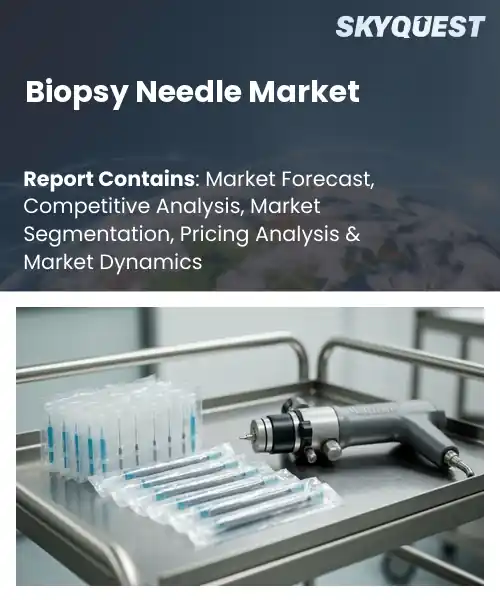
Biopsy Needle Market
Report ID: SQMIG35A3402
Report ID: SQMIG35A3402
[email protected]
USA +1 351-333-4748
Report ID:
SQMIG35A3402 |
Region:
Global |
Published Date: May, 2026
Pages:
157
|Tables:
179
|Figures:
79


Global Biopsy Needle Market size was valued at USD 1.20 Billion in 2024 and is poised to grow from USD 1.27 Billion in 2025 to USD 2.04 Billion by 2033, growing at a CAGR of 6.1% during the forecast period (2026-2033).
The biopsy needle market growth is largely driven by the increasing need for precise, minimally invasive diagnosis of human tissue due to rising rates of cancer and a growing screening population. The biopsy needle market contains devices that can remove tissue or cells for use in pathology, which include fine needle aspirators, core needles, and vacuum-assisted biopsy systems. One of the key reasons these devices are so valuable to investigating and diagnosing human diseases is because they provide quicker and safer results; therefore reducing the time between an initial diagnosis and the start of treatment and, ultimately, leading to better patient outcomes. Over the past twenty years, there has been a shift in focus in the biopsy needle market from reusable instruments to a predominance of single-use devices that are image guided (e.g., within ultrasound, CT, and MRI), with a large percentage of these devices currently integrating imaging capabilities. For example, spring-loaded core needles and vacuum-assisted systems have been introduced, which allow for better yield of tissue samples while reducing the complication rates associated with traditional biopsy methods and have become widely accepted by hospitals.
Growth in the biopsied tissue market penetration is heavily reliant on combined usage of advanced imaging and molecular diagnostics with biopsy needles, especially core and vacuum-assisted devices which allow for larger and more intact samples of tissue required for successful genomic testing. This change has led to an increase in demand for premium quality needles and a heightened focus on R&D in both surface coatings, tip geometry, and automatic sampling to minimize sample fragmentation and bleeding. The performance of targeted therapies in hospitals often results in the ordering of special needles, thereby contributing additional revenue to the needle manufacturer and training in outpatient facilities. Due to increased access to Asia and Latin America, there is now an opportunity to create more affordable single-use needles that still provide a high level of diagnostic yield while reducing the risk of infection associated with traditional multi-use needles and will enable new screening programs.
How is AI Enhancing Diagnostic Accuracy and Workflow Efficiency in the Biopsy Needle Market?
AI is transforming the biopsy needle market trends by increasing the accuracy of targeting and decreasing the variability of diagnostics. Important components of this technology are AI image fusion used to plan a procedure beforehand, navigational tools which provide real-time access to needle placement during the procedure, and pathology algorithms which automate the interpretation of core needle samples. Currently these technologies work in conjunction with ultrasound, CT and MRI technologies to improve the precision and reproducibility of sampling therefore decreasing time to diagnosis and decreasing the number of times a patient needs to be biopsied.
Technology advances have driven the market demand for these type of procedures as clinicians are looking for less invasive ways to diagnose patients as well as tighter workflows while at the same time facing pressure from device supply and increasing regulation to create integrated digital solutions.
Zeta Surgical announced the 510k clearance for its Zeta Navigation System and navigated biopsy instruments which utilize AI based image guidance to improve needle accuracy and localization of lesions on May 26, 2026. This innovation allows for a decrease in the length of time needed for the procedure while allowing the clinician to have increased confidence in obtaining accurate results from single pass biopsy procedures by supporting the adoption of targeted biopsy workflows and overall growth in the biopsy needle market.
Market snapshot - (2026-2033)
Global Market Size
USD 1.2 Billion
Largest Segment
Core Biopsy Needles
Fastest Growth
Core Biopsy Needles
Growth Rate
6.1% CAGR
To get more insights on this market click here to Request a Free Sample Report
Global biopsy needle market is segmented into by product type, procedure type, application, end user, usage type, material type, and region. Based on by product type, the market is segmented into core biopsy needles, fine needle aspiration needles, bone marrow biopsy needles, localization needles and others. Based on by procedure type, the market is segmented into image-guided biopsy, surgical biopsy, liquid biopsy and endoscopic biopsy. Based on by application, the market is segmented into breast biopsy, lung biopsy, prostate biopsy, liver biopsy, bone marrow biopsy, kidney biopsy and others. Based on by end user, the market is segmented into hospitals, diagnostic centers, ambulatory surgical centers, specialty clinics and others. Based on by usage type, the market is segmented into disposable biopsy needles and reusable biopsy needles. Based on by material type, the market is segmented into stainless steel needles, titanium needles and others. Based on region, the market is segmented into North America, Europe, Asia Pacific, Latin America and Middle East & Africa.
The absence of major innovations in core biopsy needles has made them the most widely used needle segment. This widespread use is due to the need for accurate diagnosis and complete tissue architecture for histopathology as well as other reasons. The availability of both image guidance-compatible and manual core biopsy needle types and sizes along with familiarity by most physicians have made purchasing and training patterns very entrenched. Manufacturer's resources are focused on R&D and supply chain to provide the physicians and hospitals with core biopsy needle solution products that continue to meet clinical protocol and hospital purchasing criteria.
However, demand for Fine Needle Aspiration Needles (FNAs) will present the fastest growing area of needle growth because there is increasing demand for cytology services and because there are increasing numbers of procedures that require them as part of a simplified workflow process. Improvements in design, single use, and point of care have all been key developments for FNA needles that continue to promote innovation through R&D and manufacturing and improve access to diagnostic testing of FNAs within all practice settings.
Image-guided biopsy has established itself as an industry leader in procedural reliability within the sector due to its ability to accurately localize tissue through ultrasound, CT, and MRI, resulting in reduced sampling inaccuracies. As a result of this reliability, clinicians have been encouraged to purchase imaging compatible needles that allow for the completion of accurate biopsies, while manufacturers are compelled to develop imaging optimised needle designs. Both of these factors serve to further the establishment of imaging as the preferred method for many solid organ diseases.
The rapid growth of liquid biopsy procedures is driven primarily by an increase in demand for noninvasive molecular profiling and as a result the increasing use of blood-based diagnostics. Advances in circulating tumour DNA (ctDNA) assays, as well as the development of simpler blood sampling workflows, will continue to drive innovation within this market, including dedicated liquid biopsy collection devices and increased manufacturer diversification of products that complement tissue-based testing and create new marketplace opportunities for manufacturers.
To get detailed segments analysis, Request a Free Sample Report
Factors contributing to North America's leadership position in the global biopsy needle market regional outlook include innovative clinical research environments; advanced healthcare infrastructure; and supportive reimbursement and regulatory structures that promote the use of minimally invasive diagnostics Methods (Image-guided Biopsy). In addition to having large numbers of academic hospitals, healthcare Systems also have numerous related specialties that promote early adoption of clinical Image-guided Biopsies and clinicians becoming familiar with how to perform Image-guided Biopsies. Additionally, there are multiple manufacturers of biopsy needle products and their related instruments, as well as many distributors who specialize in distributing medical devices, thus providing the backbone of supply chains to bring innovation to the market quickly and efficiently, and provide rapid market access for product innovations related to image guided biopsy.
Biopsy needle market outlook in United States enjoys significant acceptance in clinical practice, hospital systems providing support and a set framework for having devices used in which clinical procedures. The presence of many academic medical centres and specialized diagnostic labs is conducive to the extent of quality of verification/validation of medical devices, training physicians on device use etc. Manufacturers have cultivated collaborative relationships with physicians, hospitals, and other relevant stakeholders to help develop/modify the devices; create/maintain resilient supply chains; and determine/implement appropriate pricing structures for their devices. Specifically, reimbursement policies along with procurement processes have enabled devices to become part of the regular diagnostic workflow across the continuum of care.
Biopsy needle market regional forecast in Canada is supported by the country's publicly funded health care model which has standardized processes for the delivery of care and included centralized purchasing, allowing for greater access to biopsy services using imaging techniques throughout all provinces. The close relationship between hospitals and universities has allowed for physicians to receive training in clinical procedures using new technologies and clinically validate devices at their home institution. In addition, equitable access to care, collaborative purchasing, and effective distribution networks will support the ongoing implementation of advanced biopsy technologies in both tertiary and community hospitals.
Multiple factors are contributing to the growth of the European biopsy needle industry trends. The presence of advanced healthcare systems with established diagnostic infrastructures, listed below, will allow for an expedited process of cancer screening and referral pathways that continue to grow with less invasive diagnostic procedures being qualified as a primary avenue of diagnosis. Additionally, through collaboration between Device Manufacturers and hospitals, tools can be adapted and trained for localized use, while public and private investment in diagnostic equipment will drive adoption of these tools into hospitals. Additionally, there are a number of different types of payer systems in addition to the centralized procurement system that is in use by many of these regions, which will enable the scalability of these products once successfully introduced into those markets and ultimately will increase the use of these products across the continuum of patient care. Growing demands for personalized medicine are creating greater demand for no-biopsy solutions and image-guided biopsy solutions across all of the competing clinical specialty area's.
Biopsy needle industry outlook in Germany, there is a robust medical technology industry, an expansive network of hospital systems that provide care across various conditions, and well-defined pathways for clinical adoption, all of which help support the biopsy needle market. With multiple academic medical centers (AMCs) and many diagnostic labs, there is a well-defined framework for the rigorous evaluation of new devices and for providing clinical training to end-users. Collaborative manufacturer and clinician relationships also enhance product customization, as well as the resiliency of the supply chain. Additionally, established reimbursement mechanisms and procurement practices allow for advanced biopsy tools to be integrated into existing diagnostic processes, allowing them to be used across a range of care settings.
Biopsy needle market in United Kingdom shows strong growth from innovation clusters, busy clinical research networks, and new ways to purchase imaging tools (more focus on low-cost, minimally invasive methods). There is a strong partnership between the commercial sector, academic institutions, and the commissioning group to enable fast and effective piloting/scalability of biopsy technology. More importantly, the emphasis on outpatient diagnostic pathways and other initiatives will reduce the time taken for diagnosis, providing for greater acceptance of imaging-guided procedures at tertiary hospitals and in community diagnostic facilities.
Biopsy needle market in France is growing due to more hospitals and clinics using image guided methods (e.g. ultrasound) to help guide these techniques. France has robust public healthcare systems as well as procurement frameworks, which create opportunities for standardized use of biopsy devices. The development of partnerships between medtech and university hospitals facilitates evaluation and training for clinicians. There is a strong focus on improving diagnostics pathways, and integrating the results of biopsy with Pathology services will drive the market's growth in both public and private sectors.
Investment in healthcare systems is projected to continue growing throughout the Asia Pacific region as countries develop their respective healthcare infrastructures to accommodate increased levels of activity through tertiary facilities and grow local manufacturing capacity thereby reducing delivery timeframes. Countries within the region are forming more international cooperation partnerships and engaging in technological transfers that help advance the adoption of new image-guided and minimally invasive biopsy techniques. In many instances, regulatory pathways are evolving in line with the approval of medical devices while providing opportunities to raise clinicians' level of proficiency through specific training initiatives. Furthermore, by incorporating diagnostic workflows into pathology and molecular testing, clinicians can obtain greater clinical value from both diagnostic and treatment modalities. Both public and private funding will continue to help grow the advancement of cancer care and diagnostic services, thereby increasing the overall volume of product procurement. Global manufacturers continue to pursue various strategies to gain entry into the marketplace and the need for more reasonably priced, scalable solutions further support the influence that Asia Pacific has on the larger, global marketplace.
Biopsy needle market in Japan is influenced by innovative medical devices that are at the forefront of manufacturing, clinical standards in hospitals, and a well-integrated relationship between the manufacturer and the academic research centre. The use of guided image techniques, emphasis placed on improvements to diagnostic accuracy, and the adoption rate for specialty biopsy products support their development and use in this market. Additionally, the team-building process through collaborations between distribution and servicing organisations enables smooth entry to the market for product introduction, support for clinician's training programs, and working with the pathology service enhances clinical workflow and diagnostic yield.
Biopsy needle market in South Korea is progressing rapidly thanks to robust domestic production of biopsy needles, strong partnerships between medical device manufacturers and top hospitals, and the rapid introduction of image guided imaging (or imaging-guided) procedures in clinics. Technical proficiency and using digital imaging systems with advanced imaging modalities support the creation of accurate diagnostic workflows. Additionally, the South Korean government's efforts to promote medical innovation through international collaboration enhance worldwide access to the biopsy needle market. Finally, the emphasis on supporting quality, efficient supply chains, and training for practitioners is helping to ensure ongoing usage of biopsy needles at both tertiary and community-on/medical centre healthcare facilities.
To know more about the market opportunities by region and country, click here to
Buy The Complete Report
Rising Incidence Of Chronic Diseases
Advances In Needle Design
Stringent Regulatory Approval Processes
High Cost Of Single Use Needles
Request Free Customization of this report to help us to meet your business objectives.
Factors driving competition in the worldwide biopsy needle market include new product development, strategic acquisitions, and collaborations with healthcare providers to help speed up the biopsy-diagnostic process. In terms of recent activity, for example, Hologic purchased Endomag to gain access to the latter's localization and marking products; Merit acquired both a biopsy tract sealant as well as Cook's device-related assets through their acquisition of the two former Cook businesses; and Cook introduced their new EchoTip ClearCore EUS Biopsy Needle which is designed to allow physicians greater accuracy when sampling tissue from patients' bodies.
Top Player’s Company Profile
Recent Developments in the Biopsy Needle Market
SkyQuest’s ABIRAW (Advanced Business Intelligence, Research & Analysis Wing) is our Business Information Services team that Collects, Collates, Correlates, and Analyses the Data collected by means of Primary Exploratory Research backed by robust Secondary Desk research.
As per SkyQuest analysis, the need for accurate and minimally invasive tissue diagnosis is pushing the global biopsy needle market forward as more cases of cancer are discovered and patients are screened for cancer. Integrating newer imaging techniques and molecular diagnostic tools enhances the amount of sample obtained, thus making it more appealing to use core biopsy and vacuum assisted devices. Unfortunately, the complex and lengthy regulatory approval processes are restricting growth by delaying product launch and increasing product development costs. North America continues to dominate the global biopsy needle market with its superior medical infrastructure and high level of clinical adoption; therefore, the core biopsy needle segment is leading this market due to clinicians wanting both high diagnostic yield from this device and being compatible with imaging systems during procedure performance.
| Report Metric | Details |
|---|---|
| Market size value in 2024 | USD 1.2 Billion |
| Market size value in 2033 | USD 2.04 Billion |
| Growth Rate | 6.1% |
| Base year | 2024 |
| Forecast period | (2026-2033) |
| Forecast Unit (Value) | USD Billion |
| Segments covered |
|
| Regions covered | North America (US, Canada), Europe (Germany, France, United Kingdom, Italy, Spain, Rest of Europe), Asia Pacific (China, India, Japan, Rest of Asia-Pacific), Latin America (Brazil, Rest of Latin America), Middle East & Africa (South Africa, GCC Countries, Rest of MEA) |
| Companies covered |
|
| Customization scope | Free report customization with purchase. Customization includes:-
|
To get a free trial access to our platform which is a one stop solution for all your data requirements for quicker decision making. This platform allows you to compare markets, competitors who are prominent in the market, and mega trends that are influencing the dynamics in the market. Also, get access to detailed SkyQuest exclusive matrix.
Table Of Content
Executive Summary
Market overview
Parent Market Analysis
Market overview
Market size
KEY MARKET INSIGHTS
COVID IMPACT
MARKET DYNAMICS & OUTLOOK
Market Size by Region
KEY COMPANY PROFILES
Methodology
For the Biopsy Needle Market, our research methodology involved a mixture of primary and secondary data sources. Key steps involved in the research process are listed below:
1. Information Procurement: This stage involved the procurement of Market data or related information via primary and secondary sources. The various secondary sources used included various company websites, annual reports, trade databases, and paid databases such as Hoover's, Bloomberg Business, Factiva, and Avention. Our team did 45 primary interactions Globally which included several stakeholders such as manufacturers, customers, key opinion leaders, etc. Overall, information procurement was one of the most extensive stages in our research process.
2. Information Analysis: This step involved triangulation of data through bottom-up and top-down approaches to estimate and validate the total size and future estimate of the Biopsy Needle Market.
3. Report Formulation: The final step entailed the placement of data points in appropriate Market spaces in an attempt to deduce viable conclusions.
4. Validation & Publishing: Validation is the most important step in the process. Validation & re-validation via an intricately designed process helped us finalize data points to be used for final calculations. The final Market estimates and forecasts were then aligned and sent to our panel of industry experts for validation of data. Once the validation was done the report was sent to our Quality Assurance team to ensure adherence to style guides, consistency & design.
Analyst Support
Customization Options
With the given market data, our dedicated team of analysts can offer you the following customization options are available for the Biopsy Needle Market:
Product Analysis: Product matrix, which offers a detailed comparison of the product portfolio of companies.
Regional Analysis: Further analysis of the Biopsy Needle Market for additional countries.
Competitive Analysis: Detailed analysis and profiling of additional Market players & comparative analysis of competitive products.
Go to Market Strategy: Find the high-growth channels to invest your marketing efforts and increase your customer base.
Innovation Mapping: Identify racial solutions and innovation, connected to deep ecosystems of innovators, start-ups, academics, and strategic partners.
Category Intelligence: Customized intelligence that is relevant to their supply Markets will enable them to make smarter sourcing decisions and improve their category management.
Public Company Transcript Analysis: To improve the investment performance by generating new alpha and making better-informed decisions.
Social Media Listening: To analyze the conversations and trends happening not just around your brand, but around your industry as a whole, and use those insights to make better Marketing decisions.
REQUEST FOR SAMPLE
 REQUEST FREE CUSTOMIZATION
Global Biopsy Needle Market size was valued at USD 1.2 Billion in 2024 and is poised to grow from USD 1.27 Billion in 2025 to USD 2.04 Billion by 2033, growing at a CAGR of 6.1% during the forecast period (2026-2033).
The competitive landscape in the global biopsy needle market is driven by product innovation, targeted M&A, and clinical partnerships that accelerate biopsy to diagnostics workflows. Recent examples include Hologic buying Endomag for localization and marker technology, Merit acquiring biopsy tract sealant and Cook assets, and Cook launching the EchoTip ClearCore EUS biopsy needle to improve precision sampling. 'Becton Dickinson', 'Boston Scientific', 'Cook Medical', 'Argon Medical Devices', 'Cardinal Health', 'Hologic', 'Merit Medical Systems', 'Medtronic', 'Olympus Corporation', 'Stryker', 'Teleflex', 'B. Braun', 'INRAD', 'Devicor Medical Products', 'TSK Laboratory', 'Möller Medical', 'Hakko', 'RI.MOS.', 'AprioMed', 'Sterylab'
Rising prevalence of chronic diseases increases demand for diagnostic procedures, leading clinicians to rely more frequently on biopsy sampling to confirm diagnoses, guide treatment selection, and monitor disease progression. This trend elevates the need for reliable biopsy needles that support a range of indications and tissue types, encouraging manufacturers to expand product portfolios and distribution networks. As healthcare providers seek minimally invasive solutions that reduce patient discomfort and shorten recovery, procedural volumes rise and create sustained market pull for diverse needle technologies.
Shift Toward Precision Diagnostics: Healthcare providers are increasingly prioritizing precision diagnostics, driving demand for biopsy needles that enable targeted tissue sampling and seamless integration with advanced imaging and molecular assays. Clinicians favor devices that improve diagnostic confidence and reduce repeat procedures, prompting manufacturers to focus on ergonomic designs, enhanced tip geometries, and compatibility with adjunctive technologies. This shift encourages collaboration between device makers and pathology labs to optimize specimen quality and supports market growth through differentiated offerings that align with personalized medicine pathways globally.
North America Dominate the Global Biopsy Needle Market


Want to customize this report? This report can be personalized according to your needs. Our analysts and industry experts will work directly with you to understand your requirements and provide you with customized data in a short amount of time. We offer $1000 worth of FREE customization at the time of purchase.
Feedback From Our Clients


 USA (+1) 351-333-4748

