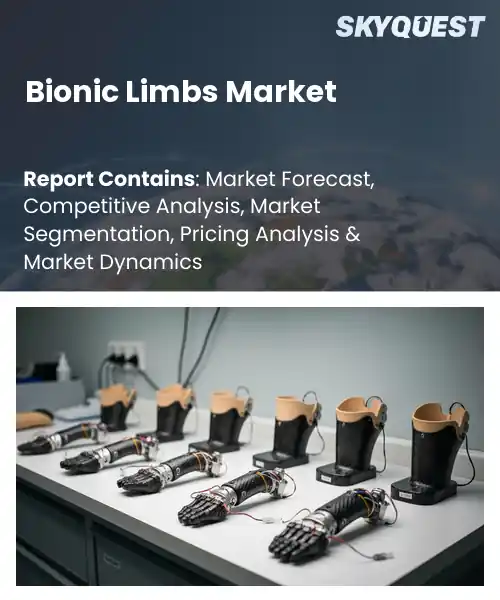
Bionic Limbs Market
Report ID: SQMIG35A4229
Report ID: SQMIG35A4229
[email protected]
USA +1 351-333-4748
Report ID:
SQMIG35A4229 |
Region:
Global |
Published Date: July, 2026
Pages:
157
|Tables:
153
|Figures:
78


Global Bionic Limbs Market size was valued at USD 7.03 Billion in 2024 and is poised to grow from USD 7.8 Billion in 2025 to USD 17.99 Billion by 2033, growing at a CAGR of 11.0% during the forecast period (2026-2033).
The bionic limbs market growth is driven mostly because more people are losing limbs, from diabetes, vascular issues, random trauma and those auto accidents that happen too often. And, as robotics keeps moving forward, and artificial intelligence, plus myoelectric sensors, and even brain-computer interface tech they all together improve the way these prosthetics work, their precision, and the whole user experience. Due to that, uptake is being pushed further by higher spending on healthcare infrastructure and better reimbursement policies in richer countries.
On top of it, the bionic limbs market penetration keeps expanding due to the rising wish for individualized solutions, also the lighter devices made using 3D printing, and people noticing these advanced prosthetics. There is an extra pull from military rehabilitation programs and sports-oriented prostheses. Also, the older population is growing, and many of them need help getting around, while more collaborations are forming between medical centers and IT companies. All of that, in a chain reaction, is fueling the global bionic limbs market too.
How is AI enhancing user control and adoption in the bionic limbs market?
AI is transforming the bionic limbs market outlook by converting raw sensor data into actionable instructions. With a bit of training, users can move their hands, arms or legs, with the help of machine-learning algorithms that convert modest muscle activity into precise movements. It learns in real-time and adapts to each wearer's habits, reducing irritation and increasing confidence. This added level of intelligence also enables clinical fitting, since the therapist can change settings through software rather than hardware. The technology feels more like an extension of the body than a heavy tool, which means it has higher adoption rates and manufacturers can scale manufacturing while keeping customisation prices low.
Market snapshot - (2026-2033)
Global Market Size
USD 7.03 Billion
Largest Segment
Bionic Arms
Fastest Growth
Bionic Legs
Growth Rate
11.0% CAGR
To get more insights on this market click here to Request a Free Sample Report
The global bionic limbs market is segmented by product type, technology, application, end user, distribution channel and region. Based on product type, the market is segmented into Bionic Arms, Bionic Hands, Bionic Legs, Bionic Feet and Others. Based on technology, the market is segmented into Myoelectric, Neuro-Controlled, Sensor-Based, AI-Enabled and Others. Based on application, the market is segmented into Upper Limb Prosthetics, Lower Limb Prosthetics, Rehabilitation, Military Rehabilitation and Others. Based on end user, the market is segmented into Hospitals, Prosthetic Clinics, Rehabilitation Centers, Defense Healthcare and Others. Based on distribution channel, the market is segmented into Direct Sales, Medical Device Distributors, Online Sales and Others. Based on region, the market is segmented into North America, Europe, Asia Pacific, Latin America and Middle East & Africa.
As per the bionic limbs market analysis, the most important part of this system is the myoelectric segment, which directly converts residual muscle signals into correct prosthetic movements, and provides a natural feeling that is easily accepted by users. This is often given as it is clinically proven over the long term and gives confidence to both patient and surgeon. This makes integration easier , as it works with current socket setups , and continuous advances in electrode materials are enhancing durability . It is the leader of the bionic limb market and all these aspects make the functional performance available to the users.
However, AI-enabled category is growing fastest which uses machine learning algorithms to predict human intent and modify motion in real time. Cloud analytics integration accelerates tailored training to attract tech-savvy patients and academic institutions. This dynamic capability feeds into clinical trials, market access, and revenue streams.
According to the bionic limbs market forecast, the market is largely driven by the restoration of upper limb functionality, which enables complex grasping and rotational movements that mimic natural arm behavior. Clinicians prioritize arms for users with greater activity demands to increase prescription volume. The modular design allows for multiple socket sizes. Comfort benefits from progress in lightweight materials, further encouraging adoption. These qualities together represent the best prosthetic option sought after worldwide at the moment.
On the contrary, miniaturization to enable skillful finger movement within a design is driving the highest growth momentum of Bionic Hands. Younger amputees like the price and the looks, and the integration with a smartphone interface makes it more useful. The market’s forced growth leads to investment in hand-centric inventions.
To get detailed segments analysis, Request a Free Sample Report
As per the bionic limbs market regional forecast, North America dominated the market, with leading research institutes, cutting-edge manufacturing capabilities, and extensive reimbursement arrangements. Academic institutions, specialty clinics and tech firms that work together closely can accelerate the clinical validation and product development process more quickly. Venture capital activity has created a boom in companies working on bio-integration and brain interfaces. Proactive policy support and regulatory clarity in the civilian and veteran populations is driving early adoption. There is also a huge network of rehabilitation clinics providing post-implantation care which increases market confidence and helps to foster continuous innovation and market share leadership.
US Bionic Limbs Market
The US bionic limbs sector is driven by a culture of entrepreneurial investment and a large pool of expertise in biomedical research. New technologies are tested in the leading academic hospitals, and patients benefit from a well-developed insurance system. There is a strong economic motivation to combine brain control systems with modern robotics to build a pipeline of next-generation gadgets. Collaborative ecosystems between defense agencies, chronic injury specialists and commercial businesses elevate the United States’ stature as a global leader in prosthetic excellence.
Canada Bionic Limbs Market
Canada’s publicly funded healthcare system encourages equal access to new prosthetic devices. Research consortiums bring together academic institutions and business partners to speed up the transfer of technology and clinical trials. Government incentives for development of state-of-the-art medical equipment. Complete rehabilitation network for smooth transition of patients from surgery to functional use. Research, legislation and service delivery all have a role to play in creating an environment for future market growth in Canada.
The European bionic limbs market penetration growth depends on a highly regulated but innovative environment that balances safety with rapid iteration of products. Good public health and payment schemes reduce the cost of access and these encourage more use. The best academic institutions and hospitals work together across national borders creating a common body of knowledge that speeds up progress in materials science, sensor technologies and neuro-interface algorithms. Components for environmental sustainability are lightweight and recyclable. Additionally, the increasing focus on personalized healthcare is increasing the demand for bespoke prosthetic solutions, positioning Europe as a hub for patient-centric care and innovation.
Germany Bionic Limbs Market
Germany has a strong network of medical device manufacturers and better engineering, which is reflected in the bionic limb market. A wide range of research funding streams fund cross-disciplinary activities bringing together biomechanics and artificial intelligence. Due to the adoption of advanced manufacturing methods such as additive layering, which allow for rapid prototyping and customization, Germany continues to be a strong player in the European market. Good health-insurance coverage enables patients to get the best prosthetic options available without going bankrupt.
UK Bionic Limbs Market
The active national health service of the UK is driving the country’s bionic limbs industry with its advanced prosthetic options. Close collaboration between young start-ups and leading research universities facilitates the transfer of technology. Government-funded innovation hubs encourage cross-disciplinary collaboration to speed up the development of neural control interfaces. Custom prosthetic devices are in demand because patient empowerment and rehabilitation outcomes are top priorities. The UK is the fastest growing market in Europe.
France Bionic Limb Market
The French bionic limbs market is forming with a focus on inclusive care and strategic investments in digital health initiatives. Public hospitals and specialized businesses are collaborating to bring next-generation prosthetic technologies to the market. The focus on ergonomics and user experience is closely related to the French legislative emphasis on patient safety and quality of life. Awareness is growing, along with the need for bionic solutions at the cutting edge. One important new competitor for the regional market is France.
Increasing adoption of technology and growing healthcare infrastructure is adding to Asia Pacific’s position. The large economies have vast industrial sites that enable them to produce complex parts inexpensively. More public and private funding for biological research accelerates innovation cycles. As disability inclusion becomes the norm, policies that improve access to prosthetic care are improved. Local design approaches involving sensor technologies and artificial intelligence, and cross regional partnerships with global experts facilitating knowledge sharing, reinforce the Asia Pacific footprint in the area of bionic limbs.
Japan Bionic Limb Market
The Japan’s bionic limb market is a mix of the nation’s emphasis on the health needs of an aging population and a tradition of precision engineering. Collaborative ecosystems linking medical schools, robotics firms and rehabilitation facilities speed the development of intuitive control systems. Government programs that are part of universal health care increase availability of sophisticated prosthetics and stimulate widespread clinical adoption. Japan’s leadership in the industry is sustained by its ongoing commitment to ergonomics and user comfort, with a focus on integrating devices into everyday life.
South Korea Bionic Limbs Market
The strong technological industry in South Korea is a boon for the market for bionic limbs, as it can quickly translate cutting-edge research into marketable products. Rapid prototyping and clinical validation of brain interface technologies is encouraged with strong government support for biotech companies. Integrated health-care networks provide innovative prosthetic services to patients in a timely manner. South Korea is an emerging catalyst for the regional market growth owing to its focus on high-performance outcomes, which has led to the steady enhancements in sensor accuracy and lightweight materials.
To know more about the market opportunities by region and country, click here to
Buy The Complete Report
Innovative Materials Reduce Weight
The advent of lightweight composites and biocompatible polymers has made bionic limbs significantly lighter, more comfortable to wear and less fatiguing to use over long durations. As materials advance, users can start using prosthetic solutions earlier in their rehabilitation journey, allowing for a more natural pattern of movement. The market is growing due to increasing demand from the manufacturers and the physicians’ preference for these ergonomically superior devices that are widely acceptable to patients and used in various activity levels. The lighter design also makes it easier to attach the remaining limbs, which boosts self-assurance and utilization in daily tasks.
Enhanced Control Interfaces Improve Functionality
State-of-the-art myoelectric and neural interface technologies translate small muscle signals into accurate prosthetic movements, enhancing functional outcomes of users. The interfaces are easy to use and this reduces the time it takes to learn to do difficult tasks such as object manipulation and walking on uneven ground. As a result, the bionic limbs are perceived as being more useful. Clinicians report increased patient satisfaction, increased functional independence and increased recommendation rates. This provides an incentive for manufacturers to increase their R&D expenditures. This cycle drives market growth through increased clinician adoption and consumer confidence in the technology.
High Manufacturing Cost Limits Adoption
The high production costs are caused by complex manufacturing procedures of bionic limbs such as precision engineering, sophisticated sensor integration and custom fitting. That means the unit prices are still high, making the devices unaffordable for patients who don’t have enough personal wealth or comprehensive insurance. This may hurt overall market adoption . If there are cheaper alternatives, providers may be reluctant to recommend the more expensive one. The financial barrier continues to be a significant obstacle to growth and widespread dissemination, even with technological advances, especially in emerging nations. It needs specialist maintenance after sale, which adds to the long-term ownership price.
Regulatory Approval Process Extends Timeframes
The safety and efficacy of medical devices are highly regulated, with market entry requiring substantial documentation, stringent clinical testing and compliance verification. The long approval process slows the launch of products and limits the ability of producers to react quickly to changing customer needs. The problem for companies in investing substantial resources to meet many international standards could dissuade smaller innovators from entering the market. The growing entry barriers slow down the overall pace of market growth and hamstring competitive dynamics, delaying the introduction of new technology. In addition, regulators require post-market surveillance, which increases the cost of ongoing compliance.
Request Free Customization of this report to help us to meet your business objectives.
The market for bionic limbs worldwide is competitive, with well known OEMs getting pressure from newer, tech driven entrants that move quicker than expected. because of that, companies have been pushing out ideas at a faster pace, doing mergers and acquisitions, plus teaming up across industries, like when a major prosthetics maker bought a sensor technology firm in 2025 so it could roll in real time feedback, or when a startup wrapped up a multi year deal with a big AI research lab to bring in machine learning based gait adjustment.
Top Player’s Company Profile
Recent Developments in the Bionic Limbs Market
January 2025: Ottobock kept widening its smart prosthetics ecosystem, building on sensor driven and microprocessor controlled prosthetic options. they used cognitive algorithms and digital connectivity to boost adaptive mobility, gait stability, and user control, though it can sound a bit broad when it is read.
February 2025: Open Bionics moved quickly on clinical partnerships, as well as distribution plans, to drive take up of its Hero Arm bionic prosthesis. the firm also continued developing lighter adjustable, 3D printed prosthetic devices, basically making it easier for adults and children who have upper limb disabilities to get around.
March 2025: Össur upgraded its lower limb prosthetics portfolio by building smarter systems that blend biomechanics, sensors, and adaptive control technology. the organization also kept supporting rehabilitation programs that aim to improve patient results and overall mobility.
SkyQuest’s ABIRAW (Advanced Business Intelligence, Research & Analysis Wing) is our Business Information Services team that Collects, Collates, Correlates, and Analyses the Data collected by means of Primary Exploratory Research backed by robust Secondary Desk research.
As per SkyQuest analysis, the global bionic limb market is majorly driven by the use of cutting edge light weight materials that enhance comfort and quicken early acceptance. However, a major hindrance to affordability in price sensitive areas is the high cost of manufacture. North America is the leader in this industry, because of its strong venture capital support, sophisticated research environment, and well established reimbursement system. Myoelectric technology is the most common because it translates residual muscle impulses into accurate motion, leading to greater user acceptance and physician confidence. Second big factor is the rapid growth of AI-enabled control interfaces, which learn unique patterns and deliver intuitive, personalized performance, expanding demand across clinical and consumer categories.
| Report Metric | Details |
|---|---|
| Market size value in 2024 | USD 7.03 Billion |
| Market size value in 2033 | USD 17.99 Billion |
| Growth Rate | 11.0% |
| Base year | 2024 |
| Forecast period | (2026-2033) |
| Forecast Unit (Value) | USD Billion |
| Segments covered |
|
| Regions covered | North America (US, Canada), Europe (Germany, France, United Kingdom, Italy, Spain, Rest of Europe), Asia Pacific (China, India, Japan, Rest of Asia-Pacific), Latin America (Brazil, Rest of Latin America), Middle East & Africa (South Africa, GCC Countries, Rest of MEA) |
| Companies covered |
|
| Customization scope | Free report customization with purchase. Customization includes:-
|
To get a free trial access to our platform which is a one stop solution for all your data requirements for quicker decision making. This platform allows you to compare markets, competitors who are prominent in the market, and mega trends that are influencing the dynamics in the market. Also, get access to detailed SkyQuest exclusive matrix.
Table Of Content
Executive Summary
Market overview
Parent Market Analysis
Market overview
Market size
KEY MARKET INSIGHTS
COVID IMPACT
MARKET DYNAMICS & OUTLOOK
Market Size by Region
KEY COMPANY PROFILES
Methodology
For the Bionic Limbs Market, our research methodology involved a mixture of primary and secondary data sources. Key steps involved in the research process are listed below:
1. Information Procurement: This stage involved the procurement of Market data or related information via primary and secondary sources. The various secondary sources used included various company websites, annual reports, trade databases, and paid databases such as Hoover's, Bloomberg Business, Factiva, and Avention. Our team did 45 primary interactions Globally which included several stakeholders such as manufacturers, customers, key opinion leaders, etc. Overall, information procurement was one of the most extensive stages in our research process.
2. Information Analysis: This step involved triangulation of data through bottom-up and top-down approaches to estimate and validate the total size and future estimate of the Bionic Limbs Market.
3. Report Formulation: The final step entailed the placement of data points in appropriate Market spaces in an attempt to deduce viable conclusions.
4. Validation & Publishing: Validation is the most important step in the process. Validation & re-validation via an intricately designed process helped us finalize data points to be used for final calculations. The final Market estimates and forecasts were then aligned and sent to our panel of industry experts for validation of data. Once the validation was done the report was sent to our Quality Assurance team to ensure adherence to style guides, consistency & design.
Analyst Support
Customization Options
With the given market data, our dedicated team of analysts can offer you the following customization options are available for the Bionic Limbs Market:
Product Analysis: Product matrix, which offers a detailed comparison of the product portfolio of companies.
Regional Analysis: Further analysis of the Bionic Limbs Market for additional countries.
Competitive Analysis: Detailed analysis and profiling of additional Market players & comparative analysis of competitive products.
Go to Market Strategy: Find the high-growth channels to invest your marketing efforts and increase your customer base.
Innovation Mapping: Identify racial solutions and innovation, connected to deep ecosystems of innovators, start-ups, academics, and strategic partners.
Category Intelligence: Customized intelligence that is relevant to their supply Markets will enable them to make smarter sourcing decisions and improve their category management.
Public Company Transcript Analysis: To improve the investment performance by generating new alpha and making better-informed decisions.
Social Media Listening: To analyze the conversations and trends happening not just around your brand, but around your industry as a whole, and use those insights to make better Marketing decisions.
REQUEST FOR SAMPLE
 REQUEST FREE CUSTOMIZATION
Global Bionic Limbs Market size was valued at USD 7.03 Billion in 2024 and is poised to grow from USD 7.8 Billion in 2025 to USD 17.99 Billion by 2033, growing at a CAGR of 11.0% during the forecast period (2026-2033).
The competitive landscape of the global bionic limbs market is shaped by intense rivalry among established OEMs and fast‑growing tech‑focused newcomers, driving accelerated product innovation, strategic M&A and cross‑industry partnerships; for example, a leading prosthetic manufacturer acquired a sensor‑technology firm in 2025 to embed real‑time feedback, while a startup secured a multi‑year partnership with a major AI research lab to integrate machine‑learning‑driven gait adaptation, intensifying pressure on pricing and differentiation. 'Össur hf.', 'Ottobock SE & Co. KGaA', 'Open Bionics Ltd.', 'Mobius Bionics LLC', 'Fillauer LLC', 'Steeper Group', 'Blatchford Group', 'Coapt LLC', 'Touch Bionics', 'Esper Bionics Inc.', 'BionIT Labs S.r.l.', 'Atom Limbs', 'Psyonic, Inc.', 'Unlimited Tomorrow, Inc.', 'Esper Hand', 'Hanger, Inc.', 'Endolite India Ltd.', 'Protunix', 'TASKA Prosthetics', 'College Park Industries, Inc.'
The development of lightweight composites and bio‑compatible polymers has significantly lowered the mass of bionic limbs, enhancing wearer comfort and reducing fatigue during prolonged use. This material advancement enables more natural movement patterns and encourages users to adopt prosthetic solutions earlier in their rehabilitation process. Consequently, manufacturers experience heightened demand as clinicians recommend these ergonomically superior devices, fostering market expansion through broader patient acceptance and expanded application across diverse activity levels. The lighter design also eases attachment to residual limbs, promoting confidence and daily use.
Neural Integration Advancements: Rapid progress in neural interface technologies is enabling more seamless communication between prosthetic devices and the human peripheral nervous system. Researchers are developing high‑density electrode arrays that capture nuanced motor intent and deliver precise sensory feedback, allowing users to perform delicate tasks with confidence. This evolution reduces reliance on bulky external controllers, improves embodiment, and expands the functional repertoire of bionic limbs, positioning the market for broader acceptance among patients seeking intuitive, life‑like prosthetic solutions in clinical practice worldwide today.
Why does North America Dominate the Global Bionic Limbs Market? |@12


Want to customize this report? This report can be personalized according to your needs. Our analysts and industry experts will work directly with you to understand your requirements and provide you with customized data in a short amount of time. We offer $1000 worth of FREE customization at the time of purchase.
Feedback From Our Clients


 USA (+1) 351-333-4748

