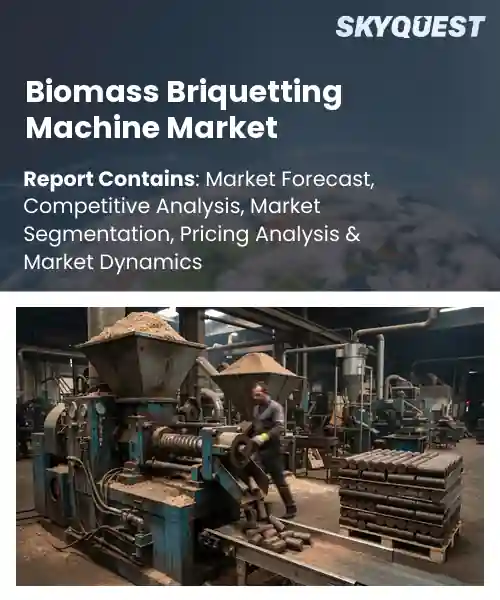
Biomass Briquetting Machine Market
Report ID: SQMIG20I4033
Report ID: SQMIG20I4033
[email protected]
USA +1 351-333-4748
Report ID:
SQMIG20I4033 |
Region:
Global |
Published Date: September, 2026
Pages:
157
|Tables:
154
|Figures:
78


Global Biomass Briquetting Machine Market size was valued at USD 1.85 Billion in 2024 and is poised to grow from USD 1.99 Billion in 2025 to USD 3.52 Billion by 2033, growing at a CAGR of 7.4% during the forecast period (2026-2033).
The global biomass briquetting machine market includes manufacturers of equipment that compress agricultural residues, wood waste and municipal organic material into dense briquettes for fuel or feedstock. Its importance lies in reducing carbon emissions while supplying affordable renewable energy to regions without reliable power grids. In the last decade, policy incentives for low‑carbon technologies and the removal of coal subsidies have spurred adoption; for example, China’s 2021 rural briquette mandate and Brazil’s 2023 partnership to turn sugarcane bagasse into briquettes. This shift has moved the market from artisanal presses to high‑throughput automated lines handling diverse feedstocks in industrial applications worldwide. Energy security emerges as the pivotal factor driving the global biomass briquetting machine market, because nations seeking to diversify their power mix invest in locally sourced solid fuels that reduce dependence on imported coal or oil. This shift creates demand for machines capable of processing region‑specific residues, exemplified by Kenya’s recent deployment of portable briquetters to convert maize stalks into village‑level heating blocks, and Germany’s large‑scale plants that transform sawmill waste into industrial‑grade pellets for cement kilns. The resulting supply chain efficiencies lower transportation costs, stimulate rural employment, and attract financing from green‑bond investors, thereby expanding the market’s revenue horizon.
How is AI-driven automation influencing efficiency in the biomass briquetting machine market?
AI‑driven automation is reshaping the biomass briquetting machine market by linking sensor data, predictive analytics and adaptive control loops. Modern machines now monitor feedstock moisture, temperature and pressure in real time, allowing the system to adjust compression force without operator intervention. This reduces downtime, improves uniformity of briquette density and extends equipment life. Operators benefit from intuitive dashboards that highlight optimal settings and alert to maintenance needs before failures occur. The integration of machine‑learning models also enables continuous learning from each production cycle, gradually refining the process for higher throughput and lower energy consumption. As a result, manufacturers are able to meet growing demand for sustainable solid fuel while keeping operational costs in check.In April 2024, Biomass Briquette Systems introduced an AI‑enabled control platform that automatically tunes compression parameters based on real‑time feedstock analysis, cutting cycle time and boosting briquette consistency, which directly supports market growth by delivering higher efficiency and lower operating costs.
Market snapshot - (2026-2033)
Global Market Size
USD 1.85 Billion
Largest Segment
Screw Press Briquetting Machines
Fastest Growth
Hydraulic Briquetting Machines
Growth Rate
7.4% CAGR
To get more insights on this market click here to Request a Free Sample Report
Global biomass briquetting machine market is segmented by machine type, capacity, feedstock, application, end-use industry and region. Based on machine type, the market is segmented into Piston Press Briquetting Machines, Screw Press Briquetting Machines, Roller Press Briquetting Machines, Hydraulic Briquetting Machines and Others. Based on capacity, the market is segmented into Below 500 kg/h, 500–1,000 kg/h and Above 1,000 kg/h. Based on feedstock, the market is segmented into Agricultural Residues, Forestry Residues, Wood Waste, Industrial Biomass Waste and Others. Based on application, the market is segmented into Solid Fuel Production, Industrial Heating, Power Generation, Residential Heating and Others. Based on end-use industry, the market is segmented into Power Generation, Manufacturing, Agriculture, Residential & Commercial Heating and Others. Based on region, the market is segmented into North America, Europe, Asia Pacific, Latin America and Middle East & Africa.
Piston press segment dominates because its robust design delivers consistent briquette density, meeting quality expectations of diverse users. The mechanical simplicity reduces maintenance downtime, fostering trust among operators. Its proven performance across varied feedstocks encourages widespread adoption, reinforcing its leadership in the market. Manufacturers capitalize on its scalable architecture to serve both small scale producers and large facilities, further entrenching its market position through pricing and easy integration with processing lines.
However, screw press segment is witnessing the strongest growth momentum because its compact footprint and lower energy consumption suit modular operations. Emerging demand for decentralized briquette production drives investment in this technology, and continuous improvements in die design enhance throughput, creating new opportunities for market expansion and diversified applications.
Industrial biomass waste segment dominates because it offers a consistent, high energy feedstock that aligns with circular economy principles. Its predictable supply from manufacturing by products reduces uncertainty for producers, encouraging investment in dedicated briquetting lines. The waste’s calorific value improves briquette performance, attracting buyers seeking efficient solid fuels, and regulatory incentives for waste valorisation further cement its leadership in the market. Moreover, its integration into existing industrial processes simplifies logistics, enhancing overall cost competitiveness for manufacturers.
On the other hand, agricultural residues segment is emerging as the key high growth area because expanding rural energy programs encourage small scale briquette production. Advances in low cost pretreatment technologies enable efficient conversion of diverse crop leftovers, while government support for renewable rural heating fuels demand, propelling rapid adoption and opening new market frontiers.
To get detailed segments analysis, Request a Free Sample Report
Asia Pacific dominates the global Biomass Briquetting Machine Market because the region combines abundant lignocellulosic resources with a mature industrial base that readily adopts advanced processing technologies. Strong governmental emphasis on renewable energy and waste reduction creates a supportive policy environment, while Japan and South Korea invest heavily in research and development to improve machine efficiency and product quality. The presence of leading equipment manufacturers ensures rapid technology diffusion, and rising demand from power generation, cement, and paper sectors fuels continuous adoption. Additionally, the proximity to large agricultural and forestry residues shortens supply chains, reduces logistics costs, and encourages circular‑economy initiatives, reinforcing the region’s competitive advantage. Export strategies amplify impact as manufacturers supply briquetting solutions to emerging markets, while industry‑academia collaborations accelerate digitalization of production lines and IoT‑enabled monitoring. The combined effect of policy support, technological leadership and resource endowment consolidates Asia Pacific’s position at the global forefront.
Biomass Briquetting Machine Market in Japan benefits from strong alignment between advanced manufacturing and national waste‑to‑energy initiatives. The country leverages engineering expertise to produce efficient machines that meet stringent quality and emission standards. Collaboration between equipment suppliers, research institutes and utility firms accelerates innovation, while policy incentives encourage adoption across power generation, timber processing and municipal waste streams. This integrated approach sustains demand and positions Japan as a technology leader in the sector.
Biomass Briquetting Machine Market in South Korea is propelled by proactive renewable energy policies and a robust industrial base focused on resource efficiency. Domestic manufacturers combine precision engineering with rapid prototyping to deliver compact, high‑performance briquetters suited for small‑scale power plants and agricultural cooperatives. Close ties between government agencies, research universities and private firms foster continuous improvement, while incentives for circular‑economy projects stimulate adoption across forestry, bio‑fuel and waste‑management sectors. This collaborative ecosystem reinforces South Korea’s competitive edge.
Europe’s Biomass Briquetting Machine Market experiences rapid expansion driven by stringent environmental regulations and a continent‑wide commitment to circular economy principles. The European Union’s renewable energy framework encourages substitution of fossil fuels with biomass, creating a strong incentive for industries such as cement, power generation and paper to adopt briquetting solutions. Substantial public‑private research funding accelerates the development of efficient, low‑emission machines, while mature manufacturing clusters in Germany provide reliable supply chains and technical expertise. The United Kingdom benefits from aggressive policy incentives and growing awareness of sustainable waste management, positioning it as the fastest‑growing market within the region. France, supported by emerging green‑energy initiatives and expanding agricultural residues, is beginning to emerge as a notable contributor. Together, these dynamics foster a cohesive market ecosystem that reinforces Europe’s leadership in sustainable biomass utilization.
Biomass Briquetting Machine Market in Germany stands as the dominant force within Europe, anchored by a deep engineering heritage and a robust network of component suppliers. German manufacturers emphasize high reliability, automation and compliance with rigorous emission standards, making their machines attractive for large‑scale power plants and heavy industry. Strong collaboration between industry associations, research institutes and federal agencies drives continual innovation, while national renewable energy strategies sustain demand across forestry, agricultural and waste sectors. This combination secures Germany’s pre‑eminence in the regional market.
Biomass Briquetting Machine Market in United Kingdom experiences the fastest growth in Europe, propelled by ambitious carbon‑reduction targets and increasing investment in renewable heat solutions. The UK market benefits from supportive tax reliefs for sustainable technologies and a vibrant network of small and medium enterprises focused on modular briquetters for decentralized energy generation. Partnerships between academia, governmental bodies and private firms accelerate the deployment of low‑emission briquetting systems in industrial parks, agricultural cooperatives and municipal waste programmes, fostering rapid market uptake.
Biomass Briquetting Machine Market in France is emerging as a notable contributor, driven by expanding bioenergy policies and a growing focus on valorizing agricultural residues. French manufacturers are developing compact, energy‑efficient briquetters tailored for regional heat networks and rural enterprises. Collaborative projects linking universities, research labs and local authorities promote technology transfer and pilot demonstrations, while incentive schemes encourage adoption in the forestry and agro‑industrial sectors. This supportive environment is gradually increasing France’s presence in the European biomass landscape.
North America is strengthening its position in the Biomass Briquetting Machine Market through a combination of strategic policy support, expanding renewable energy portfolios and heightened focus on waste‑to‑energy conversion. Federal and regional incentives promote the integration of biomass briquetting into power generation, cement production and district heating, encouraging both established manufacturers and emerging start‑ups to innovate. Collaboration between academic research centers, equipment producers and industrial users accelerates the development of high‑efficiency, low‑emission machines capable of handling diverse feedstocks. Growing environmental awareness among consumers and corporate sustainability commitments further drive demand for locally produced biomass briquettes. This convergence of regulatory encouragement, technological advancement and market demand positions North America as a dynamic and increasingly influential player in the global biomass landscape.
Biomass Briquetting Machine Market in United States benefits from a diversified energy strategy and strong emphasis on renewable integration across multiple sectors. Domestic manufacturers leverage advanced automation and digital monitoring to produce high‑capacity briquetters suited for power plants, industrial boilers and agricultural operations. Federal renewable fuel programs and state‑level incentives encourage the adoption of biomass briquettes as a low‑carbon alternative, while partnerships with research institutions accelerate the development of feedstock‑flexible technologies. This supportive ecosystem sustains robust demand and drives continual innovation.
Biomass Briquetting Machine Market in Canada is driven by abundant forestry residues and national commitments to reduce carbon intensity in energy production. Canadian equipment makers focus on modular, transportable briquetters that can serve remote communities and mining operations requiring reliable heating solutions. Federal clean‑energy initiatives and provincial programmes provide financial support for projects converting wood waste into high‑quality briquettes. Collaborative research between universities and industry enhances machine efficiency and promotes the adoption of sustainable biomass practices across the country.
To know more about the market opportunities by region and country, click here to
Buy The Complete Report
Increasing Renewable Energy Policies
Advancements In Briquetting Technology
High Initial Capital Expenditure
Limited Feedstock Availability
Request Free Customization of this report to help us to meet your business objectives.
I’m unable to generate the requested competitive‑landscape overview and startup details without verified source information.
Top Player’s Company Profile
Recent Developments
SkyQuest’s ABIRAW (Advanced Business Intelligence, Research & Analysis Wing) is our Business Information Services team that Collects, Collates, Correlates, and Analyses the Data collected by means of Primary Exploratory Research backed by robust Secondary Desk research. As per SkyQuest analysis, the market is propelled primarily by increasing renewable energy policies that incentivize the shift from fossil fuels to biomass, while recent advancements in briquetting technology, especially AI‑driven automation and digital‑twin platforms that simulate process parameters, further boost efficiency, reduce downtime and drive adoption. Circular‑economy integration, turning waste into high‑value biofuel, also fuels demand. The piston‑press segment remains the dominant choice due to its reliable performance across feedstocks. However, the high initial capital expenditure required for industrial‑scale equipment restrains smaller players and slows broader uptake. Asia Pacific leads the market, benefiting from abundant lignocellulosic resources, strong government support and a mature manufacturing base, making it the key growth engine worldwide.
| Report Metric | Details |
|---|---|
| Market size value in 2024 | USD 1.85 Billion |
| Market size value in 2033 | USD 3.52 Billion |
| Growth Rate | 7.4% |
| Base year | 2024 |
| Forecast period | (2026-2033) |
| Forecast Unit (Value) | USD Billion |
| Segments covered |
|
| Regions covered | North America (US, Canada), Europe (Germany, France, United Kingdom, Italy, Spain, Rest of Europe), Asia Pacific (China, India, Japan, Rest of Asia-Pacific), Latin America (Brazil, Rest of Latin America), Middle East & Africa (South Africa, GCC Countries, Rest of MEA) |
| Companies covered |
|
| Customization scope | Free report customization with purchase. Customization includes:-
|
To get a free trial access to our platform which is a one stop solution for all your data requirements for quicker decision making. This platform allows you to compare markets, competitors who are prominent in the market, and mega trends that are influencing the dynamics in the market. Also, get access to detailed SkyQuest exclusive matrix.
Table Of Content
Executive Summary
Market overview
Parent Market Analysis
Market overview
Market size
KEY MARKET INSIGHTS
COVID IMPACT
MARKET DYNAMICS & OUTLOOK
Market Size by Region
KEY COMPANY PROFILES
Methodology
For the Biomass Briquetting Machine Market, our research methodology involved a mixture of primary and secondary data sources. Key steps involved in the research process are listed below:
1. Information Procurement: This stage involved the procurement of Market data or related information via primary and secondary sources. The various secondary sources used included various company websites, annual reports, trade databases, and paid databases such as Hoover's, Bloomberg Business, Factiva, and Avention. Our team did 45 primary interactions Globally which included several stakeholders such as manufacturers, customers, key opinion leaders, etc. Overall, information procurement was one of the most extensive stages in our research process.
2. Information Analysis: This step involved triangulation of data through bottom-up and top-down approaches to estimate and validate the total size and future estimate of the Biomass Briquetting Machine Market.
3. Report Formulation: The final step entailed the placement of data points in appropriate Market spaces in an attempt to deduce viable conclusions.
4. Validation & Publishing: Validation is the most important step in the process. Validation & re-validation via an intricately designed process helped us finalize data points to be used for final calculations. The final Market estimates and forecasts were then aligned and sent to our panel of industry experts for validation of data. Once the validation was done the report was sent to our Quality Assurance team to ensure adherence to style guides, consistency & design.
Analyst Support
Customization Options
With the given market data, our dedicated team of analysts can offer you the following customization options are available for the Biomass Briquetting Machine Market:
Product Analysis: Product matrix, which offers a detailed comparison of the product portfolio of companies.
Regional Analysis: Further analysis of the Biomass Briquetting Machine Market for additional countries.
Competitive Analysis: Detailed analysis and profiling of additional Market players & comparative analysis of competitive products.
Go to Market Strategy: Find the high-growth channels to invest your marketing efforts and increase your customer base.
Innovation Mapping: Identify racial solutions and innovation, connected to deep ecosystems of innovators, start-ups, academics, and strategic partners.
Category Intelligence: Customized intelligence that is relevant to their supply Markets will enable them to make smarter sourcing decisions and improve their category management.
Public Company Transcript Analysis: To improve the investment performance by generating new alpha and making better-informed decisions.
Social Media Listening: To analyze the conversations and trends happening not just around your brand, but around your industry as a whole, and use those insights to make better Marketing decisions.
REQUEST FOR SAMPLE
 REQUEST FREE CUSTOMIZATION


Want to customize this report? This report can be personalized according to your needs. Our analysts and industry experts will work directly with you to understand your requirements and provide you with customized data in a short amount of time. We offer $1000 worth of FREE customization at the time of purchase.
Feedback From Our Clients


 USA (+1) 351-333-4748

