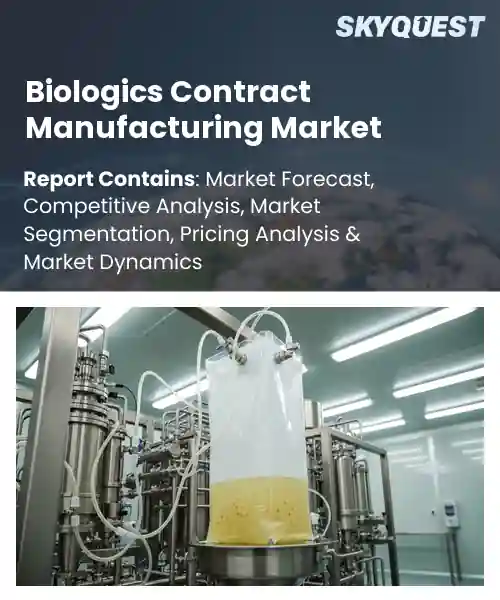
Biologics Contract Manufacturing Market
Report ID: SQMIG35I2666
Report ID: SQMIG35I2666
[email protected]
USA +1 351-333-4748
Report ID:
SQMIG35I2666 |
Region:
Global |
Published Date: May, 2026
Pages:
157
|Tables:
181
|Figures:
79


Global Biologics Contract Manufacturing Market size was valued at USD 28.5 Billion in 2024 and is poised to grow from USD 31.61 Billion in 2025 to USD 72.32 Billion by 2033, growing at a CAGR of 10.9% during the forecast period (2026-2033).
The primary driver of the biologics contract manufacturing market is expansion of biologic drug development, which has pushed biopharma companies to outsource production to CDMOs. This market encompasses outsourced services for cell line development, upstream bioreactor cultivation, downstream purification and fill-finish operations that enable firms to scale without investing in costly facilities. It matters because biologics represent a growing share of therapies for oncology and autoimmune disorders, and examples such as monoclonal antibodies and CAR-T therapies demonstrate high technical and regulatory demands. Over the past decade the market evolved from small-scale peptide manufacturing to sophisticated multi-product mammalian cell facilities today.Building on that shift, the key factor accelerating global biologics contract manufacturing is the mismatch between rising demand for complex therapies and limited in-house capacity, compelling sponsors to outsource to CDMOs. As developers pursue monoclonal antibodies, biosimilars and cell therapies, demand drives investment in single-use systems and modular plants that reduce lead times and contamination risk and enable faster scale-up. Real-world outcomes include CDMOs adding capacity to support pipelines, which lets smaller biotechs reach markets sooner and enables large firms to hedge capital risk while accessing specialized regulatory, analytical and process development expertise that would be costlier to build internally.
How is AI enhancing operational efficiency in the biologics contract manufacturing market?
AI is improving operational efficiency in the biologics contract manufacturing market by strengthening process control, speeding development and reducing variability. Machine learning and advanced analytics make sense of complex data from bioreactors, sensors and assays to predict deviations and guide real time adjustments. Digital twin models let teams simulate scale up and transfers before physical runs so risk is lower and timelines shorten. AI driven inspection and anomaly detection streamline quality control while data integration supports better scheduling and raw material use. Adoption is growing among contract manufacturers as they aim to meet demand for complex modalities with more reliable and repeatable operations.Cytiva January 2025, announced a collaboration with Cellular Origins to combine its automated Sefia platform with a robotic Constellation system, showing how automation paired with AI driven process control can cut manual steps and improve reproducibility. This kind of innovation helps scale cell and gene therapy manufacture and supports faster, more efficient biologics supply chains.
Market snapshot - (2026-2033)
Global Market Size
USD 28.5 Billion
Largest Segment
Upstream Manufacturing
Fastest Growth
Cell Line Development
Growth Rate
10.9% CAGR
To get more insights on this market click here to Request a Free Sample Report
Global biologics contract manufacturing market is segmented by service type, product type, expression system, scale of operation, end user, workflow and region. Based on service type, the market is segmented into Cell Line Development, Process Development, Upstream Manufacturing, Downstream Processing, Fill-Finish Services, Analytical & Quality Testing and Others. Based on product type, the market is segmented into Monoclonal Antibodies, Vaccines, Recombinant Proteins, Cell & Gene Therapies, Biosimilars and Others. Based on expression system, the market is segmented into Mammalian Cells, Microbial Systems, Yeast Systems, Insect Cell Systems and Others. Based on scale of operation, the market is segmented into Preclinical Manufacturing, Clinical Manufacturing and Commercial Manufacturing. Based on end user, the market is segmented into Pharmaceutical Companies, Biotechnology Companies, Research Institutes and Emerging Biotech Firms. Based on workflow, the market is segmented into Outsourced Manufacturing, Integrated End-to-End Services and Standalone Manufacturing Services. Based on region, the market is segmented into North America, Europe, Asia Pacific, Latin America and Middle East & Africa.
Upstream Manufacturing segment dominates because it underpins product yield and scalability that determine cost of goods and feasibility for large scale biologic supply. Control over cell culture conditions, bioreactor design, and process intensification directly increases productivity and enables contract manufacturers to meet growing demand for complex molecules. Investments in large scale single use systems, perfusion and fed batch expertise, and available capacity drive sponsor preference for providers with strong upstream capabilities.
However, Downstream Processing is emerging as the fastest growing area due to rising complexity in molecule purification and tightening regulatory expectations for purity and impurity control. Innovations in chromatography resins, single use filtration, and continuous downstream approaches, combined with demand for faster process development, are creating new revenue streams and enabling contract manufacturers to offer integrated solutions that capture additional value beyond primary production.
Cell Line Development segment leads because it establishes the biological foundation for expression, stability, and manufacturability that determine downstream yields and product quality across biologics portfolios. Advanced clone screening, host cell engineering, and optimized vector design produce stable high expressing clones that shorten development timelines and reduce downstream risk. Platform workflows and adoption of genome editing enhance reproducibility and make cell line capability a key selection criterion for sponsors.
Meanwhile, Analytical & Quality Testing is witnessing the strongest growth momentum as regulatory scrutiny and complex modalities increase demand for advanced characterization and release testing. Investment in high throughput assays, biosimilarity comparability methodologies, and real time analytics supports faster lot release and stronger regulatory dossiers, creating differentiated service offerings for CMOs and unlocking opportunities across clinical and commercial programs.
To get detailed segments analysis, Request a Free Sample Report
North America dominates the global biologics contract manufacturing market due to a concentration of advanced bioprocessing infrastructure, a deep base of experienced contract development and manufacturing organizations, and close proximity to leading biopharmaceutical developers. Robust regulatory frameworks and well established quality standards support complex molecule production and enable scale up of novel therapies. A rich talent pool across scientific, engineering, and regulatory disciplines facilitates rapid technology adoption and process innovation. Integrated service offerings and specialization across upstream and downstream capabilities attract global outsourcing. Strong access to capital and collaborative networks among industry, academia, and investors further reinforce capacity expansion and continuous improvement. Together, these factors create a self sustaining ecosystem that positions the region as the primary hub for high complexity biologics manufacturing and for partnerships with international sponsors.
Biologics Contract Manufacturing Market in United States is characterized by a dense network of specialized CDMOs, cutting edge process development capabilities, and a strong emphasis on quality and regulatory compliance. Close collaboration between large biopharma sponsors, academic centers, and contract partners accelerates translation of complex modalities. Focus on advanced modalities, automation, and continuous processing supports high complexity projects, while diversified funding and industry expertise sustain long term capacity and innovation.
Biologics Contract Manufacturing Market in Canada emphasizes collaboration between research intensive institutions and contract manufacturers, creating a supportive environment for early stage development and tech transfer. Strengths encompass skilled scientific teams, progressive regulatory engagement, and selective capacity focused on niche biologics and biosimilar programs. Expanding partnerships with international sponsors promote knowledge exchange and quality alignment, while regional incentives and a commitment to bioprocess optimization drive scalable solutions and specialized offerings.
Europe is experiencing rapid expansion in biologics contract manufacturing driven by a combination of a mature pharmaceutical ecosystem, progressive regulatory alignment, and a strategic focus on innovation in complex biologics. Established contract manufacturers are expanding specialized capabilities in cell and gene therapies, advanced cell culture, and aseptic fill finish, while cross border collaboration among sponsors and CDMOs accelerates capacity deployment. Public private partnerships and regional incentives support infrastructure upgrades and talent development. The presence of strong academic translational platforms fuels pipeline maturation and demand for outsourced development services. Diverse national strengths create complementary hubs for niche skillsets, enabling sponsors to source tailored solutions across the region. Together, these dynamics reinforce Europe as a competitive alternative for high quality, regulated biologics manufacturing.
Biologics Contract Manufacturing Market in Germany is anchored by a strong industrial base, precision engineering, and established validation practices. National companies offer robust upstream and downstream capabilities, supported by quality and regulatory teams. Integration of advanced bioreactor technologies and emphasis on process robustness attract complex biologics programs. Collaboration with research institutions drives innovation in bioprocess intensification, while an ecosystem oriented toward scalable production underpins Germany role as a manufacturing hub.
Biologics Contract Manufacturing Market in United Kingdom is marked by rapid capability building, a dynamic cluster of innovative biotech firms, and strong translational research networks. Flexible CDMOs focus on advanced modalities and clinical manufacturing to meet evolving sponsor needs. Proactive regulatory engagement and targeted investment support accelerated commercialization pathways. Collaborative models between industry and universities facilitate technology transfer and workforce development, reinforcing United Kingdom emergence as an expanding manufacturing destination.
Biologics Contract Manufacturing Market in France is emerging with emphasis on translational research, public support, and strategic investment in specialized capacity. National centers and private CDMOs are developing capabilities in cell therapy, viral vectors, and biosimilar manufacturing, supported by a skilled scientific workforce. Policy initiatives and collaboration between academic hospitals and industry stimulate early development and transfer. This environment establishes France as an evolving hub for niche biologics manufacturing services.
Asia Pacific is strengthening its position in the biologics contract manufacturing market through coordinated investments in capacity, technology adoption, and skills development. Regional CDMOs are upgrading facilities to meet international quality standards and are increasingly partnering with global sponsors to execute complex development and scale up programs. Governments and industry stakeholders support workforce training and infrastructure improvements, enabling quicker technology transfer and local production. Cost competitiveness combined with maturing regulatory frameworks attracts diverse program types, from biosimilars to advanced therapies. Cross border collaborations and targeted expansion of specialized sites are creating complementary networks that reduce lead times and provide alternative sourcing for high quality biologics manufacturing across the broader Asia Pacific landscape. Investment in translational research, incubators, and pilot plants fosters local innovation and enables CDMOs to capture early stage projects.
Biologics Contract Manufacturing Market in Japan is defined by advanced capabilities, stringent quality culture, and deep ties between industry and research institutions. Established manufacturers emphasize reliable process control, automation, and aseptic expertise that support complex biologics and cell therapies. Collaboration with multinational sponsors and investment in scalable facilities facilitate technology transfer. A strong regulatory focus on quality and continuous improvement underpins Japan role as a trusted partner for biologics manufacturing.
Biologics Contract Manufacturing Market in South Korea features rapid capacity growth, strong government and industry support, and emphasis on advanced modalities. Domestic CDMOs deliver agile development services and invest in single use technologies and containment manufacturing for viral vectors and cell therapies. Partnerships with global sponsors and workforce upskilling accelerate project delivery. A commitment to quality systems and export strategies positions South Korea as a competitive partner for biologics manufacturing.
To know more about the market opportunities by region and country, click here to
Buy The Complete Report
Growing Demand For Complex Therapies
Technological Advancements In Manufacturing
High Regulatory Compliance Burden
Limited Skilled Workforce Availability
Request Free Customization of this report to help us to meet your business objectives.
Competitive dynamics in the global biologics CDMO market are driven by a capacity race for viral vectors and mRNA, prompting concrete M&A, platform partnerships and targeted technology investments. Notable moves include Ajinomoto’s acquisition of Forge Biologics, announced platform launches and financing-led expansions by technology-first CDMOs, all intensifying competition for gene and advanced therapy manufacturing capacity.
Top Player’s Company Profile
Recent Developments
SkyQuest’s ABIRAW (Advanced Business Intelligence, Research & Analysis Wing) is our Business Information Services team that Collects, Collates, Correlates, and Analyses the Data collected by means of Primary Exploratory Research backed by robust Secondary Desk research. As per SkyQuest analysis, the global biologics contract manufacturing market is being propelled by a key driver in expanding biologic drug development and the resulting push to outsource capacity, while a restraint is the heavy regulatory compliance burden that raises costs and slows scale-up. The dominating region is North America supported by deep CDMO infrastructure and access to capital, and the dominating segment is upstream manufacturing which underpins yield and scalability for complex molecules. A second driver is rapid adoption of technological advances including single-use systems, AI and digital twins that improve process control and shorten development timelines, enabling CDMOs to deliver more flexible end-to-end solutions.
| Report Metric | Details |
|---|---|
| Market size value in 2024 | USD 28.5 Billion |
| Market size value in 2033 | USD 72.32 Billion |
| Growth Rate | 10.9% |
| Base year | 2024 |
| Forecast period | (2026-2033) |
| Forecast Unit (Value) | USD Billion |
| Segments covered |
|
| Regions covered | North America (US, Canada), Europe (Germany, France, United Kingdom, Italy, Spain, Rest of Europe), Asia Pacific (China, India, Japan, Rest of Asia-Pacific), Latin America (Brazil, Rest of Latin America), Middle East & Africa (South Africa, GCC Countries, Rest of MEA) |
| Companies covered |
|
| Customization scope | Free report customization with purchase. Customization includes:-
|
To get a free trial access to our platform which is a one stop solution for all your data requirements for quicker decision making. This platform allows you to compare markets, competitors who are prominent in the market, and mega trends that are influencing the dynamics in the market. Also, get access to detailed SkyQuest exclusive matrix.
Table Of Content
Executive Summary
Market overview
Parent Market Analysis
Market overview
Market size
KEY MARKET INSIGHTS
COVID IMPACT
MARKET DYNAMICS & OUTLOOK
Market Size by Region
KEY COMPANY PROFILES
Methodology
For the Biologics Contract Manufacturing Market, our research methodology involved a mixture of primary and secondary data sources. Key steps involved in the research process are listed below:
1. Information Procurement: This stage involved the procurement of Market data or related information via primary and secondary sources. The various secondary sources used included various company websites, annual reports, trade databases, and paid databases such as Hoover's, Bloomberg Business, Factiva, and Avention. Our team did 45 primary interactions Globally which included several stakeholders such as manufacturers, customers, key opinion leaders, etc. Overall, information procurement was one of the most extensive stages in our research process.
2. Information Analysis: This step involved triangulation of data through bottom-up and top-down approaches to estimate and validate the total size and future estimate of the Biologics Contract Manufacturing Market.
3. Report Formulation: The final step entailed the placement of data points in appropriate Market spaces in an attempt to deduce viable conclusions.
4. Validation & Publishing: Validation is the most important step in the process. Validation & re-validation via an intricately designed process helped us finalize data points to be used for final calculations. The final Market estimates and forecasts were then aligned and sent to our panel of industry experts for validation of data. Once the validation was done the report was sent to our Quality Assurance team to ensure adherence to style guides, consistency & design.
Analyst Support
Customization Options
With the given market data, our dedicated team of analysts can offer you the following customization options are available for the Biologics Contract Manufacturing Market:
Product Analysis: Product matrix, which offers a detailed comparison of the product portfolio of companies.
Regional Analysis: Further analysis of the Biologics Contract Manufacturing Market for additional countries.
Competitive Analysis: Detailed analysis and profiling of additional Market players & comparative analysis of competitive products.
Go to Market Strategy: Find the high-growth channels to invest your marketing efforts and increase your customer base.
Innovation Mapping: Identify racial solutions and innovation, connected to deep ecosystems of innovators, start-ups, academics, and strategic partners.
Category Intelligence: Customized intelligence that is relevant to their supply Markets will enable them to make smarter sourcing decisions and improve their category management.
Public Company Transcript Analysis: To improve the investment performance by generating new alpha and making better-informed decisions.
Social Media Listening: To analyze the conversations and trends happening not just around your brand, but around your industry as a whole, and use those insights to make better Marketing decisions.
REQUEST FOR SAMPLE
 REQUEST FREE CUSTOMIZATION


Want to customize this report? This report can be personalized according to your needs. Our analysts and industry experts will work directly with you to understand your requirements and provide you with customized data in a short amount of time. We offer $1000 worth of FREE customization at the time of purchase.
Feedback From Our Clients


 USA (+1) 351-333-4748

