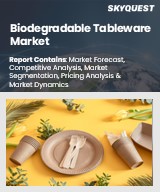
Biodegradable Tableware Market
Report ID: SQMIG25I2043
Report ID: SQMIG25I2043
[email protected]
USA +1 351-333-4748
Report ID:
SQMIG25I2043 |
Region:
Global |
Published Date: December, 2025
Pages:
172
|Tables:
95
|Figures:
71


Global Biodegradable Tableware Market size was valued at USD 17.12 Billion in 2024 and is poised to grow from USD 18.44 Billion in 2025 to USD 33.39 Billion by 2033, growing at a CAGR of 7.7% during the forecast period (2026–2033).
The primary driver of the global biodegradable tableware market is the increasing global push for sustainability and plastic waste reduction. Growing awareness about the detrimental effects of single-use plastics on oceans, wildlife, and ecosystems has compelled governments to introduce strict regulations and bans on plastic cutlery and packaging. This regulatory pressure, paired with consumer preference for eco-friendly solutions, is creating strong demand for biodegradable alternatives. Companies are responding by scaling up production and investing in innovative materials like bagasse, cornstarch, bamboo, and palm leaves. This transition is not only meeting compliance requirements but also aligning with corporate sustainability goals, accelerating market expansion.
A key trend driving the global biodegradable tableware sector is cost competitiveness against traditional plastic products. While consumers are increasingly aware of sustainability, affordability remains central to purchasing decisions. Initially, biodegradable tableware was priced significantly higher due to limited production and raw material costs, restricting adoption. However, advancements in manufacturing technologies and improved supply chain efficiencies are lowering production costs. Additionally, growing demand has created economies of scale, making eco-friendly options more accessible to businesses and households. This narrowing price gap is encouraging broader adoption, positioning biodegradable tableware as a viable and sustainable mainstream alternative worldwide.
In What Ways does AI Make Biodegradable Tableware More Affordable and Scalable?
Artificial intelligence is directly shaping the biodegradable tableware market by accelerating material innovation and improving efficiency. AI-powered predictive modeling allows researchers to test and identify plant-based polymers that replicate the durability of plastics while remaining fully compostable. This reduces R&D timelines and brings more competitive products to market. Indirectly, AI-driven analytics in supply chain management enhance demand forecasting and reduce overproduction, lowering costs for manufacturers. As a result, biodegradable products are becoming more affordable and scalable. A related development is Nestlé’s collaboration with IBM, where generative AI tools are being used to design sustainable packaging materials.
In 2025, Nestlé, in collaboration with IBM Research, advanced its patenting strategy by exploring AI-driven generative design tools for sustainable packaging materials. This integration enables faster identification of biodegradable polymer blends for food packaging and tableware, bridging regulatory needs with innovation, and positioning AI as a catalyst for eco-friendly product development.
Market snapshot - 2026-2033
Global Market Size
USD 15.9 billion
Largest Segment
Plates/Trays
Fastest Growth
Cutlery
Growth Rate
7.7% CAGR
To get more insights on this market click here to Request a Free Sample Report
Global Biodegradable Tableware Market is segmented by Product Type, Material Type, Distribution Channel, Application and region. Based on Product Type, the market is segmented into Bowls, Cups, Plates, Cutlery and Others. Based on Material Type, the market is segmented into Paper, Silk, Bioplastic, Wood, Bamboo and Others. Based on Distribution Channel, the market is segmented into Hypermarkets & Supermarkets, Convenience Stores, Online Stores and Others. Based on Application, the market is segmented into Commercial and Household. Based on region, the market is segmented into North America, Europe, Asia Pacific, Latin America and Middle East & Africa.
Based on the global biodegradable tableware market forecast, plates and trays dominate the industry due to their high utility in households, restaurants, and catering services. Current innovations focus on durable, leak-resistant materials like bagasse, bamboo, and sugarcane pulp, often enhanced with water- and oil-repellent coatings. Rising demand for single-use alternatives to plastics, coupled with cost-effective mass production, drives widespread adoption. Their versatility, affordability, and eco-friendly appeal make plates and trays the leading segment globally.
Bowls are expected to be the fastest-growing segment in the global biodegradable tableware market due to rising demand from foodservice outlets, especially for soups, salads, and takeaway meals. Their convenience, compatibility with eco-friendly packaging trends, and increasing adoption in fast-casual dining and delivery services drive significant growth opportunities.
Wood dominates the global biodegradable tableware market due to its natural strength, durability, and eco-friendly appeal. Current innovations focus on lightweight, smooth-finished utensils, plates, and trays made from sustainably sourced wood, often treated to enhance water and heat resistance. Its versatility in design, premium look, and compostable nature make it ideal for both everyday use and premium dining, driving widespread adoption and positioning wood as the leading raw material segment globally.
Paper is set to be the fastest-growing raw material in the global biodegradable tableware market due to its low cost, ease of mass production, and versatility in shapes and designs. Innovations like coated, grease-resistant, and printed paper products enhance durability, making it an attractive, sustainable alternative to plastics for widespread adoption.
To get detailed segments analysis, Request a Free Sample Report
As per the global biodegradable tableware market analysis, Europe is dominating the industry, driven by strict EU regulations on single-use plastics and strong environmental consciousness among consumers. Countries like Germany, France, and the UK lead in adopting sustainable tableware in restaurants, catering, and events. Innovations in durable, compostable materials such as bagasse, bamboo, and molded pulp, combined with growing e-commerce and retail availability, are fueling demand, making Europe a key region for market growth and eco-friendly product adoption.
Germany is a major contributor to the Europe biodegradable tableware market due to stringent environmental regulations and high consumer awareness of sustainability. Restaurants, catering services, and households increasingly adopt compostable products made from bagasse, bamboo, and molded pulp. Innovations in durable, heat- and water-resistant designs, coupled with strong e-commerce and retail distribution, drive widespread adoption, positioning Germany as a leading European market for eco-friendly tableware solutions.
The UK contributes prominently to Europe biodegradable tableware market, driven by regulatory restrictions on plastics and high environmental awareness among consumers. Restaurants, cafes, and catering services increasingly switch to compostable tableware made from bamboo, bagasse, and paper. Product innovations focus on durability, design, and eco-friendliness. Coupled with expanding e-commerce channels and sustainability-focused campaigns, these factors make the UK a key player in Europe’s and the global biodegradable tableware market.
France plays a significant role in the Europe biodegradable tableware market, supported by bans on single-use plastics and strong eco-conscious consumer behavior. The foodservice and hospitality sectors are rapidly adopting bagasse, wood, and paper-based tableware. Innovations in compostable, lightweight, and design-friendly products enhance usability and appeal. Government incentives, sustainability campaigns, and growing retail and online availability further strengthen France’s contribution to the regional and global market.
Asia Pacific’s biodegradable tableware market is witnessing fastest growing region, driven by rising environmental awareness, government regulations limiting single-use plastics, and increasing adoption in the foodservice and catering sectors. Countries like China, India, and Japan lead in demand for bagasse, bamboo, and paper-based tableware. Innovations in cost-effective, durable, and compostable products, along with expanding e-commerce and urban consumption, are fueling market penetration, making Asia Pacific a key growth region globally.
Japan contributes significantly to the Asia Pacific biodegradable tableware market due to strong environmental regulations and high consumer awareness of sustainability. The foodservice, catering, and retail sectors increasingly adopt eco-friendly products made from bagasse, bamboo, and molded pulp. Innovations focus on lightweight, durable, and heat-resistant designs. Coupled with advanced manufacturing technologies and growing e-commerce distribution, Japan is strengthening its position as a leading market for biodegradable and compostable tableware in the Asia Pacific region.
South Korea plays a key role in the Asia Pacific biodegradable tableware market, driven by government policies restricting single-use plastics and increasing eco-conscious consumer behavior. Restaurants, cafeterias, and catering services are shifting to compostable tableware made from bagasse, bamboo, and paper. Product innovations emphasize durability, aesthetics, and environmental safety. Rising urbanization, e-commerce penetration, and sustainability campaigns further promote adoption, positioning South Korea as a rapidly growing contributor in the Asia Pacific biodegradable tableware market.
North America’s biodegradable tableware market is driven by strong environmental regulations, rising consumer awareness, and widespread adoption in the foodservice sector. The U.S. leads due to strict single-use plastic bans, sustainability initiatives, and growing demand from restaurants, cafeterias, and catering services. Innovations in bagasse, bamboo, and paper-based products, along with increasing e-commerce penetration, are expanding accessibility. These factors collectively position North America as a significant and steadily growing regional market.
The U.S. is the largest contributor to North America’s biodegradable tableware market, driven by strict regulations limiting single-use plastics and strong consumer preference for sustainable products. Restaurants, cafeterias, and catering services increasingly adopt bagasse, bamboo, and paper-based tableware. Innovations in durable, compostable designs and growing e-commerce distribution enhance market penetration. Corporate sustainability initiatives and government incentives further stimulate production and adoption, reinforcing the U.S.’s dominant role in the regional market.
Canada contributes significantly to North America biodegradable tableware market through government-led environmental policies and growing public awareness of plastic pollution. The foodservice and hospitality sectors are increasingly shifting to biodegradable tableware made from bagasse, wood, and paper. Innovations in lightweight, durable, and compostable products meet consumer demand for eco-friendly alternatives. Partnerships between local manufacturers and international suppliers, alongside sustainability-driven campaigns, support market growth, positioning Canada as a key player in North America’s expanding biodegradable tableware market.
To know more about the market opportunities by region and country, click here to
Buy The Complete Report
Environmental Regulations
Rising Consumer Awareness
Lack of Awareness in Emerging Markets
Supply Chain Challenges
Request Free Customization of this report to help us to meet your business objectives.
The global biodegradable tableware market outlook is highly competitive, featuring established international players and emerging regional companies. Key players include Huhtamäki Oyj, Pactiv LLC, Dart Container Corporation, Biotrem, and BioPak. Companies like Huhtamäki focus on renewable materials and circular economy initiatives, while Biotrem specializes in wheat-bran-based tableware. Strategies such as expanding product portfolios, enhancing sustainability practices, and increasing production capacities enable these firms to strengthen market presence and meet growing demand for eco-friendly tableware globally.
As per the global biodegradable tableware industry analysis, the market is witnessing rapid growth, fueled by rising environmental awareness, plastic bans, and demand for sustainable alternatives. Startups are driving innovation by using natural materials, upcycling agricultural waste, and developing chemical-free production processes. These emerging companies focus on creating durable, compostable tableware that meets consumer and regulatory expectations. Their innovative approaches not only reduce plastic pollution but also promote circular economies, positioning startups as key market disruptors.
SkyQuest’s ABIRAW (Advanced Business Intelligence, Research & Analysis Wing) is our Business Information Services team that Collects, Collates, Correlates, and Analyses the Data collected by means of Primary Exploratory Research backed by robust Secondary Desk research.
As per SkyQuest analysis, the global biodegradable tableware industry is witnessing strong growth, driven by environmental awareness, regulatory pressures, and consumer demand for sustainable alternatives. Rising bans on single-use plastics and growing preference for eco-friendly solutions are compelling manufacturers to innovate with materials like bagasse, bamboo, wood, and palm leaves. AI integration accelerates product development and supply chain efficiency, reducing costs and improving accessibility.
Plates and trays dominate due to versatility and affordability, while wood remains the preferred raw material. Paper is emerging fastest due to low cost and mass production ease. Europe leads in adoption, supported by strict regulations, while Asia Pacific shows rapid growth, driven by government policies, urbanization, and expanding e-commerce. Startups and established companies alike are innovating to meet sustainability goals, promoting the global biodegradable tableware market strategies.
| Report Metric | Details |
|---|---|
| Market size value in 2024 | USD 17.12 Billion |
| Market size value in 2033 | USD 33.39 Billion |
| Growth Rate | 7.7% |
| Base year | 2024 |
| Forecast period | 2026-2033 |
| Forecast Unit (Value) | USD Billion |
| Segments covered |
|
| Regions covered | North America (US, Canada), Europe (Germany, France, United Kingdom, Italy, Spain, Rest of Europe), Asia Pacific (China, India, Japan, Rest of Asia-Pacific), Latin America (Brazil, Rest of Latin America), Middle East & Africa (South Africa, GCC Countries, Rest of MEA) |
| Companies covered |
|
| Customization scope | Free report customization with purchase. Customization includes:-
|
To get a free trial access to our platform which is a one stop solution for all your data requirements for quicker decision making. This platform allows you to compare markets, competitors who are prominent in the market, and mega trends that are influencing the dynamics in the market. Also, get access to detailed SkyQuest exclusive matrix.
Table Of Content
Executive Summary
Market overview
Parent Market Analysis
Market overview
Market size
KEY MARKET INSIGHTS
COVID IMPACT
MARKET DYNAMICS & OUTLOOK
Market Size by Region
KEY COMPANY PROFILES
Methodology
For the Biodegradable Tableware Market, our research methodology involved a mixture of primary and secondary data sources. Key steps involved in the research process are listed below:
1. Information Procurement: This stage involved the procurement of Market data or related information via primary and secondary sources. The various secondary sources used included various company websites, annual reports, trade databases, and paid databases such as Hoover's, Bloomberg Business, Factiva, and Avention. Our team did 45 primary interactions Globally which included several stakeholders such as manufacturers, customers, key opinion leaders, etc. Overall, information procurement was one of the most extensive stages in our research process.
2. Information Analysis: This step involved triangulation of data through bottom-up and top-down approaches to estimate and validate the total size and future estimate of the Biodegradable Tableware Market.
3. Report Formulation: The final step entailed the placement of data points in appropriate Market spaces in an attempt to deduce viable conclusions.
4. Validation & Publishing: Validation is the most important step in the process. Validation & re-validation via an intricately designed process helped us finalize data points to be used for final calculations. The final Market estimates and forecasts were then aligned and sent to our panel of industry experts for validation of data. Once the validation was done the report was sent to our Quality Assurance team to ensure adherence to style guides, consistency & design.
Analyst Support
Customization Options
With the given market data, our dedicated team of analysts can offer you the following customization options are available for the Biodegradable Tableware Market:
Product Analysis: Product matrix, which offers a detailed comparison of the product portfolio of companies.
Regional Analysis: Further analysis of the Biodegradable Tableware Market for additional countries.
Competitive Analysis: Detailed analysis and profiling of additional Market players & comparative analysis of competitive products.
Go to Market Strategy: Find the high-growth channels to invest your marketing efforts and increase your customer base.
Innovation Mapping: Identify racial solutions and innovation, connected to deep ecosystems of innovators, start-ups, academics, and strategic partners.
Category Intelligence: Customized intelligence that is relevant to their supply Markets will enable them to make smarter sourcing decisions and improve their category management.
Public Company Transcript Analysis: To improve the investment performance by generating new alpha and making better-informed decisions.
Social Media Listening: To analyze the conversations and trends happening not just around your brand, but around your industry as a whole, and use those insights to make better Marketing decisions.
REQUEST FOR SAMPLE
 REQUEST FREE CUSTOMIZATION


Want to customize this report? This report can be personalized according to your needs. Our analysts and industry experts will work directly with you to understand your requirements and provide you with customized data in a short amount of time. We offer $1000 worth of FREE customization at the time of purchase.
Feedback From Our Clients


 USA (+1) 351-333-4748

