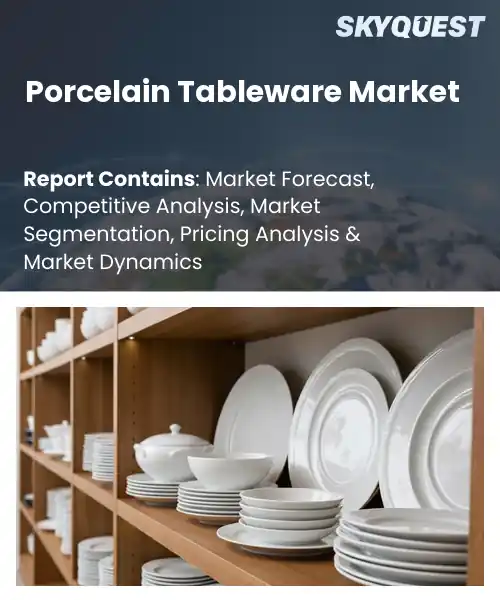
Porcelain Tableware Market
Report ID: SQMIG25I2072
Report ID: SQMIG25I2072
[email protected]
USA +1 351-333-4748
Report ID:
SQMIG25I2072 |
Region:
Global |
Published Date: May, 2026
Pages:
157
|Tables:
91
|Figures:
76


Global Porcelain Tableware Market size was valued at USD 7.94 Billion in 2024 and is poised to grow from USD 8.54 Billion in 2025 to USD 15.22 Billion by 2033, growing at a CAGR of 7.5% during the forecast period (2026-2033).
The main reason for the global porcelain tableware market growth is that consumers prefer durable, stylish dining options. As a result, manufacturers are constantly striving to create new designs and finishes. The definition of porcelain tableware covers all kinds of dishes made from vitrified clay, including plates and bowls, as well as everything you might find in a dining area, like cups or serving bowls. This is significant because porcelain tableware is used both at home and in hotels and restaurants. Porcelain tableware has been produced since ancient China, and then spread to Meissen, Germany, and Stoke-on-Trent, England, before going global with the Industrial Revolution and worldwide trade.
Today, urbanization, the growth of restaurants, and the increased acceptance of online shopping have caused many new channels of distribution to develop, as well as product segmentation and innovation. The growth of premium dining experiences, or premiumization, is also creating increased demand from both foodservice operations and affluent consumers for high-quality, durable porcelain items that can handle heavy duty dishwashing but still present the brand's desired image. Therefore, hotels, airlines, and world-class restaurants are all requesting the creation of customized tableware that incorporates their branding in both the form and finish to enhance the overall experience of their guests.
The increasing existence of laws regulating the use of single-use products also presents manufacturers with opportunities to promote longer-lasting dishes made from recyclable materials to both the production of dishware for catering organizations and the sale of these products through e-commerce retailers. Consequently manufacturers invest in digital decoration, lean ceramics and regional glazing facilities, lowering unit costs and enabling rapid small-batch production for seasonal collections and B2B contracts and expanding exports globally.
How is AI Improving Quality Control In Porcelain Tableware Manufacturing?
By using machine vision, calibrated lighting, and learning algorithms to identify surface defects and differences in glazes, AI enhances porcelain tableware quality control. Consistency of inspections, adaptability to color and texture, and providing actionable feedback connecting defects to specific production processes are three of the most important features. Most manufacturers today have transitioned from using manual inspection procedures to inline systems that can inspect plates, cups, and other products as they are produced on the manufacturing line. Solutions like these allow companies to maintain their product's quality while cutting back on waste and labor due to the diversity of designs and high visual standards throughout the industry.
Real-life examples of this include cameras that can detect black spots, chips, or unevenly applied glazes, as well as software applications that track production trends for quick remediation. Sacmi announced in April 2026 that it has developed an automated system for inspecting plates utilizing specialized lighting and artificial intelligence which can detect defects on both white and colored pieces and allows manufacturers to combine their inspections with the production workflow. With this technology, manufacturers can rapidly remove defects and improve consistency in visual quality while scaling up confidence in the ability to create different product designs.
Market snapshot - (2026-2033)
Global Market Size
USD 7.94 Billion
Largest Segment
Porcelain and Bone China
Fastest Growth
Stoneware
Growth Rate
7.5% CAGR
To get more insights on this market click here to Request a Free Sample Report
Global porcelain tableware market is segmented by product type, application, distribution channel and region. Based on product type, the market is segmented into Plates and Trays, Bowls and Tureens, Cups and Mugs, Dinnerware Sets and Others. Based on application, the market is segmented into Household/Residential and Commercial/HoReCa. Based on distribution channel, the market is segmented into Offline Retail, Online Retail and Direct B2B Sales. Based on region, the market is segmented into North America, Europe, Asia Pacific, Latin America and Middle East & Africa.
As per porcelain tableware market analysis, the Plate and Tray category is one of the most widely used items by households and restaurants alike for all of their Dining experiences causing repetitive sales from both consumers and institutional buyers. Manufacturers will be able to maximise their manufacturing and cost efficiencies because of the broad functionality of these products. The availability of design variations gives manufacturers an opportunity to differentiate themselves through the material finishes, resulting in manufacturer differentiation across many segments. As a result, there is continuous demand for Plates and Trays resulting in steady revenues and channel depth reinforcing supplier commitment to development and innovation around decorative and durable finishes.
As per porcelain tableware market forecast, dinnerware sets are currently experiencing the fastest growth rate as both consumers and institutions prefer to have coordinated designs when giving gifts and/or when dining out, allowing for higher retail prices compared to individual place settings, and the opportunity for bundle shopping on-line. Factors influencing growth in the dinnerware sets segment include lifestyle trends, customisation of products, and growth in channels for dining experiences ultimately increasing value added accessories in the porcelain tableware market.
Digital platforms enhance visibility through online retail distribution, which improves brand exposure by making it easier for consumers to find brands' inventory and purchase products. Online retail has additional benefits beyond just improving discoverability; it also allows for more creativity by providing consumers with visually presented product assortment. The main way that online purchasing is growing is through the positive impact of customer reviews, promotional activity that is focused on generating new customers through targeting, and using the internet to create flexible options to fulfill orders. Because of these capabilities, suppliers have been challenged to improve the design and presentation of their products online; they have also been pressured to develop rapid cycles for adjusting production in response to current consumer trends.
As per porcelain tableware market outlook, online retail is growing rapidly due to the emerging trend of direct B2B sales as institutional buyers and hospitality organizations increasingly require custom-designed porcelain. The growing demand for private-label products and long-term contractual relationships with suppliers encourages manufacturers to invest in manufacturing contracts and designing durable products, resulting in increased sales for large customers, while driving innovation in commercial-use products.
To get detailed segments analysis, Request a Free Sample Report
As per porcelain tableware market regional analysis, Asia Pacific's dominance is due to numerous factors, including a combination of cultural heritage, experience in manufacturing, and the ability to integrate supply chains. The region combines centuries of artisanal craftsmanship with modern manufacturing techniques to produce everything from high-quality handmade items to high-volume commercially mass-produced tableware. The availability of specialized raw materials, a large number of highly skilled employees, and technical expertise in finishing items reinforces the region's worldwide reputation for quality and continued innovations in design. A motionless dining culture, along with the region's large hospitality sector, encourages the growth of the region's industries as they produce items on a large scale while encouraging new ideas and production methods. The region's well-established export supply chain is another factor that helps its products reach other parts of the world. As a result of investing in branding and working with designers, the perceived value of the products has increased, and continued advancements in glazing, strength and durability, and sustainable materials have improved this competitive advantage. All these combined strengths create an ecosystem that provides the basis for continued global leadership in the porcelain tableware market.
Japanese Porcelain Tableware Market conveys the marriage of tradition with modern trends, having presence of Japanese master artisans who are still producing their pots using traditional techniques and collectively informed by regional kilns that produce finished pieces for both Japanese collectors and International buyers alike. The characteristics of these premium porcelain pieces look to emphasize eye for detail, perfection in the finish of each piece and use of subtle aesthetic design forms to support a strong luxury and gift segment within overall market growth. Collaborative projects between local artisans and modern designers support innovation while increased demand from restaurants seeking high quality presentation will drive volumes in commercial sector. The heritage associated with the respective brands along with impeccable attention to detail bolster long-standing reputations for producing quality goods ultimately differentiating each brand’s products within the overall market.
South Korean Porcelain Tableware Market is rapidly becoming a unique blend of modern, stylistic design juxtaposed against cultural heritage background. Demand for stylish/ designer porcelain tableware at food service sector is being driven by current urban lifestyle trends and the increased consumption in Korean fine cuisine created by an active dining experience. The increasing number of domestic small manufacturing business and design studios have helped to propel the market for hand-crafted/ high-quality finished porcelain tableware and allowing them to offer unique lines of tableware that emphasize high-quality materials and finishes. Projects that involve collaboration between designers and restaurants or retailers are adding to the speed at which trends can be adopted and market share is growing rapidly with exportations; therefore, there is continued emphasis on advancing innovations, cultivating brand storytelling and promoting products through highly visible means to further stimulate growth and encourage premiumization of products.
As per porcelain tableware market regional outlook, the significant growth in consumer dining experiences, as well as a focus on premiumization, has stimulated European growth from both a revitalized emphasis by consumers on creating unique dining experiences and an established tradition of craftsmanship that continues to be adapted to modern tastes. The combination of technical excellence and leadership in design within established manufacturing centers has created products that appeal to discerning customers and high-end hospitality brands. Sustainable and long-lasting products are becoming an integral part of the purchasing decision being made by consumers today, further motivating producers to utilize sustainable materials and practice environmentally responsible sourcing. Retail evolution, including both curated independent stores and digitally based platforms, provide additional opportunities for consumers to gain access to niche and artisan products. Due to an increased number of cross-border collaborations between designers and manufacturers, product diversity has been enhanced. As manufacturers continue to be required to meet stricter regulations in quality and safety, consumers will also have improved levels of confidence in the products they purchase. All these factors have created a very fertile ground for continued growth within both the main-stream and high-end segments of the market.
The Porcelain Tableware Market in Germany is supported by an established manufacturing heritage that concentrates on precision, long-lasting durability, and functional design. As such, the top manufacturers place great importance on the engineering quality and consistent finishing of their products as they serve both the domestic hospitality market and the global export markets. The market is also driven by a demand for well-made products that will last and integrate seamlessly into modern dining environments, with sustainability and provenance of the materials used in the development of the products considered to be very important. The development of the products will also benefit from collaboration with industrial designers, which has helped to improve the aesthetic appeal and functionality of the products, thereby reinforcing Germany’s position as a leader in high-quality, reliable porcelain products.
The Porcelain Tableware Market in the United Kingdom has an emerging collection of design-driven and heritage-inspired collections. These collections are continuing to grow due to the vibrant hospitality industry and a strong independent retail market that supports the introduction of new designers and custom-made items. Consumers are also showing an increasing amount of interest in curated table settings, as well as limited edition collections and product collaborations, which continue to inspire innovation with new finishes and patterns. Digital and lifestyle media have aided in amplifying the trends for the products, thereby allowing niche manufacturers to reach much larger audiences and contribute to the rapid growth of the market.
Porcelain Tableware Market in France is emerging through a renaissance of artisanal ateliers and a strong linkage to haute cuisine and aesthetic tradition. Producers emphasize refined craftsmanship, elegant forms, and narrative-driven collections that resonate with luxury dining establishments and discerning private buyers. Regional producers leverage cultural heritage and design sophistication to create distinct product identities, while small scale and boutique export initiatives enhance international recognition. Aesthetic excellence and culinary pairing remain central to market development.
North America is strengthening its position through a combination of artisanal revival, strategic reshoring of higher value production, and a pronounced emphasis on sustainability and customization. Consumer demand for distinctive, durable, and ethically produced tableware has encouraged investment in small-scale manufacturers and designer collaborations. Retail channels, including specialty stores and direct-to-consumer platforms, facilitate market access for niche brands while hospitality industry modernization sustains demand for premium presentation. Innovation in glazing methods and material sourcing, along with partnerships between craftspeople and larger producers, enhances product quality and variety. These developments create a diversified market structure that balances mass appeal with artisanal differentiation, supporting an elevated role in the global porcelain tableware landscape.
Porcelain Tableware Market in United States combines mass-market availability with a strong and growing artisan segment focused on design and sustainability. The market benefits from creative synergies between studios, designers, and restaurant professionals that drive product trends and bespoke offerings. Retail diversity, ranging from big-box channels to specialty boutiques and online brands, supports broad consumer reach. Emphasis on customization, durable finishes, and responsible materials aligns with consumer preferences and bolsters both domestic production and curated imports.
Porcelain Tableware Market in Canada is marked by quality-focused consumers and a preference for sustainably produced, well-crafted tableware. Boutique producers and regional artisans contribute unique collections that cater to hospitality and home dining niches. Cross-border trade and curated retail channels provide access to international design influences while local makers emphasize craftsmanship and material integrity. The market favors durable, aesthetically cohesive pieces that support long-term use and reflect contemporary lifestyle values.
To know more about the market opportunities by region and country, click here to
Buy The Complete Report
Rising Consumer Preference For Porcelain
Consumers are increasingly turning to porcelain tableware due to its perceived elegance, cleanliness, and association as a premium dining option; therefore, porcelain tableware encourages both "purchase" and repeat purchases for individuals, households and businesses alike. Conversely, manufacturers and retailers are expanding their product lines and delivering design narratives to improve visibility and desirability of porcelain tableware; thus, growing consumer interest in porcelain tableware supports manufacturers' and retailers' ability to invest in new product designs and marketing through additional distribution channels and increased penetration of products in both mainstream and upscale market segments.
Expansion Of Hotel And Restaurant Sector
High Production And Raw Material Costs
Increased production costs, including the price of raw materials, limit the expansion of market potential by raising the price of final products and reducing the margin for producers. This creates a situation where smaller producers are unable to invest in design innovation or expand capacity, as a result of their increased operating expenses. As prices continue to rise, manufacturers may cut costs or pass price increases to end consumers, reducing demand in price-sensitive segments. This situation enables new entrants to the market to be slower, reducing the promotional efforts made by manufacturers, and consolidating market power among a few larger firms, which limits overall market dynamism and growth.
Competition From Substitute Materials
Request Free Customization of this report to help us to meet your business objectives.
Competitive dynamics in the global porcelain tableware market are shaped by consolidation through targeted acquisitions such as Steelite’s purchase of foodservice divisions, high-profile collaborations exemplified by Meissen’s partnership with Westwing, and technology-driven differentiation where startups deploy co-design platforms and direct-to-consumer sustainability models exemplified by KRENU and Fable to challenge legacy manufacturers.
SkyQuest’s ABIRAW (Advanced Business Intelligence, Research & Analysis Wing) is our Business Information Services team that Collects, Collates, Correlates, and Analyses the Data collected by means of Primary Exploratory Research backed by robust Secondary Desk research.
As per SkyQuest analysis, the global porcelain tableware market is driven by rising consumer preference for durable, aesthetically refined dining experiences and a second driver is the expansion of the hotel and restaurant sector that fuels institutional procurement. A restraint is high production and raw material costs that squeeze margins and hinder smaller manufacturers. The dominating region is Asia Pacific due to deep manufacturing clusters, artisanal heritage and strong domestic and export demand. The dominating segment is Plates and Trays because of their daily-use ubiquity and production efficiency. Together these forces are steering premiumization, digital customization and sustainability investments across the value chain.
| Report Metric | Details |
|---|---|
| Market size value in 2024 | USD 7.94 Billion |
| Market size value in 2033 | USD 15.22 Billion |
| Growth Rate | 7.5% |
| Base year | 2024 |
| Forecast period | (2026-2033) |
| Forecast Unit (Value) | USD Billion |
| Segments covered |
|
| Regions covered | North America (US, Canada), Europe (Germany, France, United Kingdom, Italy, Spain, Rest of Europe), Asia Pacific (China, India, Japan, Rest of Asia-Pacific), Latin America (Brazil, Rest of Latin America), Middle East & Africa (South Africa, GCC Countries, Rest of MEA) |
| Companies covered |
|
| Customization scope | Free report customization with purchase. Customization includes:-
|
To get a free trial access to our platform which is a one stop solution for all your data requirements for quicker decision making. This platform allows you to compare markets, competitors who are prominent in the market, and mega trends that are influencing the dynamics in the market. Also, get access to detailed SkyQuest exclusive matrix.
Table Of Content
Executive Summary
Market overview
Parent Market Analysis
Market overview
Market size
KEY MARKET INSIGHTS
COVID IMPACT
MARKET DYNAMICS & OUTLOOK
Market Size by Region
KEY COMPANY PROFILES
Methodology
For the Porcelain Tableware Market, our research methodology involved a mixture of primary and secondary data sources. Key steps involved in the research process are listed below:
1. Information Procurement: This stage involved the procurement of Market data or related information via primary and secondary sources. The various secondary sources used included various company websites, annual reports, trade databases, and paid databases such as Hoover's, Bloomberg Business, Factiva, and Avention. Our team did 45 primary interactions Globally which included several stakeholders such as manufacturers, customers, key opinion leaders, etc. Overall, information procurement was one of the most extensive stages in our research process.
2. Information Analysis: This step involved triangulation of data through bottom-up and top-down approaches to estimate and validate the total size and future estimate of the Porcelain Tableware Market.
3. Report Formulation: The final step entailed the placement of data points in appropriate Market spaces in an attempt to deduce viable conclusions.
4. Validation & Publishing: Validation is the most important step in the process. Validation & re-validation via an intricately designed process helped us finalize data points to be used for final calculations. The final Market estimates and forecasts were then aligned and sent to our panel of industry experts for validation of data. Once the validation was done the report was sent to our Quality Assurance team to ensure adherence to style guides, consistency & design.
Analyst Support
Customization Options
With the given market data, our dedicated team of analysts can offer you the following customization options are available for the Porcelain Tableware Market:
Product Analysis: Product matrix, which offers a detailed comparison of the product portfolio of companies.
Regional Analysis: Further analysis of the Porcelain Tableware Market for additional countries.
Competitive Analysis: Detailed analysis and profiling of additional Market players & comparative analysis of competitive products.
Go to Market Strategy: Find the high-growth channels to invest your marketing efforts and increase your customer base.
Innovation Mapping: Identify racial solutions and innovation, connected to deep ecosystems of innovators, start-ups, academics, and strategic partners.
Category Intelligence: Customized intelligence that is relevant to their supply Markets will enable them to make smarter sourcing decisions and improve their category management.
Public Company Transcript Analysis: To improve the investment performance by generating new alpha and making better-informed decisions.
Social Media Listening: To analyze the conversations and trends happening not just around your brand, but around your industry as a whole, and use those insights to make better Marketing decisions.
REQUEST FOR SAMPLE
 REQUEST FREE CUSTOMIZATION
Global Porcelain Tableware Market size was valued at USD 7.94 Billion in 2024 and is poised to grow from USD 8.54 Billion in 2025 to USD 15.22 Billion by 2033, growing at a CAGR of 7.5% during the forecast period (2026-2033).
Competitive dynamics in the global porcelain tableware market are shaped by consolidation through targeted acquisitions such as Steelite’s purchase of foodservice divisions, high-profile collaborations exemplified by Meissen’s partnership with Westwing, and technology-driven differentiation where startups deploy co-design platforms and direct-to-consumer sustainability models exemplified by KRENU and Fable to challenge legacy manufacturers. 'Villeroy & Boch', 'Rosenthal GmbH', 'Fiskars Group', 'Lenox Corporation', 'Noritake', 'Rosendahl Design Group', 'Bernardaud', 'Meissen Porcelain Manufactory', 'Degrenne', 'Hermes International', 'Portmeirion Group', 'Steelite International', 'Churchill China', 'Libbey', 'Anchor Hocking', 'Everyday Leon', 'RAK Ceramics', 'Seltmann Weiden', 'Kahla Porcelain', 'BHS Tabletop'
The growing preference among consumers for porcelain tableware stems from its perceived elegance, clean finish, and association with premium dining experiences, which encourages purchase decisions and repeat buying for household and commercial use. Manufacturers and retailers respond by expanding product lines and emphasizing design storytelling, increasing visibility and desirability. This elevated consumer interest supports product diversification and brand differentiation, encouraging investment in design innovation and marketing that together expand distribution channels and raise market penetration in mainstream and upscale segments.
Sustainable Circular Design: Manufacturers and brands are increasingly prioritizing closed-loop materials, repairable product concepts and recyclable glazing to meet consumer demand for environmentally responsible dining solutions. Design strategies focus on durability, modular components and transparent end-of-life pathways, enabling long-term value and reduced waste. Collaborations across supply chains foster reuse initiatives and take-back programs while aesthetic innovation ensures sustainability aligns with premium positioning. This shift reshapes sourcing, product development and brand communications toward circularity as a core differentiator in competitive porcelain tableware portfolios globally.
Why does Asia Pacific Dominate the Global Porcelain Tableware Market? |@12


Want to customize this report? This report can be personalized according to your needs. Our analysts and industry experts will work directly with you to understand your requirements and provide you with customized data in a short amount of time. We offer $1000 worth of FREE customization at the time of purchase.
Feedback From Our Clients


 USA (+1) 351-333-4748

