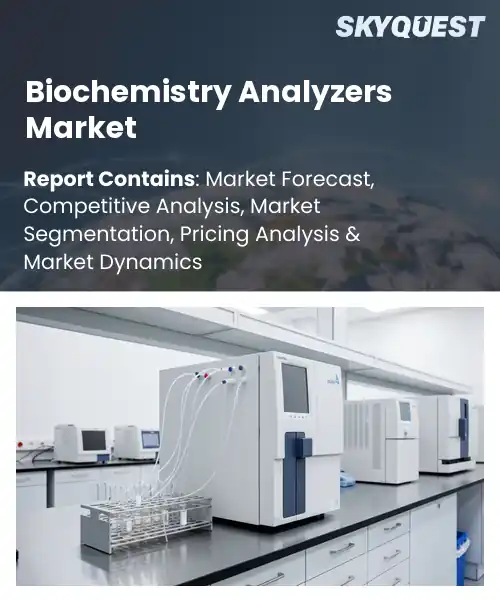
Biochemistry Analyzers Market
Report ID: SQMIG35A4009
Report ID: SQMIG35A4009
[email protected]
USA +1 351-333-4748
Report ID:
SQMIG35A4009 |
Region:
Global |
Published Date: June, 2026
Pages:
157
|Tables:
118
|Figures:
77


Global Biochemistry Analyzers Market size was valued at USD 14.52 Billion in 2024 and is poised to grow from USD 15.41 Billion in 2025 to USD 24.85 Billion by 2033, growing at a CAGR of 6.12% during the forecast period (2026-2033).
The global biochemistry analyzers market consists of the devices which automate the measurement of metabolites, enzymes and electrolytes in clinical and research laboratories. Its importance is that accurate data are needed to guide patient treatment, drug development and epidemiological surveillance. The increasing incidence of chronic diseases like diabetes and cardiovascular diseases is the major factor for hospitals and testing centres to expand their testing capabilities. Recently, the adoption rate has increased due to the development of cartridge-based platforms by manufacturers, which reduce the sample volume and time. For example, Siemens' Atellica and Roche's cobas systems have become standard in hospitals, showing the market's shift to solutions.
Another key factor fueling the global biochemistry analyzers market is the rising tendency of hospital networks to opt for decentralized testing to get faster turnaround for routine panels. Institutions that have integrated laboratory information systems reduce transcription errors, which speeds up billing cycles and improves patient flow. This advantage propels the demand for modular analyzers that can be connected to cloud-based data repositories. A good example is Abbott’s i-STAT deployment in remote clinics where electrolyte assessment informs emergency care decisions. Vendors have been investing in AI-enhanced quality control and consumable subscription models, creating revenue streams beyond hardware sales and fueling market growth.
How is AI-driven automation influencing accuracy and cost in the biochemistry analyzers market?
Automated biochemistry analyzers use machine learning to process samples, interpret the results and quality control the results. The technology is trained on large data-sets to improve detection limits and reduce run to run variability. Automating repetitive steps reduces manual work and the chance of human error, resulting in more reliable diagnosis. The streamlined approach saves large hospitals and small clinics money by cutting down on reagent use and turnaround time. This is a growing market and vendors are coming out with AI modules that predict maintenance requirements thus further reducing downtime and operating costs.
Roche launched an Artificial Intelligence-based fully automated biochemical analyzer providing higher precision at lower cost per test in March 2024. It’s helped to speed up the market momentum and shows what smart automation can do.
Market snapshot - (2026-2033)
Global Market Size
USD 14.52 Billion
Largest Segment
Fully Automated Analyzers
Fastest Growth
Point-of-Care Analyzers
Growth Rate
6.12% CAGR
To get more insights on this market click here to Request a Free Sample Report
Global biochemistry analyzers market is segmented by type, technology, application, end-user and region. Based on type, the market is segmented into Fully Automated Analyzers, Semi-Automated Analyzers and Point-of-Care Analyzers. Based on technology, the market is segmented into Spectrophotometry, Potentiometry and Chemiluminescence. Based on application, the market is segmented into Liver Function Tests, Kidney Function, Lipid Profile and Glucose. Based on end-user, the market is segmented into Hospitals, Diagnostic Labs and Clinics. Based on region, the market is segmented into North America, Europe, Asia Pacific, Latin America and Middle East & Africa.
The fully automated analyzers segment is anticipated to lead the market as these analyzers integrate sample preparation, reagent handling, and results reporting in a single workflow, thereby eliminating manual interventions and minimizing error rates. This degree of automation is perfect for hospitals and large diagnostic labs that require predictable throughput and operational efficiency. They are more attractive and widely adopted in biochemistry analyzers market and they are better in data management and regulatory compliances.
However, the Point of care Analyzers segment is expected to register the highest CAGR during the forecast period due to its compact designs and wireless connectivity that facilitate bedside testing to meet the rising demand for rapid diagnostics in outpatient settings. The ease of use and low capital outlay is attractive to clinics and smaller labs and this leads to faster market penetration and opens up new opportunities for decentralized testing.
Technology-based spectrophotometry segment accounted for the largest market share in 2020 owing to the availability of flexible analytical platform for absorption measurement in wide range of wavelengths to perform different assay chemistries. Its reliability and well established calibration protocols make it the instrument of choice for routine panels like liver and kidney function testing, The extensive library of reagents and the ability to work with existing laboratory infrastructure further strengthen its position, thus driving the continued demand in the biochemistry analyzers market.
Meanwhile, the Chemiluminescence segment is witnessing the highest growth momentum owing to its high sensitivity to detect low concentration biomarkers, thereby increasing its clinical application for early screening of diseases. The technology is a booster for automated immunoassays and a catalyst for future market growth with the development of new luminescent substrates.
To get detailed segments analysis, Request a Free Sample Report
North America continues to lead the pack, with its mature clinical laboratory ecosystem, strong investment in diagnostics innovation and network of world-class academic institutions driving ongoing product refinement. The region’s regulatory environment encourages fast adoption of sophisticated analytical platforms, while maintaining strong quality standards. Robust reimbursement models and integrated healthcare delivery models drive hospitals and reference labs to high throughput, reliable biochemistry analyzers. And a healthy supply chain of domestic manufacturers and a talented workforce also accelerates deployment and keeps the market moving.
The United States Biochemistry Analyzers Market is driven by the existence of world-class research hospitals in United States demanding advanced analytical performance for complex assays. High sample volumes and multiplexing drive demand for precision medicine instruments. Device manufacturers, software developers and clinical laboratories working together in ecosystems drive faster adoption of new technologies. A culture of continuous improvement is key to the long-term uptake in both academic and commercial settings.
A publicly funded health care system in Canada focusing on availability of reliable diagnostic tools is driving the Biochemistry Analyzers Market. The early uptake of new analyzer features is stimulated by good links between universities, research institutes and clinical laboratories. The emphasis is on regional collaboration and technology transfer to support the uptake of advanced automation, with a priority on affordability to ensure that procurement decisions are aligned with sustainable operating models across provincial health networks.
In Europe, the fast pace of development is driven by harmonized regulations, strong public health care commitments and a history of collaboration on research across borders. Investment in laboratory modernization programs promotes the replacement of legacy platforms with high efficiency biochemistry analyzers that support evolving diagnostic guidelines. The continent is home to leading instrument manufacturers, who can maintain close customer relationships and customized service models. Furthermore, the focus on sustainability and cost effectiveness is visible in the use of flexible and modular analyzer configurations that can address the different clinical needs of the member states.
A strong university hospital network, demanding high-precision instruments for complex biochemical profiling, is underpinning the Germany Biochemistry Analyzers Market. Thanks to its strong engineering culture in the country, analyzer reliability and workflow integration are continuously improved. The partnership between manufacturers and clinical consortia enables rapid feedback cycles and new functionalities are indeed addressing emerging diagnostic challenges whilst preserving strict quality standards across the public and private laboratory space.
The United Kingdom Biochemistry Analyzers Market is driven by a rapid adoption of next generation platforms, due to an emphasis on personalized healthcare pathways. The National Health Service’s push to upgrade laboratory infrastructure is resulting in the adoption of analyzers that can provide both speed and a broad test menu. Joint research activities between academia and industry promote the dissemination of new analytical capabilities into everyday clinical practice, thereby providing a lively environment for continued market growth.
As laboratories seek flexible solutions offering a balance between performance and operational efficiency, the market for biochemistry analyzers in France is expanding. Evaluation of new analyzer technologies in networks of regional hospitals is a strong driver for public-private partnerships. The focus is on fast access to biochemistry data for best patient outcomes. The demand for systems that facilitate sample processing and data management is on the rise and is contributing to make France an emerging player on the European market scene.
The Asia Pacific is strengthening its position due to a combination of increasing healthcare infrastructure, increasing focus on early detection of diseases, and increasing investment in laboratory automation. With the growing population health needs in the region being met with upgraded diagnostic capabilities in countries, analyzers with high throughput and flexible assay configurations are being adopted. Innovation hubs with partnerships between local producers, academic research centres and international companies are speeding the transfer and adoption of new technologies, better matching local clinical needs and creating a competitive marketplace.
Japan’s biochemistry analyzer market is mature, underpinned by a tradition of precision engineering and a healthcare system that prioritizes diagnostic accuracy. The large hospitals are selecting devices that can be integrated with sophisticated information systems that allow them to analyze the data in great detail. This close collaboration between device developers and clinical researchers allows for rapid incorporation of new assay capabilities and reinforces Japan’s reputation for providing state-of-the-art biochemistry analyzer solutions for routine testing and advanced research applications.
South Korean biochemistry analyzer market is driven by a dynamic biotech industry which is focused on accelerating the commercialization of diagnostic technologies. Hospitals and reference labs are seeking to buy analyzers that provide the speed, reliability and scalability to deal with increased testing volumes. We have seen strong government support for healthcare innovation in South Korea, which has encouraged local manufacturers to work with global technology providers to accelerate the adoption of advanced analytical platforms as the country seeks to provide efficient and high quality patient care.
To know more about the market opportunities by region and country, click here to
Buy The Complete Report
Increasing Demand For Clinical Research
Advancements In Automation Technologies
High Capital Investment Requirements
Stringent Regulatory Approval Processes
Request Free Customization of this report to help us to meet your business objectives.
The world market for biochemical analyzers is highly competitive with aggressive M&A activity, strategic partnerships and fast-paced technology innovation. Top players are also buying niche players to complement their assay portfolio and partnerships with AI companies are speeding up the development of data-driven diagnostics. Recent examples include partnerships between major device manufacturers and AI startups to embed machine learning algorithms in analyser software, and a handful of high-profile acquisitions of point-of-care platform companies to gain market reach and speed of results.
SkyQuest’s ABIRAW (Advanced Business Intelligence, Research & Analysis Wing) is our Business Information Services team that Collects, Collates, Correlates, and Analyses the Data collected by means of Primary Exploratory Research backed by robust Secondary Desk research.
As per SkyQuest analysis the global biochemistry analyzers market is being propelled primarily by the rising demand for clinical research, which pushes laboratories to adopt high‑throughput platforms for biomarker and drug‑development studies. A second strong driver is the rapid advancement in automation technologies that lift sample capacity, cut manual labor and improve data reliability, encouraging institutions to replace legacy systems. However, the high capital investment required for sophisticated instruments remains a notable restraint, especially for smaller labs. North America dominates the market thanks to its mature laboratory ecosystem and robust reimbursement frameworks, while fully automated analyzers lead the segment landscape by offering end‑to‑end workflow efficiency.
| Report Metric | Details |
|---|---|
| Market size value in 2024 | USD 14.52 Billion |
| Market size value in 2033 | USD 24.85 Billion |
| Growth Rate | 6.12% |
| Base year | 2024 |
| Forecast period | (2026-2033) |
| Forecast Unit (Value) | USD Billion |
| Segments covered |
|
| Regions covered | North America (US, Canada), Europe (Germany, France, United Kingdom, Italy, Spain, Rest of Europe), Asia Pacific (China, India, Japan, Rest of Asia-Pacific), Latin America (Brazil, Rest of Latin America), Middle East & Africa (South Africa, GCC Countries, Rest of MEA) |
| Companies covered |
|
| Customization scope | Free report customization with purchase. Customization includes:-
|
To get a free trial access to our platform which is a one stop solution for all your data requirements for quicker decision making. This platform allows you to compare markets, competitors who are prominent in the market, and mega trends that are influencing the dynamics in the market. Also, get access to detailed SkyQuest exclusive matrix.
Table Of Content
Executive Summary
Market overview
Parent Market Analysis
Market overview
Market size
KEY MARKET INSIGHTS
COVID IMPACT
MARKET DYNAMICS & OUTLOOK
Market Size by Region
KEY COMPANY PROFILES
Methodology
For the Biochemistry Analyzers Market, our research methodology involved a mixture of primary and secondary data sources. Key steps involved in the research process are listed below:
1. Information Procurement: This stage involved the procurement of Market data or related information via primary and secondary sources. The various secondary sources used included various company websites, annual reports, trade databases, and paid databases such as Hoover's, Bloomberg Business, Factiva, and Avention. Our team did 45 primary interactions Globally which included several stakeholders such as manufacturers, customers, key opinion leaders, etc. Overall, information procurement was one of the most extensive stages in our research process.
2. Information Analysis: This step involved triangulation of data through bottom-up and top-down approaches to estimate and validate the total size and future estimate of the Biochemistry Analyzers Market.
3. Report Formulation: The final step entailed the placement of data points in appropriate Market spaces in an attempt to deduce viable conclusions.
4. Validation & Publishing: Validation is the most important step in the process. Validation & re-validation via an intricately designed process helped us finalize data points to be used for final calculations. The final Market estimates and forecasts were then aligned and sent to our panel of industry experts for validation of data. Once the validation was done the report was sent to our Quality Assurance team to ensure adherence to style guides, consistency & design.
Analyst Support
Customization Options
With the given market data, our dedicated team of analysts can offer you the following customization options are available for the Biochemistry Analyzers Market:
Product Analysis: Product matrix, which offers a detailed comparison of the product portfolio of companies.
Regional Analysis: Further analysis of the Biochemistry Analyzers Market for additional countries.
Competitive Analysis: Detailed analysis and profiling of additional Market players & comparative analysis of competitive products.
Go to Market Strategy: Find the high-growth channels to invest your marketing efforts and increase your customer base.
Innovation Mapping: Identify racial solutions and innovation, connected to deep ecosystems of innovators, start-ups, academics, and strategic partners.
Category Intelligence: Customized intelligence that is relevant to their supply Markets will enable them to make smarter sourcing decisions and improve their category management.
Public Company Transcript Analysis: To improve the investment performance by generating new alpha and making better-informed decisions.
Social Media Listening: To analyze the conversations and trends happening not just around your brand, but around your industry as a whole, and use those insights to make better Marketing decisions.
REQUEST FOR SAMPLE
 REQUEST FREE CUSTOMIZATION
Global Biochemistry Analyzers Market size was valued at USD 14.52 Billion in 2024 and is poised to grow from USD 15.41 Billion in 2025 to USD 24.85 Billion by 2033, growing at a CAGR of 6.12% during the forecast period (2026-2033).
The competitive landscape of the global biochemistry analyzers market is shaped by aggressive M&A activity, strategic partnerships, and rapid technology innovation, with leading firms acquiring niche players to broaden assay portfolios, while collaborations with AI specialists accelerate data‑driven diagnostics; recent examples include major device manufacturers partnering with AI startups to embed machine‑learning algorithms into analyzer software, and several high‑profile acquisitions of point‑of‑care platform companies to enhance market reach and speed of result delivery. 'Roche Diagnostics (cobas)', 'Abbott Laboratories (Architect)', 'Siemens Healthineers', 'Beckman Coulter (Danaher)', 'bioMérieux SA', 'Mindray Medical International', 'Ortho Clinical Diagnostics', 'Randox Laboratories', 'Horiba Medical', 'Tosoh Corporation', 'DiaSys Diagnostic Systems', 'ERBA Mannheim', 'Analyticon Biotechnologies', 'ELITechGroup', 'Hitachi High-Tech (Roche)', 'Fujifilm Wako Pure Chemical', 'Sysmex Corporation', 'Maccura Biotechnology', 'Shenzhen Yhlo Biotech', 'Agappe Diagnostics'
Increasing demand for clinical research drives the adoption of biochemistry analyzers as laboratories seek efficient, high‑throughput platforms to support expansive biomarker studies, drug discovery programs, and personalized medicine initiatives; these instruments provide rapid, reliable quantification of metabolites and proteins, reducing turnaround times and enabling researchers to generate robust data sets that accelerate scientific insights and therapeutic development, thereby creating sustained purchasing momentum across academic, governmental, and private sectors. The proliferation of collaborative networks and multi‑center trials further amplifies the need for standardized analytical capabilities, reinforcing market expansion.
Integrated Point-Of-Care Solutions: The market is shifting toward compact, fully integrated point‑of‑care analyzers that combine sample preparation, detection, and data management in a single cartridge. Healthcare providers value rapid turnaround times, reduced labor, and the ability to conduct tests at bedside or in remote clinics. Manufacturers respond by embedding micro‑fluidic technologies, wireless connectivity, and AI‑driven result interpretation, enabling clinicians to make immediate decisions without relying on central laboratory infrastructure. Consequently hospitals prioritize devices that support integration with electronic health records and telemedicine networks.
Why does North America Dominate the Global Biochemistry Analyzers Market? |@12


Want to customize this report? This report can be personalized according to your needs. Our analysts and industry experts will work directly with you to understand your requirements and provide you with customized data in a short amount of time. We offer $1000 worth of FREE customization at the time of purchase.
Feedback From Our Clients


 USA (+1) 351-333-4748

