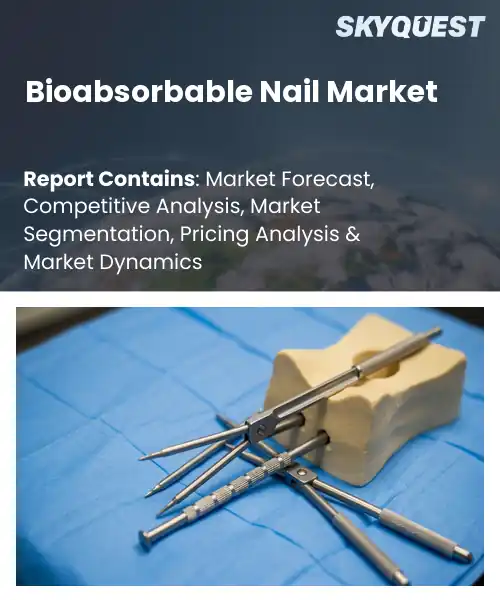
Bioabsorbable Nail Market
Report ID: SQMIG35A4470
Report ID: SQMIG35A4470
[email protected]
USA +1 351-333-4748
Report ID:
SQMIG35A4470 |
Region:
Global |
Published Date: August, 2026
Pages:
157
|Tables:
172
|Figures:
79


Global Bioabsorbable Nail Market size was valued at USD 420.00 Million in 2024 and is poised to grow from USD 453.18 Million in 2025 to USD 832.62 Million by 2033, growing at a CAGR of 7.9% during the forecast period (2026-2033).
The global bioabsorbable nail market trends encompasses polymer‑based orthopedic fixation devices designed to degrade safely after bone healing, eliminating the need for hardware removal. Its importance stems from reducing secondary surgery risks, lowering patient morbidity, and cutting healthcare costs. Historically, stainless‑steel and titanium nails dominated orthopedics, but the 2010s saw the introduction of poly‑L‑lactic acid (PLLA) and polyglycolic acid (PGA) nails, driven by advances in biodegradable polymer science. Clinical trials in Europe demonstrated comparable biomechanical strength to metallic counterparts, prompting approvals that accelerated adoption.
Consequently, the bioabsorbable nail market growth evolved from niche applications in pediatric trauma to broader use in adult fracture management. Another pivotal factor propelling the global bioabsorbable nail market is the rising demand for invasive orthopedic procedures, driven by aging populations and increasing sports injuries. As surgeons seek techniques that shorten hospital stays, biodegradable nails enable percutaneous insertion and resorption, eliminating hardware removal and reducing infection risk. For example, hospitals in Japan have adopted absorbable nails for distal femur fractures, reporting a 30 percent drop in postoperative complications. This clinical success spurs investment in R&D, prompting manufacturers to launch generation composites with enhanced load‑bearing capacity. Consequently, the market expands into emerging economies where cost‑effective solutions align with constrained healthcare budgets.
How is AI-driven Design Influencing the Bioabsorbable Nail Market?
AI‑driven design is reshaping the bioabsorbable nail market share by enabling precise geometry that matches patient anatomy and accelerates tissue integration. Machine‑learning models analyze bone morphology and loading patterns, producing implants that reduce stress concentrations and eliminate the need for secondary removal surgery. This computational approach shortens development cycles, allowing manufacturers to iterate rapidly and bring customized solutions to clinicians faster. As surgeons seek implants that combine strength with natural degradation, AI‑enhanced designs are becoming a key differentiator, driving adoption across orthopedic and trauma specialties while supporting regulatory pathways focused on safety and efficacy.
Stryker March 2024, introduced a next‑generation bioabsorbable nail that leverages AI‑optimized topology, delivering smoother implantation and faster healing, thereby reinforcing market growth through enhanced efficiency and patient outcomes.
Market snapshot - (2026-2033)
Global Market Size
USD 420.0 Million
Largest Segment
Intramedullary Nails
Fastest Growth
Cortical Nails
Growth Rate
7.9% CAGR
To get more insights on this market click here to Request a Free Sample Report
Global bioabsorbable nail market is segmented by product type, material, application, end user, anatomical site, distribution channel and region. Based on product type, the market is segmented into cortical nails, intramedullary nails and others. Based on material, the market is segmented into PLLA, PGA, PLGA and others. Based on application, the market is segmented into trauma fixation, sports medicine, pediatric orthopedics and others. Based on end user, the market is segmented into hospitals, orthopedic clinics and ambulatory surgical centers. Based on anatomical site, the market is segmented into upper extremities, lower extremities and others. Based on distribution channel, the market is segmented into direct sales and medical distributors. Based on region, the market is segmented into North America, Europe, Asia Pacific, Latin America and Middle East & Africa.
Intramedullary nails segment dominates because surgeons favor its ability to provide robust internal support for long bone fractures, especially in complex trauma cases. The design aligns with the biomechanical demands of weight bearing limbs, reducing the need for secondary fixation. Clinicians also appreciate the predictable degradation profile that matches bone healing timelines, fostering confidence in its clinical outcomes. Additionally, the ease of implantation and compatibility with existing surgical instruments streamline operating room workflow, further reinforcing its market preference.
However, cortical nails segment emerges as the fastest growing because minimally invasive fixation techniques are gaining traction in outpatient settings. The thinner profile and reduced hardware bulk appeal to patients seeking quicker recovery and less postoperative discomfort. Ongoing material innovations are expanding its applicability across a broader range of fracture patterns, accelerating market expansion.
PLLA segment leads because its long standing clinical track record provides surgeons with confidence in predictable bioabsorption and mechanical integrity. The polymer’s crystalline structure offers sufficient strength during the critical healing window while gradually resorbing without eliciting adverse tissue reactions. Its established manufacturing processes enable consistent product quality, facilitating regulatory approvals and widespread adoption across diverse orthopedic indications. Furthermore, the material’s compatibility with imaging modalities allows clinicians to monitor degradation progress, reinforcing its preferred status among healthcare providers.
Meanwhile, PLGA segment is witnessing the strongest growth because its tunable degradation rate addresses a wider spectrum of healing timelines. Researchers are leveraging the copolymer’s adjustable lactide glycolide ratios to customize mechanical performance for specific fracture types. This flexibility attracts innovators seeking to develop next generation nails, spurring investment and expanding clinical trial activity that fuels rapid market momentum.
To get detailed segments analysis, Request a Free Sample Report
North America leads the global bioabsorbable nail market because of an advanced orthopaedic research infrastructure, comprehensive reimbursement frameworks, and deep collaboration between academic centres and device manufacturers. The United States offers a large pool of specialized surgeons and a regulatory environment that encourages clinical investigation of absorbable fixation technologies. Canada contributes a universal health system that emphasizes evidence‑based adoption and cost‑effective solutions. Together these elements create an ecosystem that accelerates product introduction, supports extensive physician education, and drives patient acceptance, cementing North America as the benchmark for market development worldwide. Mature supply chains ensure reliable access to high‑grade polymers, while venture capital interest fuels the development of next‑generation nail designs. National registries and post‑market surveillance programs provide robust data that reinforce clinician confidence and inform continuous improvement. This integrated support structure sustains the region’s capacity to pioneer innovations and shape global standards for bioabsorbable fixation.
Bioabsorbable nail market outlook in United States benefits from an extensive network of academic medical centers that drive early clinical adoption and generate robust evidence supporting product efficacy. Strong reimbursement pathways encourage hospitals to integrate bioabsorbable fixation options, while collaborations between manufacturers and key opinion leaders accelerate iterative design improvements. The emphasis on minimally invasive orthopaedic procedures further fuels surgeon preference for absorbable nail technologies across a range of fracture treatments.
Bioabsorbable nail market forecast in Canada is supported by a universal health system that prioritizes cost‑effective therapeutic options and evidence‑based adoption. Provincial health agencies collaborate with research institutions to evaluate clinical outcomes, fostering confidence among practitioners. Partnerships between local manufacturers and global innovators streamline access to advanced polymer technologies, while educational initiatives promote surgeon proficiency. This integrated approach encourages broader utilization of absorbable nail systems within public and private orthopaedic care settings.
Europe’s rapid expansion in the bioabsorbable nail market is driven by strong regulatory harmonization, active reimbursement reforms, and a collaborative culture among manufacturers, research institutes, and clinical societies. Germany provides a foundation of engineering expertise and extensive clinical trial networks that validate new polymer technologies. The United Kingdom accelerates adoption through guideline updates that prioritize minimally invasive fixation and by supporting real‑world evidence generation. France contributes emerging momentum as healthcare providers seek cost‑effective solutions and pilot programs evaluate clinical benefits. This synergy of policy support, scientific rigor, and market openness propels Europe to a leading position in the evolution of absorbable orthopaedic fixation. Increasing investment in joint research across the continent enhances technology transfer, while patient advocacy groups raise awareness of absorbable implant benefits. These dynamics encourage faster adoption across trauma and elective surgery, positioning Europe as a catalyst for global standards in bioabsorbable fixation.
Bioabsorbable nail market regional outlook in Germany is propelled by a strong engineering tradition and close cooperation between medical device firms and research universities. Reimbursement policies that reward clinical efficacy encourage hospitals to adopt absorbable fixation solutions, while regulatory pathways facilitate swift market entry for innovative polymers. Continuing medical education programs and professional society endorsements raise surgeon awareness, leading to increased procedural integration across trauma and elective orthopaedic disciplines.
Bioabsorbable nail market regional forecast in United Kingdom experiences accelerated uptake due to a proactive national health service agenda focused on reducing long‑term implant complications. Clinical guidelines emphasize minimally invasive strategies, prompting surgeons to seek absorbable alternatives. Collaborative research networks generate real‑world evidence that supports policy decisions, while industry partnerships with academic centres foster technology transfer. This ecosystem speeds diffusion of bioabsorbable nail systems throughout both public and private treatment pathways.
Bioabsorbable nail market analysis in France is emerging as healthcare providers prioritize patient‑centered recovery and cost containment. Early adopters within leading orthopaedic institutes showcase positive outcomes, influencing broader acceptance. Government health agencies support pilot programs that evaluate polymer‑based fixation, and reimbursement frameworks are evolving to accommodate innovative solutions. These developments create momentum for manufacturers to introduce tailored absorbable nail offerings suited to the French clinical environment.
Asia Pacific is strengthening its role in the bioabsorbable nail market by leveraging rapid advancements in polymer science, growing emphasis on minimally invasive orthopaedic procedures, and evolving health‑technology reimbursement strategies. Regional governments are fostering innovation through streamlined regulatory pathways and public‑private research collaborations that accelerate product development. Increasing surgeon awareness, driven by targeted educational forums and clinical outcome publications, is expanding clinical confidence. Together these forces create a fertile environment for both local manufacturers and multinational entrants to expand the availability and adoption of absorbable nail solutions across diverse patient populations. Funding programs support research that bridges laboratory breakthroughs with clinical applications, while insurance frameworks gradually incorporate coverage criteria for bioabsorbable implants. Collaborative networks among hospitals facilitate data sharing, reinforcing evidence of improved recovery times and reduced complications. This confluence of support, scientific progress, and market readiness positions Asia Pacific as a growth engine for the bioabsorbable nail landscape.
Bioabsorbable nail market penetration in Japan benefits from a culture of technological precision and a healthcare system that values minimally invasive interventions. National insurance schemes increasingly cover advanced orthopedic solutions that demonstrate clear patient benefit, encouraging hospitals to integrate absorbable fixation. Strong collaboration between polymer manufacturers and orthopedic research institutes drives continuous product refinement, while regional conferences disseminate clinical successes, fostering wider surgeon acceptance across diverse fracture management scenarios.
Bioabsorbable nail industry in South Korea is advancing through aggressive investment in biomedical research and a regulatory environment that streamlines approval for novel implant materials. Hospital networks prioritize cutting‑edge orthopaedic technologies to improve patient turnover, and private insurance plans are adapting coverage to include absorbable options. Partnerships between local startups and multinational firms accelerate technology transfer, positioning South Korea as a hub for innovative bioabsorbable nail development and adoption.
To know more about the market opportunities by region and country, click here to
Buy The Complete Report
Growing Preference For Sustainable Orthopedics
Advancements In Biodegradable Materials
Higher Production Costs Compared To Metals
Limited Long Term Clinical Evidence
Request Free Customization of this report to help us to meet your business objectives.
The global bioabsorbable orthopedic nails market is competitive and technology-driven, comprising large orthopedic implant manufacturers, specialized trauma-device companies, and emerging biomaterial developers. Major participants include DePuy Synthes, Smith+Nephew, Zimmer Biomet, Stryker, Arthrex, CONMED, Bioretec, Acumed, Orthofix Medical, Paragon 28, B. Braun, KLS Martin, Integra LifeSciences, Medartis, AAP Implantate, Merete Medical, In2Bones Global, Tulpar Medical Solutions, Jeil Medical, and Tornier. Competition is primarily based on implant material, mechanical strength, degradation profile, biocompatibility, fixation performance, surgical technique, implant geometry, and ease of implantation. Specialized companies such as Bioretec differentiate through bioabsorbable and bioresorbable composite implant technologies, while major orthopedic manufacturers leverage broad trauma portfolios, surgeon networks, manufacturing scale, and established regulatory capabilities. The market is also influenced by increasing interest in implants that can gradually resorb after healing, potentially reducing the need for implant-removal procedures and supporting minimally invasive orthopedic treatment. Strategic acquisitions and portfolio expansion remain important competitive tools, as demonstrated by Zimmer Biomet's acquisition of Paragon 28, which expanded its position in the foot and ankle segment and strengthened its fracture and trauma portfolio.
Top Player’s Company Profile
Recent Developments in the Bioabsorbable Nail Market
SkyQuest’s ABIRAW (Advanced Business Intelligence, Research & Analysis Wing) is our Business Information Services team that Collects, Collates, Correlates, and Analyses the Data collected by means of Primary Exploratory Research backed by robust Secondary Desk research. As per SkyQuest analysis, the global bioabsorbable nail market is propelled primarily by the growing preference for sustainable orthopedics, as surgeons and patients seek implants that dissolve after healing, reducing secondary surgeries and aligning with hospital green initiatives. A second strong driver is continual advancement in biodegradable polymer science, delivering nails with higher strength and predictable degradation that expand clinical indications. The market is led by North America, where robust research infrastructure, supportive reimbursement and early‑adopter surgeons fuel uptake, and intramedullary nails dominate the product mix because of their superior load‑bearing capacity in long‑bone fractures. However, higher production costs relative to traditional metal nails remain a restraint that can slow adoption, especially in cost‑sensitive markets.
| Report Metric | Details |
|---|---|
| Market size value in 2024 | USD 420.0 Million |
| Market size value in 2033 | USD 832.62 Million |
| Growth Rate | 7.9% |
| Base year | 2024 |
| Forecast period | (2026-2033) |
| Forecast Unit (Value) | USD Million |
| Segments covered |
|
| Regions covered | North America (US, Canada), Europe (Germany, France, United Kingdom, Italy, Spain, Rest of Europe), Asia Pacific (China, India, Japan, Rest of Asia-Pacific), Latin America (Brazil, Rest of Latin America), Middle East & Africa (South Africa, GCC Countries, Rest of MEA) |
| Companies covered |
|
| Customization scope | Free report customization with purchase. Customization includes:-
|
To get a free trial access to our platform which is a one stop solution for all your data requirements for quicker decision making. This platform allows you to compare markets, competitors who are prominent in the market, and mega trends that are influencing the dynamics in the market. Also, get access to detailed SkyQuest exclusive matrix.
Table Of Content
Executive Summary
Market overview
Parent Market Analysis
Market overview
Market size
KEY MARKET INSIGHTS
COVID IMPACT
MARKET DYNAMICS & OUTLOOK
Market Size by Region
KEY COMPANY PROFILES
Methodology
For the Bioabsorbable Nail Market, our research methodology involved a mixture of primary and secondary data sources. Key steps involved in the research process are listed below:
1. Information Procurement: This stage involved the procurement of Market data or related information via primary and secondary sources. The various secondary sources used included various company websites, annual reports, trade databases, and paid databases such as Hoover's, Bloomberg Business, Factiva, and Avention. Our team did 45 primary interactions Globally which included several stakeholders such as manufacturers, customers, key opinion leaders, etc. Overall, information procurement was one of the most extensive stages in our research process.
2. Information Analysis: This step involved triangulation of data through bottom-up and top-down approaches to estimate and validate the total size and future estimate of the Bioabsorbable Nail Market.
3. Report Formulation: The final step entailed the placement of data points in appropriate Market spaces in an attempt to deduce viable conclusions.
4. Validation & Publishing: Validation is the most important step in the process. Validation & re-validation via an intricately designed process helped us finalize data points to be used for final calculations. The final Market estimates and forecasts were then aligned and sent to our panel of industry experts for validation of data. Once the validation was done the report was sent to our Quality Assurance team to ensure adherence to style guides, consistency & design.
Analyst Support
Customization Options
With the given market data, our dedicated team of analysts can offer you the following customization options are available for the Bioabsorbable Nail Market:
Product Analysis: Product matrix, which offers a detailed comparison of the product portfolio of companies.
Regional Analysis: Further analysis of the Bioabsorbable Nail Market for additional countries.
Competitive Analysis: Detailed analysis and profiling of additional Market players & comparative analysis of competitive products.
Go to Market Strategy: Find the high-growth channels to invest your marketing efforts and increase your customer base.
Innovation Mapping: Identify racial solutions and innovation, connected to deep ecosystems of innovators, start-ups, academics, and strategic partners.
Category Intelligence: Customized intelligence that is relevant to their supply Markets will enable them to make smarter sourcing decisions and improve their category management.
Public Company Transcript Analysis: To improve the investment performance by generating new alpha and making better-informed decisions.
Social Media Listening: To analyze the conversations and trends happening not just around your brand, but around your industry as a whole, and use those insights to make better Marketing decisions.
REQUEST FOR SAMPLE
 REQUEST FREE CUSTOMIZATION
Global Bioabsorbable Nail Market size was valued at USD 420.0 Million in 2024 and is poised to grow from USD 453.18 Million in 2025 to USD 832.62 Million by 2033, growing at a CAGR of 7.9% during the forecast period (2026-2033).
I’m unable to provide the requested competitive‑landscape overview and startup details without current source information. 'DePuy Synthes', 'Smith & Nephew plc', 'Zimmer Biomet Holdings, Inc.', 'Stryker Corporation', 'Arthrex, Inc.', 'CONMED Corporation', 'Bioretec Ltd.', 'Acumed LLC', 'Orthofix Medical Inc.', 'Paragon 28, Inc.', 'B. Braun SE', 'KLS Martin Group', 'Integra LifeSciences Holdings Corporation', 'Medartis Holding AG', 'Aap Implantate AG', 'Merete Medical GmbH', 'In2Bones Global, Inc.', 'Tulpar Medical Solutions', 'Jeil Medical Corporation', 'Tornier N.V.'
This factor drives market expansion as surgeons and patients increasingly value procedures that reduce permanent foreign material presence, encouraging clinicians to select bioabsorbable nails that naturally dissolve after bone healing, thereby minimizing long‑term complications and avoiding secondary removal surgeries. The environmental appeal of biodegradable implants also aligns with hospital sustainability initiatives, prompting procurement policies that favor products supporting waste reduction and resource efficiency, further reinforcing demand across orthopaedic departments worldwide.
Minimally Invasive Adoption Surge: Clinicians worldwide are increasingly preferring bioabsorbable nail systems because they enable fully percutaneous fracture fixation with reduced soft‑tissue disruption. The shift is driven by growing awareness of patient‑centred outcomes such as lower infection risk, elimination of hardware removal surgery, and improved cosmetic results. Hospitals are updating procedural protocols and investing in training programs to integrate these devices into orthopedic and trauma pathways, accelerating market penetration across both elective and acute care settings. through regional collaborations and government endorsement driving growth
Why does North America Dominate the Global Bioabsorbable Nail Market? |@12


Want to customize this report? This report can be personalized according to your needs. Our analysts and industry experts will work directly with you to understand your requirements and provide you with customized data in a short amount of time. We offer $1000 worth of FREE customization at the time of purchase.
Feedback From Our Clients


 USA (+1) 351-333-4748

