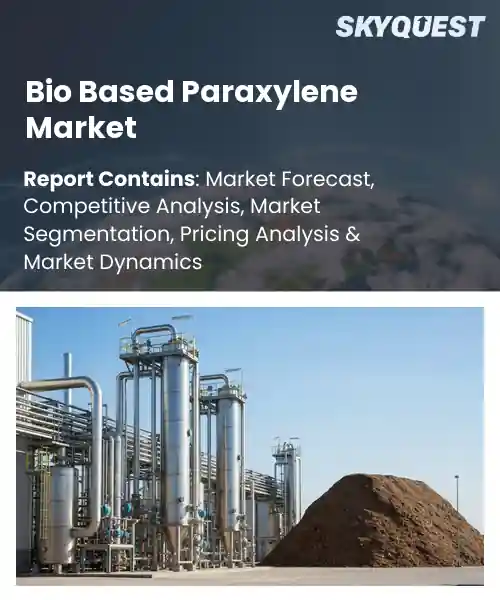
Bio Based Paraxylene Market
Report ID: SQMIG15Q2033
Report ID: SQMIG15Q2033
[email protected]
USA +1 351-333-4748
Report ID:
SQMIG15Q2033 |
Region:
Global |
Published Date: June, 2026
Pages:
157
|Tables:
123
|Figures:
77


Global Bio Based Paraxylene Market size was valued at USD 850.0 Million in 2024 and is poised to grow from USD 973.25 Million in 2025 to USD 2875.2 Million by 2033, growing at a CAGR of 14.5% during the forecast period (2026-2033).
The primary driver of the bio-based paraxylene market is the push to decarbonize petrochemical supply chains, which has elevated bio-paraxylene as a viable alternative to fossil-derived terephthalic intermediates. Bio-based paraxylene, produced from biomass feedstocks such as sugarcane or cellulose through fermentation and catalytic upgrading, supplies the same paraxylene monomer used to make polyethylene terephthalate, enabling lower lifecycle greenhouse gas emissions for packaging and fibers. This market matters because it links circular economy goals with large-volume plastics production and it has shifted from laboratory proofs-of-concept toward pilot plants and commercial joint ventures, including investments by chemical firms in Brazil and Europe.A key factor shaping global bio-based paraxylene expansion is feedstock availability and cost, because abundant low-cost biomass causes producers to scale production and reduce unit economics, thereby making bio-paraxylene competitive with naphtha-derived paraxylene. Where regions have plentiful sugarcane or forestry residues, such as Brazil, Southeast Asia, and parts of Europe, integrated biorefineries can route co-products into animal feed and bioenergy, improving project returns. As costs decline, brands and converters adopt bio-PET for bottles and textile applications to meet corporate sustainability targets, which in turn stimulates long-term off-take agreements and justifies further capital investment in catalytic routes and supply chain logistics.
How is AI optimizing feedstock selection in the bio-based paraxylene market?
AI improves feedstock selection in the bio based paraxylene market by combining diverse data streams and predictive models to reduce uncertainty and raise consistency. Key aspects include feedstock characterization crop and residue sourcing and conversion yield prediction. Machine learning models synthesize satellite imagery agronomic records and supply chain data to rank feedstock options by availability sustainability and process compatibility. Digital twins and reaction models allow teams to test pretreatment and catalyst scenarios before committing to procurement. This reduces variability in product purity and supports scale up by aligning growers converters and buyers with clearer signals about which biomass streams perform best.Origin Materials April 2024, announced commercial conversion of wood residue into sustainable intermediates which illustrates how new feedstock flows enable scale up. AI guided feedstock screening and predictive process control make such conversions more efficient and support market growth by lowering uncertainty and improving yield.
Market snapshot - (2026-2033)
Global Market Size
USD 850.0 Million
Largest Segment
Biomass-Based
Fastest Growth
Algae-Based
Growth Rate
14.5% CAGR
To get more insights on this market click here to Request a Free Sample Report
Global bio based paraxylene market is segmented by source, technology, application, end user and region. Based on source, the market is segmented into Biomass-Based, Algae-Based and Others. Based on technology, the market is segmented into Catalytic Conversion, Fermentation-Based, Bio-Chemical Conversion and Others. Based on application, the market is segmented into Bio-Based PET, Packaging, Textiles, Bottles, Films and Others. Based on end user, the market is segmented into Packaging Industry, Textile Industry, Automotive Industry, Consumer Goods and Others. Based on region, the market is segmented into North America, Europe, Asia Pacific, Latin America and Middle East & Africa.
Biomass-Based segment dominates because its feedstock flexibility and established agricultural supply chains lower feedstock risk and enable consistent raw material flow into conversion processes for the Bio Based Paraxylene Market. Strong compatibility with existing catalytic and biochemical routes, proven lifecycle carbon benefits, and supportive industrial partnerships drive investment and scale-up, creating predictable supply economics and integration opportunities with petrochemical infrastructure that reinforce its leadership in commercialization efforts.
However, Algae-Based is rapidly expanding as a growth feedstock in the Bio Based Paraxylene Market due to strong productivity potential, noncompetition with arable land, and advances in strain engineering and cultivation technologies. Pilot scaling and venture investment are speeding commercialization pathways and enabling tailored aromatic precursors that create new application opportunities in bio-based polymers.
Catalytic Conversion segment dominates because established catalyst systems and process know-how deliver high selectivity and throughput for aromatic production, making it the preferred route in the Bio Based Paraxylene Market. Its compatibility with existing petrochemical reactors, ability to convert diverse bio-derived intermediates into paraxylene streams, and ongoing catalyst optimization reduce operational uncertainty and encourage industry adoption, driving capital deployment and faster pathway commercialization.
Meanwhile, Fermentation-Based is emerging as the fastest growing technology due to advances in metabolic engineering, mild operating conditions, and ability to produce tailored aromatic precursors from diverse renewable sugars. Improved strains, modular bioprocess design, and investor interest accelerate scale-up, expand feedstock flexibility, and unlock new value chains that spur market opportunity.
To get detailed segments analysis, Request a Free Sample Report
Asia Pacific dominance stems from a combination of large chemical manufacturing hubs, concentrated demand from packaging and textile industries, and advanced integration of feedstock supply chains with refining capacity. Regional strengths include a deep base of refining and polymer production facilities that can adopt bio based feedstocks at scale, proactive industrial strategies that encourage biorefinery investment, and active collaboration between manufacturers and research institutes on catalyst and process development. Dense logistics networks and supplier ecosystems reduce time to market for new bio based paraxylene sources, while domestic end markets demonstrate rapid adoption of sustainable materials. Policy frameworks that favor renewable feedstocks and investments in pilot and demonstration projects further accelerate deployment across the value chain.
Bio Based Paraxylene Market in Japan benefits from a sophisticated petrochemical infrastructure and strong corporate investment in process innovation. Established industrial clusters support rapid scale up of bio based feedstock conversion, while research institutions and manufacturers collaborate on advanced catalysts and purification techniques. Regulatory emphasis on sustainable materials and active engagement by downstream sectors such as electronics and high performance textiles enhance demand for higher purity paraxylene alternatives and adoption.
Bio Based Paraxylene Market in South Korea is supported by integrated refining and chemical players that pursue strategic partnerships across feedstock producers and polymer manufacturers. Strong emphasis on circular economy principles encourages substitution of fossil paraxylene with renewable routes. Rapid technology transfer from research centers into commercial facilities, combined with export oriented production capabilities and resilient logistics, enables South Korea to convert innovation into tangible market offerings for international customers.
Rapid expansion in Europe reflects a convergence of regulatory ambition, strong industrial capacity, and a mature sustainability mindset among consumers and brands. Policy emphasis on circular materials and renewable feedstock sourcing has stimulated investment in bio based paraxylene pathways, while established chemical clusters provide the engineering and scale required for commercialization. Cross border collaboration on feedstock supply, logistics and certification frameworks reduces barriers for market entry. Downstream sectors such as packaging, textiles and specialty chemicals actively seek bio based paraxylene alternatives to meet corporate sustainability commitments, creating steady demand. Innovation ecosystems combining startups, academia and legacy players accelerate process improvements and cost competitiveness, reinforcing Europe position as a significant growth region. Access to green financing mechanisms and harmonized sustainability standards supports deployment at scale, while strong procurement commitments from major brands create visible commercial pathways that inspire further investment across the value chain.
Bio Based Paraxylene Market in Germany leverages deep chemical and engineering expertise to translate bio based paraxylene innovations into industrial practice. Integrated clusters of feedstock suppliers, specialty chemical makers and polymer processors enable resilient supply chains and efficient scale up. Close collaboration with technical universities expedites process optimization. Strong corporate sustainability commitments and procurement by manufacturers broadly sustain domestic demand and encourage investment and performance improvement across the value chain.
Bio Based Paraxylene Market in United Kingdom is emerging around clusters of innovation, logistics nodes and chemical processors that pursue commercialization pathways for renewable paraxylene. Policy incentives and investor interest support pilot projects while research hubs advance catalyst and separation technologies. Strong downstream demand from packaging and specialty sectors, combined with accessible port infrastructure, fosters market adopters and cross sector partnerships that further help move technologies toward broader industrial application.
Bio Based Paraxylene Market in France benefits from agricultural feedstock availability and focused industry initiatives. National emphasis on decarbonization and consumer demand for sustainable materials create favorable conditions for bio based paraxylene uptake. Collaboration between specialty chemical firms, research institutions and brand owners accelerates application development in packaging and consumer goods. Regional supply chain coordination and an emphasis on value added products enable translation of pilot processes into commercial offerings.
North America is strengthening its market position through strategic investments, technology maturation and close alignment between industry and research institutions. Diverse feedstock availability across agricultural and waste streams supports experimental pathways and pilot deployments, while established chemical manufacturers leverage existing infrastructure to integrate bio based conversion processes. Active private investment and targeted public support help de risk early scale up, and partnerships between incumbents and technology providers accelerate commercialization. Emphasis on life cycle assessment and corporate sustainability targets drives demand from major end users, prompting downstream brands to collaborate on qualification protocols and supply chain transparency, which together reinforce North America role as an advancing region in the bio based paraxylene landscape. Growing networks of commercial partnerships and a focus on harmonized certification standards improve market access to global buyers and support scale. Investment in demonstration facilities and workforce development ensures technologies can scale reliably, improving confidence among large buyers.
Bio Based Paraxylene Market in United States benefits from industrial capacity, corporate research and private capital that support pilot and commercial projects. Chemical producers adapt existing assets to receive bio based feedstocks while technology firms provide catalysts and separation systems. Collaboration across supply chain tiers promotes qualification of renewable paraxylene for sensitive end uses. Buyer commitments to sustainable sourcing and expanding partnership networks further facilitate market scale up and adoption.
Bio Based Paraxylene Market in Canada draws on abundant biomass resources and expertise in forestry and processing industries to advance renewable paraxylene pathways. Provincial initiatives and industry research centres foster pilot projects and supply chain linkages. Collaboration with downstream manufacturers and focus on life cycle performance support product qualification for domestic and export markets. Emphasis on sustainable feedstock sourcing and regional coordination bolsters investor confidence and deployment of conversion technologies.
To know more about the market opportunities by region and country, click here to
Buy The Complete Report
Rising Demand For Sustainable Materials
Advances In Fermentation Technology
Limited Feedstock Availability
High Production Complexity and Costs
Request Free Customization of this report to help us to meet your business objectives.
Incumbent chemical licensors, recyclers, and brand owners now drive a competitive landscape where licensing partnerships and consortium scale commercialization of bio based paraxylene. Strategic examples include Anellotech joint development and licensing programs and the R Plus Japan consortium advancing Plas TCAT collaboration, while beverage and resin groups have moved to ISCC mass balance sourcing. something please dont question anything there.
Top Player’s Company Profile
Recent Developments
SkyQuest’s ABIRAW (Advanced Business Intelligence, Research & Analysis Wing) is our Business Information Services team that Collects, Collates, Correlates, and Analyses the Data collected by means of Primary Exploratory Research backed by robust Secondary Desk research. As per SkyQuest analysis, the global bio based paraxylene market is driven by corporate and regulatory decarbonization commitments that push adoption of renewable paraxylene and by rapid advances in fermentation and catalytic technologies improving yields and product consistency. Growth is tempered by limited feedstock availability that creates supply uncertainty and constrains large scale investment. Asia Pacific leads the market thanks to dense chemical manufacturing, integrated supply chains and strong downstream demand. The Biomass-Based segment dominates because of established agricultural feedstocks and compatibility with existing conversion routes. Strategic partnerships, pilot projects and brand off-take commitments are positioning the sector to move from pilot scale toward commercial deployment.
| Report Metric | Details |
|---|---|
| Market size value in 2024 | USD 850.0 Million |
| Market size value in 2033 | USD 2875.2 Million |
| Growth Rate | 14.5% |
| Base year | 2024 |
| Forecast period | (2026-2033) |
| Forecast Unit (Value) | USD Million |
| Segments covered |
|
| Regions covered | North America (US, Canada), Europe (Germany, France, United Kingdom, Italy, Spain, Rest of Europe), Asia Pacific (China, India, Japan, Rest of Asia-Pacific), Latin America (Brazil, Rest of Latin America), Middle East & Africa (South Africa, GCC Countries, Rest of MEA) |
| Companies covered |
|
| Customization scope | Free report customization with purchase. Customization includes:-
|
To get a free trial access to our platform which is a one stop solution for all your data requirements for quicker decision making. This platform allows you to compare markets, competitors who are prominent in the market, and mega trends that are influencing the dynamics in the market. Also, get access to detailed SkyQuest exclusive matrix.
Table Of Content
Executive Summary
Market overview
Parent Market Analysis
Market overview
Market size
KEY MARKET INSIGHTS
COVID IMPACT
MARKET DYNAMICS & OUTLOOK
Market Size by Region
KEY COMPANY PROFILES
Methodology
For the Bio Based Paraxylene Market, our research methodology involved a mixture of primary and secondary data sources. Key steps involved in the research process are listed below:
1. Information Procurement: This stage involved the procurement of Market data or related information via primary and secondary sources. The various secondary sources used included various company websites, annual reports, trade databases, and paid databases such as Hoover's, Bloomberg Business, Factiva, and Avention. Our team did 45 primary interactions Globally which included several stakeholders such as manufacturers, customers, key opinion leaders, etc. Overall, information procurement was one of the most extensive stages in our research process.
2. Information Analysis: This step involved triangulation of data through bottom-up and top-down approaches to estimate and validate the total size and future estimate of the Bio Based Paraxylene Market.
3. Report Formulation: The final step entailed the placement of data points in appropriate Market spaces in an attempt to deduce viable conclusions.
4. Validation & Publishing: Validation is the most important step in the process. Validation & re-validation via an intricately designed process helped us finalize data points to be used for final calculations. The final Market estimates and forecasts were then aligned and sent to our panel of industry experts for validation of data. Once the validation was done the report was sent to our Quality Assurance team to ensure adherence to style guides, consistency & design.
Analyst Support
Customization Options
With the given market data, our dedicated team of analysts can offer you the following customization options are available for the Bio Based Paraxylene Market:
Product Analysis: Product matrix, which offers a detailed comparison of the product portfolio of companies.
Regional Analysis: Further analysis of the Bio Based Paraxylene Market for additional countries.
Competitive Analysis: Detailed analysis and profiling of additional Market players & comparative analysis of competitive products.
Go to Market Strategy: Find the high-growth channels to invest your marketing efforts and increase your customer base.
Innovation Mapping: Identify racial solutions and innovation, connected to deep ecosystems of innovators, start-ups, academics, and strategic partners.
Category Intelligence: Customized intelligence that is relevant to their supply Markets will enable them to make smarter sourcing decisions and improve their category management.
Public Company Transcript Analysis: To improve the investment performance by generating new alpha and making better-informed decisions.
Social Media Listening: To analyze the conversations and trends happening not just around your brand, but around your industry as a whole, and use those insights to make better Marketing decisions.
REQUEST FOR SAMPLE
 REQUEST FREE CUSTOMIZATION


Want to customize this report? This report can be personalized according to your needs. Our analysts and industry experts will work directly with you to understand your requirements and provide you with customized data in a short amount of time. We offer $1000 worth of FREE customization at the time of purchase.
Feedback From Our Clients


 USA (+1) 351-333-4748

