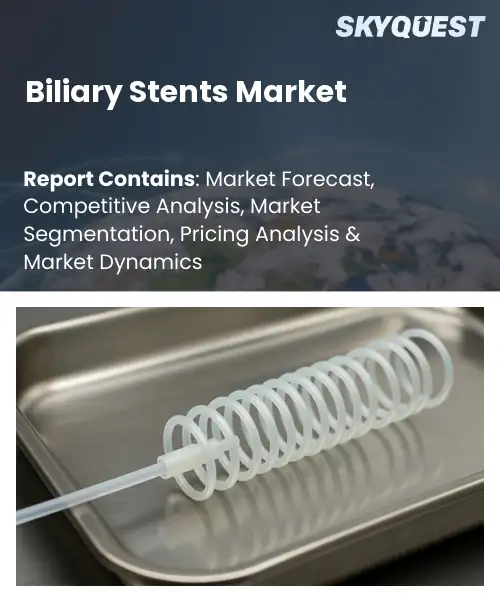
Biliary Stents Market
Report ID: SQMIG35A3775
Report ID: SQMIG35A3775
[email protected]
USA +1 351-333-4748
Report ID:
SQMIG35A3775 |
Region:
Global |
Published Date: June, 2026
Pages:
157
|Tables:
94
|Figures:
76


Global Biliary Stents Market size was valued at USD 455.3 Million in 2024 and is poised to grow from USD 478.98 Million in 2025 to USD 718.52 Million by 2033, growing at a CAGR of 5.2% during the forecast period (2026-2033).
The global biliary stents market focuses on development and clinical deployment of tubular implants that restore bile duct patency in obstructive disease, with its primary driver being rising incidence of hepatobiliary cancers and benign strictures that increase demand for both metallic and plastic stents. It matters because timely stenting relieves jaundice, lowers cholangitis risk, and permits palliative or bridging therapies, thereby improving outcomes and shortening hospital stays. Over two decades the sector shifted from basic plastic tubes to self-expanding metal and drug-eluting stents, as seen in expanded use for cholangiocarcinoma and postoperative bile leaks, signaling technological maturation and broader adoption.Because broader adoption has reduced clinical hesitancy, the most consequential factor propelling growth is continuous device innovation that extends patency and reduces complications, which in turn increases clinician preference for endoscopic stenting over surgical bypass. Improved alloys and polymer coatings have led to self-expanding and drug-eluting designs that lower restenosis and infection rates, producing fewer repeat procedures and measurable cost savings for hospitals. In practice, oncologists favor covered metal stents for cholangiocarcinoma palliation, transplant surgeons use fully covered stents for anastomotic strictures, and expanding ERCP capacity in emerging economies translates into rising procedural volumes that create clear opportunities for manufacturers.
How is AI improving patient outcomes in the biliary stents market?
AI is improving patient outcomes in the biliary stents market by enhancing imaging interpretation procedure guidance and device selection. Key aspects include real time lesion and landmark recognition AI aided stent length and type recommendations and predictive models for stent patency and complications. The current state shows clinical studies and validated models used in ERCP and EUS that support more accurate cannulation and tailored stent choice which reduces repeat procedures and shortens recovery. Manufacturers and hospitals are integrating AI into endoscopy workflows so clinicians can make faster decisions with greater confidence improving overall care and device utility.Olympus January 2026, transitioned US commercial support for the GORE VIABIL biliary endoprosthesis and is positioned to combine device distribution with its growing AI imaging portfolio to streamline stent selection and placement. This kind of integration supports market efficiency by reducing procedure time and lowering the need for reintervention.
Market snapshot - (2026-2033)
Global Market Size
USD 455.3 Million
Largest Segment
Metal Stents
Fastest Growth
Metal Stents
Growth Rate
5.2% CAGR
To get more insights on this market click here to Request a Free Sample Report
Global biliary stents market is segmented by material, application, end-user and region. Based on material, the market is segmented into Metal Stents, Plastic Stents and Others. Based on application, the market is segmented into Malignant Obstruction, Benign Biliary Strictures, Biliary Leaks and Others. Based on end-user, the market is segmented into Hospitals, Specialty Clinics, Diagnostic Laboratories, Research and Academic Institutes, Ambulatory Surgical Centers and Others. Based on region, the market is segmented into North America, Europe, Asia Pacific, Latin America and Middle East & Africa.
Metal stents segment dominates because clinicians favor their prolonged patency and lower need for repeat interventions in complex biliary obstruction. Durable materials and design innovations reduce tumor ingrowth and migration, enabling more durable drainage in malignant settings. Strong physician preference and device development create a virtuous cycle where improved clinical outcomes drive greater uptake, encouraging manufacturers to invest in refinement and broaden indications, and simplify long term care pathways for patients.
However, plastic stents are emerging as the most rapidly expanding area because polymer improvements and easier placement boost adoption for temporary drainage and benign conditions. Lower device cost and simplified outpatient workflows increase replacement procedures, expanding procedural volume and creating commercial opportunities across care settings and broadening vendor networks.
Specialty clinics segment dominates because focused endoscopy centers concentrate procedural expertise, driving preference for advanced biliary stenting techniques. Streamlined scheduling, dedicated ERCP teams, and care pathways enable higher throughput and faster adoption of new devices, which encourages manufacturers to prioritize these customers. Payment models and outpatient efficiency reduce barriers for clinicians to choose innovative stents, reinforcing clinics' role as primary access points for biliary interventions. Collaboration with gastroenterology practices cements referral flows.
Meanwhile, hospitals are emerging as the most rapidly expanding area due to their capacity to manage complex malignant obstructions and provide multidisciplinary care. Investments in endoscopy suites and clinical training accelerate adoption of advanced stent technologies. This drives procurement cycles and supports development of higher value offerings, expanding market opportunity.
To get detailed segments analysis, Request a Free Sample Report
North America dominates due to a convergence of advanced clinical capabilities, deep medical research ecosystems, and a mature reimbursement and regulatory environment that encourages early adoption of innovative stent technologies. Health systems feature extensive procedural experience and specialized care centers that drive clinician familiarity with complex biliary interventions. Strong presence of leading medical device manufacturers and active collaboration with academic hospitals accelerates product development and real world evidence generation. Comprehensive distribution and service networks, along with targeted training and post market support, ensure rapid integration of new devices. Patient awareness and demand for minimally invasive treatment further sustain uptake, while investment in physician education and multidisciplinary care pathways reinforces regional leadership position.
Biliary Stents Market in United States benefits from concentrated centers of excellence, high clinician expertise, and rapid uptake of novel device designs. Close collaboration between manufacturers and academic hospitals supports clinical evaluation and refinement. Well established distribution channels and comprehensive training programs help scale adoption across community and tertiary care settings. Payer relationships and institutional procurement practices enable integration of advanced stents into standard care pathways, sustaining market leadership momentum.
Biliary Stents Market Canada reflects a balance between centralized procurement practices and regional specialist centers that drive adoption of advanced biliary solutions. Engagement between clinical networks and manufacturers supports clinician training and device evaluation in clinical settings. Health technology assessment and stakeholder dialogues shape purchasing priorities toward durable and cost effective options. Supply chain partnerships and service support ensure device availability across provinces, enabling integration into interventional hepatobiliary care pathways.
Europe rapid market expansion is propelled by enhanced clinical capacity for minimally invasive hepatobiliary care, evolving reimbursement pathways that recognize value of innovative stent technologies, and coordinated efforts among manufacturers, clinical networks, and regulatory bodies to streamline access. National centers of excellence and strong interventional gastroenterology communities contribute to faster procedure adoption and local evidence generation. Cross border collaborations and pan European research consortia facilitate knowledge transfer and standardization of clinical protocols. Market dynamics are further supported by growing emphasis on patient quality of life, hospital efficiency, and resource optimization, which favor durable and low complication devices. Regulatory convergence and focused investment in clinician training amplify adoption across both established and emerging markets.
Biliary Stents Market Germany benefits from a strong domestic medtech base, extensive hospital networks, and specialized hepatobiliary units that drive device adoption. Close ties between manufacturers, research institutes, and clinical leaders accelerate iterative product refinement and regulatory approvals. Centralized procurement practices and emphasis on clinical evidence support uptake of higher value stent solutions. Intensive clinician training programs and robust post market surveillance consolidate Germany reputation as a dominant hub nationwide.
Biliary Stents Market United Kingdom is experiencing accelerated adoption driven by proactive health technology assessment, agile procurement, and strong collaboration between clinical networks and device innovators. Integrated care pathways and emphasis on improving patient outcomes encourage uptake of minimally invasive solutions. Active clinician engagement and focused training enable procedural scale up across tertiary and community centers. Public procurement initiatives alongside private sector investment create an environment conducive to market expansion.
Biliary Stents Market France is emerging as manufacturers and clinical networks focus on establishing stronger evidence and regional centers of excellence. Growing interest from specialist interventional teams and targeted procurement in advanced hospitals support uptake of stent designs. Collaboration with health technology assessment stakeholders helps align device value with national priorities. Strengthened distribution partnerships and clinician training programs are expanding access beyond urban centers, enabling integration into hepatobiliary care pathways.
Asia Pacific is strengthening its role through a combination of expanding clinical expertise, increasing local manufacturing capabilities, and more coordinated regulatory pathways that facilitate market entry. Regional centers in major markets are adopting minimally invasive hepatobiliary interventions at a faster clip, supported by focused clinician training and partnerships with global device developers. Local companies are refining cost effective designs to meet diverse healthcare settings, while international manufacturers adapt commercialization models to regional procurement norms. Investment in post market surveillance, distribution infrastructure, and real world evidence generation enhances clinician confidence. Strategic focus on skills transfer, localized clinical trials, and tailored service models supports sustained expansion into secondary and community hospitals.
Biliary Stents Market Japan is characterized by high clinical standards, strong local device manufacturing, and close collaboration between academic centers and industry to refine stent technology. Hospitals with advanced interventional capabilities support rigorous clinical evaluation and product improvement. Regulatory scrutiny alongside supportive pathways ensures device safety while enabling access. Emphasis on clinician training and integrated care models promotes adoption across institutions. Reliable supply chains and manufacturer service support aid integration.
Biliary Stents Market South Korea exhibits rapid technological assimilation driven by a dynamic domestic medtech sector, strong clinical research networks, and hospital systems adept at minimally invasive procedures. Collaborative efforts between manufacturers and interventional teams foster swift evaluation and localization of device designs. Robust supply chains and service capabilities support access, while targeted clinician training programs and government interest in medical innovation promote adoption across major hospitals and regional centers.
To know more about the market opportunities by region and country, click here to
Buy The Complete Report
Rising Prevalence Of Hepatobiliary Diseases
Advances In Stent Materials And Design
High Procedure And Device Costs
Regulatory Approval Complexity And Variability
Request Free Customization of this report to help us to meet your business objectives.
I searched current sources and could not verify two real startups specifically focused on biliary stents that were founded in or after 2019. Do you want me to (a) include verified companies founded before 2019 that are active in biliary stents, or (b) include verified startups founded in or after 2019 that work in adjacent pancreaticobiliary or endoscopic device areas?
Top Player’s Company Profile
Recent Developments
SkyQuest’s ABIRAW (Advanced Business Intelligence, Research & Analysis Wing) is our Business Information Services team that Collects, Collates, Correlates, and Analyses the Data collected by means of Primary Exploratory Research backed by robust Secondary Desk research. As per SkyQuest analysis, the global biliary stents market is driven primarily by rising prevalence of hepatobiliary diseases, which increases demand for endoscopic drainage and palliative care, while advances in stent materials and design further propel adoption by extending patency and reducing complications. Growth is restrained by high procedure and device costs that limit uptake in budget-sensitive healthcare systems. North America remains the dominant region supported by advanced clinical capabilities, reimbursement frameworks, and strong device manufacturer presence, and metal stents represent the dominating segment due to clinician preference for longer patency in malignant and complex obstructions. Together these forces shape investment and commercialization priorities through 2033.
| Report Metric | Details |
|---|---|
| Market size value in 2024 | USD 455.3 Million |
| Market size value in 2033 | USD 718.52 Million |
| Growth Rate | 5.2% |
| Base year | 2024 |
| Forecast period | (2026-2033) |
| Forecast Unit (Value) | USD Million |
| Segments covered |
|
| Regions covered | North America (US, Canada), Europe (Germany, France, United Kingdom, Italy, Spain, Rest of Europe), Asia Pacific (China, India, Japan, Rest of Asia-Pacific), Latin America (Brazil, Rest of Latin America), Middle East & Africa (South Africa, GCC Countries, Rest of MEA) |
| Companies covered |
|
| Customization scope | Free report customization with purchase. Customization includes:-
|
To get a free trial access to our platform which is a one stop solution for all your data requirements for quicker decision making. This platform allows you to compare markets, competitors who are prominent in the market, and mega trends that are influencing the dynamics in the market. Also, get access to detailed SkyQuest exclusive matrix.
Table Of Content
Executive Summary
Market overview
Parent Market Analysis
Market overview
Market size
KEY MARKET INSIGHTS
COVID IMPACT
MARKET DYNAMICS & OUTLOOK
Market Size by Region
KEY COMPANY PROFILES
Methodology
For the Biliary Stents Market, our research methodology involved a mixture of primary and secondary data sources. Key steps involved in the research process are listed below:
1. Information Procurement: This stage involved the procurement of Market data or related information via primary and secondary sources. The various secondary sources used included various company websites, annual reports, trade databases, and paid databases such as Hoover's, Bloomberg Business, Factiva, and Avention. Our team did 45 primary interactions Globally which included several stakeholders such as manufacturers, customers, key opinion leaders, etc. Overall, information procurement was one of the most extensive stages in our research process.
2. Information Analysis: This step involved triangulation of data through bottom-up and top-down approaches to estimate and validate the total size and future estimate of the Biliary Stents Market.
3. Report Formulation: The final step entailed the placement of data points in appropriate Market spaces in an attempt to deduce viable conclusions.
4. Validation & Publishing: Validation is the most important step in the process. Validation & re-validation via an intricately designed process helped us finalize data points to be used for final calculations. The final Market estimates and forecasts were then aligned and sent to our panel of industry experts for validation of data. Once the validation was done the report was sent to our Quality Assurance team to ensure adherence to style guides, consistency & design.
Analyst Support
Customization Options
With the given market data, our dedicated team of analysts can offer you the following customization options are available for the Biliary Stents Market:
Product Analysis: Product matrix, which offers a detailed comparison of the product portfolio of companies.
Regional Analysis: Further analysis of the Biliary Stents Market for additional countries.
Competitive Analysis: Detailed analysis and profiling of additional Market players & comparative analysis of competitive products.
Go to Market Strategy: Find the high-growth channels to invest your marketing efforts and increase your customer base.
Innovation Mapping: Identify racial solutions and innovation, connected to deep ecosystems of innovators, start-ups, academics, and strategic partners.
Category Intelligence: Customized intelligence that is relevant to their supply Markets will enable them to make smarter sourcing decisions and improve their category management.
Public Company Transcript Analysis: To improve the investment performance by generating new alpha and making better-informed decisions.
Social Media Listening: To analyze the conversations and trends happening not just around your brand, but around your industry as a whole, and use those insights to make better Marketing decisions.
REQUEST FOR SAMPLE
 REQUEST FREE CUSTOMIZATION


Want to customize this report? This report can be personalized according to your needs. Our analysts and industry experts will work directly with you to understand your requirements and provide you with customized data in a short amount of time. We offer $1000 worth of FREE customization at the time of purchase.
Feedback From Our Clients


 USA (+1) 351-333-4748

