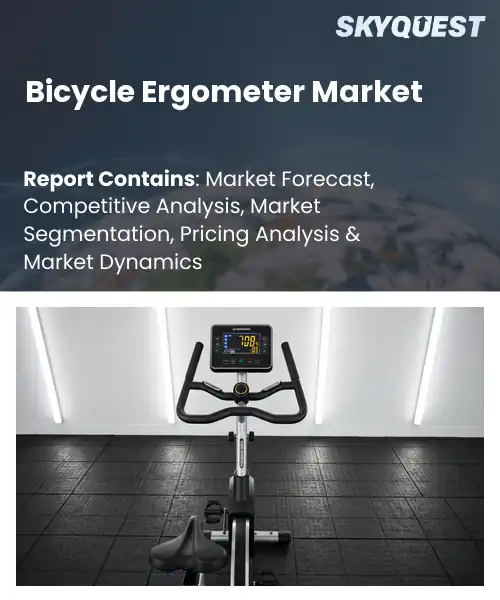
Bicycle Ergometer Market
Report ID: SQMIG35A4461
Report ID: SQMIG35A4461
[email protected]
USA +1 351-333-4748
Report ID:
SQMIG35A4461 |
Region:
Global |
Published Date: August, 2026
Pages:
157
|Tables:
173
|Figures:
79


Global Bicycle Ergometer Market size was valued at USD 1.6 Billion in 2024 and is poised to grow from USD 1.73 Billion in 2025 to USD 3.18 Billion by 2033, growing at a CAGR of 7.9% during the forecast period (2026-2033).
Bicycle ergometer is a machine which simulates the exercise of biking for assessing the fitness level of the body. This device has heart rate sensors, resistance sensors, and sensors for measuring the biomechanics of the patient and its purpose is to provide information about the fitness levels of individuals through a standard workout routine. Importance of this market is based on the fact that there is a need for standardization of the exercises being performed so as to follow certain clinical guidelines and trends of the consumer segment. It came into existence in the early 1970s due to the popularity of stationary bikes in hospitals.
An important driver behind the bicycle ergometer market around the world is the use of health platforms which take raw performance statistics to derive meaningful information. With the addition of Bluetooth technology and analytics, every pedal stroke can create a training plan, help increase motivation, and even be used to monitor patients' heart conditions remotely. Hence, healthcare professionals have been prescribing more connected ergometers in order to facilitate the cardiac rehabilitation of patients, improving readmission rates while keeping the costs low. At the same time, insurance companies understand the benefits of preventive measures and offer discounts that attract new customers to the market.
How is AI-driven Automation Shaping the Global Bicycle Ergometer Market?
AI driven automation is reshaping the bicycle ergometer market by embedding sensors, machine learning and cloud connectivity into the core hardware. Modern ergometers now adjust resistance in real time based on a rider’s power output, predict maintenance needs before failures occur, and generate personalized workout programs that evolve with user performance. Manufacturers are leveraging these capabilities to differentiate products, while gyms and home users benefit from more engaging and efficient training sessions. The convergence of data analytics, virtual coaching and seamless equipment integration creates a feedback loop that fuels product innovation and expands the appeal of smart cycling solutions worldwide.
Market snapshot - (2026-2033)
Global Market Size
USD 1.6 Billion
Largest Segment
Upright Ergometers
Fastest Growth
Indoor Cycling Ergometers
Growth Rate
7.9% CAGR
To get more insights on this market click here to Request a Free Sample Report
Global bicycle ergometer market is segmented by product type, resistance type, application, end user, distribution channel and region. Based on product type, the market is segmented into Upright Ergometers, Recumbent Ergometers and Indoor Cycling Ergometers. Based on resistance type, the market is segmented into Magnetic, Electromagnetic, Air Resistance and Others. Based on application, the market is segmented into Fitness Training, Cardiac Rehabilitation and Sports Performance. Based on end user, the market is segmented into Hospitals, Fitness Centers and Home Users. Based on distribution channel, the market is segmented into Direct Sales, Specialty Stores and Online Retail. Based on region, the market is segmented into North America, Europe, Asia Pacific, Latin America and Middle East & Africa.
Upright ergometers segment dominates because they align with the core expectations of most fitness facilities and home users, offering a familiar riding posture that mimics traditional bicycles. Their compact footprint and straightforward mechanical design simplify installation and maintenance, fostering broad acceptance across diverse environments. Additionally, the ergonomic familiarity encourages consistent usage, driving brand loyalty and reinforcing their central position in the bicycle ergometer market within the overall ecosystem and strengthens the value proposition.
Meanwhile, recumbent ergometers segment emerges as the fastest growing because their reclined seating reduces strain on the lower back, attracting an expanding demographic of rehabilitation patients and senior users. This comfort driven appeal fuels rising adoption in clinical settings and home environments, accelerating market expansion and opening new opportunity corridors.
Magnetic resistance segment is the most dominating one due to its ability to provide silent and smooth operation satisfying the acoustic needs of gyms, clinics, and private houses. Precision adjustability of the technology allows users to increase exercise level without any wear and tear of mechanical parts, increasing durability of equipment and lowering maintenance cost. It makes magnetic resistance the optimal choice for bicycle ergometers manufacturers and consumers, who are interested in low maintenance products.
However, the air resistance segment demonstrates the highest growth rate due to its ability to provide a realistic load resembling outdoors cycling experience. It satisfies the demands of enthusiastic cyclists and athletes and stimulates market development and innovations.
To get detailed segments analysis, Request a Free Sample Report
Asia Pacific’s predominance is owed to an effective synergy between its superior manufacturing capabilities, heightened urban health consciousness, and government programs encouraging physical activity. The region enjoys access to skilled engineering workforce which is instrumental in bringing innovation in terms of products, leading to the development of ergonomically designed products suitable for varied customers. Emphasis on fitness and growing involvement of middle class population increases demand for such products in both business and residential environment. Furthermore, investments made towards health infrastructure and consumer education campaigns add to this effect, making the region a benchmark in the world of bicycle ergometers.
Bicycle Ergometer Market in Japan reflects a sophisticated consumer base that values precision engineering and integrated digital features. Manufacturers leverage advanced sensor technology and seamless connectivity to cater to both rehabilitation centers and personal fitness enthusiasts. The market is reinforced by a strong tradition of health monitoring and a growing preference for home‑based training solutions, encouraging continual product refinement and brand loyalty.
Bicycle Ergometer Market in South Korea is propelled by a vibrant digital ecosystem and a national focus on preventive health measures. Local producers emphasize sleek design, IoT integration, and interactive platforms that resonate with tech‑savvy users. Governmental promotion of wellness programs and an expanding network of fitness facilities further stimulate demand, fostering an environment where innovation and consumer engagement thrive.
Expansion in North America is fueled by the growing health awareness of people, increasing corporate wellness programs, and the emergence of a culture that promotes home-based flexibility for workout exercises. Users are now looking for devices that provide high levels of information, a good training experience, and a connection to different health applications. Product availability through retail and fitness store channels has been increasing, and even professional sports and physical rehabilitation industries have recognized the ergonomic advantages of bicycle ergometers.
Bicycle Ergometer Market in United States is characterized by strong consumer demand for high‑performance, multifunctional equipment that integrates with popular fitness ecosystems. Brands prioritize customizable resistance profiles and real‑time performance analytics, appealing to both dedicated athletes and casual users. A thriving network of specialty retailers and online platforms enhances product visibility, while corporate wellness programs and insurance incentives further encourage adoption across workplaces and homes.
Bicycle Ergometer Market in Canada benefits from a growing emphasis on active living and a supportive health policy framework that encourages regular exercise. Manufacturers focus on durability and climate‑adapted designs suitable for indoor use throughout the year. Collaborative partnerships with health institutions and community fitness initiatives amplify awareness, driving steady interest among health‑focused consumers and rehabilitation providers alike.
Europe’s strength in this arena lies in its high standards, strong research collaboration, and the long-standing tradition of functional fitness. Sustainability and lifecycle management of the products are a priority for Europe, which leads companies to use sustainable materials and design efficient mechanisms. In addition, integration with health monitoring systems and cross-border research projects lead to improvement. Finally, wide application in clinical rehabilitation programs, sports medicine, and company wellness programs demonstrates Europe’s desire to make use of bicycle ergometers as an essential element of health strategy.
Bicycle Ergometer Market in Germany is driven by engineering precision and a reputation for reliable, high‑quality equipment. Industry players focus on modular designs that support extensive data tracking and ergonomic customization, catering to both professional training facilities and home users. Strong collaborations with academic institutions and a robust network of physiotherapy clinics reinforce product credibility and market penetration.
Bicycle Ergometer Market in United Kingdom reflects a keen interest in health monitoring and integrated digital experiences. Manufacturers prioritize sleek aesthetics, seamless app connectivity, and versatile resistance options that align with the country’s active lifestyle trends. Partnerships with national health campaigns and fitness influencers amplify consumer engagement, encouraging broader adoption across gyms and personal spaces.
Bicycle Ergometer Market in France is shaped by a cultural appreciation for holistic wellness and a thriving sports medicine community. Product development emphasizes comfort, intuitive interfaces, and compatibility with popular French fitness platforms. Government‑backed wellness initiatives and a strong presence of rehabilitation centers drive demand, reinforcing the market’s growth trajectory.
To know more about the market opportunities by region and country, click here to
Buy The Complete Report
Rising Fitness Awareness Encourages Purchase
Advancements in Ergometer Technology Expand Applications
High Initial Purchase Cost Limits Adoption
Limited Space in Urban Homes Reduces Demand
Request Free Customization of this report to help us to meet your business objectives.
The global market for bicycle ergometers is relatively concentrated, with manufacturers of established exercise equipment and medical devices vying for business within the clinical, sports, rehab, and fitness sectors. Competition within this sector focuses on measurement accuracy, resistance control, durability, connectivity, biometrics, ergonomics, and product reliability. Market leaders have enhanced their competitive positions using technology for connected fitness, performance analytics, and clinical solutions, while local players have competed through lower-priced products and applications.
SkyQuest’s ABIRAW (Advanced Business Intelligence, Research & Analysis Wing) is our Business Information Services team that Collects, Collates, Correlates, and Analyses the Data collected by means of Primary Exploratory Research backed by robust Secondary Desk research.
As per SkyQuest analysis, the global bicycle‑ergometer market is being propelled primarily by rising fitness awareness that pushes consumers toward home‑based cardio solutions, while a second strong catalyst is the rapid advancement of sensor‑rich, connected technology that broadens applications from rehabilitation to elite training. The market is led by the upright‑ergometer segment, which benefits from its familiar posture and compact design, and Asia‑Pacific remains the dominant region thanks to manufacturing strengths and growing health‑conscious demand. However, the high initial purchase price of premium units restrains wider adoption, especially among price‑sensitive households and smaller gyms, tempering overall growth and underscores the need for cost‑effective models.
| Report Metric | Details |
|---|---|
| Market size value in 2024 | USD 1.6 Billion |
| Market size value in 2033 | USD 3.18 Billion |
| Growth Rate | 7.9% |
| Base year | 2024 |
| Forecast period | (2026-2033) |
| Forecast Unit (Value) | USD Billion |
| Segments covered |
|
| Regions covered | North America (US, Canada), Europe (Germany, France, United Kingdom, Italy, Spain, Rest of Europe), Asia Pacific (China, India, Japan, Rest of Asia-Pacific), Latin America (Brazil, Rest of Latin America), Middle East & Africa (South Africa, GCC Countries, Rest of MEA) |
| Companies covered |
|
| Customization scope | Free report customization with purchase. Customization includes:-
|
To get a free trial access to our platform which is a one stop solution for all your data requirements for quicker decision making. This platform allows you to compare markets, competitors who are prominent in the market, and mega trends that are influencing the dynamics in the market. Also, get access to detailed SkyQuest exclusive matrix.
Table Of Content
Executive Summary
Market overview
Parent Market Analysis
Market overview
Market size
KEY MARKET INSIGHTS
COVID IMPACT
MARKET DYNAMICS & OUTLOOK
Market Size by Region
KEY COMPANY PROFILES
Methodology
For the Bicycle Ergometer Market, our research methodology involved a mixture of primary and secondary data sources. Key steps involved in the research process are listed below:
1. Information Procurement: This stage involved the procurement of Market data or related information via primary and secondary sources. The various secondary sources used included various company websites, annual reports, trade databases, and paid databases such as Hoover's, Bloomberg Business, Factiva, and Avention. Our team did 45 primary interactions Globally which included several stakeholders such as manufacturers, customers, key opinion leaders, etc. Overall, information procurement was one of the most extensive stages in our research process.
2. Information Analysis: This step involved triangulation of data through bottom-up and top-down approaches to estimate and validate the total size and future estimate of the Bicycle Ergometer Market.
3. Report Formulation: The final step entailed the placement of data points in appropriate Market spaces in an attempt to deduce viable conclusions.
4. Validation & Publishing: Validation is the most important step in the process. Validation & re-validation via an intricately designed process helped us finalize data points to be used for final calculations. The final Market estimates and forecasts were then aligned and sent to our panel of industry experts for validation of data. Once the validation was done the report was sent to our Quality Assurance team to ensure adherence to style guides, consistency & design.
Analyst Support
Customization Options
With the given market data, our dedicated team of analysts can offer you the following customization options are available for the Bicycle Ergometer Market:
Product Analysis: Product matrix, which offers a detailed comparison of the product portfolio of companies.
Regional Analysis: Further analysis of the Bicycle Ergometer Market for additional countries.
Competitive Analysis: Detailed analysis and profiling of additional Market players & comparative analysis of competitive products.
Go to Market Strategy: Find the high-growth channels to invest your marketing efforts and increase your customer base.
Innovation Mapping: Identify racial solutions and innovation, connected to deep ecosystems of innovators, start-ups, academics, and strategic partners.
Category Intelligence: Customized intelligence that is relevant to their supply Markets will enable them to make smarter sourcing decisions and improve their category management.
Public Company Transcript Analysis: To improve the investment performance by generating new alpha and making better-informed decisions.
Social Media Listening: To analyze the conversations and trends happening not just around your brand, but around your industry as a whole, and use those insights to make better Marketing decisions.
REQUEST FOR SAMPLE
 REQUEST FREE CUSTOMIZATION
Global Bicycle Ergometer Market size was valued at USD 1.6 Billion in 2024 and is poised to grow from USD 1.73 Billion in 2025 to USD 3.18 Billion by 2033, growing at a CAGR of 7.9% during the forecast period (2026-2033).
I’m sorry, but I don’t have sufficient information to complete this request. 'Life Fitness', 'Technogym S.p.A.', 'Matrix Fitness', 'Precor Incorporated', 'Johnson Health Tech Co., Ltd.', 'SportsArt Fitness', 'Monark Exercise AB', 'Ergoline GmbH', 'Lode B.V.', 'SCHILLER AG', 'Ergoline GmbH', 'Body Bike International A/S', 'Keiser Corporation', 'BH Fitness', 'Wattbike Ltd.', 'Concept2, Inc.', 'Tacx (Garmin Ltd.)', 'Elite S.r.l.', 'Stages Cycling LLC', 'Bodytone International Sport S.L.'
Consumers are placing greater emphasis on personal health and preventive exercise, prompting a shift toward home‑based cardio solutions that fit flexible schedules. As awareness of cardiovascular benefits grows, individuals seek reliable equipment that simulates outdoor cycling without weather constraints. Bicycle ergometers offer controlled intensity, measurable performance metrics, and low‑impact workouts, aligning with these motivations. Consequently, demand escalates across fitness enthusiasts, rehabilitation patients, and corporate wellness programs, reinforcing market expansion through increased unit sales and broader product adoption in various regions.
Connected Training Integration: Fitness centers and home users are increasingly demanding ergometers that seamlessly sync with digital health ecosystems, enabling real‑time data sharing with mobile apps, wearable devices, and corporate wellness platforms. Manufacturers are embedding Bluetooth, Wi‑Fi, and cloud‑based analytics, allowing personalized training programs, remote coaching, and performance benchmarking. This connectivity drives higher user engagement, supports data‑driven health initiatives, and creates recurring revenue streams through subscription services, positioning the bicycle ergometer as a pivotal component of integrated digital fitness solutions for modern athletes.
Why does Asia Pacific Dominate the Global Bicycle Ergometer Market? |@12


Want to customize this report? This report can be personalized according to your needs. Our analysts and industry experts will work directly with you to understand your requirements and provide you with customized data in a short amount of time. We offer $1000 worth of FREE customization at the time of purchase.
Feedback From Our Clients


 USA (+1) 351-333-4748

