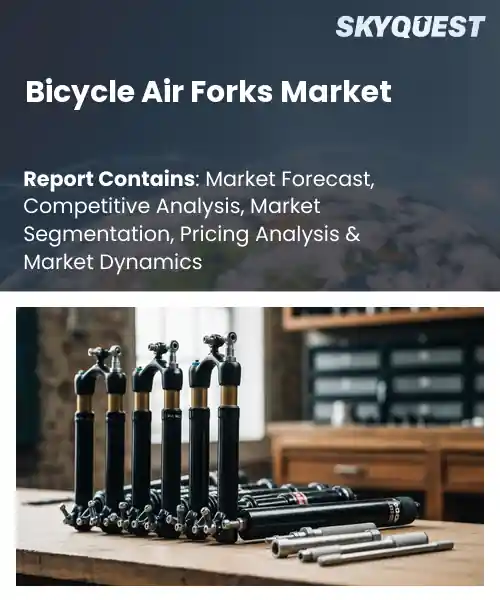
Bicycle Air Forks Market
Report ID: SQMIG25J2171
Report ID: SQMIG25J2171
[email protected]
USA +1 351-333-4748
Report ID:
SQMIG25J2171 |
Region:
Global |
Published Date: March, 2026
Pages:
157
|Tables:
143
|Figures:
78


Global Bicycle Air Forks Market size was valued at USD 543.0 Million in 2024 and is poised to grow from USD 591.87 Million in 2025 to USD 1179.34 Million by 2033, growing at a CAGR of 9.0% during the forecast period (2026-2033).
Surge in popularity of mountain biking and gravel cycling, rising adoption of e-bikes, and growing demand for lightweight and high-performance suspension systems are shaping sales of bicycle air forks through 2033.
The evolution of the bicycle air forks, from being high-end racing parts to becoming popular through advances in manufacturing technology and seals, opens up new opportunities for business. Such advancements have allowed for a wider range of applications in trails, gravel bikes, and even e-mountain bikes, while simultaneously nurturing an entire community of accessories, repair equipment, and customization services. Electrification within the bicycle market is another critical consideration that is contributing to the growth of the industry, as heavier battery packs and increased velocity make a tunable and robust suspension system necessary. With the growing numbers of bicycle companies incorporating air forks to manufacture their electric bikes, production is growing, thus making them cheaper and more available in the aftermarket. Growing emphasis on performance, rider comfort, and tunability is expected to primarily drive market growth.
On the contrary, high product and maintenance costs, technical complexity in setup and servicing, durability concerns under extreme conditions, and competition from simpler coil-based forks are expected to hamper bicycle air forks market penetration in the future.
How is IoT Improving Performance Monitoring in the Bicycle Air Forks Market?
The application of IoT has enhanced performance monitoring through bicycle air forks by incorporating pressure and motion sensors that transmit information to the rider's device and cloud servers. Critical aspects involve real-time pressure monitoring, identification of any seal damage at an early stage, and automatic tuning depending on the nature of the surface. There is now a shift from manual settings to automatic configurations, which ease installation and enhance the lifespan of maintenance. This promotes high levels of trust and facilitates premium maintenance and servicing practices.
In February 2026, SRAM updated its AXS app to improve suspension connectivity and diagnostics. This allows riders and service shops to monitor fork performance, detect issues early, and make remote adjustments, helping improve reliability and support market growth.
Market snapshot - (2026-2033)
Global Market Size
USD 543.0 Million
Largest Segment
Mid-Travel
Fastest Growth
Long Travel
Growth Rate
9.0% CAGR
To get more insights on this market click here to Request a Free Sample Report
Global bicycle air forks market is segmented by suspension travel, wheel size compatibility, adjustability features, stanchion diameter, sales channel, and region. Based on suspension travel, the market is segmented into short travel, mid-travel, and long travel. Based on wheel size compatibility, the market is segmented into 26-inch, 27.5-inch, and 29-inch. Based on adjustability features, the market is segmented into compression adjust (high/low speed), rebound adjust, and remote lockout systems. Based on stanchion diameter, the market is segmented into 30mm - 32mm, 34mm – 36mm, and 38mm - 40mm. Based on sales channel, the market is segmented into OEM and aftermarket. Based on region, the market is segmented into North America, Europe, Asia Pacific, Latin America, and Middle East & Africa.
The mid-travel segment is forecasted to spearhead the global bicycle air forks market revenue generation across the study period. Mid-travel forks strike an optimal compromise between efficiency and capability for a wide range of trail conditions, which helps this segment hold sway over others. The combination of their stroke length, adjustability, and consistent dampening makes specialized setups unnecessary and has created a desire for OEMs to incorporate them in their models because of the emphasis on adaptability.
However, long travel is witnessing the fastest growth as per this bicycle air forks market forecast. Aggressive trail and enduro riding adoption pushes demand for greater absorption and adjustability to create new business scope. Manufacturers are coming up with advanced air spring curves and damping systems capable of withstanding bigger shocks and frames of bikes, hence opening up possibilities for manufacturers of high-end forks and their accessories.
The rebound adjust segment is estimated to account for the largest global bicycle air forks market share going forward. Precise control over wheel return and contact patch stability helps this segment hold sway over others. Rebound tuning is a critical performance lever for both casual and competitive riders. Its function in matching air spring dynamics reduces trial-and-error configurations, prompting its extensive use by designers and installers aiming to achieve uniform vehicle control and response in different riding situations.
Nevertheless, remote lockout systems have been identified to be one of the most rapidly growing segments because the riders seek suspension control while cycling uphill or making pedaling more effective. Incorporating such components within cockpits and electronic devices facilitates the product differentiation process, which helps to explore new market niches.
To get detailed segments analysis, Request a Free Sample Report
Concentrated manufacturing capability, deep supplier ecosystems, and a strong culture of cycling innovation allows Asia Pacific to lead sales of bicycle air forks on a global level. Local manufacturers in the Asia-Pacific have access to integrated component cluster development and supply chain coordination, resulting in a consistent level of refinement and cost control associated with product development. Rapid urbanization, along with the growth and continuation of recreational cycling communities, have aided in developing and creating a stable demand for bicycles across multiple consumer segments. Furthermore, due to the long-standing nature of established distribution networks, as well as the increasing desire for performance based premium part offerings, the level of investment has created the depth of the market. Furthermore, government assistance to promote and develop sustainable forms of transportation, combined with the large-scale establishment of sustainable infrastructures, and public awareness, have aided in establishing an environment conducive for the growth of bicycle air fork solutions throughout the Asia-Pacific region.
High emphasis on precision engineering, premium component preferences, and strong collaboration are shaping bicycle air forks demand in Japan. A high standard of performance in terms of smooth riding experience increases the need for effective damping and light-weighted design. Research on material and manufacturing techniques is frequently tested on the Japanese market before being released widely, whereas sophisticated customers and retailers contribute to the adoption of innovative air forks.
Emphasis on performance orientation and experimentation, with domestic firms emphasizing adaptable damping systems are shaping sales of bicycle air forks in South Korea. Cooperation between the supplier, as well as the cycling community, leads to feedback systems that will improve the fit of the product according to the various conditions. The urban cycling trend, together with increasing popularity in the sport of cycling, makes a market for adaptable air forks viable.
Mature cycling culture, strong aftermarket channels, and increasing demand for performance and comfort are shaping bicycle air forks adoption in Europe. Regional manufacturers have been consistently providing innovative products to match the various terrains and riding styles of customers, while independent retail outlets and independent shops have created an environment for making informed purchasing decisions and tuning products after purchase. The regulation of preferred modes of transportation and the investment in the cycling infrastructure are also helping to create increased visibility for bicycle components and encouraging the use of more advanced parts. Collaboration between component manufacturers and bicycle manufacturers is rapidly resulting in greater numbers of bicycles with air forks. As the European bicycle air forks market continues to mature, there are many opportunities to support premium innovations while also providing performance-based solutions at lower price points.
Engineering excellence and component durability are key factors defining demand for bicycle air forks in Germany. High expectations of consumers regarding quality and durability contribute to the need for precise air fork systems for German weather conditions. Production companies emphasize thorough testing and modularity in their design, which is appropriate for touring and performing. Specialized shops and skilled riders determine the company’s goals, whereas the distribution channel ensures adequate after-sales support.
High consumer interest in lightweight and versatile components for mixed urban and off-road riding helps shape sales of bicycle air forks in the United Kingdom. Enthusiasm among cyclists leads to a demand for performance enhancements, which is catered to by retailers and garages for fitting purposes. The manufacturers provide modules and adjustable mechanisms for ensuring the comfort requirements of commuters as well as the performance aspects of trail riding are met.
Rising interest in trail riding and component customization, with consumers seeking balanced performance shapes procurement of bicycle air forks in France. Tuning facilities are available in local garages, which make the products more suitable for different surfaces. Through regional events and activities, air forks become established in the country. New designs with attractive damping and finishing are offered by local brands and foreign manufacturers.
High emphasis on innovation, diverse riding disciplines, and expanding aftermarket service capabilities shape bicycle air forks demand in North America. Manufacturers concentrate on developing innovative materials, providing user-friendly adjustability options, and ensuring compatibility with different frame platforms to service mountain bikes, gravel bikes, and urban commuter segments. A strong network of expert retailers and independent shops cater to customers by offering installation and tuning services and building consumer confidence in their products. Cooperating with various brands encourages the integration of air forks into standard manufactured bicycles, and consumer feedback from the enthusiast community provides input for product design and the adaptation of prototypes. Investment in bike lane and trail infrastructure as well as activity event ecosystems will create an increase in public awareness and, ultimately, increase the demand for advanced suspension solutions in North America.
Presence of an active enthusiast base and varied terrain are helping boosts demand for bicycle air forks in the United States. Cooperation with bike manufacturers ensures further adoption in different markets, and customer suggestions and new trails assist in developing products. Suppliers concentrate on ensuring compatibility with high-performance bikes, with additional aftermarket support offered by specialty shops and repair facilities.
Varied riding environments from urban centers to mountain trails, create demand for adaptable, weather resistant components such as bicycle air forks in Canda. Increased attention towards electric-powered and adventure biking is driving more people towards air forks that offer a balance between comfort and performance. Manufacturers consider corrosion resistance and shock absorption regardless of varying climate conditions. The dealer network and regional events help enhance customization and knowledge among users.
To know more about the market opportunities by region and country, click here to
Buy The Complete Report
Urban Commuting Preference
Bicycle users in cities now prefer models that provide both comfort and efficiency, leading to an increased interest in air forks to improve their performance and lower rider fatigue. With growing demand for flexible suspension systems due to the diverse terrain on city roads and trails, bicycle manufacturers and original equipment manufacturers (OEMs) focus on providing air fork designs customized for city bikes and electric bikes, as well as expanding the product range in retailers to cater to customer demands.
Advances In Materials Engineering
Materials science advancements along with developments in damping technologies have made air forks much more appealing in terms of functionality, allowing for construction of light and versatile air forks that cater to a wide range of customer requirements. Thanks to technology improvements, companies produce modifiable air fork units that decrease the maintenance hassle while providing improved performance in different riding conditions. Such products foster OEM integration and customer trust, contributing to differentiation strategies and boosting bicycle air forks market outlook as well.
Higher Purchase And Maintenance Costs
High initial costs of buying quality air forks together with maintenance costs could make potential buyers who are price conscious reluctant to buy them. The perception of high total costs outweighing anticipated benefits could make buyers prefer basic suspension models or solid forks. The producers should ensure that they prove the buyers of the long-term benefit they could get from investing in the more expensive air forks. Until then, market growth could be slowed down by their low adoption rates.
Compatibility And Retrofit Challenges
Incompatibilities in the geometry of different types of bikes, variations in steering systems, and varying wheel sizes present challenges that have made air forks unattractive to consumers for retrofit. Specific mounting considerations or compatibility issues associated with certain frame designs and forks make their installation difficult, necessitating consultation with an expert to modify the component parts. This has led to a fragmented market with little cross-compatibility, making it harder for the product to gain wider acceptance among recreational riders who want to retrofit their bicycles.
Request Free Customization of this report to help us to meet your business objectives.
Competitive dynamics in the global bicycle air forks market are driven by supplier consolidation, OEM partnerships and rapid product innovation, forcing firms to pursue acquisitions, platform alliances and smart suspension R&D. Examples include Fox Factory asset purchases to broaden suspension offerings and Rivian’s ALSO spinout partnering on smart air fork systems, while e-bike startups adopt air forks to differentiate ride quality.
SkyQuest’s ABIRAW (Advanced Business Intelligence, Research & Analysis Wing) is our Business Information Services team that Collects, Collates, Correlates, and Analyses the Data collected by means of Primary Exploratory Research backed by robust Secondary Desk research.
As per SkyQuest analysis, increasing adoption of performance bicycles, rising popularity of e-bikes, and growing demand for lightweight and tunable suspension systems are anticipated to drive the demand for bicycle air forks going forward. However, high costs of advanced suspension systems, maintenance complexity, and competition from coil-based alternatives are slated to slow down the adoption of bicycle air forks in the future. North America is slated to spearhead the demand for bicycle air forks owing to strong cycling culture, high adoption of mountain and electric bikes, and presence of leading component manufacturers. Development of IoT-enabled suspension systems and integration of connected diagnostics and tuning applications are anticipated to be key trends driving the bicycle air forks sectors in the long run.
| Report Metric | Details |
|---|---|
| Market size value in 2024 | USD 543.0 Million |
| Market size value in 2033 | USD 1179.34 Million |
| Growth Rate | 9.0% |
| Base year | 2024 |
| Forecast period | (2026-2033) |
| Forecast Unit (Value) | USD Million |
| Segments covered |
|
| Regions covered | North America (US, Canada), Europe (Germany, France, United Kingdom, Italy, Spain, Rest of Europe), Asia Pacific (China, India, Japan, Rest of Asia-Pacific), Latin America (Brazil, Rest of Latin America), Middle East & Africa (South Africa, GCC Countries, Rest of MEA) |
| Companies covered |
|
| Customization scope | Free report customization with purchase. Customization includes:-
|
To get a free trial access to our platform which is a one stop solution for all your data requirements for quicker decision making. This platform allows you to compare markets, competitors who are prominent in the market, and mega trends that are influencing the dynamics in the market. Also, get access to detailed SkyQuest exclusive matrix.
Table Of Content
Executive Summary
Market overview
Parent Market Analysis
Market overview
Market size
KEY MARKET INSIGHTS
COVID IMPACT
MARKET DYNAMICS & OUTLOOK
Market Size by Region
KEY COMPANY PROFILES
Methodology
For the Bicycle Air Forks Market, our research methodology involved a mixture of primary and secondary data sources. Key steps involved in the research process are listed below:
1. Information Procurement: This stage involved the procurement of Market data or related information via primary and secondary sources. The various secondary sources used included various company websites, annual reports, trade databases, and paid databases such as Hoover's, Bloomberg Business, Factiva, and Avention. Our team did 45 primary interactions Globally which included several stakeholders such as manufacturers, customers, key opinion leaders, etc. Overall, information procurement was one of the most extensive stages in our research process.
2. Information Analysis: This step involved triangulation of data through bottom-up and top-down approaches to estimate and validate the total size and future estimate of the Bicycle Air Forks Market.
3. Report Formulation: The final step entailed the placement of data points in appropriate Market spaces in an attempt to deduce viable conclusions.
4. Validation & Publishing: Validation is the most important step in the process. Validation & re-validation via an intricately designed process helped us finalize data points to be used for final calculations. The final Market estimates and forecasts were then aligned and sent to our panel of industry experts for validation of data. Once the validation was done the report was sent to our Quality Assurance team to ensure adherence to style guides, consistency & design.
Analyst Support
Customization Options
With the given market data, our dedicated team of analysts can offer you the following customization options are available for the Bicycle Air Forks Market:
Product Analysis: Product matrix, which offers a detailed comparison of the product portfolio of companies.
Regional Analysis: Further analysis of the Bicycle Air Forks Market for additional countries.
Competitive Analysis: Detailed analysis and profiling of additional Market players & comparative analysis of competitive products.
Go to Market Strategy: Find the high-growth channels to invest your marketing efforts and increase your customer base.
Innovation Mapping: Identify racial solutions and innovation, connected to deep ecosystems of innovators, start-ups, academics, and strategic partners.
Category Intelligence: Customized intelligence that is relevant to their supply Markets will enable them to make smarter sourcing decisions and improve their category management.
Public Company Transcript Analysis: To improve the investment performance by generating new alpha and making better-informed decisions.
Social Media Listening: To analyze the conversations and trends happening not just around your brand, but around your industry as a whole, and use those insights to make better Marketing decisions.
REQUEST FOR SAMPLE
 REQUEST FREE CUSTOMIZATION
Global Bicycle Air Forks Market size was valued at USD 543.0 Million in 2024 and is poised to grow from USD 591.87 Million in 2025 to USD 1179.34 Million by 2033, growing at a CAGR of 9.0% during the forecast period (2026-2033).
Competitive dynamics in the global bicycle air forks market are driven by supplier consolidation, OEM partnerships and rapid product innovation, forcing firms to pursue acquisitions, platform alliances and smart suspension R&D. Examples include Fox Factory asset purchases to broaden suspension offerings and Rivian’s ALSO spinout partnering on smart air fork systems, while e-bike startups adopt air forks to differentiate ride quality. 'FOX Factory', 'RockShox (SRAM)', 'SR Suntour', 'Manitou (Hayes Performance)', 'ÖHLINS', 'DT Swiss', 'RST (Dah Ken)', 'Marzocchi', 'X-Fusion', 'Cane Creek', 'Formula', 'DVO Suspension', 'Formula Brakes', 'MRP', 'Lauf Cycling', 'Intend BC', 'EXT (Extreme Shox)', 'BOS Suspension', 'White Brothers', 'Trust Performance'
Urban commuters increasingly favor bicycles that offer comfort, efficiency, and reliability, which directly elevates interest in air forks that enhance ride quality and reduce rider fatigue. As more riders seek adaptable suspension for mixed urban surfaces, manufacturers and OEMs prioritize development and supply of air fork solutions tailored to city bikes and e-bikes, while retailers expand offerings to meet buyer expectations. This alignment between user needs and product capabilities stimulates market growth by converting casual riders into customers for higher-value suspension components and encouraging aftermarket upgrades.
Urban Commuter Preference Shift: Demand for responsive, low-maintenance air forks is rising as urban riders prioritize comfort, reliability and adaptable suspension for daily commuting. Manufacturers are tailoring designs to optimize ride quality, ease of service and weight for mixed urban terrain. Retailers and service networks emphasize user education and compatibility guidance, while product narratives highlight convenience and real-world usability. This trend is expanding aftermarket options and encouraging collaborations between bike makers and suspension specialists to deliver equipment that matches evolving urban mobility preferences globally.
Why does Asia Pacific Dominate the Global Bicycle Air Forks Market? |@12


Want to customize this report? This report can be personalized according to your needs. Our analysts and industry experts will work directly with you to understand your requirements and provide you with customized data in a short amount of time. We offer $1000 worth of FREE customization at the time of purchase.
Feedback From Our Clients


 USA (+1) 351-333-4748

