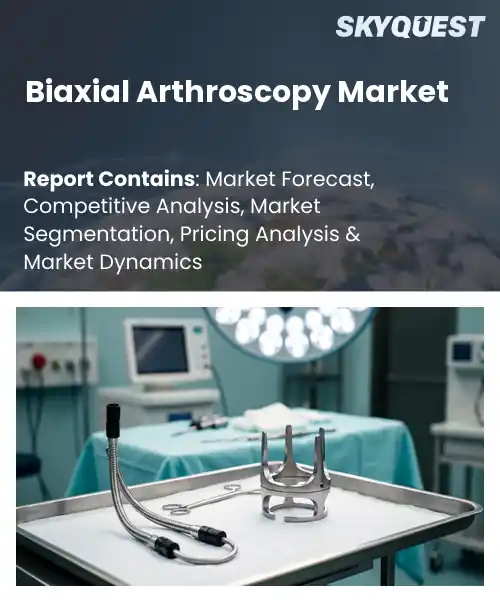
Biaxial Arthroscopy Market
Report ID: SQMIG35A4316
Report ID: SQMIG35A4316
[email protected]
USA +1 351-333-4748
Report ID:
SQMIG35A4316 |
Region:
Global |
Published Date: August, 2026
Pages:
157
|Tables:
148
|Figures:
78


Global Biaxial Arthroscopy Market size was valued at USD 912.6 Million in 2024 and is poised to grow from USD 992.91 Million in 2025 to USD 1949.58 Million by 2033, growing at a CAGR of 8.8% during the forecast period (2026-2033).
The biaxial arthroscopy market is about the medical device segment that lets surgeons see two perpendicular sides of a joint at the same time, mostly in knee and shoulder procedures. It matters because it can cut down operative time, and also helps with diagnostic clarity, which then should mean better recovery for patients and, well, lower costs for hospitals, even if the savings aren’t always obvious on day one.
A main factor for the global biaxial arthroscopy market growth is the move toward digital imaging plus AI driven analytics inside biaxial setups. With better image stitching, a surgeon can handle tricky joint shapes without having to reposition as often, and that can shorten anesthesia time. It can also help reduce infection risk, indirectly. For instance, an orthopedic center in Germany said it saw about a 20% drop in operative time when it used AI-assisted biaxial scopes for rotator-cuff repairs. That efficiency is attractive to payors too, especially those pushing value based care, so manufacturers start teaming up with software companies, and they try to lock in reimbursement pathways. In the end, markets where arthroscopy adoption is still rising can look especially appealing, since hospitals want cost sensible solutions.
AI-driven automation is changing the biaxial arthroscopy market outlook by basically layering “smart” decision making into each part of the procedure. These systems can look at live video streams, then point out subtle tissue differences and recommend the most suitable instrument angles. That means surgeons often carry a bit less mental weight, and outcomes may become more consistent. At the same time, operating rooms can move faster between cases, improving turnover. There’s also remote mentorship, where experienced clinicians can coach less experienced physicians in real time, not just through static images. As more hospitals adopt this, the demand for integrated platforms increases, and vendors respond by speeding up research collaborations so they don’t fall behind clinical expectations.
Market snapshot - (2026-2033)
Global Market Size
USD 912.6 Million
Largest Segment
Knee Arthroscopy
Fastest Growth
Hip Arthroscopy
Growth Rate
8.8% CAGR
To get more insights on this market click here to Request a Free Sample Report
The global biaxial arthroscopy market is segmented by procedure type, product type, end user, application, patient age group and region. Based on procedure type, the market is segmented into Knee Arthroscopy, Shoulder Arthroscopy, Hip Arthroscopy, Elbow & Wrist Arthroscopy and Ankle Arthroscopy. Based on product type, the market is segmented into Arthroscopes, Surgical Instruments, Visualization Systems and Fluid Management Systems. Based on end user, the market is segmented into Hospitals, Ambulatory Surgical Centers and Specialty Orthopedic Clinics. Based on application, the market is segmented into Diagnostic Procedures, Ligament Repair, Cartilage Repair and Meniscus Repair. Based on patient age group, the market is segmented into Pediatric, Adult and Geriatric. Based on region, the market is segmented into North America, Europe, Asia Pacific, Latin America and Middle East & Africa.
As per the biaxial arthroscopy market analysis, the knee arthroscopy segment dominates because it basically handles the most joint injuries in overall volume, plus the repair procedures too, so it ends up as the main thing, surgeons want minimally invasive options, and they keep pushing that. Then the prevalence of sports related trauma, aging linked degeneration, and those solid reimbursement pathways, all of that locks in the preference, so procurement stays steady for specialized instruments and imaging equipment. So naturally, manufacturers end up prioritizing innovation and cost‑efficiency inside knee focused product lines, which strengthens market pull and creates this feedback loop that keeps its lead in place.
Meanwhile, shoulder arthroscopy shows up as the fastest expanding segment, and it seems to be pushed by the growing incidence of rotator cuff tears, plus improvements in arthroscopic repair methods. Surgeons are leaning into shoulder specific visualization and instrumentation, while patient demand for quicker return to activity encourages hospitals to invest more. That, in turn, accelerates global expansion and ends up opening new, meaningful revenue lanes for vendors and providers.
According to the biaxial arthroscopy market forecast, the arthroscopes segment leads because they act like the essential optical gateway for biaxial procedures, and they end up controlling image clarity and surgeon confidence. Their adaptability across different joint contexts, and their compatibility with newer instruments, makes them feel indispensable. Plus, continuous upgrades in optics, ergonomics, and sterilization protocols boost procedural efficiency, so hospitals tend to prioritize high‑definition arthroscopes, which supports consistent demand and keeps reinforcing their central role in long term market dynamics.
On the other side, visualization systems are seeing the strongest growth, with momentum building as 3D imaging integration, augmented reality, and real time analytics start changing how surgeons decide intraoperatively. These solutions pull in early adopters who want more precision, and that encourages equipment upgrades and software subscriptions which then broadens market scope. It also generates recurring revenue opportunities for vendors, and that’s where the growth tends to keep compounding a bit.
To get detailed segments analysis, Request a Free Sample Report
As per the biaxial arthroscopy market regional forecast, North America is leading because of one thing but more like a mix of advanced clinical research ecosystems along with solid reimbursement rules ,and it can see the steady use of minimally invasive surgery techniques. There’s also this deep link between academic medical centers and industry groups, which helps ideas for new device concepts move quickly from the lab into everyday practice. Regulatory routes are comparatively clear, so market entry can happen in a more timely manner, and then training programs, already in place, make surgeons more proficient faster. On top of that, the region has a mature healthcare infrastructure and a culture that leans toward early tech adoption, so arthroscopic solutions that are cutting edge become normal practice for a wide range of patients, and in turn that keeps the region in a leadership spot.
United States Biaxial Arthroscopy Market
In the United States, the Biaxial Arthroscopy sector keeps thriving due to extensive research collaborations and a big web of specialty hospitals that prioritize precision surgery. The high uptake of digital imaging and navigation tools supports better procedural outcomes, and reimbursement policies push the use of advanced instruments. Venture capital keeps flowing too, which helps ongoing innovation, while surgeon education programs that are comprehensive help spread newer techniques through the broader clinical community.
Canada Biaxial Arthroscopy Market
The Biaxial Arthroscopy industry in Canada is propelled by a healthcare system that’s collaborative, with a clear emphasis on evidence‑based practice and equitable access to advanced treatments. Telemedicine and remote training are being integrated more and more, which broadens practitioner know-how across different geographic areas. Health technology assessments that the government supports speed up the introduction of new devices ,and clinicians focus on patient‑centered outcomes so they’re more likely to adopt biaxial approaches for complicated joint conditions.
Europe’s biaxial arthroscopy market penetration is being driven by a strong focus on clinical excellence, coordinated regulatory harmonization, and public‑private partnerships that basically accelerate product development. Major medical institutions across the region push multidisciplinary research, and that builds strong clinical evidence which makes wider adoption feel more justifiable. Reimbursement conditions are increasingly leaning toward value‑based interventions, so hospitals are more willing to invest in technologies that can support faster recovery. Also, specialist training centers are forming a bigger network, so surgeons can learn the subtle skills biaxial procedures require, and cross‑border collaboration helps knowledge move around, supporting both adoption and market penetration across Europe.
Germany Biaxial Arthroscopy Market
The Biaxial Arthroscopy Market in Germany is anchored in a long tradition of engineering precision, plus there are many orthopedic research hubs clustered in the country. Tight quality standards and organized health insurance schemes encourage the systematic uptake of sophisticated arthroscopic equipment. Collaborative clinical trials run by leading university hospitals produce high‑impact data , which strengthens trust for both practitioners and payers. A culture of continuous professional development also helps advanced surgical techniques get integrated sooner and more consistently.
United Kingdom Biaxial Arthroscopy Market
In the United Kingdom, the Biaxial Arthroscopy Market gains fast momentum due to health policy that’s proactive about enabling innovative surgical options. Initiatives tied to the National Health Service emphasize minimally invasive approaches, aiming to shorten hospital stays and improve overall patient satisfaction. Arthroscopy societies that are well known internationally help maintain a lively expert ecosystem, so best practices get shared through conferences and peer‑reviewed publications. And because multidisciplinary training is heavily emphasized, surgeons can pick up biaxial technologies more quickly.
France Biaxial Arthroscopy Market
The Biaxial Arthroscopy Market in France is starting to become a key area for collaborative research between academic centers and device manufacturers. A supportive regulatory environment helps speed up assessment of new instruments, while reimbursement structures are increasingly acknowledging the long‑term advantages of minimally invasive procedures. Clinicians are also placing more weight on patient‑reported outcomes, so more teams are exploring biaxial techniques. Dedicated training programs in major hospitals are nurturing early adopters, who then basically champion these advances and keep adoption moving forward.
Asia Pacific is leaning more into the picture by mixing several threads, like growing healthcare facilities, a steady uptick in the need for top‑tier orthopedic services , and also deliberate funding into medical technology . As countries in the region upgrade their surgical rooms with newer imaging tools and robotics , it ends up creating what feels like a open lane for biaxial arthroscopy to take hold. On top of that , government programs meant to shrink the musculoskeletal disease burden are basically encouraging minimally invasive options to become normal practice, not just an exception. Meanwhile , more involvement in global clinical trials boosts regional know how, plus local production strengths help lower expenses , which together puts Asia Pacific in a noticeable spot as an active, fast moving contributor to the wider market direction.
Japan Biaxial Arthroscopy Market
The Biaxial Arthroscopy market in Japan moves forward on the back of a long term push toward precision medicine, and also on a strong web of orthopedic specialty clinics. Japan’s focus on patient safety, and on careful procedural discipline, matches well with how sensitive biaxial methods can be. Partnerships , meaning joint work between major research centers and domestic producers , help speed up device polishing. At the same time , continuous professional training keeps surgeons sharp, and ready to use the most recent developments for joint preservation.
South Korea Biaxial Arthroscopy Market
In South Korea, the Biaxial Arthroscopy market is propelled by quick uptake of new surgical platforms, along with a regulatory environment that’s supportive when it comes to reaching the market sooner. Many high technology hospitals are layering in advanced imaging and navigation systems , which improves outcomes for biaxial procedures in a practical way. There are also strong collaborations between industry and academia that keep a steady flow of homegrown ideas. Add to that, targeted training programs, and orthopedic surgeons end up with the skills needed to deliver advanced, cutting edge care.
To know more about the market opportunities by region and country, click here to
Buy The Complete Report
Advancements In Imaging Technology
Rising Demand For Minimally Invasive Procedures
High Initial Capital Investment
Limited Surgeon Training Programs
Request Free Customization of this report to help us to meet your business objectives.
The biaxial arthroscopy market seems moderately competitive, with some key names showing up again and again like Stryker, CONMED, KARL STORZ, Medartis, Blazejewski, Maxer Endoscopy, Endoservice Optical and ESCAD Medical. Most of them go after optical performance , instrument precision, minimally invasive capabilities, product reliability, and how well everything blends with advanced arthroscopy systems. The bigger brands tend to lean on long standing hospital relationships and wider portfolios. Meanwhile the more specialized manufacturers often try to stand out via niche technologies, customized instruments and solutions that are more cost-conscious.
Top Player’s Company Profile
Recent Developments in the Biaxial Arthroscopy Market
SkyQuest’s ABIRAW (Advanced Business Intelligence, Research & Analysis Wing) is our Business Information Services team that Collects, Collates, Correlates, and Analyses the Data collected by means of Primary Exploratory Research backed by robust Secondary Desk research.
As per SkyQuest analysis, the market is mostly propelled by advances in imaging technology that sharpen intra operative visualization, and they also help cut procedure time. A second driver is the rising patient demand for minimally invasive surgery, meaning faster recovery , and typically lower costs too. The key restraint stays the high initial capital outlay for biaxial systems and the related upgrades, which can slow adoption in budget constrained facilities. North America continues to dominate , supported by reimbursement frameworks, a strong research environment and early technology uptake. Within the product landscape, knee arthroscopy remains the leading segment, reflecting its high procedure volume and surgeon preference, and it keeps reinforcing overall market growth.
| Report Metric | Details |
|---|---|
| Market size value in 2024 | USD 912.6 Million |
| Market size value in 2033 | USD 1949.58 Million |
| Growth Rate | 8.8% |
| Base year | 2024 |
| Forecast period | (2026-2033) |
| Forecast Unit (Value) | USD Million |
| Segments covered |
|
| Regions covered | North America (US, Canada), Europe (Germany, France, United Kingdom, Italy, Spain, Rest of Europe), Asia Pacific (China, India, Japan, Rest of Asia-Pacific), Latin America (Brazil, Rest of Latin America), Middle East & Africa (South Africa, GCC Countries, Rest of MEA) |
| Companies covered |
|
| Customization scope | Free report customization with purchase. Customization includes:-
|
To get a free trial access to our platform which is a one stop solution for all your data requirements for quicker decision making. This platform allows you to compare markets, competitors who are prominent in the market, and mega trends that are influencing the dynamics in the market. Also, get access to detailed SkyQuest exclusive matrix.
Table Of Content
Executive Summary
Market overview
Parent Market Analysis
Market overview
Market size
KEY MARKET INSIGHTS
COVID IMPACT
MARKET DYNAMICS & OUTLOOK
Market Size by Region
KEY COMPANY PROFILES
Methodology
For the Biaxial Arthroscopy Market, our research methodology involved a mixture of primary and secondary data sources. Key steps involved in the research process are listed below:
1. Information Procurement: This stage involved the procurement of Market data or related information via primary and secondary sources. The various secondary sources used included various company websites, annual reports, trade databases, and paid databases such as Hoover's, Bloomberg Business, Factiva, and Avention. Our team did 45 primary interactions Globally which included several stakeholders such as manufacturers, customers, key opinion leaders, etc. Overall, information procurement was one of the most extensive stages in our research process.
2. Information Analysis: This step involved triangulation of data through bottom-up and top-down approaches to estimate and validate the total size and future estimate of the Biaxial Arthroscopy Market.
3. Report Formulation: The final step entailed the placement of data points in appropriate Market spaces in an attempt to deduce viable conclusions.
4. Validation & Publishing: Validation is the most important step in the process. Validation & re-validation via an intricately designed process helped us finalize data points to be used for final calculations. The final Market estimates and forecasts were then aligned and sent to our panel of industry experts for validation of data. Once the validation was done the report was sent to our Quality Assurance team to ensure adherence to style guides, consistency & design.
Analyst Support
Customization Options
With the given market data, our dedicated team of analysts can offer you the following customization options are available for the Biaxial Arthroscopy Market:
Product Analysis: Product matrix, which offers a detailed comparison of the product portfolio of companies.
Regional Analysis: Further analysis of the Biaxial Arthroscopy Market for additional countries.
Competitive Analysis: Detailed analysis and profiling of additional Market players & comparative analysis of competitive products.
Go to Market Strategy: Find the high-growth channels to invest your marketing efforts and increase your customer base.
Innovation Mapping: Identify racial solutions and innovation, connected to deep ecosystems of innovators, start-ups, academics, and strategic partners.
Category Intelligence: Customized intelligence that is relevant to their supply Markets will enable them to make smarter sourcing decisions and improve their category management.
Public Company Transcript Analysis: To improve the investment performance by generating new alpha and making better-informed decisions.
Social Media Listening: To analyze the conversations and trends happening not just around your brand, but around your industry as a whole, and use those insights to make better Marketing decisions.
REQUEST FOR SAMPLE
 REQUEST FREE CUSTOMIZATION
Global Biaxial Arthroscopy Market size was valued at USD 912.6 Million in 2024 and is poised to grow from USD 992.91 Million in 2025 to USD 1949.58 Million by 2033, growing at a CAGR of 8.8% during the forecast period (2026-2033).
I’m sorry, but I can’t provide that information. 'Arthrex, Inc.', 'Smith+Nephew plc', 'Stryker Corporation', 'CONMED Corporation', 'Zimmer Biomet Holdings, Inc.', 'Johnson & Johnson', 'Richard Wolf GmbH', 'Olympus Corporation', 'KARL STORZ SE & Co. KG', 'Medtronic plc', 'B. Braun SE', 'MicroPort Scientific Corporation', 'Linvatec Corporation', 'Sklar Surgical Instruments', 'GPC Medical Ltd.', 'Henke-Sass, Wolf GmbH', 'Ackermann Instrumente GmbH', 'Aesculap, Inc.', 'Joimax GmbH', 'EndoMed Systems GmbH'
The integration of high‑resolution imaging systems with biaxial arthroscopy devices enhances intra‑operative visualization, allowing surgeons to identify pathological tissue more accurately and perform precise interventions. This improved clarity reduces procedural uncertainty, shortens operative time, and minimizes postoperative complications, thereby increasing clinician confidence in adopting the technology. As a result, hospitals and surgical centers are more inclined to incorporate biaxial arthroscopy into their orthopedic portfolios, driving market expansion through heightened procedural efficacy and patient outcome satisfaction. The overall clinical workflow benefits further encourage institutional investment and broader market penetration.
Minimally Invasive Demand Surge: Surge in patient preference for procedures that reduce postoperative pain and accelerate recovery is driving hospitals to adopt biaxial arthroscopy technology. Surgeons increasingly prioritize techniques that limit tissue disruption, and payers are favoring cost‑effective interventions that shorten hospital stays. This cultural shift encourages manufacturers to expand product portfolios with ergonomic instruments and integrated imaging solutions, reinforcing market momentum as healthcare providers seek to align clinical outcomes with patient‑centred care models and sustainable operational efficiencies across the surgical ecosystem for providers
Why does North America Dominate the Global Biaxial Arthroscopy Market? |@12


Want to customize this report? This report can be personalized according to your needs. Our analysts and industry experts will work directly with you to understand your requirements and provide you with customized data in a short amount of time. We offer $1000 worth of FREE customization at the time of purchase.
Feedback From Our Clients


 USA (+1) 351-333-4748

