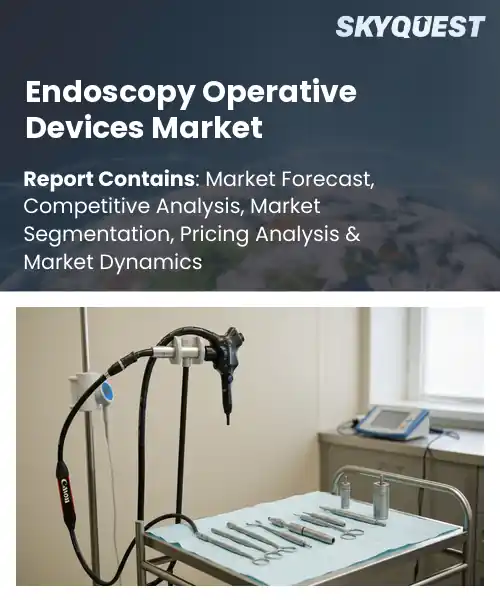
Endoscopy Operative Devices Market
Report ID: SQMIG35A3602
Report ID: SQMIG35A3602
[email protected]
USA +1 351-333-4748
Report ID:
SQMIG35A3602 |
Region:
Global |
Published Date: May, 2026
Pages:
157
|Tables:
119
|Figures:
77


Global Endoscopy Operative Devices Market size was valued at USD 14.52 Billion in 2024 and is poised to grow from USD 15.48 Billion in 2025 to USD 25.85 Billion by 2033, growing at a CAGR of 6.62% during the forecast period (2026-2033).
The primary driver of the endoscopy operative devices market is the accelerating shift toward minimally invasive procedures driven by patient demand for faster recovery, lower complication rates and shorter hospital stays. Endoscopy devices include flexible and rigid scopes, imaging systems, insufflators, electrosurgical tools with disposable accessories underpinning diagnostic and therapeutic interventions across gastroenterology, urology, pulmonology and surgical specialties. Over decades the sector evolved from rigid fiberoptic scopes to high-definition video endoscopes, then to single-use scopes and robot-assisted platforms as manufacturers responded to clinical needs and infection-control pressures. This evolution matters because it expands indications, improves outcomes and reduces care costs.
A key trend driving the global endoscopy operative devices sctor growth is rapid technological innovation, which directly expands clinical capabilities and commercial opportunities. Endoscopy is being performed with greater precision, with improvements in imaging quality, instrument motion, and software analytics, allowing clinicians to provide more complex diagnostic and therapeutic procedures endoscopically; this results in increasing procedure volumes and significant investment by hospitals in the use of advanced devices. One of the advances in endoscopy is the use of artificial intelligence to assist in the detection of polyps; this has resulted in increased adenoma detection rates and reduced incidence of interval colorectal cancer, which encourages more widespread uptake of screening and increased utilization of devices.
How is AI Improving Diagnostic Accuracy in the Endoscopy Operative Devices Market?
Endoscopy operated devices are gaining better diagnostic accuracy through the use of artificial intelligence; providing continuous image analysis, lesion detection and tissue characterization during the procedure. Some of the ways in which this will happen are through computer aided detection and computer aided diagnosis systems, which will highlight subtle lesions, provide an objective measurement or estimate of size as well as suggest possible pathologies. The current state demonstrates an increase in clinical validation and an increase in integration of these systems with endoscopic platforms, which will help reduce missed findings as well as create a more standardised reporting format. Examples include validated polyp sizing modules and commercial detection software now moving from trials into everyday use.
In Feb 2026, Medtronic received CE Mark for ColonPRO and the next generation GI Genius module, which use deep learning for real time polyp detection and size estimation to improve diagnostic accuracy and streamline documentation, supporting wider adoption and greater procedural efficiency.
Market snapshot - (2026-2033)
Global Market Size
USD 14.52 Billion
Largest Segment
Polypectomy Snares
Fastest Growth
Hemostasis Devices
Growth Rate
6.62% CAGR
To get more insights on this market click here to Request a Free Sample Report
Global endoscopy operative devices market is segmented by device type, procedure, end-user, distribution and region. Based on device type, the market is segmented into Biopsy Forceps, Hemostasis Devices, Polypectomy Snares, Dilation Devices and Retrieval Devices. Based on procedure, the market is segmented into Gastrointestinal Endoscopy, Bronchoscopy, Arthroscopy and Laparoscopy. Based on end-user, the market is segmented into Hospitals, Ambulatory Surgical Centers and Specialty Clinics. Based on distribution, the market is segmented into Direct and Distributors. Based on region, the market is segmented into North America, Europe, Asia Pacific, Latin America and Middle East & Africa.
What Role do Biopsy Forceps Play in Shaping Operative Endoscopy Device Demand?
Based on the global endoscopy operative devices market growth, biopsy forceps segment dominates because its instruments are fundamental to diagnostic and interventional endoscopic workflows, creating persistent clinical demand across procedures. Clinician reliance on accurate tissue sampling drives procurement preferences and fosters continual product refinement; manufacturers focus on ergonomic design, scope compatibility, and reusable versus disposable options to ensure integration into established workflows. This critical role, both confirming pathology and informing treatment decisions, establishes its leadership in the area of pathology and encourages (motivation) continued investment into this area.
However, polypectomy snares are emerging as the fastest growing device owing to greater uptake of minimally invasive polypectomy and innovations that enhance snare control and lesion capture. Improvements in materials and electrosurgical compatibility, alongside expanding procedural training, are broadening clinical use and accelerating new product development and market opportunities.
How is Gastrointestinal Endoscopy Driving Device Development in the Endoscopy Operative Devices Market?
Gastrointestinal endoscopy segment dominates because it covers a wide spectrum of diagnostic and therapeutic procedures that continuously require varied operative devices. There is a large clinical demand for these uses which is driving manufacturers to develop creative solutions that include GI-focused specialties, compatibility with endoscopic equipment, and efficient procedures. The existence of established guidelines and care pathways for treating patients through endoscopy creates purchasing patterns and standardization of devices, as well as focusing on the development of devices used exclusively in GI applications.
Meanwhile, bronchoscopy is witnessing the strongest growth momentum as interventional pulmonology expands indications and advanced navigation and imaging technologies enable more complex airway procedures. Increasing need for specialty withdrawal and sample collection devices and/or devices designed specifically for use in the airways is driving targeted device design.
To get detailed segments analysis, Request a Free Sample Report
How do Quality Outcome Priorities Influence Purchasing Decisions in North America?
As per the global endoscopy operative devices market share, North America dominates due to a convergence of advanced clinical infrastructure, concentrated investment in medical technology, and strong adoption of minimally invasive procedures. The region has an extensive ecosystem of major device manufacturers, specialized distributors, and established clinical research networks that all help to speed up the development of new devices for quick introduction to market; in addition, reimbursement and other clinical guideline environments are conducive to the acceptance of those devices in procedures and to the adoption of trials of new instruments. In addition, there is an experienced group of clinicians, including specialized training programs and high volumes of procedures, which facilitate the rapid integration of implantable devices into clinical practice. Cross-collaboration between the medical device industry and academia has allowed iterative development and generation of clinical evidence for new products.
United States Endoscopy Operative Devices Market
Endoscopy operative devices market in United States reflects a mature commercial landscape characterized by a dense concentration of manufacturers, leading research institutions, and high procedural throughput. Clinical leadership, robust training frameworks, and strong hospital procurement pathways support early adoption of advanced instruments and iterative device improvement. Clinical evidence production is generated by strategic partnerships between the industry and academic centers, while continuous innovation and diverse product offerings based upon specialist requirements are driven by the competitive environments in both sectors.
Canada Endoscopy Operative Devices Market
Endoscopy operative devices market in in Canada is shaped by a collaborative healthcare environment and centralized procurement practices that influence product adoption. Clinical networks and centers of excellence facilitate dissemination of best practices and training for minimally invasive procedures. Manufacturers work with hospital system leaders and legislators to develop products and features that fit their workflows. Buying decisions are made based upon business needs, safety and outcomes, while encouraging careful adoption of innovative surgical devices in accordance to financial limits.
How are Reimbursement Frameworks Influencing Market Adoption in Europe?
Based on global endoscopy operative devices regional forecast, rapid expansion in Europe arises from a combination of strong clinical demand for minimally invasive care, coordinated health policy initiatives, and heightened focus on procedural quality and patient experience. The investment into diagnostic and therapeutic endoscope technology from hospitals and outpatient services with support from medical societies is what will drive usage of more advanced devices for operative purposes. In addition to this, the increased use of advanced devices will also be fueled by alliances across countries between the manufacturers, academic institutions, and clinical network to facilitate the transfer of technology and clinical validation. The varied needs of the marketplace due to economic differences in both established and emerging healthcare systems present an opportunity for both remedial and creative solutions for devices in each of the markets. Providing both incremental advances and disruptive innovations that can more easily be adopted into national government funded programs and regional centers of excellence.
Germany Endoscopy Operative Devices Market
Endoscopy operative devices market in Germany benefits from a robust industrial base, advanced clinical research, and integrated hospital systems that together sustain leadership in device innovation and deployment. Strong ties between manufacturers and specialist centers facilitate product validation and refinement. National clinical guidelines and high procedural expertise support early incorporation of new operative technologies. Concentrated investment in center level capabilities cements Germany role as a primary hub for clinical activity and regional adoption.
United Kingdom Endoscopy Operative Devices Market
Endoscopy operative devices market in United Kingdom is characterized by dynamic adoption pathways, progressive regulatory engagement, and concentrated investment in outpatient endoscopy services that accelerate uptake of novel operative tools. Emphasis on efficiency, patient experience, and enhanced recovery pathways encourages hospitals to trial innovative devices. Strong collaboration between start up innovators and clinical champions, coupled with targeted procurement initiatives, supports swift scaling of promising technologies across national health service networks.
France Endoscopy Operative Devices Market
Endoscopy operative devices market in France is evolving through renewed focus on modernization of clinical facilities and growing interest from specialist centers. Regulatory pathways are maturing, enabling wider evaluation of novel operative instruments. Educational initiatives and training collaborations are strengthening clinician familiarity with advanced techniques. Emerging regional centers of excellence and targeted investment in outpatient services are creating a receptive environment for incremental innovation and selective adoption of specialized endoscopic devices.
How is Asia Pacific Strengthening its Position in Endoscopy Operative Devices Market?
As per global endoscopy operative devices regional outlook, Asia Pacific is strengthening its position by combining expanding clinical capacity, targeted investment in healthcare infrastructure, and growing capabilities in local device manufacturing and development. By incorporating process-oriented training, and subject matter expert teams, regional centers are expanding their ability to train personnel to use new products while providing access to established global manufacturers through cross-border partnerships that will help facilitate the transfer of technology as well as customizing product solutions for each country in a more timely manner than previously possible. The modernization of the regulatory process and increased emphasis on the generation of clinical evidence provides easier access for new and innovative surgical devices to be introduced into the marketplace. There are also many different types of care delivery systems in place, ranging from tertiary care hospitals to outpatient departments, which offer a variety of adoption pathways for both multi-national and domestic manufacturers to consider using different approaches and developing strategies to gain adoption of their products in order to be successful.
Japan Endoscopy Operative Devices Market
Endoscopy operative devices market in Japan is characterized by advanced engineering, strong clinical research, and close collaboration between manufacturers and hospitals. Precision in manufacturing supports the development of quality instruments designed for operators by operators; they support the clinical centre with rigorously tested products and their manufacturer through a supply chain that has been pre-established for production. The focus on product reliability and procedure efficiency makes Japan a primary source of innovation and early progress in regional endoscopic procedures.
South Korea Endoscopy Operative Devices Market
Endoscopy operative devices market in South Korea benefits from a dynamic medical technology sector, strong electronics expertise, and active collaboration between hospitals and innovative device firms. Improved efficiency in assessing the use of clinical evaluations and introducing specific teaching methods will help medical professionals to implement innovative surgical techniques. Furthermore, collaborating with companies based in other countries can speed up the process of developing domestic products and support Korea's role as a key supplier to the Asian endoscopy market.
To know more about the market opportunities by region and country, click here to
Buy The Complete Report
Drivers
Rising Minimally Invasive Procedure Adoption
Technological Innovation and Integration
Restraints
High Procedure and Training Requirements
Reimbursement and Cost Pressures
Request Free Customization of this report to help us to meet your business objectives.
The competitive landscape in global endoscopy operative devices market outlook is defined by large medtech firms expanding disposable endoscope portfolios, targeted acquisitions, institutional distribution partnerships, and rapid adoption of robotics and AI from deeptech entrants. Concrete examples include Ambu scaling single use aScope programs through GPO deals, Olympus signing distribution agreements for single use products, and Boston Scientific pursuing co development partnerships to accelerate disposable and AI imaging platforms.
Top Player’s Company Profile
Recent Developments
SkyQuest’s ABIRAW (Advanced Business Intelligence, Research & Analysis Wing) is our Business Information Services team that Collects, Collates, Correlates, and Analyses the Data collected by means of Primary Exploratory Research backed by robust Secondary Desk research.
As per SkyQuest analysis, the global endoscopy operative devices industry is shifting toward minimally invasive procedures that shorten recovery and reduce complications, and a second driver is rapid technological innovation including AI enhanced visualization and single use scopes that expand clinical capabilities. A key restraint is extensive procedural training and steep learning curves that slow adoption of advanced platforms and limit near term uptake. North America is the dominating region due to advanced clinical infrastructure, concentrated industry presence and supportive reimbursement, while Biopsy Forceps is the dominating segment because of its fundamental role in diagnostic and interventional workflows. Together these forces steer investment toward interoperable, clinician friendly devices and software enabled solutions.
| Report Metric | Details |
|---|---|
| Market size value in 2024 | USD 14.52 Billion |
| Market size value in 2033 | USD 25.85 Billion |
| Growth Rate | 6.62% |
| Base year | 2024 |
| Forecast period | (2026-2033) |
| Forecast Unit (Value) | USD Billion |
| Segments covered |
|
| Regions covered | North America (US, Canada), Europe (Germany, France, United Kingdom, Italy, Spain, Rest of Europe), Asia Pacific (China, India, Japan, Rest of Asia-Pacific), Latin America (Brazil, Rest of Latin America), Middle East & Africa (South Africa, GCC Countries, Rest of MEA) |
| Companies covered |
|
| Customization scope | Free report customization with purchase. Customization includes:-
|
To get a free trial access to our platform which is a one stop solution for all your data requirements for quicker decision making. This platform allows you to compare markets, competitors who are prominent in the market, and mega trends that are influencing the dynamics in the market. Also, get access to detailed SkyQuest exclusive matrix.
Table Of Content
Executive Summary
Market overview
Parent Market Analysis
Market overview
Market size
KEY MARKET INSIGHTS
COVID IMPACT
MARKET DYNAMICS & OUTLOOK
Market Size by Region
KEY COMPANY PROFILES
Methodology
For the Endoscopy Operative Devices Market, our research methodology involved a mixture of primary and secondary data sources. Key steps involved in the research process are listed below:
1. Information Procurement: This stage involved the procurement of Market data or related information via primary and secondary sources. The various secondary sources used included various company websites, annual reports, trade databases, and paid databases such as Hoover's, Bloomberg Business, Factiva, and Avention. Our team did 45 primary interactions Globally which included several stakeholders such as manufacturers, customers, key opinion leaders, etc. Overall, information procurement was one of the most extensive stages in our research process.
2. Information Analysis: This step involved triangulation of data through bottom-up and top-down approaches to estimate and validate the total size and future estimate of the Endoscopy Operative Devices Market.
3. Report Formulation: The final step entailed the placement of data points in appropriate Market spaces in an attempt to deduce viable conclusions.
4. Validation & Publishing: Validation is the most important step in the process. Validation & re-validation via an intricately designed process helped us finalize data points to be used for final calculations. The final Market estimates and forecasts were then aligned and sent to our panel of industry experts for validation of data. Once the validation was done the report was sent to our Quality Assurance team to ensure adherence to style guides, consistency & design.
Analyst Support
Customization Options
With the given market data, our dedicated team of analysts can offer you the following customization options are available for the Endoscopy Operative Devices Market:
Product Analysis: Product matrix, which offers a detailed comparison of the product portfolio of companies.
Regional Analysis: Further analysis of the Endoscopy Operative Devices Market for additional countries.
Competitive Analysis: Detailed analysis and profiling of additional Market players & comparative analysis of competitive products.
Go to Market Strategy: Find the high-growth channels to invest your marketing efforts and increase your customer base.
Innovation Mapping: Identify racial solutions and innovation, connected to deep ecosystems of innovators, start-ups, academics, and strategic partners.
Category Intelligence: Customized intelligence that is relevant to their supply Markets will enable them to make smarter sourcing decisions and improve their category management.
Public Company Transcript Analysis: To improve the investment performance by generating new alpha and making better-informed decisions.
Social Media Listening: To analyze the conversations and trends happening not just around your brand, but around your industry as a whole, and use those insights to make better Marketing decisions.
REQUEST FOR SAMPLE
 REQUEST FREE CUSTOMIZATION
Global Endoscopy Operative Devices Market size was valued at USD 14.52 Billion in 2024 and is poised to grow from USD 15.48 Billion in 2025 to USD 25.85 Billion by 2033, growing at a CAGR of 6.62% during the forecast period (2026-2033).
The competitive landscape in global endoscopy operative devices is defined by large medtech firms expanding disposable endoscope portfolios, targeted acquisitions, institutional distribution partnerships, and rapid adoption of robotics and AI from deeptech entrants. Concrete examples include Ambu scaling single use aScope programs through GPO deals, Olympus signing distribution agreements for single use products, and Boston Scientific pursuing co development partnerships to accelerate disposable and AI imaging platforms. 'Olympus Corporation', 'Karl Storz SE', 'Stryker Corporation', 'Richard Wolf GmbH', 'Fujifilm Holdings', 'Boston Scientific', 'Johnson & Johnson (Ethicon)', 'Medtronic plc', 'CONMED Corporation', 'Smith & Nephew', 'Pentax Medical (HOYA)', 'Arthrex Inc.', 'Cook Medical', 'Steris plc', 'NovaBay Pharmaceuticals', 'Applied Medical', 'Endo-Flex GmbH', 'Vision Sciences (Artivion)', 'MTW Endoskopie (Olympus)', 'Micro-Tech (Nanjing)'
More widespread adoption of minimally invasive procedures has heightened demand for advanced endoscopic operative devices, as clinicians favor tools that enable precise visualization and targeted intervention with reduced patient trauma. Hospitals and surgical centers prioritize technologies that support shorter recovery pathways and improved procedural outcomes, prompting procurement and clinical integration. Device manufacturers respond with iterative innovation and compatibility features that facilitate broader clinical use. Training programs and procedural guidelines increasingly incorporate endoscopic techniques, reinforcing clinician confidence and driving sustained device utilization across specialties.
Ai Enhanced Visualization Tools: Integration of advanced machine learning and image-processing algorithms into endoscopy platforms is shifting clinical workflows by improving lesion detection, margin delineation, and real-time decision support. Surgeons and endoscopists benefit from augmented visualization that highlights subtle tissue changes and suggests procedural steps, enabling more consistent outcomes across varying operator experience. This trend drives demand for software-enabled devices, influences purchasing decisions toward interoperable systems, and encourages partnerships between device manufacturers and AI vendors to embed regulatory-compliant analytics into routine endoscopic care.
Why does North America Dominate the Global Endoscopy Operative Devices Market? |@12


Want to customize this report? This report can be personalized according to your needs. Our analysts and industry experts will work directly with you to understand your requirements and provide you with customized data in a short amount of time. We offer $1000 worth of FREE customization at the time of purchase.
Feedback From Our Clients


 USA (+1) 351-333-4748

