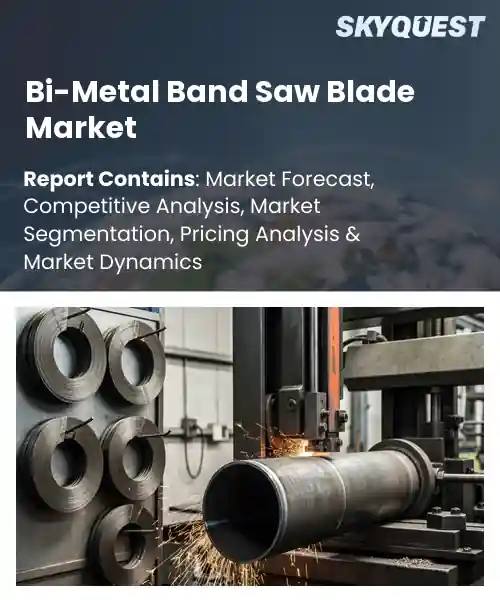
Bi-Metal Band Saw Blade Market
Report ID: SQMIG20I3022
Report ID: SQMIG20I3022
[email protected]
USA +1 351-333-4748
Report ID:
SQMIG20I3022 |
Region:
Global |
Published Date: May, 2026
Pages:
157
|Tables:
119
|Figures:
72


Global Bi-Metal Band Saw Blade Market size was valued at USD 1.52 Billion in 2024 and is poised to grow from USD 1.61 Billion in 2025 to USD 2.52 Billion by 2033, growing at a CAGR of 5.81% during the forecast period (2026-2033).
I view the bi metal band saw blade market as supplying saw blades that weld high speed steel teeth to a flexible alloy backing for cutting ferrous and non ferrous metals across automotive, aerospace and construction. The market matters because blade life and cut quality determine throughput, scrap rates and unit cost across fabrication shops and production lines. Historically the industry moved from carbon blades to bimetal designs in the mid 20th century and advanced through refined tooth geometries, improved coatings and tighter machine integration, shown when job shops replaced disposable carbon blades with longer lasting bimetal alternatives at scale.
Building on that migration, a key growth factor is rising demand for productivity and the ability to cut harder, more varied alloys. When manufacturers prioritize throughput and versatility they adopt blades with optimized tooth geometry, tougher HSS grades and coatings that reduce blade change frequency and machine idle time. The consequence is lower per piece cost and justified investment in premium blades, which opens opportunities for suppliers to offer coating variants, customized tooth pitches, maintenance and aftermarket services. Practical use cases include automotive line cutting of dual phase steels, aerospace tubing and large section energy sector fabrication and repair facilities.
How is AI enhancing quality control in the bi-metal band saw blade market?
AI is improving quality control across the bi metal band saw blade market by combining machine vision and sensor data to spot surface defects tooth geometry errors and inconsistent welds early in the process. Systems equipped with AI learn normal patterns of tooth shape coating and weld transitions and then flag deviations for immediate review. That reduces scrap and rework while enabling closed loop feedback to adjust heat treatment welding and coating steps. In high volume metal fabrication settings AI inspection scales inspection speed and consistency and lets manufacturers standardize output and shorten time to market.
M. K. Morse March 2026, introduced the Challenger Edge Lock bi metal blade, and AI driven inspection and process monitoring can ensure coating uniformity and tooth shape consistency to support longer blade life fewer changeovers and higher shop efficiency.
Market snapshot - (2026-2033)
Global Market Size
USD 1.52 Billion
Largest Segment
Medium Pitch (6-10 TPI)
Fastest Growth
Coarse Pitch (Above 10 TPI)
Growth Rate
5.81% CAGR
To get more insights on this market click here to Request a Free Sample Report
Global bi-metal band saw blade market is segmented by tooth pitch, width, application, end-use and region. Based on tooth pitch, the market is segmented into Fine Pitch (Below 6 TPI), Medium Pitch (6-10 TPI) and Coarse Pitch (Above 10 TPI). Based on width, the market is segmented into Below 20mm, 20-40mm and Above 40mm. Based on application, the market is segmented into Metal Cutting, Wood Cutting, Structural Steel and Tubes & Profiles. Based on end-use, the market is segmented into Automotive, Aerospace, Metalworking Shops and Construction. Based on region, the market is segmented into North America, Europe, Asia Pacific, Latin America and Middle East & Africa.
Fine Pitch (Below 6 TPI) segment dominates due to its dense tooth geometry that produces finer finishes and tighter kerf control on thin and delicate workpieces, thereby reducing vibration and cutting force during operations. This performance matches the needs of precision-driven manufacturing and has led tool specifiers and shops to favor these blades for quality-critical jobs, which in turn drives suppliers’ focus on fine-tooth designs and related tooling support.
But Medium Pitch (6-10 TPI) is rapidly becoming the fastest growing area as it offers a balance of cutting speed and finish and widening applicability across mixed material workshops. Innovations in tooth geometry and variable pitch designs provide more versatility and faster cycle times, leading to higher adoption in automated production and greater operational opportunities.
The larger blade bodies above the 40mm segment have increased stiffness and heat dissipation when cutting large cross sections, which reduces deflection and extends blade life under heavy loads. Thanks to their mechanical robustness they are the first choice for demanding structural and profile cutting applications. Major equipment suppliers and production operators are calling for wider blades for consistent process stability and less unplanned maintenance.
But at the same time the fastest growing width is Under 20mm. Compact blades provide the possibility of high speed cuts in thin tubing and small profiles in agreement with the trends of light weight and precision fabrication. Better carbide bonding and tooth form enhances efficiency on delicate parts, enabling use in automated cells and creating niche opportunities in specialized production.
To get detailed segments analysis, Request a Free Sample Report
The dominance of the Asia Pacific is a function of deep manufacturing ecosystems coming together with integrated supply chains and a dense concentration of end users across multiple heavy and precision industries. Large industrial clusters have a stable demand for cutting consumables, and local producers have developed metallurgical and heat treatment expertise that produces competitive, high-performance blades. Strong OEM relationships make for early adoption of specialized designs and strong distribution channels provide rapid aftermarket support. Skilled technical labor plus cost structures enable high-volume production with niche customization. The regional collaboration among material suppliers, machine tool makers and fabricators creates an innovation feedback loop that continuously improves the durability of products and cutting efficiency, further strengthening Asia Pacific’s leadership position in the bi-metal band saw blade market.
Japan Bi-Metal Band Saw Blade Market is characterized by precision, metallurgical research and high quality. Domestic manufacturers are stressing the use of sophisticated tooth geometries, improved bonding techniques and rigorous testing to satisfy the exacting requirements of the automotive, aerospace and precision tool markets. Close relationships with machine tool builders allow integrated solutions and a culture of continuous improvement allows incremental performance gains. The demand for high reliability products and special blades for precision cutting and tight tolerance applications drive the industry.
South Korea Bi-Metal Band Saw Blade Market is supported by proximity to large heavy industries and strong export-oriented fabrication sectors. Suppliers are pushing hard for hard, wear-resistant designs in shipbuilding, steel processing and electronics component fabrication. High productivity and short-turnaround time are driving the development of durable blades and efficient re-sharpening services. We work together with industrial end users and manufacturers to create customized solutions for heavy duty and high volume cutting requirements supported by agile distribution channels serving domestic and international customers.
North America growth driven by modernization of fabrication facilities, productivity and safety issues and proximity of blade manufacturers to industrial end users. Investment in advanced machine tools drives demand for higher performance consumables and aftermarket service models and local technical support improve blade utilization. Suppliers are developing tooth geometry and edge treatments that provide reliable cutting solutions for industries such as aerospace, automotive and energy. Good distribution networks and service centers for quick deployment and maintenance. Regional focus on training, standards and quality assurance further increases market adoption. Also, strategic alliances of suppliers and large fabricators are bringing dedicated bi-metal band saw blade offerings.
The United States Bi-Metal Band Saw Blade market is driven by diverse performance and service based end-use industries. Providers tout a variety of product line, technical support and onsite resharpening capabilities that eliminate downtime. Typically, the market works with machine tool OEMs and industrial customers to provide solutions specific to aerospace, defense and heavy fabrication needs. Better cutting is driven by safety standards and efficiency: Premium blades and lifecycle management services.
Canada Bi-Metal Band Saw Blade Market is influenced by the resource and heavy industries, who are looking for durability and reliability. They partner with mining, energy and fabrication companies to provide blades that can be used 24 hours a day in demanding environments. Distribution networks are tailored to dispersed industrial areas and product offerings often include cold climate considerations and enhanced service options. The business relations with the neighboring markets are close, which allow a large number of solutions and technical skills.
High level metallurgy, high quality standards and innovation to meet niche industry requirements combine to reinforce the European market position. Strong engineering clusters enable close co-operation between blade manufacturers, machine tool builders and end users to develop tailor-made solutions for the automotive, aerospace and precision manufacturing industries. Regulatory focus on safety and environmental performance is driving the development of longer-lasting, more efficient products. Alloy selection, bonding processes and tooth design are improved through research and collaborative development investments. Resharpening and technical training are good aftermarket services that add value to the blades. Continental distribution networks allow for fast support to industrial customers and strengthen Europe as a hub for high-quality bi-metal blade solutions.
Germany Bi-Metal Band Saw Blade market is characterized by the close relationship with the automotive and machine tool industry and engineering know-how. We are manufacturers specializing in High precision manufacturing, advanced metallurgical processes and custom blade solutions meeting the most stringent standards of quality. We work with OEMs and fabricators to make better products. The market is based on durability, consistent performance and service offerings keeping production going for demanding industrial applications.
Bi-Metal Band Saw Blade Market in the United Kingdom is characterized by a focus on custom solutions and service-oriented offerings for the repair, maintenance and precision fabrication sectors. To support aerospace, defense and specialty manufacturing needs, suppliers offer custom tooth profiles and resharpening programs. A dynamic distribution network and a local expertise in the application of the tools and the optimization of the processes create a demand for specialized and high-performance blades.
In the France Bi-Metal Band Saw Blade Market, the diversified industrial activity of rail, aerospace, and heavy equipment manufacturing is one of the prime drivers for the Bi-Metal Band Saw Blade Market in France. Suppliers provide robust, high-performance blades, with built-in reliability and ease of maintenance. Solutions are developed in collaboration with end users to meet specific cutting challenges. Lifecycle support and technical guidance are important to strengthen the relationship with the supplier. It requires quality and continuity of service to enable complex fabrication environments in the market.
To know more about the market opportunities by region and country, click here to
Buy The Complete Report
Rising Manufacturing Demand
· Increasing industrial production and increasing fabrication activities are creating the demand for reliable cutting tools. Bi-metal band saw blades provide durability and consistent performance to meet the requirements of manufacturers. They can work with many different materials, which means less tool changes and less downtime, so it’s a smooth flow of production. Fabricators are looking at productivity and part quality, which is making them more particular about the blades they buy in terms of life and cut quality. The adoption by job shops and original equipment manufacturers strengthens market growth through linking tangible performance benefits to purchase decisions and maintenance plans.
· Advancements In Blade Technology
Bi-metal band saw blades have been improved in toughness and fatigue resistance by development of improved metallurgical processes and bonding techniques to produce a more uniform cut over a wide range of workpieces. Better edge shapes and tooth configurations reduce vibration and optimize chip evacuation, for cleaner cuts and longer tool life. Such technological refinements allow manufacturers to customize blades to specific industrial applications providing thereby supplier differentiation and customer confidence. End users benefit from performance gains and reduced maintenance requirements, and the market benefits from higher-value, more specialized blade solutions with increased demand.
· Volatility In Raw Materials
The availability and cost of high-quality steels and alloying elements vary and make production planning more difficult and increase the procurement risks for blade producers. Uncertainty about the supply of materials makes manufacturers delay capacity expansion or to be conservative in their holdings of inventories, thus decreasing responsiveness to changes in demand. The use of substitute materials complicates quality control and may affect blade performance and customer confidence. Such pressures can result in increased lead times and greater scrutiny of procurement decisions, reducing market agility and discouraging aggressive investment in product development that would otherwise underwrite faster market growth.
· Limited Skilled Workforce Availability
However, due to lack of skilled operators and technicians experienced in setting up, maintaining and optimizing bi-metal band saw blades, manufacturers and end users cannot achieve consistent cutting performance and productivity gains. Training gaps mean dependence on outside service providers, more machine down time, less throughput and reluctance to adopt advanced blade solutions. If a company does not have in-house expertise, it may not want to pay for new blade technologies or automated systems. This reduces the market momentum and limits the diffusion of higher-value products across industrial segments.
Request Free Customization of this report to help us to meet your business objectives.
The competitive landscape of the Global bi-metal band saw blade is dominated by increased product differentiation, capacity and distribution plays and manufacturing digitization as companies chase industrial contracts and aftermarket service contracts. Recent concrete moves include Wikus’ launch of the GENERO precision bi-metal blade and Starrett’s introduction of Tennax Pro. Newer entrants are focused on Industry 4.0 production control and rapid regional warehousing to undercut legacy supply chains.
SkyQuest’s ABIRAW (Advanced Business Intelligence, Research & Analysis Wing) is our Business Information Services team that Collects, Collates, Correlates, and Analyses the Data collected by means of Primary Exploratory Research backed by robust Secondary Desk research.
As per SkyQuest analysis, the global bi-metal band saw blade market is driven primarily by rising manufacturing demand for durable, versatile cutting tools that improve throughput and lower per-piece costs and additionally supported by ongoing advancements in blade metallurgy, tooth geometries and coatings that extend life and enhance cut quality. A key restraint is volatility in raw materials which raises procurement risk and can hinder capacity expansion and quality consistency. Asia Pacific remains the dominant region thanks to deep manufacturing ecosystems and integrated supply chains while fine pitch blades below 6 TPI dominate the market by delivering the precision and surface finish required for thin, delicate workpieces. These dynamics push suppliers toward innovation, aftermarket services and regional distribution.
| Report Metric | Details |
|---|---|
| Market size value in 2024 | USD 1.52 Billion |
| Market size value in 2033 | USD 2.52 Billion |
| Growth Rate | 5.81% |
| Base year | 2024 |
| Forecast period | (2026-2033) |
| Forecast Unit (Value) | USD Billion |
| Segments covered |
|
| Regions covered | North America (US, Canada), Europe (Germany, France, United Kingdom, Italy, Spain, Rest of Europe), Asia Pacific (China, India, Japan, Rest of Asia-Pacific), Latin America (Brazil, Rest of Latin America), Middle East & Africa (South Africa, GCC Countries, Rest of MEA) |
| Companies covered |
|
| Customization scope | Free report customization with purchase. Customization includes:-
|
To get a free trial access to our platform which is a one stop solution for all your data requirements for quicker decision making. This platform allows you to compare markets, competitors who are prominent in the market, and mega trends that are influencing the dynamics in the market. Also, get access to detailed SkyQuest exclusive matrix.
Table Of Content
Executive Summary
Market overview
Parent Market Analysis
Market overview
Market size
KEY MARKET INSIGHTS
COVID IMPACT
MARKET DYNAMICS & OUTLOOK
Market Size by Region
KEY COMPANY PROFILES
Methodology
For the Bi-Metal Band Saw Blade Market, our research methodology involved a mixture of primary and secondary data sources. Key steps involved in the research process are listed below:
1. Information Procurement: This stage involved the procurement of Market data or related information via primary and secondary sources. The various secondary sources used included various company websites, annual reports, trade databases, and paid databases such as Hoover's, Bloomberg Business, Factiva, and Avention. Our team did 45 primary interactions Globally which included several stakeholders such as manufacturers, customers, key opinion leaders, etc. Overall, information procurement was one of the most extensive stages in our research process.
2. Information Analysis: This step involved triangulation of data through bottom-up and top-down approaches to estimate and validate the total size and future estimate of the Bi-Metal Band Saw Blade Market.
3. Report Formulation: The final step entailed the placement of data points in appropriate Market spaces in an attempt to deduce viable conclusions.
4. Validation & Publishing: Validation is the most important step in the process. Validation & re-validation via an intricately designed process helped us finalize data points to be used for final calculations. The final Market estimates and forecasts were then aligned and sent to our panel of industry experts for validation of data. Once the validation was done the report was sent to our Quality Assurance team to ensure adherence to style guides, consistency & design.
Analyst Support
Customization Options
With the given market data, our dedicated team of analysts can offer you the following customization options are available for the Bi-Metal Band Saw Blade Market:
Product Analysis: Product matrix, which offers a detailed comparison of the product portfolio of companies.
Regional Analysis: Further analysis of the Bi-Metal Band Saw Blade Market for additional countries.
Competitive Analysis: Detailed analysis and profiling of additional Market players & comparative analysis of competitive products.
Go to Market Strategy: Find the high-growth channels to invest your marketing efforts and increase your customer base.
Innovation Mapping: Identify racial solutions and innovation, connected to deep ecosystems of innovators, start-ups, academics, and strategic partners.
Category Intelligence: Customized intelligence that is relevant to their supply Markets will enable them to make smarter sourcing decisions and improve their category management.
Public Company Transcript Analysis: To improve the investment performance by generating new alpha and making better-informed decisions.
Social Media Listening: To analyze the conversations and trends happening not just around your brand, but around your industry as a whole, and use those insights to make better Marketing decisions.
REQUEST FOR SAMPLE
 REQUEST FREE CUSTOMIZATION
Global Bi-Metal Band Saw Blade Market size was valued at USD 1.52 Billion in 2024 and is poised to grow from USD 1.61 Billion in 2025 to USD 2.52 Billion by 2033, growing at a CAGR of 5.81% during the forecast period (2026-2033).
The Global bi-metal band saw blade competitive landscape is marked by intensified product differentiation, capacity and distribution plays, and manufacturing digitization as companies chase industrial contracts and aftermarket service contracts. Recent concrete moves include Wikus launching the GENERO precision bi-metal blade and Starrett introducing Tennax Pro, while newer entrants emphasize Industry 4.0 production control and rapid regional warehousing to undercut legacy supply chains. 'Amada Co. Ltd.', 'Starrett Company', 'Simonds International (Bahco)', 'LENOX Tools (Stanley Black & Decker)', 'Bahco (Snap-on)', 'Bichamp Cutting Technology', 'M.K. Morse Company', 'DoAll Company', 'Wikus-Sägenfabrik', 'Arntz Optibelt', 'Eberle GmbH', 'Haynes Wire Company', 'Pilana (MEP)', 'Hyd-Mech Group', 'Cosen Saws International'
Rising industrial production and expanding fabrication activities increase demand for reliable cutting tools, and bi-metal band saw blades offer durability and consistent performance that align with manufacturers’ needs. Their ability to handle diverse materials reduces tool change frequency and operational interruptions, which supports production continuity. As fabricators prioritize productivity and part quality, procurement shifts toward blades that balance lifespan and cutting precision. This adoption by original equipment manufacturers and job shops strengthens market growth by linking practical performance benefits to purchasing decisions and maintenance strategies.
Precision Manufacturing Adoption: The bi-metal band saw blade market is shifting toward precision manufacturing requirements that demand tighter tolerances, cleaner cuts, and consistent edge integrity across complex alloys. Manufacturers and end users are prioritizing blades engineered for repeatable performance in automated and CNC workflows, enabling reduced secondary finishing and higher throughput. This trend stimulates product development in geometry control, tooth design and bonding processes, and encourages closer collaboration between blade makers and equipment OEMs to optimize cutting systems for higher-value industrial segments.
Why does Asia Pacific Dominate the Global Bi-Metal Band Saw Blade Market? |@12


Want to customize this report? This report can be personalized according to your needs. Our analysts and industry experts will work directly with you to understand your requirements and provide you with customized data in a short amount of time. We offer $1000 worth of FREE customization at the time of purchase.
Feedback From Our Clients


 USA (+1) 351-333-4748

