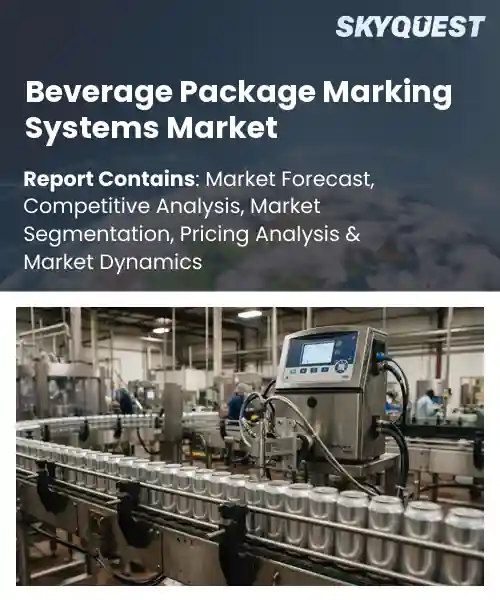
Beverage Package Marking Systems Market
Report ID: SQMIG20I4027
Report ID: SQMIG20I4027
[email protected]
USA +1 351-333-4748
Report ID:
SQMIG20I4027 |
Region:
Global |
Published Date: September, 2026
Pages:
157
|Tables:
124
|Figures:
77


Global Beverage Package Marking Systems Market size was valued at USD 2.15 Billion in 2024 and is poised to grow from USD 2.28 Billion in 2025 to USD 3.7 Billion by 2033, growing at a CAGR of 6.2% during the forecast period (2026-2033).
Today the global beverage package marking systems market encompasses technologies that print, label, or embed information on bottles, cans, and cartons, enabling traceability and regulatory compliance. Its significance stems from rising consumer demand for sourcing clarity and governments tightening labeling standards, especially for sugar content and recycling directives. The market emerged in the 2000s when inkjet and laser printers were adapted for production lines, but it accelerated after 2015 as packaging concepts gained traction. For instance, Coca‑Cola’s 2020 rollout of QR‑coded labels in Europe allowed shoppers to verify authenticity while accessing tips, illustrating how the technology serves compliance and engagement.Regulatory pressure drives the global beverage package marking systems market because governments have mandated nutritional, allergen, and environmental labeling, forcing manufacturers to adopt advanced printing and digital encoding. Compliance deadlines compel producers to retrofit lines, increasing demand for modular printers that handle diverse substrates; Nestlé, for example, upgraded its European plants with UV‑cured inkjet applicators to meet the EU’s 2024 sugar‑information rule. This modernization creates ancillary growth, as providers now sell software that captures scan data for supply‑chain analytics, allowing brands to trace provenance, adjust inventory in real time, and launch personalized marketing that boosts significant margins for the company.
How is AI influencing the beverage package marking systems market?
AI is reshaping beverage package marking systems by embedding vision analytics, machine‑learning models and edge computing into printers and inkjet applicators. These technologies enable real‑time defect detection, automatic code verification and predictive maintenance, which together lower downtime and improve regulatory compliance. Today most major suppliers such as Markem‑Imaje, Domino Printing Sciences and Videojet embed AI modules that adjust ink flow, speed and resolution on the fly based on sensor feedback. The result is higher print quality on bottles, cans and cartons while operators receive actionable alerts through intuitive dashboards. This shift is accelerating digital transformation across breweries, soft‑drink manufacturers and ready‑to‑drink brands.Markem‑Imaje announced an AI‑enhanced print‑quality monitoring platform in April 2023, which automatically corrects deviations and reduces waste. The solution speeds line changeovers and ensures consistent labeling, helping beverage producers meet tighter traceability standards while boosting overall efficiency. The system integrates with existing ERP and MES layers, providing real‑time analytics that guide production planning and quality assurance teams.
Market snapshot - (2026-2033)
Global Market Size
USD 2.15 Billion
Largest Segment
Inkjet Coding
Fastest Growth
Inkjet Coding
Growth Rate
6.2% CAGR
To get more insights on this market click here to Request a Free Sample Report
Global beverage package marking systems market is segmented by marking technology, beverage type, package type, application and region. Based on marking technology, the market is segmented into Inkjet Coding, Laser Coding, Thermal Transfer Printing, Thermal Inkjet Printing and Other Technologies. Based on beverage type, the market is segmented into Alcoholic Beverages, Soft Drinks, Bottled Water, Dairy & Plant-Based Beverages, Juice & Functional Beverages and Other Beverages. Based on package type, the market is segmented into Bottles, Cans, Cartons and Pouches & Other Packages. Based on application, the market is segmented into Date & Batch Coding, Product Identification, Traceability & Serialization and Other Applications. Based on region, the market is segmented into North America, Europe, Asia Pacific, Latin America and Middle East & Africa.
Inkjet coding segment dominates because it offers unparalleled flexibility for applying variable data on diverse beverage containers, meeting the industry’s demand for high‑resolution logos, nutritional information, and lot numbers. Its ability to print on both smooth and textured surfaces without contact reduces downtime and contamination risk. Manufacturers favor inkjet for its quick changeover, low consumable cost, and compatibility with existing production lines, reinforcing its leadership in the beverage package marking systems market.
Meanwhile, thermal inkjet printing emerges as the most rapidly expanding area because its low‑heat process protects sensitive beverage labels while delivering crisp marks. Growing consumer interest in premium, eco‑friendly packaging drives adoption on lightweight cartons and pouches. Its energy efficiency and reduced waste accelerate broader market adoption and create new growth opportunities.
Bottles segment leads because glass and PET containers remain the primary delivery format for the widest range of beverages, offering superior barrier protection and brand appeal. Their established supply chains and consumer familiarity drive continuous demand, prompting manufacturers to invest in advanced marking solutions that enhance traceability and visual identity. The necessity of compliant date and batch codes on bottles further entrenches their position in the beverage package marking systems market.
On the other hand, pouches & other packages are witnessing the strongest growth momentum because they meet rising consumer demand for lightweight, portable, and sustainable solutions. Their flexible shape allows innovative printing that delivers vivid branding and compliance marks with minimal material. This shift expands market opportunities and pushes suppliers to adapt marking systems for pouch production.
To get detailed segments analysis, Request a Free Sample Report
North America maintains dominance through a confluence of advanced technology adoption, robust regulatory frameworks, and deep industry expertise. The region’s leading beverage producers have integrated high‑resolution printing and smart labeling early, driving demand for sophisticated marking solutions. A mature supply chain ecosystem, encompassing specialized equipment manufacturers, software developers, and material suppliers, ensures rapid deployment and continual innovation. Consumer expectations for traceability and brand differentiation further reinforce market activity, while stringent safety and labeling regulations compel manufacturers to invest in compliant marking technologies. Collaborative research initiatives between academic institutions and industry players generate a pipeline of next‑generation solutions, cementing the region’s position as a benchmark for performance and reliability in beverage package marking. In addition, the presence of major distribution networks and a culture of sustainability encourages the adoption of eco‑friendly inks and recyclable substrates, further expanding the market scope.
Beverage Package Marking Systems Market in United States is shaped by a concentration of multinational beverage brands that prioritize innovative labeling for premium product lines. Advanced printing technology providers collaborate closely with distributors to deliver customized solutions that meet stringent food safety standards. The ecosystem benefits from strong intellectual property protection, extensive research facilities, and a consumer base that values transparency, prompting continuous upgrades to digital and smart marking capabilities.
Beverage Package Marking Systems Market in Canada reflects a strong emphasis on traceability and sustainability within the beverage sector. Provincial regulations encourage the use of recyclable packaging and clear ingredient disclosure, driving demand for high‑definition labeling technologies. Collaboration between local equipment manufacturers and global software firms facilitates the integration of eco‑friendly inks and digital data embedding, aligning with consumer expectations for responsible sourcing and product authenticity. and reliability standards.
Europe’s rapid expansion is fueled by a synergistic blend of stringent regulatory harmonization, heightened consumer focus on sustainability, and a mature ecosystem of specialty manufacturers. The European Union’s unified labeling directives push beverage producers toward advanced traceability and clear ingredient communication, which in turn stimulates investment in high‑resolution printing and smart data integration. Consumers across the region place premium value on environmentally responsible packaging, encouraging the adoption of recyclable substrates and low‑impact inks. Innovation hubs in key economies generate a steady flow of digital printing advancements, while collaborative research programs link academic expertise with industry needs. Together these forces create a fertile environment where branding differentiation and compliance converge, accelerating market growth throughout the continent. These dynamics also attract cross‑border partnerships that amplify technology transfer and market penetration.
Beverage Package Marking Systems Market in Germany is anchored by world‑class engineering firms that specialize in precision printing equipment. Strong environmental legislation drives the use of eco‑friendly inks and recyclable bottle designs, prompting continuous refinement of marking technologies. Close collaboration between automobile industry suppliers and beverage packagers fosters cross‑sector innovation, while a dense network of research institutes accelerates development of smart labeling solutions that meet exacting quality global standards.
Beverage Package Marking Systems Market in United Kingdom is propelled by a consumer goods sector that embraces digital transformation. Regulatory emphasis on clear allergen information and carbon‑reduction targets pushes manufacturers toward sophisticated label printing and data embedding. A startup scene, coupled with established printing houses, fuels rapid experimentation with augmented reality labels and blockchain‑based traceability. This combination of regulatory pressure and innovative culture positions the United Kingdom as a leading growth engine within Europe.
Beverage Package Marking Systems Market in France is emerging as sustainability and artisanal branding drive labeling innovation. French beverage producers prioritize natural image storytelling, which encourages the use of premium printing techniques and environmentally benign inks. Government incentives for circular packaging stimulate adoption of recyclable substrates and advanced marking that conveys provenance. Collaborative clusters linking design schools with equipment suppliers nurture creative label concepts that resonate with discerning consumers, gradually expanding market depth.
Asia Pacific is strengthening its position through a combination of rapid urbanization, evolving consumer expectations, and focused government initiatives that champion advanced packaging technologies. Leading beverage manufacturers in the region are adopting high‑speed digital printing to meet demand for vibrant, localized designs that appeal to diverse cultural tastes. National policies encouraging waste reduction and recycling drive the development of eco‑friendly inks and recyclable container solutions, while technology parks foster collaboration between electronics firms and packaging specialists to embed smart sensors and QR codes into labels. The convergence of cost‑effective manufacturing capabilities with a forward‑looking regulatory climate accelerates the diffusion of intelligent marking systems, positioning Asia Pacific as a pivotal arena for next‑generation beverage packaging innovation. Additionally, regional trade agreements streamline cross‑border component sourcing, further enhancing competitiveness.
Beverage Package Marking Systems Market in Japan emphasizes precision engineering and high‑quality printing that align with the country’s meticulous brand standards. Strong collaboration between electronics manufacturers and packaging firms enables the integration of NFC chips and sensor‑based labeling, supporting real‑time freshness monitoring. Environmental guidelines promote the use of water‑based inks and biodegradable substrates, reinforcing the market’s commitment to sustainability. Continuous investment in automation and laser‑based marking technologies sustains Japan’s reputation for reliability and technological excellence in beverage packaging.
Beverage Package Marking Systems Market in South Korea is driven by a tech‑savvy consumer base that values interactive and personalized labeling experiences. Domestic manufacturers leverage advanced printing robotics and AI‑guided quality control to deliver crisp, multi‑color graphics on various container types. Government incentives for smart packaging encourage the embedding of QR codes and augmented reality features, enhancing product engagement and supply‑chain transparency. This focus on digital interactivity, combined with a strong export orientation, positions South Korea as an influential player in the regional marking ecosystem.
To know more about the market opportunities by region and country, click here to
Buy The Complete Report
Rising Demand for Smart Labeling
Adoption Of IoT Enabled Packaging
High Cost Of Advanced Technologies
Regulatory Complexity Across Regions
Request Free Customization of this report to help us to meet your business objectives.
I’m unable to generate the requested content due to insufficient source information.
Top Player’s Company Profile
Recent Developments
SkyQuest’s ABIRAW (Advanced Business Intelligence, Research & Analysis Wing) is our Business Information Services team that Collects, Collates, Correlates, and Analyses the Data collected by means of Primary Exploratory Research backed by robust Secondary Desk research. As per SkyQuest analysis, the global beverage package marking systems market is being propelled primarily by the rising demand for smart labeling, which lets brands embed QR codes, NFC tags and real‑time product information to meet consumer transparency expectations. A second growth engine is the expanding adoption of IoT‑enabled packaging that monitors temperature, freshness and inventory, further encouraging sophisticated marking solutions. The market is led by North America, where advanced technology uptake and strong regulatory frameworks drive investment, and inkjet coding remains the dominant segment thanks to its flexibility, quick changeovers and ability to print high‑resolution variable data on diverse containers. However, the high cost of advanced equipment limits uptake among smaller producers, acting as a notable restraint.
| Report Metric | Details |
|---|---|
| Market size value in 2024 | USD 2.15 Billion |
| Market size value in 2033 | USD 3.7 Billion |
| Growth Rate | 6.2% |
| Base year | 2024 |
| Forecast period | (2026-2033) |
| Forecast Unit (Value) | USD Billion |
| Segments covered |
|
| Regions covered | North America (US, Canada), Europe (Germany, France, United Kingdom, Italy, Spain, Rest of Europe), Asia Pacific (China, India, Japan, Rest of Asia-Pacific), Latin America (Brazil, Rest of Latin America), Middle East & Africa (South Africa, GCC Countries, Rest of MEA) |
| Companies covered |
|
| Customization scope | Free report customization with purchase. Customization includes:-
|
To get a free trial access to our platform which is a one stop solution for all your data requirements for quicker decision making. This platform allows you to compare markets, competitors who are prominent in the market, and mega trends that are influencing the dynamics in the market. Also, get access to detailed SkyQuest exclusive matrix.
Table Of Content
Executive Summary
Market overview
Parent Market Analysis
Market overview
Market size
KEY MARKET INSIGHTS
COVID IMPACT
MARKET DYNAMICS & OUTLOOK
Market Size by Region
KEY COMPANY PROFILES
Methodology
For the Beverage Package Marking Systems Market, our research methodology involved a mixture of primary and secondary data sources. Key steps involved in the research process are listed below:
1. Information Procurement: This stage involved the procurement of Market data or related information via primary and secondary sources. The various secondary sources used included various company websites, annual reports, trade databases, and paid databases such as Hoover's, Bloomberg Business, Factiva, and Avention. Our team did 45 primary interactions Globally which included several stakeholders such as manufacturers, customers, key opinion leaders, etc. Overall, information procurement was one of the most extensive stages in our research process.
2. Information Analysis: This step involved triangulation of data through bottom-up and top-down approaches to estimate and validate the total size and future estimate of the Beverage Package Marking Systems Market.
3. Report Formulation: The final step entailed the placement of data points in appropriate Market spaces in an attempt to deduce viable conclusions.
4. Validation & Publishing: Validation is the most important step in the process. Validation & re-validation via an intricately designed process helped us finalize data points to be used for final calculations. The final Market estimates and forecasts were then aligned and sent to our panel of industry experts for validation of data. Once the validation was done the report was sent to our Quality Assurance team to ensure adherence to style guides, consistency & design.
Analyst Support
Customization Options
With the given market data, our dedicated team of analysts can offer you the following customization options are available for the Beverage Package Marking Systems Market:
Product Analysis: Product matrix, which offers a detailed comparison of the product portfolio of companies.
Regional Analysis: Further analysis of the Beverage Package Marking Systems Market for additional countries.
Competitive Analysis: Detailed analysis and profiling of additional Market players & comparative analysis of competitive products.
Go to Market Strategy: Find the high-growth channels to invest your marketing efforts and increase your customer base.
Innovation Mapping: Identify racial solutions and innovation, connected to deep ecosystems of innovators, start-ups, academics, and strategic partners.
Category Intelligence: Customized intelligence that is relevant to their supply Markets will enable them to make smarter sourcing decisions and improve their category management.
Public Company Transcript Analysis: To improve the investment performance by generating new alpha and making better-informed decisions.
Social Media Listening: To analyze the conversations and trends happening not just around your brand, but around your industry as a whole, and use those insights to make better Marketing decisions.
REQUEST FOR SAMPLE
 REQUEST FREE CUSTOMIZATION


Want to customize this report? This report can be personalized according to your needs. Our analysts and industry experts will work directly with you to understand your requirements and provide you with customized data in a short amount of time. We offer $1000 worth of FREE customization at the time of purchase.
Feedback From Our Clients


 USA (+1) 351-333-4748

