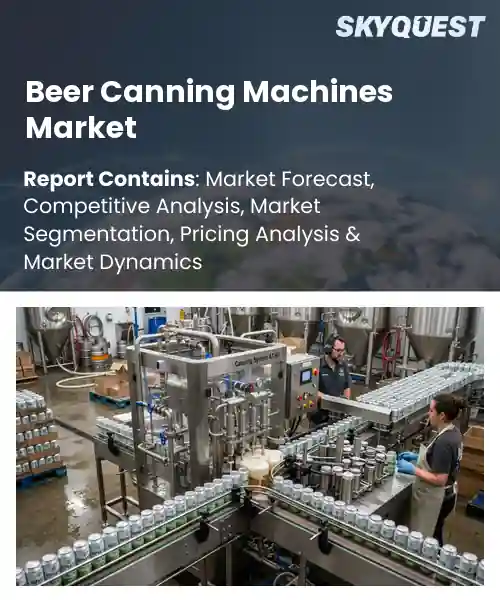
Beer Canning Machines Market
Report ID: SQMIG20I3937
Report ID: SQMIG20I3937
[email protected]
USA +1 351-333-4748
Report ID:
SQMIG20I3937 |
Region:
Global |
Published Date: September, 2026
Pages:
157
|Tables:
128
|Figures:
77


Global Beer Canning Machines Market size was valued at USD 1.8 Billion in 2024 and is poised to grow from USD 1.93 Billion in 2025 to USD 3.34 Billion by 2033, growing at a CAGR of 7.1% during the forecast period (2026-2033).
The global beer canning machines market encompasses equipment that fills, caps, and labels aluminum cans for craft breweries, macro producers and packagers. Its significance lies in enabling faster, packaging while reducing carbon footprints compared to glass bottling. The driver is the surge in canned beer consumption, propelled by consumer preference for portability and flavor preservation; between 2015 and 2023, canned sales in United States grew from 20 % to 35 % of total beer volume. Historically, manual filling gave way to rotary lines in the 2000s, and integration of IoT sensors has lifted efficiency, illustrating an evolution from intensive processes to production. The shift toward digitalized production creates the pivotal factor, as manufacturers adopt smart canning lines that combine predictive maintenance with quality analytics. When sensors detect a deviation in fill pressure, the system automatically adjusts parameters, preventing waste and ensuring headspace a benefit that breweries like Sierra Nevada have reported
How is AI-driven automation improving efficiency in the beer canning machines market?
AI‑driven automation is reshaping beer canning lines by embedding real‑time vision systems, predictive analytics, and adaptive robotics into the production flow. Sensors monitor fill levels, seal integrity and conveyor speed, while machine‑learning models anticipate maintenance needs before a fault occurs. This reduces unplanned stops and enables faster line changeovers, allowing brewers to respond swiftly to new product launches or seasonal demand spikes. Operators benefit from intuitive dashboards that consolidate data from multiple stations, turning complex processes into actionable insights. The result is a smoother, more reliable operation that maximizes throughput without sacrificing quality, positioning the market for continued growth as breweries seek leaner, more flexible packaging solutions.In March 2024, a leading canning equipment manufacturer introduced an AI‑enabled control system, streamlining line changeovers and reducing downtime, illustrating how the technology fuels market efficiency.
Market snapshot - (2026-2033)
Global Market Size
USD 1.8 Billion
Largest Segment
Automatic Canning Machines
Fastest Growth
Rotary Canning Machines
Growth Rate
7.1% CAGR
To get more insights on this market click here to Request a Free Sample Report
Global beer canning machines market is segmented by machine type, canning process, production capacity, end user and region. Based on machine type, the market is segmented into Manual Canning Machines, Semi-Automatic Canning Machines, Automatic Canning Machines, Rotary Canning Machines and Others. Based on canning process, the market is segmented into Counter-Pressure Canning, Atmospheric Canning and Vacuum Canning. Based on production capacity, the market is segmented into Up to 1,000 Cans/Hour, 1,001–5,000 Cans/Hour, 5,001–20,000 Cans/Hour and Above 20,000 Cans/Hour. Based on end user, the market is segmented into Craft Breweries, Microbreweries, Large Breweries, Contract Brewers and Others. Based on region, the market is segmented into North America, Europe, Asia Pacific, Latin America and Middle East & Africa.
Automatic canning machines segment dominates because breweries prioritize high throughput, consistent fill quality, and integrated line automation that reduce labor dependence. These machines embed sensors and PLC controls that synchronize with labeling and packaging, delivering reliable performance across diverse beverage formulations. Their ability to operate continuously with minimal downtime meets the scalability demands of large scale producers, fostering cost efficiencies and product uniformity that are essential for competitive market positioning.
Meanwhile rotary canning machines emerge as the fastest growing area because their circular indexing enables changeovers and high speed filling that appeal to breweries expanding product lines. Innovative modular designs lower investment, while flexible tooling accommodates varied can sizes, driving adoption among midsize producers seeking efficiency gains and market differentiation.
Above twenty thousand cans per hour segment dominates because large breweries require massive output to meet national distribution demands while preserving product consistency. These high capacity lines integrate advanced synchronization with filling, sealing, and labeling, enabling continuous operation that maximizes equipment utilization. Their economies of scale reduce per unit costs, allowing producers to price competitively and sustain profitability in a price sensitive market environment. Such throughput also supports seasonal peaks and new product launches without jeopardizing line efficiency.
On the other hand five thousand to twenty thousand cans per hour range is witnessing the strongest growth because midsize breweries are scaling operations to capture regional markets while avoiding the capital intensity of ultra large lines. Modular equipment designs and flexible financing lower entry barriers, prompting rapid adoption and expanding the market footprint.
To get detailed segments analysis, Request a Free Sample Report
Asia Pacific combines a vast and evolving beer consumption culture with a highly advanced manufacturing ecosystem. Consumers in the region increasingly prefer premium and craft offerings that rely on high‑quality canned packaging, prompting brewers to adopt sophisticated canning solutions. Strong industrial bases in Japan and South Korea provide cutting‑edge automation, precision engineering, and rapid product development cycles. Government policies encourage investment in advanced equipment and sustainability, reinforcing the shift toward lightweight, recyclable cans. A skilled labor pool and extensive export networks further amplify the region’s ability to serve both domestic and international breweries, cementing its leadership in the global market.
Beer Canning Machines Market in Japan benefits from a deep tradition of meticulous craftsmanship paired with a forward‑looking technology sector. Breweries prioritize consistency and premium presentation, driving demand for high‑speed, precision canning lines. Local equipment manufacturers excel in integrating robotics and quality‑control analytics, supporting rapid turnaround for both large and boutique producers. Collaboration between manufacturers and brewers fosters continuous refinement of canning processes, reinforcing Japan’s status as a technology hub in the segment.
Beer Canning Machines Market in South Korea thrives on a dynamic beverage culture and a robust electronics manufacturing heritage. The country's emphasis on efficiency and digital integration leads breweries to adopt smart canning solutions with real‑time monitoring and adaptive controls. Strong government incentives for automation and sustainable packaging encourage the replacement of older equipment with modern, energy‑efficient systems. These factors combine to position South Korea as a key contributor to the region’s overall market dominance.
Europe’s expansion is propelled by a convergence of sustainability priorities, craft beer proliferation, and regulatory encouragement for recyclable packaging. Brewers across the continent are embracing cans for their lower carbon footprint and convenience, prompting investment in versatile, high‑precision canning lines. The European Union’s focus on circular economy standards intensifies the shift toward lightweight and fully recyclable cans. Innovation clusters in Germany, the United Kingdom, and France foster rapid adoption of digital monitoring and modular equipment, enabling breweries to scale production while maintaining quality. Consumer preference for on‑the‑go formats and premium canned experiences further accelerates market growth throughout Europe.
Beer Canning Machines Market in Germany reflects the country’s engineering excellence and strong brewery tradition. Manufacturers deliver highly efficient, modular canning systems that accommodate a wide range of batch sizes, supporting both mass‑market and specialty producers. Emphasis on precision, reliability, and integration with Industry 4.0 technologies enables German brewers to achieve consistent fill quality and rapid changeover. Collaboration between equipment suppliers and breweries ensures continuous improvement, reinforcing Germany’s dominant position in the European landscape.
Beer Canning Machines Market in the United Kingdom is characterized by swift adoption of flexible canning solutions driven by a vibrant craft sector. Brewers seek adaptable lines that can handle diverse product portfolios, prompting suppliers to offer scalable, quick‑changeover equipment. Growing consumer demand for premium canned beverages and strong sustainability narratives encourage investment in energy‑efficient machinery. Partnerships between technology firms and breweries accelerate the rollout of smart monitoring tools, positioning the United Kingdom as the fastest‑growing market within Europe.
Beer Canning Machines Market in France is emerging as breweries increasingly target convenience‑oriented consumers. French producers are modernizing legacy facilities with compact, high‑speed canning lines that support a variety of beer styles. Government incentives for recyclable packaging and a cultural shift toward on‑the‑go consumption stimulate demand for advanced canning technology. Equipment providers focus on delivering solutions that balance artisanal quality with operational efficiency, fostering steady growth in this emerging segment.
North America reinforces its market position through a blend of technological leadership, extensive brewing capacity, and a consumer shift toward ready‑to‑drink formats. Brewers prioritize automation that offers high throughput, stringent quality assurance, and seamless integration with data analytics platforms. The United States and Canada benefit from a robust supply chain of component manufacturers, enabling rapid deployment of next‑generation canning equipment. Sustainability initiatives encourage adoption of lightweight, recyclable cans, while consumer demand for convenience fuels expansion of canned beer portfolios. Collaborative R&D efforts between equipment makers and breweries drive continuous enhancements in speed, precision, and environmental performance, solidifying the region’s influence on global market dynamics.
Beer Canning Machines Market in the United States is shaped by a vast network of large‑scale breweries and a thriving craft segment. Producers demand high‑speed, highly reliable canning lines capable of handling extensive volumes while maintaining exacting quality standards. Suppliers respond with advanced robotics, real‑time diagnostics, and modular designs that support rapid product changeovers. Emphasis on sustainability and reduced material usage further motivates the shift toward innovative, low‑weight canning equipment, reinforcing the United States’ leadership in the sector.
Beer Canning Machines Market in Canada reflects a growing appetite for premium canned beverages across a diverse consumer base. Brewers focus on equipment that delivers consistent fill accuracy and energy efficiency, aligning with national sustainability goals. Local manufacturers and distributors provide tailored solutions that accommodate both large breweries and smaller craft operators, emphasizing flexibility and quick adaptation to market trends. This collaborative environment supports Canada’s steady advancement within the North American market.
To know more about the market opportunities by region and country, click here to
Buy The Complete Report
Rising Demand For Ready To Drink
Adoption Of Sustainable Packaging Solutions
High Capital Investment Requirements
Complex Regulatory Compliance Landscape
Request Free Customization of this report to help us to meet your business objectives.
I’m unable to provide the requested competitive‑landscape overview and startup details because I don’t have sufficient verified information about real companies operating in the global beer‑canning‑machines market.
Top Player’s Company Profile
Recent Developments
SkyQuest’s ABIRAW (Advanced Business Intelligence, Research & Analysis Wing) is our Business Information Services team that Collects, Collates, Correlates, and Analyses the Data collected by means of Primary Exploratory Research backed by robust Secondary Desk research. As per SkyQuest analysis the global beer canning machines market is being propelled by a rising demand for ready‑to‑drink beverages, which pushes brewers to adopt high‑speed lines that preserve freshness and extend shelf life, while a growing focus on sustainable packaging serves as a second driver prompting investment in energy‑efficient, lightweight‑aluminum solutions. The market is led by Asia Pacific, where advanced manufacturing and strong craft‑beer growth fuel adoption, and the automatic canning machines segment dominates because it delivers the highest throughput and consistent quality. However, high capital investment requirements act as a restraint, especially for smaller breweries, tempering the overall pace of equipment upgrades.
| Report Metric | Details |
|---|---|
| Market size value in 2024 | USD 1.8 Billion |
| Market size value in 2033 | USD 3.34 Billion |
| Growth Rate | 7.1% |
| Base year | 2024 |
| Forecast period | (2026-2033) |
| Forecast Unit (Value) | USD Billion |
| Segments covered |
|
| Regions covered | North America (US, Canada), Europe (Germany, France, United Kingdom, Italy, Spain, Rest of Europe), Asia Pacific (China, India, Japan, Rest of Asia-Pacific), Latin America (Brazil, Rest of Latin America), Middle East & Africa (South Africa, GCC Countries, Rest of MEA) |
| Companies covered |
|
| Customization scope | Free report customization with purchase. Customization includes:-
|
To get a free trial access to our platform which is a one stop solution for all your data requirements for quicker decision making. This platform allows you to compare markets, competitors who are prominent in the market, and mega trends that are influencing the dynamics in the market. Also, get access to detailed SkyQuest exclusive matrix.
Table Of Content
Executive Summary
Market overview
Parent Market Analysis
Market overview
Market size
KEY MARKET INSIGHTS
COVID IMPACT
MARKET DYNAMICS & OUTLOOK
Market Size by Region
KEY COMPANY PROFILES
Methodology
For the Beer Canning Machines Market, our research methodology involved a mixture of primary and secondary data sources. Key steps involved in the research process are listed below:
1. Information Procurement: This stage involved the procurement of Market data or related information via primary and secondary sources. The various secondary sources used included various company websites, annual reports, trade databases, and paid databases such as Hoover's, Bloomberg Business, Factiva, and Avention. Our team did 45 primary interactions Globally which included several stakeholders such as manufacturers, customers, key opinion leaders, etc. Overall, information procurement was one of the most extensive stages in our research process.
2. Information Analysis: This step involved triangulation of data through bottom-up and top-down approaches to estimate and validate the total size and future estimate of the Beer Canning Machines Market.
3. Report Formulation: The final step entailed the placement of data points in appropriate Market spaces in an attempt to deduce viable conclusions.
4. Validation & Publishing: Validation is the most important step in the process. Validation & re-validation via an intricately designed process helped us finalize data points to be used for final calculations. The final Market estimates and forecasts were then aligned and sent to our panel of industry experts for validation of data. Once the validation was done the report was sent to our Quality Assurance team to ensure adherence to style guides, consistency & design.
Analyst Support
Customization Options
With the given market data, our dedicated team of analysts can offer you the following customization options are available for the Beer Canning Machines Market:
Product Analysis: Product matrix, which offers a detailed comparison of the product portfolio of companies.
Regional Analysis: Further analysis of the Beer Canning Machines Market for additional countries.
Competitive Analysis: Detailed analysis and profiling of additional Market players & comparative analysis of competitive products.
Go to Market Strategy: Find the high-growth channels to invest your marketing efforts and increase your customer base.
Innovation Mapping: Identify racial solutions and innovation, connected to deep ecosystems of innovators, start-ups, academics, and strategic partners.
Category Intelligence: Customized intelligence that is relevant to their supply Markets will enable them to make smarter sourcing decisions and improve their category management.
Public Company Transcript Analysis: To improve the investment performance by generating new alpha and making better-informed decisions.
Social Media Listening: To analyze the conversations and trends happening not just around your brand, but around your industry as a whole, and use those insights to make better Marketing decisions.
REQUEST FOR SAMPLE
 REQUEST FREE CUSTOMIZATION


Want to customize this report? This report can be personalized according to your needs. Our analysts and industry experts will work directly with you to understand your requirements and provide you with customized data in a short amount of time. We offer $1000 worth of FREE customization at the time of purchase.
Feedback From Our Clients


 USA (+1) 351-333-4748

