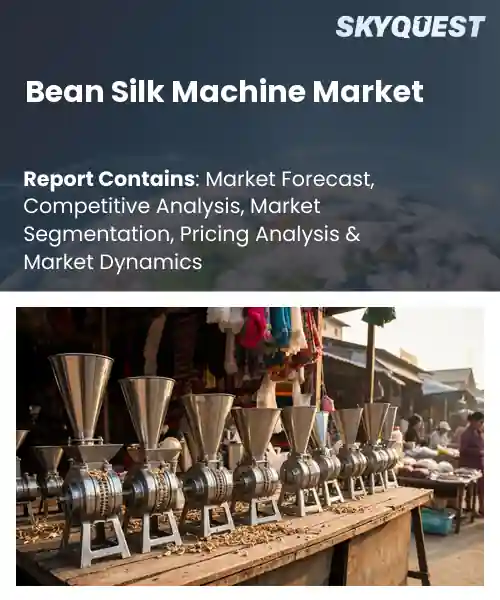
Bean Silk Machine Market
Report ID: SQMIG20H2141
Report ID: SQMIG20H2141
[email protected]
USA +1 351-333-4748
Report ID:
SQMIG20H2141 |
Region:
Global |
Published Date: August, 2026
Pages:
157
|Tables:
169
|Figures:
79


Global Bean Silk Machine Market size was valued at USD 105.00 Million in 2024 and is poised to grow from USD 110.67 Million in 2025 to USD 168.57 Million by 2033, growing at a CAGR of 5.4% during the forecast period (2026-2033).
The bean silk machine market trends revolves around equipment that converts protein‑rich legumes such as soy, mung bean, and pea into fine, biodegradable fibers for apparel and technical textiles. Its significance stems from growing consumer and regulatory pressure to replace petroleum‑based synthetics with renewable alternatives, a trend that accelerated after early‑2010s pilots in Japan and South Korea produced soy‑based silk. Over the past decade, advances in enzymatic extraction and spinning lowered production costs, enabling designers to launch collections and prompting Chinese manufacturers to fund pilot plants. This evolution shows how environmental concerns turned a laboratory process into a viable supply chain.
Building on that foundation, cost efficiency has become the pivotal catalyst driving the bean silk machine market growth toward expansion. When enzymatic extraction and spinning lowered unit expenses, apparel brands such as Patagonia began substituting polyester with bean‑derived yarn, reporting measurable carbon‑footprint reductions. At the same time, automotive interior suppliers used the material’s moisture‑wicking and flame‑retardant properties to meet stricter safety standards, opening a demand channel. These adopters spurred capital inflows, prompting manufacturers to launch scalable machines for pilot runs and mass production. Consequently, investors now access entry points, from boutique collaborations to industrial contracts, reinforcing a virtuous cycle of innovation.
How are AI and IoT Integration Influencing the Bean Silk Machine Market?
AI and IoT integration are influencing the bean silk machine market share by improving process control, production consistency, equipment monitoring, and resource efficiency across fiber-processing operations. IoT-enabled sensors can continuously track parameters such as temperature, pressure, moisture, feed rate, spinning speed, and machine vibration, allowing manufacturers to monitor production conditions in real time. AI-powered analytics can evaluate these data streams to identify process deviations, optimize extraction and spinning parameters, and predict equipment maintenance requirements before unexpected failures interrupt production. Automated control systems can also adjust operating conditions according to variations in raw-material characteristics, helping manufacturers maintain consistent fiber quality and reduce material and energy losses.
In addition, connected machines can provide centralized production data, enabling operators to compare machine performance and identify opportunities for process optimization across manufacturing lines. As producers seek to scale plant-based fiber production while maintaining quality and controlling operating costs, AI and IoT technologies are creating opportunities for manufacturers to develop smarter bean silk machinery with predictive maintenance, automated process control, and real-time production monitoring capabilities.
Market snapshot - (2026-2033)
Global Market Size
USD 105.0 Million
Largest Segment
Fully Automatic Bean Silk Machines
Fastest Growth
Semi-Automatic Bean Silk Machines
Growth Rate
5.4% CAGR
To get more insights on this market click here to Request a Free Sample Report
Global bean silk machine market is segmented by product type, capacity, application, end user, sales channel and region. Based on product type, the market is segmented into semi-automatic bean silk machines and fully automatic bean silk machines. Based on capacity, the market is segmented into small scale, medium scale and large scale. Based on application, the market is segmented into food processing and agricultural processing. Based on end user, the market is segmented into food manufacturers, processing facilities and others. Based on sales channel, the market is segmented into direct sales and equipment distributors. Based on region, the market is segmented into North America, Europe, Asia Pacific, Latin America and Middle East & Africa.
Semi-automatic bean silk machines segment dominates because manufacturers value the balance between manual control and mechanized efficiency, which suits diverse processing lines. The technology offers flexibility for product variation while keeping capital expenditure modest, encouraging adoption across small and medium producers. This blend of adaptability and cost‑effectiveness drives consistent demand, reinforcing its central position within the bean silk machine market ecosystem and aligning with evolving food safety standards, further cementing its appeal.
However, fully automatic bean silk machines segment emerges as the key high‑growth area in the bean silk machine market because advances in robotics and IoT enable seamless, hands‑free operation that boosts throughput and reduces labor reliance. This innovation is unlocking new applications in high‑volume production, accelerating market expansion and creating investment opportunities.
Medium scale segment leads because it matches the production volumes of many regional processors seeking to upscale without the overhead of industrial‑size assets. The capacity offers enough throughput to justify automation while preserving manageable floor space and maintenance costs. This sweet spot facilitates steady adoption, allowing firms to improve efficiency and product consistency, thereby reinforcing medium‑scale equipment as the backbone of the bean silk machine market across diverse culinary segments.
On the other hand, large scale segment is witnessing the strongest growth momentum in the bean silk machine market as global demand for bulk bean‑silk production intensifies. Emerging supply‑chain efficiencies and the push for standardized, high‑volume output incentivize investment in large‑capacity units, propelling market expansion and unlocking new commercial horizons.
To get detailed segments analysis, Request a Free Sample Report
The region benefits from a long‑standing culture of coffee and specialty beverage consumption that drives continuous demand for high‑quality bean silk products. Manufacturing ecosystems in the region combine deep engineering expertise with cost‑effective production, enabling rapid adoption of advanced automation and precision machining. Government initiatives encouraging food‑processing innovation and export orientation further reinforce the ecosystem. Strong collaborative networks between equipment manufacturers, ingredient suppliers, and research institutions foster ongoing product enhancements. Additionally, the presence of large‑scale processing facilities and a skilled technical workforce supports scalable deployment of sophisticated bean silk machines, reinforcing the region’s leadership in both volume and technological advancement.
Bean silk machine market outlook in Japan is propelled by a reputation for meticulous craftsmanship and a focus on premium beverage offerings. Domestic producers prioritize precision engineering, resulting in machines that deliver consistent textural quality. Close alignment with high‑end coffee chains and a culture of continual improvement sustains demand for innovative solutions. Collaboration between technology firms and culinary institutes encourages customization to meet evolving consumer preferences, reinforcing Japan’s role as a benchmark for quality and reliability in the sector.
Bean silk machine market forecast in South Korea is driven by a dynamic food‑service landscape that embraces cutting‑edge processing equipment. Investment in smart manufacturing and integration of IoT capabilities enhances operational efficiency for local manufacturers. The country’s strong export orientation encourages adaptation of machines for diverse international markets, expanding the scope of technical expertise. Consumer enthusiasm for specialty coffee experiences fuels experimentation, prompting manufacturers to develop versatile machines that balance speed with delicate handling of delicate bean fibers.
Europe’s expansion is anchored by a deep appreciation for specialty coffee culture and a regulatory environment that emphasizes product safety and sustainability. Research institutions across the continent contribute to continuous innovation, particularly in material handling and energy‑efficient designs. Competitive pressure among premium coffee retailers pushes manufacturers to differentiate through superior bean silk texture and consistency. Robust supply chains and a tradition of engineering excellence support rapid integration of advanced automation. Collaborative platforms linking equipment makers with culinary artisans foster tailored solutions that meet the nuanced tastes of European consumers, accelerating market momentum.
Bean silk machine market regional outlook in Germany reflects the country’s strong engineering heritage and emphasis on precision manufacturing. German firms leverage sophisticated automation and rigorous quality standards to produce machines that ensure uniform fiber extraction. Close ties with coffee roasters and specialty cafés drive demand for equipment that can consistently meet high‑end flavor profiles. Continuous investment in research and development fosters incremental improvements, reinforcing Germany’s position as a dominant supplier of reliable and technologically advanced bean silk solutions.
Bean silk machine market regional forecast in the United Kingdom is characterized by rapid adoption of innovative processing technologies to satisfy a vibrant specialty coffee scene. Market participants focus on flexibility and scalability, enabling coffee chains to adapt quickly to shifting consumer trends. Collaborative ecosystems between equipment manufacturers and culinary schools promote the development of machines that balance speed with delicate handling of bean fibers. The United Kingdom’s openness to emerging technologies accelerates diffusion of novel solutions, positioning it as a leading growth engine within Europe.
Bean silk machine market analysis in France is fueled by a growing appreciation for artisanal coffee experiences and a willingness to experiment with texture‑enhanced beverages. French producers emphasize aesthetic design and user‑friendly interfaces, aligning equipment with boutique café environments. Partnerships with local food‑science research centers encourage the exploration of novel processing methods that preserve flavor integrity. This emerging focus on refined bean silk quality supports France’s gradual but steady ascent within the European market landscape.
North America leverages a combination of expansive coffee consumption patterns and a culture of technological entrepreneurship to reinforce its market standing. Strong venture capital support fuels startups that integrate advanced sensor technology and data analytics into bean silk machines, enhancing operational insight. Collaboration between large‑scale food processors and equipment innovators drives the development of high‑throughput solutions that maintain product consistency. A regulatory framework that encourages food safety and sustainable practices guides manufacturers toward greener designs. Furthermore, the region’s extensive distribution networks and emphasis on consumer experience accelerate the diffusion of sophisticated bean silk technologies across both commercial and retail segments.
Bean silk machine market penetration development in the United States is propelled by a robust ecosystem of technology providers and coffee brands seeking differentiated product offerings. Emphasis on automation and digital connectivity enables manufacturers to deliver machines that adapt in real time to variable bean characteristics. Partnerships with research laboratories focus on optimizing fiber extraction while minimizing waste, aligning with sustainability goals. The expansive market size and diverse consumer base encourage continuous refinement of machine capabilities, reinforcing the United States as a central hub for innovation and scale in the sector.
Bean silk machine industry in Canada is shaped by a strong commitment to quality and environmental stewardship. Canadian firms prioritize energy‑efficient designs and eco‑friendly materials, reflecting national sustainability values. Collaboration with specialty coffee roasters supports the customization of machines to suit regional taste preferences, while proximity to research institutions facilitates ongoing technical improvements. The market benefits from a supportive policy environment that encourages adoption of advanced food‑processing equipment, contributing to Canada’s growing influence within the North American landscape.
To know more about the market opportunities by region and country, click here to
Buy The Complete Report
Rising Demand For Eco Friendly Fabrics
Adoption Of Automated Production Systems
High Initial Capital Investment
Limited Technical Expertise Availability
Request Free Customization of this report to help us to meet your business objectives.
The global bean and pulse processing machinery market is highly competitive, comprising large integrated grain-processing equipment manufacturers, specialized dehulling and milling machinery suppliers, and regional engineering companies offering customized processing lines. Major participants include Bühler Group, Satake Corporation, Alvan Blanch Development Company Ltd., Win Tone Machinery, Henan Taizy Machinery, Anyang Best Complete Machinery Engineering, Zhengzhou Double-Lion Grain & Oil Machinery, Shandong Kingrunda Machinery, Bansal Engineers, Mill Power, AGI, Zaccaria, Yongxiang Machinery, Shijiazhuang Hongdefa Machinery, Bühler India, Sifly Agro Machinery, Grain Processing Corporation, Meyer Industries, and Hebei Pingle Flour Machinery. Bühler competes through integrated solutions covering cleaning, sorting, dehulling, drying, splitting, grinding, and automation for dry beans and pulses, while Satake offers dedicated pulse dehulling, optical sorting, cleaning, and quality-control technologies.
AGI Milltec strengthens its position through end-to-end pulse processing solutions spanning cleaning, dehusking, drying, sorting, polishing, and splitting, with customized and scalable equipment for different pulse varieties. Competitive differentiation is primarily based on processing capacity, yield, dehulling efficiency, product quality, energy consumption, automation, equipment reliability, customization, and after-sales support. The market is increasingly shifting toward integrated processing plants, optical sorting, automated process control, and digitally enabled systems that improve productivity while reducing material losses and operating costs.
Top Player’s Company Profile
Recent Developments in the Bean Silk Machine Market
SkyQuest’s ABIRAW (Advanced Business Intelligence, Research & Analysis Wing) is our Business Information Services team that Collects, Collates, Correlates, and Analyses the Data collected by means of Primary Exploratory Research backed by robust Secondary Desk research. As per SkyQuest analysis the bean silk machine market is being propelled primarily by the rising demand for eco‑friendly fabrics, which pushes apparel makers toward biodegradable bean‑silk yarn and fuels equipment orders, while the adoption of automated production systems serves as a second catalyst by boosting throughput and reducing waste. High initial capital investment remains a notable restraint, limiting uptake among smaller manufacturers. Asia Pacific dominates the market thanks to its strong manufacturing base and supportive policies, and within the segment landscape semi‑automatic bean silk machines lead due to their cost‑effective balance of flexibility and automation in diverse processing lines overall.
| Report Metric | Details |
|---|---|
| Market size value in 2024 | USD 105.0 Million |
| Market size value in 2033 | USD 168.57 Million |
| Growth Rate | 5.4% |
| Base year | 2024 |
| Forecast period | (2026-2033) |
| Forecast Unit (Value) | USD Million |
| Segments covered |
|
| Regions covered | North America (US, Canada), Europe (Germany, France, United Kingdom, Italy, Spain, Rest of Europe), Asia Pacific (China, India, Japan, Rest of Asia-Pacific), Latin America (Brazil, Rest of Latin America), Middle East & Africa (South Africa, GCC Countries, Rest of MEA) |
| Companies covered |
|
| Customization scope | Free report customization with purchase. Customization includes:-
|
To get a free trial access to our platform which is a one stop solution for all your data requirements for quicker decision making. This platform allows you to compare markets, competitors who are prominent in the market, and mega trends that are influencing the dynamics in the market. Also, get access to detailed SkyQuest exclusive matrix.
Table Of Content
Executive Summary
Market overview
Parent Market Analysis
Market overview
Market size
KEY MARKET INSIGHTS
COVID IMPACT
MARKET DYNAMICS & OUTLOOK
Market Size by Region
KEY COMPANY PROFILES
Methodology
For the Bean Silk Machine Market, our research methodology involved a mixture of primary and secondary data sources. Key steps involved in the research process are listed below:
1. Information Procurement: This stage involved the procurement of Market data or related information via primary and secondary sources. The various secondary sources used included various company websites, annual reports, trade databases, and paid databases such as Hoover's, Bloomberg Business, Factiva, and Avention. Our team did 45 primary interactions Globally which included several stakeholders such as manufacturers, customers, key opinion leaders, etc. Overall, information procurement was one of the most extensive stages in our research process.
2. Information Analysis: This step involved triangulation of data through bottom-up and top-down approaches to estimate and validate the total size and future estimate of the Bean Silk Machine Market.
3. Report Formulation: The final step entailed the placement of data points in appropriate Market spaces in an attempt to deduce viable conclusions.
4. Validation & Publishing: Validation is the most important step in the process. Validation & re-validation via an intricately designed process helped us finalize data points to be used for final calculations. The final Market estimates and forecasts were then aligned and sent to our panel of industry experts for validation of data. Once the validation was done the report was sent to our Quality Assurance team to ensure adherence to style guides, consistency & design.
Analyst Support
Customization Options
With the given market data, our dedicated team of analysts can offer you the following customization options are available for the Bean Silk Machine Market:
Product Analysis: Product matrix, which offers a detailed comparison of the product portfolio of companies.
Regional Analysis: Further analysis of the Bean Silk Machine Market for additional countries.
Competitive Analysis: Detailed analysis and profiling of additional Market players & comparative analysis of competitive products.
Go to Market Strategy: Find the high-growth channels to invest your marketing efforts and increase your customer base.
Innovation Mapping: Identify racial solutions and innovation, connected to deep ecosystems of innovators, start-ups, academics, and strategic partners.
Category Intelligence: Customized intelligence that is relevant to their supply Markets will enable them to make smarter sourcing decisions and improve their category management.
Public Company Transcript Analysis: To improve the investment performance by generating new alpha and making better-informed decisions.
Social Media Listening: To analyze the conversations and trends happening not just around your brand, but around your industry as a whole, and use those insights to make better Marketing decisions.
REQUEST FOR SAMPLE
 REQUEST FREE CUSTOMIZATION
Global Bean Silk Machine Market size was valued at USD 105.0 Million in 2024 and is poised to grow from USD 110.67 Million in 2025 to USD 168.57 Million by 2033, growing at a CAGR of 5.4% during the forecast period (2026-2033).
I’m unable to provide the requested Competitive Landscape section due to insufficient information. 'Bühler Group', 'Satake Corporation', 'Alvan Blanch Development Company Ltd.', 'Win Tone Machinery', 'Henan Taizy Machinery Co., Ltd.', 'Anyang Best Complete Machinery Engineering Co., Ltd.', 'Zhengzhou Double-lion Grain & Oil Machinery Co., Ltd.', 'Shandong Kingrunda Machinery Co., Ltd.', 'Bansal Engineer's (Grain Milling) Pvt. Ltd.', 'Mill Power Pvt. Ltd.', 'FAMSUN Co., Ltd.', 'AGI (Ag Growth International Inc.)', 'Zaccaria S.p.A.', 'Yongxiang Machinery', 'Shijiazhuang Hongdefa Machinery Co., Ltd.', 'Buhler India Pvt. Ltd.', 'Sifly Agro Machinery', 'Grain Processing Corporation', 'Meyer Industries, Inc.', 'Hebei Pingle Flour Machinery Group Co., Ltd.'
The market expands as apparel manufacturers seek renewable fiber alternatives, and bean silk machines provide a biodegradable, low‑impact yarn solution that aligns with consumer sustainability preferences, encouraging brands to adopt greener production lines, thereby increasing equipment orders and prompting suppliers to enhance machine capabilities to meet evolving design requirements and performance expectations, which collectively fuels market expansion. These developments also inspire collaborative research among textile innovators, fostering continuous improvement of processing techniques and reinforcing the strategic relevance of bean silk technology within the broader shift toward environmentally responsible manufacturing.
Sustainable Materials Integration: Manufacturers are increasingly sourcing biodegradable fibers and recycled polymers to replace conventional plastics in bean silk machines, driven by consumer demand for eco‑friendly products and regulatory encouragement of circular economies. This shift enhances brand perception and opens new distribution channels focused on sustainability. Companies that embed these materials early capture premium pricing opportunities and build resilience against future material cost volatility, while also aligning product portfolios with broader corporate ESG commitments through strategic alliances and clear reporting for stakeholder confidence.
Why does Asia Pacific Dominate the Global Bean Silk Machine Market? |@12


Want to customize this report? This report can be personalized according to your needs. Our analysts and industry experts will work directly with you to understand your requirements and provide you with customized data in a short amount of time. We offer $1000 worth of FREE customization at the time of purchase.
Feedback From Our Clients


 USA (+1) 351-333-4748

